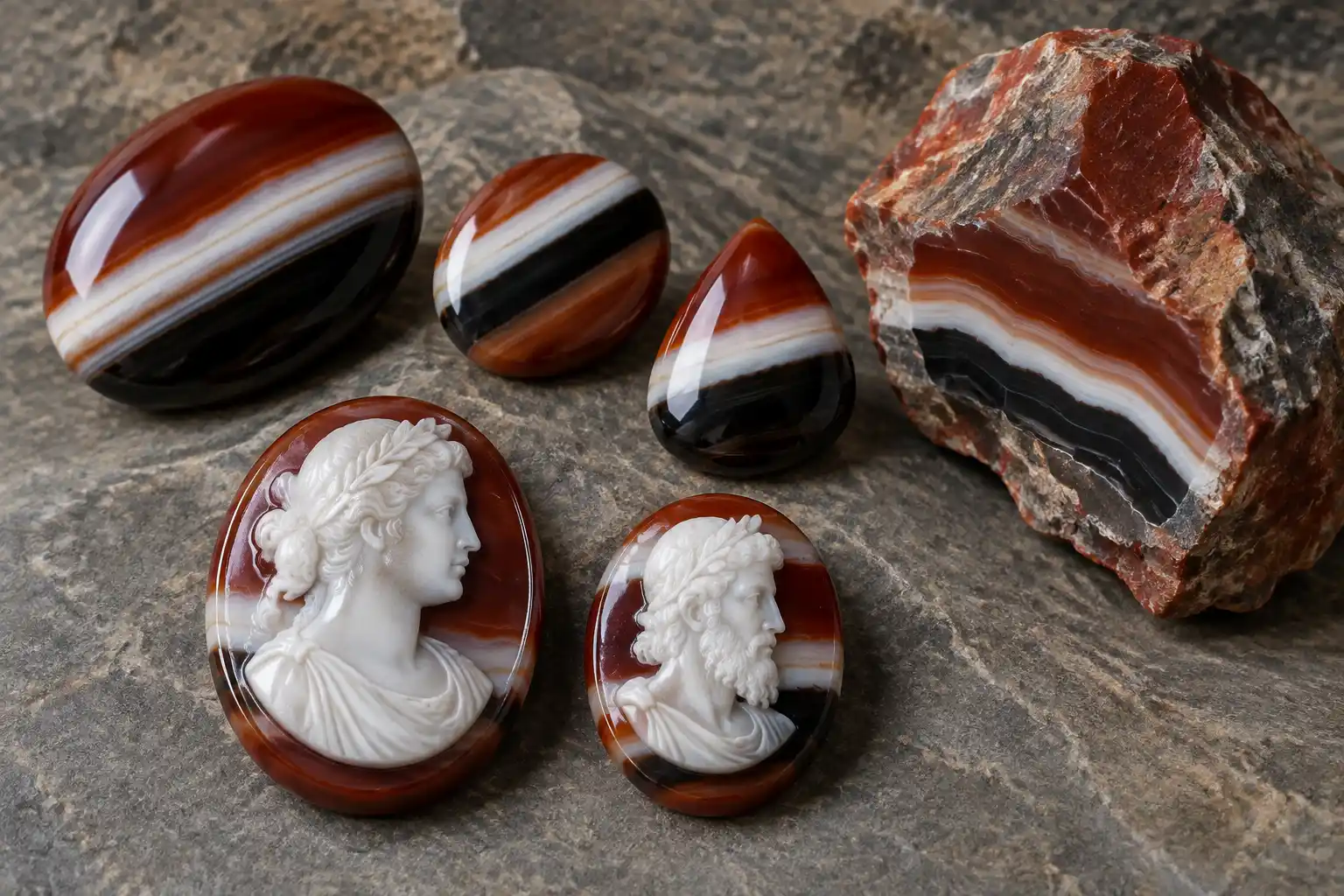
14 Sardonyx Benefits for Strength & Emotional Stability
Sardonyx benefits begin with the practical qualities of a banded chalcedony gemstone rather than with claims of supernatural strength. Sardonyx combines layers of sard, typically brownish red to reddish orange, with contrasting onyx bands that may appear white, black, or differently colored. Both are forms of cryptocrystalline quartz, giving sardonyx the silica-rich composition and durability expected from chalcedony.
The stone usually reaches about 6.5 to 7 on the Mohs scale and has no true cleavage. Its straight or nearly parallel bands can create excellent natural contrast for cabochons, seals, beads, cameos, intaglios, signet rings, and decorative carving.
Modern spiritual traditions add strength, courage, emotional stability, discipline, protection, and relationship symbolism to sardonyx benefits. These ideas can make the gemstone personally meaningful, but sardonyx does not medically regulate emotions, treat anxiety, improve neurological function, or create an invisible protective field.
14 Sardonyx Benefits at a Glance
- Mohs hardness around 6.5 to 7 provides useful resistance to everyday scratching.
- The absence of true cleavage supports practical use in carvings and jewelry.
- Contrasting red-brown, white, and black layers create distinctive natural patterns.
- Straight banding makes sardonyx especially suitable for cameos and intaglios.
- Fine-grained chalcedony can take a smooth, durable polish.
- The stone works well in seals, beads, pendants, rings, brooches, and decorative objects.
- Its long carving history gives sardonyx cultural and artistic significance.
- Roman signet use shows how its practical physical properties supported real historical functions.
- Geological occurrences provide insight into silica deposition and banded chalcedony formation.
- Sardonyx can help students distinguish chalcedony, sard, onyx, agate, and other silica-rich gems.
- Natural and dyed examples provide a useful lesson in gemstone treatment and disclosure.
- Modern strength symbolism can make sardonyx a personal reminder of persistence and discipline.
- Emotional-stability traditions can support reflection without being treated as psychological therapy.
- Simple care with warm soapy water helps preserve sardonyx when dyes, fractures, and heat exposure are considered.
Sardonyx Benefits Begin With Banded Chalcedony
Understanding sardonyx benefits starts with its place in the quartz family. Sardonyx is made from varieties of chalcedony, the cryptocrystalline form of silica in which extremely fine quartz crystals form a dense interlocking structure.
Sard contributes brownish-red, reddish-orange, or brown bands. Onyx traditionally refers to chalcedony with relatively straight and parallel banding, so sardonyx combines these red-brown layers with contrasting onyx bands.
The result differs from many agates, which often show curved, concentric, irregular, or fortification-style patterns. The straight banding of sardonyx is particularly important for carving.
This natural layering is one of the strongest sardonyx benefits because different colors can be selectively removed by the carver to create raised or recessed images.
Sardonyx Benefits for Cameos and Intaglios
Carving is one of the most important practical sardonyx benefits. For centuries, lapidaries have used its contrasting layers to create cameos, where a raised design stands against a differently colored background.
Intaglio carving works in the opposite direction by cutting an image below the surface. This technique was especially useful for seals because the engraved design could leave an impression in wax.
The dense chalcedony structure accepts a smooth polish and holds fine carved details better than many softer ornamental stones. A skilled carver can plan the design around individual bands so faces, clothing, profiles, or symbols emerge in contrasting colors.
This relationship between natural geology and human craftsmanship makes sardonyx particularly valuable for studying historical lapidary art.
Roman Seals Give Sardonyx Real Historical Value
The history of sardonyx includes extensive use in seals, signet rings, cameos, and engraved gems. Roman carvers valued banded chalcedony because detailed images could be cut into it and because sealing wax did not readily adhere to the polished stone.
Signet rings had a practical purpose. An engraved gemstone could mark wax used to close correspondence or establish identity, turning sardonyx into a functional object rather than simply decoration.
Roman soldiers and other wearers also gave sardonyx symbolic meanings involving courage and protection. Those beliefs form part of its cultural history, but the useful carving properties of chalcedony explain why the stone was physically well suited to engraved jewelry.
The real history is rich enough without turning every ancient sardonyx object into proof of modern chakra or energy practices.
Hardness Supports Regular Jewelry Use
Sardonyx benefits from the durability of chalcedony. A Mohs hardness around 6.5 to 7 provides much better scratch resistance than calcite, fluorite, rhodochrosite, or many softer decorative stones.
The cryptocrystalline quartz structure also lacks true cleavage. Sardonyx can still chip or fracture after a strong blow, but it does not readily split along fixed crystal planes.
This combination makes the stone practical for pendants, earrings, brooches, beads, cufflinks, signet rings, and other jewelry. Rings face the most impacts, so antique carvings or valuable cameos still deserve careful wear.
Older sardonyx jewelry can also contain delicate settings. The stone may remain physically sound while prongs, adhesives, or metal components require professional attention.
Banding Gives Sardonyx Distinctive Visual Appeal
Color contrast is another important source of sardonyx benefits. The alternating layers can include white, cream, red-brown, orange-brown, dark brown, or black.
Unlike a uniform transparent gemstone, sardonyx is valued for the relationship between its layers. Clean separation between colors can make a polished stone particularly effective for carving or graphic jewelry designs.
The natural sardonyx color meaning may inspire symbolic associations with strength, balance, grounding, or vitality, but geology explains why the colors exist. Iron compounds influence the reddish and brown tones, while differences in impurities and silica deposition produce contrasting chalcedony layers.
Color symbolism is therefore separate from color formation. One belongs to human interpretation, while the other belongs to mineral chemistry and growth.
Geological Occurrence Adds Scientific Interest
Knowing where sardonyx is found adds geological value to the gemstone. India is especially known for sardonyx with strong contrasting bands, while sources also occur in Brazil, Madagascar, Uruguay, Germany, the United States, and other regions.
Chalcedony forms when silica-rich solutions deposit extremely fine crystalline quartz in cavities, fractures, veins, or other open spaces. Repeated stages of silica deposition can create visible layering.
Changes in iron compounds, impurities, fluid chemistry, and growth conditions influence the colors of individual bands. The striped stone therefore preserves evidence of repeated mineral deposition rather than one single uniform growth event.
For collectors, locality can add meaning because each occurrence reflects a particular geological setting and silica-forming history.
Sardonyx Benefits for Gem Identification
Sardonyx benefits gemology students because the names sard, onyx, agate, chalcedony, and sardonyx are often confused. All belong within the quartz-rich chalcedony family, but appearance and banding patterns influence the traditional variety names.
Sard is normally brownish-red to orange-brown chalcedony. Onyx traditionally has straight or parallel layers, while sardonyx combines sard-colored layers with contrasting onyx bands.
Commercial naming can become less precise. Banded calcite is sometimes sold under names containing “onyx,” even though calcite has very different chemistry, hardness, and acid sensitivity.
Basic gemological testing can separate chalcedony from softer carbonate imitations. Hardness, refractive properties, specific gravity, microscopic structure, and reaction to appropriate laboratory tests provide stronger evidence than trade names alone.
Treatments and Dyeing Need Clear Disclosure
Sardonyx and other chalcedony varieties can be dyed to strengthen or alter their colors. Dyeing has a long history in agate and chalcedony treatment because the fine porous structure of some stones can accept coloring agents.
Treatment does not automatically make a sardonyx carving unattractive. The important issue is whether the color has been represented accurately.
High heat can affect some dyed stones, so repair work on jewelry deserves care. Strong chemicals can also alter dyes or adhesives even when the underlying chalcedony itself is relatively stable.
Collectors purchasing valuable antique cameos should consider both the stone and the possibility of later restoration, dyeing, backing, or repair.
Strength as Sardonyx Symbolism
Strength is one of the most familiar spiritual sardonyx benefits. Ancient and modern traditions have associated the stone with courage, determination, protection, discipline, and resilience.
Its physical appearance makes these themes understandable. Straight contrasting bands can look structured and orderly, while chalcedony itself is relatively durable compared with many carving stones.
A person might wear sardonyx as a reminder to continue a difficult project or maintain a personal boundary. The gemstone can become associated with persistence through repeated use.
It does not biologically increase muscle strength, stamina, hormone levels, or neurological performance. The strength is symbolic rather than physiological.
Emotional Stability Without Psychological Claims
Emotional stability is another common theme among sardonyx benefits. Someone may use the stone during journaling or meditation as a reminder to pause before reacting to a stressful event.
A consistent symbolic object can help structure a personal routine. A wearer might notice a sardonyx ring and use that moment to reconsider an impulsive response or focus on the practical facts of a situation.
The gemstone itself does not treat anxiety, depression, trauma, bipolar disorder, panic attacks, or another mental-health condition. Persistent or severe symptoms deserve qualified professional care.
Sardonyx symbolism can complement reflection without taking the place of psychological or medical support.
Relationship and Communication Symbolism
Traditional sardonyx beliefs sometimes connect the gemstone with stable relationships, happiness, and clear communication. Modern spiritual practices continue some of these themes.
Sardonyx can represent a marriage, friendship, partnership, family bond, personal promise, or relationship milestone. Its alternating layers may also provide a simple metaphor for different personalities existing within one relationship.
The stone cannot make another person communicate honestly or remain loyal. Healthy relationships depend on mutual behavior, consent, boundaries, communication, and compatibility.
Symbolism works best when it reminds the wearer of the qualities they personally want to practice.
August Birthstone Significance
Sardonyx is one of the traditional birthstones associated with August, alongside peridot and spinel in modern birthstone lists. This gives the stone an additional personal role in birthday jewelry and family gifts.
Birthstone traditions are cultural customs rather than biological connections between a gemstone and the month someone was born. An August birthday does not change how the body responds to chalcedony.
The tradition still creates meaningful jewelry. A sardonyx cameo or ring may represent an August birth, family member, anniversary, or inherited custom.
Personal associations often become more important than generalized spiritual meanings over time.
Water, Cleaning, and Heat Care
Sardonyx is relatively durable, but care should account for dyes, antique settings, fractures, and adhesives. The question of whether sardonyx is safe in water is best answered by separating gentle cleaning from repeated soaking or chemical exposure.
Warm soapy water and a soft brush are generally the safest cleaning method. This approach is especially sensible when the treatment history of a stone is unknown.
Steam and ultrasonic cleaning should be used cautiously. Heat can affect dyed sardonyx, while old settings, repairs, or preexisting fractures can introduce additional risks.
A valuable carved cameo deserves conservative care because damage to the carving cannot be restored as easily as an ordinary polished surface.
Sardonyx Benefits for Collectors
Collectors may value sardonyx for exceptional band contrast, carving quality, age, artist attribution, provenance, historical jewelry design, or unusual natural patterns. Antique cameos and intaglios can have artistic and historical value extending well beyond the worth of the raw stone.
A natural uncarved specimen offers a different type of interest. It can show silica layering, iron-related coloration, and the geological structure that makes carved sardonyx possible.
Treatment and restoration matter more as value rises. A repaired antique object may still be desirable, but collectors benefit from knowing what is original and what has changed.
The strongest sardonyx benefits therefore span geology, gemology, art, history, and personal symbolism rather than depending on one metaphysical claim.
Conclusion
Sardonyx benefits include useful chalcedony hardness, no true cleavage, distinctive parallel banding, excellent carving potential, ancient seal and cameo use, geological interest, and strong jewelry versatility. Strength and emotional-stability symbolism can provide personal meaning, but these traditions remain separate from medical or psychological effects.
FAQs
What are the main sardonyx benefits?
Sardonyx benefits include Mohs hardness around 6.5 to 7, useful jewelry durability, attractive banding, excellent carving potential, geological interest, and a long history in cameos and seals. Modern traditions also associate it with strength, discipline, courage, emotional stability, and relationships.
What is sardonyx made of?
Sardonyx is banded chalcedony, a cryptocrystalline form of silica. It combines reddish-brown sard layers with contrasting onyx bands that may appear white, black, cream, or other shades.
Is sardonyx the same as onyx?
Not exactly. Onyx traditionally refers to chalcedony with straight or parallel contrasting bands, while sardonyx specifically combines sard-colored reddish or brownish layers with contrasting onyx bands.
Is sardonyx durable for jewelry?
Yes. Sardonyx has Mohs hardness around 6.5 to 7 and no true cleavage, making it suitable for many jewelry styles. Strong impacts can still chip the stone, and antique carvings deserve additional protection.
Why was sardonyx used for cameos?
Its naturally contrasting layers allow a carver to expose different colors at different depths. This makes faces, figures, clothing, and backgrounds stand out clearly within one piece of stone.
Was sardonyx used in ancient Rome?
Yes. Sardonyx was popular for Roman seals, signet rings, engraved gems, and other carved objects. Its fine texture and layered colors made it particularly suitable for intaglios and cameos.
Does sardonyx provide emotional stability?
There is no scientific evidence that sardonyx treats emotional or psychological conditions. A person may use the gemstone as a reminder to pause, reflect, communicate carefully, or maintain a chosen routine.
Is sardonyx associated with strength?
Yes, in historical and modern symbolism. Strength, courage, discipline, and protection are common themes, but the stone does not physically increase muscular strength, stamina, or biological energy.
Is sardonyx an August birthstone?
Yes. Sardonyx is one of the traditional August birthstones and remains associated with birthday jewelry alongside peridot and spinel.
Is sardonyx commonly dyed?
Sardonyx and related chalcedony can be dyed to alter or intensify color. Treatment should be disclosed when known because heat and chemicals may affect some dyed stones.
Can sardonyx go in water?
Brief cleaning with warm soapy water is generally different from prolonged soaking. Dyed stones, antique settings, adhesives, or repaired carvings may require more conservative care.
Where is sardonyx found?
Sardonyx occurs in several parts of the world, with India particularly known for strongly contrasting material. Brazil, Madagascar, Uruguay, Germany, the United States, and other regions also produce banded chalcedony.
Can sardonyx have personal meaning?
Yes. Sardonyx can represent an August birthday, marriage, friendship, personal promise, family heirloom, achievement, or travel memory. Personal symbolism does not require a universal metaphysical explanation.
Is sardonyx safe to wear every day?
Sardonyx can handle regular jewelry wear when protected from hard impacts and abrasion. Valuable antique cameos, intaglios, and dyed stones deserve more cautious treatment than a simple modern cabochon.
Disclaimer: Strength, emotional-stability, courage, relationship, protective, chakra, and energetic descriptions of sardonyx reflect cultural traditions, spiritual beliefs, and personal practices. Sardonyx is not a medical or psychological treatment and cannot guarantee emotional stability, protection, or relationship outcomes.