Sardonyx: Meaning, Properties & Symbolism
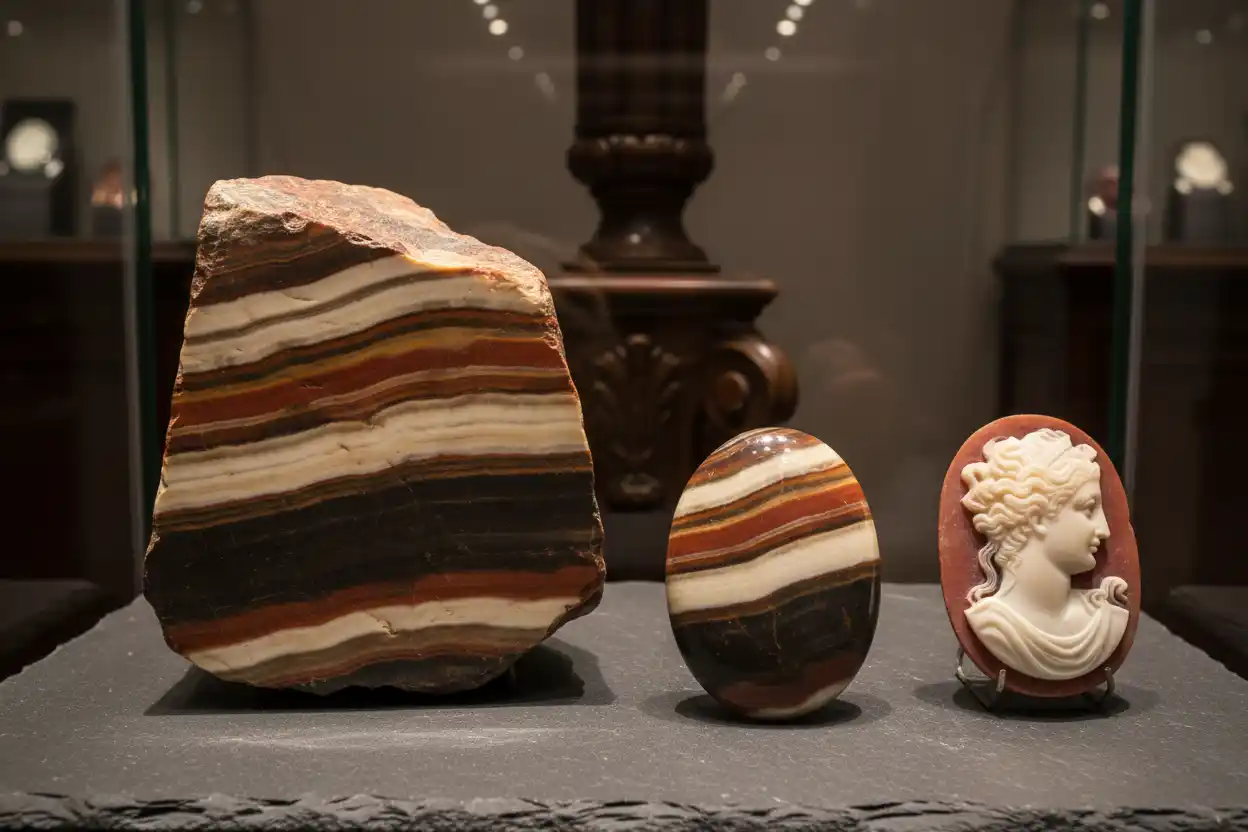
Sardonyx is a banded variety of chalcedony in which reddish-brown sard alternates with white, cream, or dark onyx-like layers. Its parallel color bands make it particularly suitable for seals, intaglios, cameos, beads, cabochons, and architectural ornaments.
Rather than being a separate mineral species, sardonyx consists mainly of microscopic quartz and moganite fibers arranged in dense layers. This structure gives it the durability of chalcedony while allowing skilled cutters to use each contrasting band as part of a carved design.
Sardonyx at a Glance
| Property | Sardonyx |
|---|---|
| Composition | Primarily silicon dioxide, SiO₂, as microcrystalline quartz with moganite |
| Group or type | Banded chalcedony; a parallel-banded agate variety |
| Color | Red-brown, orange-brown, brown, white, cream, black, or dark brown in contrasting layers |
| Crystal system or texture | Trigonal quartz structure; cryptocrystalline fibrous aggregate |
| Habit | Nodular, vein-filling, massive, layered, or banded |
| Luster | Waxy to vitreous when polished |
| Transparency | Translucent to opaque |
| Mohs hardness | 6.5–7 |
| Cleavage | None |
| Tenacity | Tough for a quartz aggregate, though edges can chip |
| Common uses | Cameos, intaglios, signet stones, beads, cabochons, seals, carvings, decorative objects |
| Primary care concern | Dyed material, sharp impacts, high heat, and chemical exposure |
What Is Sardonyx?
Sardonyx belongs to the broad chalcedony family. Chalcedony consists of intergrown microscopic silica fibers rather than the large visible crystals associated with rock crystal or amethyst.
When chalcedony develops recognizable banding, gemologists commonly classify it as agate. Sardonyx represents a more specific banded form in which sard-colored layers alternate with pale or dark layers.
Sard contributes the orange-red, brownish-red, or dark reddish-brown color. The term onyx traditionally describes chalcedony with straight, parallel bands, especially black and white material. Modern retail use of onyx is broader and often includes uniformly black dyed chalcedony.
Sardonyx should also be distinguished from carnelian. Carnelian usually has an orange to reddish-orange body color without the strongly contrasting, parallel bands that define sardonyx.
How Sardonyx Forms
Sardonyx forms when silica-rich fluids enter cavities, fractures, and porous zones within volcanic or sedimentary rocks. As the fluids cool or their chemistry changes, microscopic silica fibers accumulate along the cavity walls.
Repeated episodes of deposition create separate layers. Variations in iron content, oxidation state, water chemistry, porosity, and included particles produce differences in color and translucency.
Iron oxides and hydroxides give sard layers their orange, red, and brown tones. Pale layers contain fewer coloring particles, while dark layers may contain iron-rich material, organic matter, other mineral inclusions, or later artificial coloring.
The banding records changes in the fluid system rather than annual growth or simple sedimentary layering. A single nodule may therefore contain straight bands, irregular zones, fortification patterns, translucent sections, and opaque layers.
Readers comparing the wider family can consult types of agate and types of chalcedony without treating every banded silica specimen as sardonyx.
Natural Sardonyx Colors
Classic sardonyx combines reddish-brown sard with white or cream bands. Some pieces contain darker brown or nearly black layers, while others show orange-red against pale grey.
Natural colors often appear earthy rather than fluorescent. Rust red, mahogany, chestnut, burnt orange, ivory, and charcoal are more typical than intense purple, blue, emerald green, or hot pink.
Color terminology can vary between sellers. The broader agate color meaning and chalcedony color meaning guides explain color across the larger families, while sardonyx remains defined primarily by its layered structure and sard-colored component.
Material sold as green, purple, vivid blue, or unusually saturated pink sardonyx is often dyed agate or chalcedony. The label may describe a commercial pattern rather than a strict mineralogical variety.
Sardonyx may appear in collections of red gemstones or brown gemstones, although its multicolored banding makes a one-color category incomplete.
Banding and Internal Features
The most valuable natural pattern usually consists of distinct, parallel layers with enough thickness for carving. Clean boundaries allow a cameo artist to place a pale portrait or figure above a dark background.
Some sardonyx has fine, closely spaced stripes suited to cabochons and beads. Other material contains broad layers that can support deeper relief carving or larger ornamental objects.
Under magnification, natural material may show fibrous texture, iron-oxide particles, minute pits, healed fractures, irregular band boundaries, or small mineral inclusions. None of these features alone proves origin or treatment.
Dye may concentrate in cracks, pores, drill holes, or along band boundaries. Conversely, uniform color does not automatically prove treatment because dense natural chalcedony can show even saturation.
Sardonyx, Onyx, and Agate
All three names overlap, but they do not mean exactly the same thing.
Agate is the broadest term and covers many forms of visibly banded chalcedony. Its layers may be curved, concentric, angular, moss-like, scenic, or irregular.
Traditional onyx has straight, parallel bands, most famously black and white. However, much of the uniform black material sold today gained its color through dyeing.
Sardonyx has straight or relatively parallel bands that include sard-colored red-brown, orange-brown, or brown layers. Its classification rests on both pattern and color.
The types of onyx guide examines the wider naming issue, including the distinction between silica onyx and the softer calcite material sometimes called onyx marble.
Notable Sources of Sardonyx
India has long supplied sardonyx suitable for carving, beads, seals, and cabochons. Historically important cutting centers also developed specialized methods for enhancing and carving layered chalcedony.
Brazil and Uruguay produce abundant agate nodules, including material with sardonyx-like parallel layers. Madagascar supplies varied chalcedony and agate, while Germany and the Czech Republic have significant historical connections to hardstone cutting.
Sri Lanka, Russia, Pakistan, Indonesia, and the United States also yield banded chalcedony sold as sardonyx. However, a country of cutting or export does not necessarily identify the geological origin.
Precise locality usually matters less for ordinary sardonyx than pattern, treatment disclosure, cutting, and carving quality. Antique or archaeologically significant objects represent a major exception because provenance can dominate their value.
Sardonyx in Ancient Jewelry and Carving
Sardonyx has a long association with seals, signet rings, cameos, intaglios, amulets, and personal ornaments. Its toughness allows fine detail, while its layered colors make carved relief easy to see.
An intaglio carries a design cut below the surface and can create a raised impression in wax or clay. A cameo uses raised carving, often exposing a pale upper layer against a darker background.
Roman patrons used layered hardstones for portraits, mythological scenes, imperial imagery, and personal seals. Later European workshops continued the tradition in religious objects, jewelry, commemorative portraits, and decorative art.
Historical importance does not authenticate a modern object. Antique-style carving, artificial aging, glass cameos, molded resin, and assembled stones remain common enough that costly pieces deserve specialist examination.
How to Identify Sardonyx
Begin with the banding. Natural sardonyx should contain red-brown, brownish-orange, or dark sard layers alternating with pale or dark chalcedony bands.
A polished surface normally has a waxy to glassy luster. Translucent edges may glow orange or red under a strong light, while denser layers remain opaque.
Sardonyx has no cleavage and commonly shows conchoidal fracture at broken edges. Its hardness of 6.5–7 allows it to resist scratching from ordinary metal objects, although a destructive scratch test should never be performed on jewelry or carvings.
Magnification can reveal dye concentrations, gas bubbles in glass, molding seams in plastic, glue layers in assembled pieces, or grainy calcite texture. The real vs fake agate guide provides additional tests relevant to sardonyx because both materials share the same chalcedony framework.
A gemological laboratory may use refractive-index testing, specific gravity, spectroscopy, microscopy, Raman analysis, or chemical testing when the object carries substantial value.
Common Lookalikes and Mislabels
Banded agate can resemble sardonyx but may lack the characteristic sard-colored layers or parallel structure. The difference can become subjective when colors and patterns grade into one another.
Carnelian with pale zones may receive a sardonyx label even when it lacks consistent banding. Similarly, uniformly dark chalcedony may be sold as onyx rather than sardonyx.
Calcite onyx, Mexican onyx, and onyx marble are carbonate materials rather than silica. They have much lower hardness, visible cleavage, and sensitivity to acids.
Glass can imitate layered color through fused sheets or molded bands. Air bubbles, flow lines, lower hardness, and an overly uniform internal structure may expose it.
Manufacturers can also assemble thin slices of contrasting material into doublets or triplets. Glue lines, abrupt boundaries, differing lusters, and separation at the edges provide warning signs.
Treatments and Color Enhancement
Dyeing is the most significant treatment in the sardonyx market. Porous chalcedony can absorb coloring agents that deepen black, red, brown, blue, green, or purple areas.
Heat may intensify orange, red, or brown tones by changing iron compounds. Traditional agate-processing methods have also used chemical impregnation followed by heating to darken selected layers.
Treatment does not automatically make a piece unsuitable for jewelry. Problems arise when sellers present dyed or heated material as naturally vivid and charge a premium based on that claim.
The treated agate guide examines enhancement within the same material family, while gemstone treatments explained covers disclosure principles that apply across the trade.
Ask whether color has been dyed, heated, impregnated, coated, stabilized, or assembled. Sellers should also disclose repair or restoration on carvings and antique objects.
Synthetic Sardonyx and Imitations
Laboratories can grow synthetic quartz, but commercially significant synthetic sardonyx remains uncommon. Creating convincing natural-looking, multi-layer cryptocrystalline material offers little economic advantage when natural agate is widely available.
Glass, resin, ceramic, dyed chalcedony, and assembled slices are more practical imitations. Cameo glass has a legitimate history as an artistic material, although it should not be represented as natural sardonyx.
Plastic imitations feel lighter and warmer, scratch more easily, and may show molding lines. Glass usually has lower hardness and may contain rounded gas bubbles.
An imitation can still have decorative or historical value. Accurate labeling allows buyers to judge it on craftsmanship rather than a false material identity.
Cutting and Carving Behavior
Sardonyx cuts and polishes well, but successful work starts with orientation. A cutter studies the thickness, direction, continuity, and contrast of each layer before sawing the rough.
Cabochons emphasize natural stripes and broad color zones. Beads may display concentric rings, parallel bars, or irregular patches depending on how the rough intersects the layers.
Cameo cutters remove the upper layer selectively so a pale figure remains above a dark background. Intaglio cutters engrave into the surface, often using the dense material for seals or signet stones.
Although sardonyx lacks cleavage, excessive pressure can chip thin edges. Hidden fractures, cavities, and abrupt changes between layers can also interrupt carving.
Polishing typically produces a smooth waxy-to-vitreous surface. Poorly finished work may show flat spots, scratches, undercut pits, uneven domes, or softened carving details.
Durability and Jewelry Suitability
Sardonyx has enough hardness for many jewelry styles. Its interlocking cryptocrystalline texture also gives it better toughness than minerals with prominent cleavage.
Pendants, earrings, beads, cuff links, brooches, and signet stones suit it particularly well. Rings can perform satisfactorily when the setting protects exposed edges and the wearer removes the piece during heavy manual activity.
Sharp blows may chip a cabochon or break a carving at its thinnest point. Cameos deserve special care because noses, fingers, hair, lettering, and raised borders can fracture even when the underlying stone remains intact.
Dyed material may react to heat, solvents, cosmetics, or prolonged soaking. Jewelers should know about treatments before resizing, repairing, steaming, or repolishing a piece.
Sardonyx Value and July 2026 Asking Prices
Most sardonyx is not priced by carat alone. Band contrast, layer thickness, natural color, carving potential, cutting quality, craftsmanship, age, condition, metalwork, signature, and provenance often matter more than weight.
As of July 2026, commercial loose cabochons, tumbled pieces, and small carved components commonly carry asking prices around $5–$30. Specialist bead strands often appear around $15–$40, depending on bead size, matching, finish, and treatment disclosure.
Well-cut cameos, intaglios, signet stones, and larger carvings may ask approximately $75–$500 or more. Exceptional hand carving, signed work, antique provenance, archaeological importance, precious-metal mounting, or a recognized maker can raise the value far beyond the underlying material price.
Very low online prices often accompany dyed agate, mixed-quality beads, unclear naming, or mass-produced carving. High prices require more than attractive color; they should reflect craftsmanship, rarity, documentation, condition, or historical importance.
Detailed seller selection, product types, and purchasing checks belong on the dedicated where to buy sardonyx page.
Buying Sardonyx
First determine whether the piece is natural-colored, dyed, heated, assembled, restored, or antique. A seller who cannot answer may still offer an attractive decorative piece, but the uncertainty should affect the price.
Request photographs in neutral daylight from the front, back, edge, and under transmitted light. Edge photographs can reveal layer thickness, glue seams, color concentration, and whether a cameo uses natural bands.
For carved work, inspect facial features, lettering, borders, tool marks, polish, and damage to raised details. Machine-cut or molded pieces may have value, though they should not receive hand-carved pricing.
Antique claims need evidence. Provenance documents, maker signatures, metal hallmarks, old settings, wear patterns, and specialist opinions provide more support than an “ancient style” description.
Birthstone shoppers should note that sardonyx is one of the traditional stones associated with August. The August birthstone guide places it alongside the month’s better-known modern alternatives.
Both the crystals that start with S and gemstones that start with S directories provide the correct alphabetical context without changing sardonyx’s specific identity.
How to Clean and Store Sardonyx
Use lukewarm water, mild soap, and a soft cloth or brush. Clean around carved recesses gently so dirt does not remain trapped in fine details.
Avoid bleach, acids, aggressive jewelry dips, acetone, abrasive cleaners, and prolonged soaking. These substances may affect dyes, adhesives, metal settings, or repaired areas.
Steam and ultrasonic cleaning should be avoided when the piece is dyed, fractured, assembled, antique, intricately carved, or mounted in a delicate setting. The principles in how to clean onyx jewelry also apply to many sardonyx pieces because both consist of chalcedony.
Store the jewelry separately in a padded compartment. Wrap cameos and intaglios so raised or engraved details cannot rub against harder gemstones.
Sardonyx Meaning and Symbolism
Sardonyx has accumulated symbolism through its use in seals, military ornaments, religious objects, portraits, and personal jewelry. Its contrasting layers have often represented unity between different qualities, while the durability of carved seals contributed associations with authority, commitment, and identity.
Historical traditions linked sardonyx with courage, eloquence, protection, happiness, marital stability, and honorable conduct. Interpretations differed across cultures and periods, so no single meaning represents every historical user.
Modern crystal traditions commonly describe sardonyx as a symbol of discipline, confidence, integrity, grounded communication, partnership, and sustained effort. The alternating bands may serve as a visual metaphor for balancing independence with cooperation.
These meanings remain cultural, spiritual, or personal interpretations. Scientific evidence does not show that sardonyx cures disease, guarantees relationships, or changes health outcomes.
A person may wear it as an August birthstone, family keepsake, signet, carving, or reminder of a chosen value. Others appreciate the stone solely for its banding, lapidary history, and connection with ancient hardstone art.
Frequently Asked Questions
1. Is sardonyx a separate mineral?
No. It is a banded variety of chalcedony composed mainly of microscopic quartz and moganite.
2. How does sardonyx differ from onyx?
Sardonyx includes red-brown or orange-brown sard layers, while traditional onyx usually refers to parallel black-and-white chalcedony.
3. How does sardonyx differ from carnelian?
Carnelian normally has an orange-to-red body color without the contrasting parallel bands expected in sardonyx.
4. Must sardonyx bands be perfectly straight?
No, but relatively parallel, distinct layers support the name more strongly than curved, fortification-style, or chaotic agate patterns.
5. Is every black-and-white banded stone sardonyx?
No. Without a sard-colored red-brown or orange-brown component, the material may be better classified as onyx or banded agate.
6. Is vivid green or purple sardonyx natural?
Such colors are usually dyed or commercially named agate. Sellers should disclose any enhancement.
7. Is sardonyx an August birthstone?
Yes. Sardonyx has a long-standing traditional association with August, alongside other birthstones assigned to the month.
8. Why is sardonyx suitable for cameos?
Its contrasting layers allow a cutter to create a pale raised image against a darker background from one piece of stone.
9. Can sardonyx scratch glass?
It often can because its hardness reaches 6.5–7, but scratch tests can damage jewelry and do not prove identity by themselves.
10. Is dyed sardonyx still genuine stone?
It may be genuine chalcedony or agate with artificial color. The material can remain natural stone, but the treatment must be disclosed.
11. Can sardonyx be worn in a daily ring?
It can tolerate moderate wear, particularly in a protective setting, but raised carvings and exposed edges remain vulnerable to impact.
12. Which seller photographs reveal sardonyx quality best?
Neutral-light front, back, edge, magnified, and transmitted-light images reveal band continuity, carving depth, dye concentration, repairs, and assembled layers.
For most buyers, the decisive question is not whether sardonyx is inexpensive or costly, but whether its color, construction, treatment, carving, and history have been described accurately.