13 Scolecite Benefits for Inner Peace & Spiritual Awakening
Scolecite benefits begin with the real properties of a delicate calcium zeolite rather than claims that the mineral produces medical or supernatural effects. Scolecite has the ideal formula CaAl2Si3O10·3H2O, belongs to the natrolite subgroup of the zeolite family, and crystallizes in the monoclinic system.
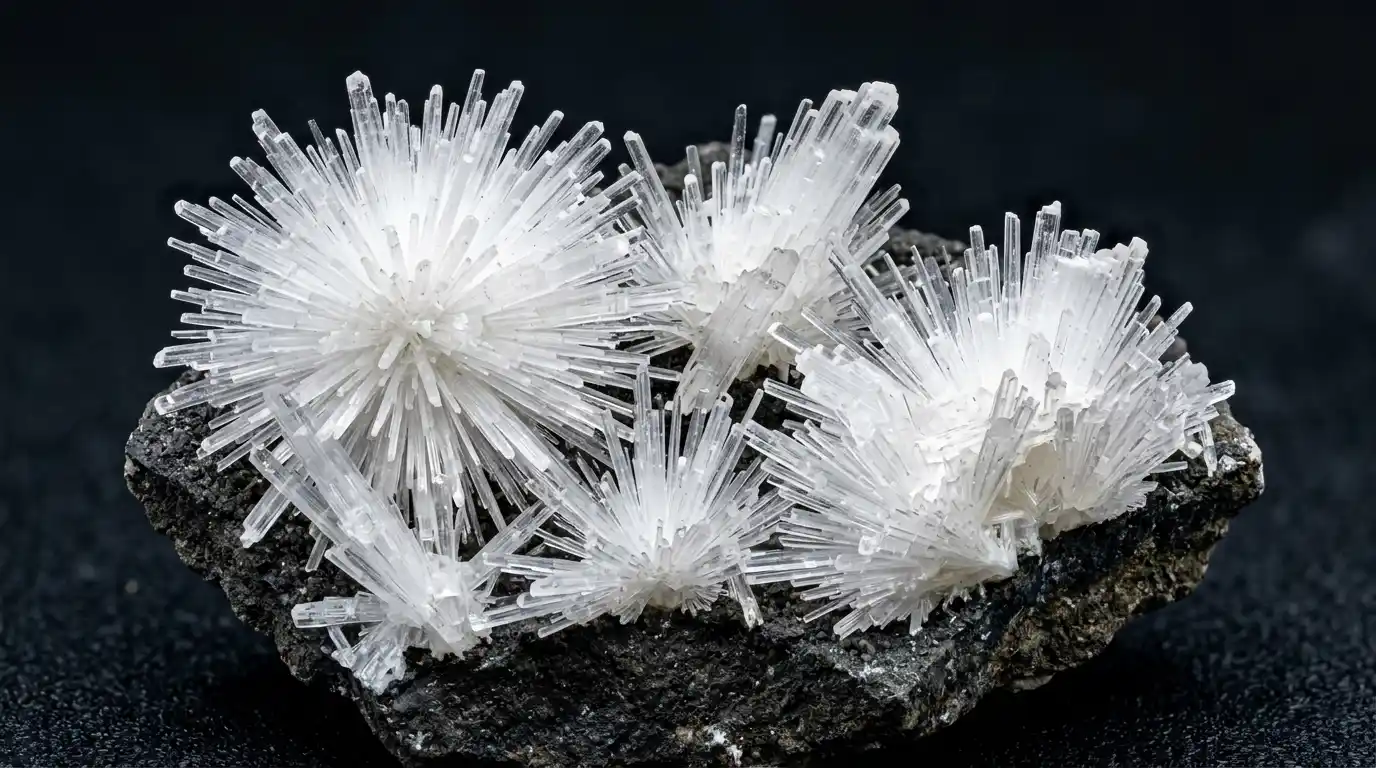
Its most recognizable specimens form slender white or colorless prismatic crystals, acicular needles, fibrous aggregates, or radiating sprays. Scolecite usually measures around 5 to 5.5 on the Mohs scale and has perfect cleavage with brittle tenacity, making fine crystal clusters beautiful but relatively easy to damage.
Modern crystal traditions associate scolecite benefits with inner peace, meditation, spiritual awakening, restful reflection, and crown chakra symbolism. These interpretations can support personal rituals, but scolecite does not medically treat anxiety, insomnia, depression, neurological conditions, or emotional distress.
13 Scolecite Benefits at a Glance
- Delicate radiating crystal sprays give scolecite exceptional mineral-collection appeal.
- Its calcium aluminosilicate chemistry provides a useful example of zeolite mineralogy.
- Structural water within the crystal makes scolecite valuable for understanding hydrated zeolite frameworks.
- Slender prismatic and acicular crystal habits offer clear lessons in crystal morphology.
- White, colorless, pink, salmon, and occasional other colors provide attractive natural variation.
- Basalt cavities and hydrothermal occurrences connect scolecite with volcanic and low-temperature mineral processes.
- Association with other zeolites helps collectors study multi-stage mineral growth.
- Its reaction to heating played a direct role in the origin of the name scolecite.
- Transparent crystals can occasionally be cut, although perfect cleavage and brittleness make faceting difficult.
- Modern inner-peace symbolism can make scolecite a useful focus for quiet reflection.
- Spiritual-awakening traditions can support meditation without being treated as measurable biological effects.
- Careful handling teaches the importance of hardness, cleavage, crystal habit, and specimen preservation.
- Sensible water, heat, and dust precautions help preserve delicate crystals and avoid exaggerated wellness practices.
Scolecite Benefits Begin With Zeolite Mineralogy
The strongest scientific scolecite benefits come from its place within the zeolite family. Zeolites are framework aluminosilicate minerals with open structural channels or cavities containing water molecules and extra-framework cations.
Scolecite is a calcium-rich member of the natrolite subgroup. Its ideal formula includes three water molecules per formula unit, making structural water an essential part of the mineral rather than surface moisture left after washing.
This distinction matters because some internet descriptions treat the water in zeolites as evidence that a crystal can hydrate the human body or draw toxins from it. Structural water does not make scolecite a medical hydration device or detoxification tool.
The chemistry instead gives scolecite benefits for mineral education. It offers a clear example of how water can exist as an organized component of a crystalline framework.
Radiating Crystal Sprays Create Collector Appeal
One of the most obvious scolecite benefits is its elegant crystal habit. Fine specimens may contain hundreds of slender white needles arranged as radiating sprays, spherical clusters, fans, or dense fibrous groups.
Individual crystals can also develop as narrow prisms with pointed terminations. Their fragile geometry gives scolecite a light, almost architectural appearance that makes high-quality specimens attractive to mineral collectors.
These crystals are not fibers in the same industrial sense as asbestos, but thin sprays can still break mechanically if handled roughly. Collector specimens are best supported from the matrix rather than grasped directly by the crystals.
The most impressive scolecite benefits often disappear when a specimen is polished. Natural crystal form is usually the reason collectors value the mineral in the first place.
Scolecite Shows How Zeolites Form in Volcanic Cavities
Geology is another important source of scolecite benefits. Scolecite commonly occurs as a secondary mineral in cavities and fractures within basalt and other volcanic rocks, where mineral-rich fluids deposit zeolites after the host lava has already solidified.
These cavities may contain several generations of mineral growth. Scolecite can occur with stilbite, heulandite, apophyllite, natrolite, mesolite, prehnite, calcite, and other low-temperature minerals.
Knowing where scolecite is found connects a specimen with real geological settings. India, particularly the Deccan volcanic region, is famous for attractive zeolite assemblages, while scolecite also occurs in Iceland, Canada, the United States, the United Kingdom, and many other regions.
A crystal spray on natural basalt matrix therefore records part of a volcanic rock’s later mineral history. That geological story is one of the most valuable scolecite benefits for collectors.
Scolecite Benefits for Studying Crystal Habit
Crystal habit describes the characteristic external form a mineral develops when it has enough space to grow. Scolecite commonly forms slender prismatic or acicular crystals, making crystal habit easy to observe even without advanced equipment.
Radiating groups show how many crystals can grow outward from a common region of nucleation. Fibrous or needle-like clusters can also reveal competition for space as crystals extend into a cavity.
Scolecite crystallizes in the monoclinic system, although its slender habit can visually resemble related natrolite-group zeolites. Visual appearance alone may therefore be insufficient for a confident species identification.
These scolecite benefits make good specimens valuable teaching pieces. They connect abstract crystallographic terms with visible structures that students can examine directly.
White and Pink Colors Add Natural Variation
Scolecite is most commonly colorless or white, but specimens may also appear pink, salmon, reddish, or occasionally greenish. Color can depend on inclusions, trace chemistry, staining, associated minerals, or the conditions under which the crystals formed.
The ideas surrounding scolecite color meaning often connect white with peace or spiritual clarity and pink with compassion. These are modern symbolic interpretations rather than different measurable energetic properties.
Gemologically, color should be evaluated alongside crystal form, luster, damage, transparency, and mineral associations. A pure white crystal spray can be just as scientifically valuable as a rarer pink specimen.
The strongest scolecite benefits do not require unusual coloration. Crystal quality and geological relationships often matter more to collectors.
The Name Scolecite Comes From Its Reaction to Heat
Scolecite has one of the more memorable mineral names. It comes from a Greek word associated with a worm, referring to the way the mineral can curl or behave in a worm-like manner when strongly heated during older blowpipe testing.
This reaction relates to scolecite’s hydrated zeolite structure. Heating can drive off structural water and alter the mineral rather than simply warming an unchanged crystal.
That history provides an important care lesson. A collectible scolecite specimen should not be intentionally exposed to flames or strong heat as part of a cleansing ritual.
The mineral’s reaction to heat helped people recognize it scientifically. Repeating that reaction on a valuable specimen would only risk damaging it.
Structural Water Is Not a Reason to Soak Scolecite
Zeolite minerals contain water within their crystal frameworks, but that does not mean soaking improves scolecite. The question of whether scolecite is safe in water should focus on specimen preservation rather than metaphysical charging.
Brief contact with clean water does not automatically dissolve scolecite, but delicate sprays, fractures, cleavage, matrix minerals, and repeated wet-dry cycles can create practical risks. Strong water pressure alone may break fine acicular crystals.
Long soaking also provides no proven spiritual or health advantage. Water inside the zeolite structure is part of the mineral’s chemistry and is not equivalent to water absorbed during a cleansing ritual.
Dry dusting with a soft air blower or very gentle brush is often safer for fragile collector clusters than unnecessary immersion.
Perfect Cleavage Limits Jewelry Durability
Scolecite benefits collectors far more than everyday jewelry wearers because the mineral is relatively delicate. Mohs hardness around 5 to 5.5 means quartz-rich dust and many common gemstones can scratch its surface.
Perfect cleavage creates another weakness. A force applied in an unfortunate direction can split a crystal even when there is little visible surface wear beforehand.
Transparent scolecite has occasionally been faceted, but cutting is difficult because cleavage, brittleness, and typically narrow crystal sizes limit usable rough. Finished gems are best regarded as collector stones rather than robust everyday jewelry.
Pendants or protected pieces are more realistic than exposed rings. Fine natural sprays are usually best left uncut.
Scolecite Benefits for Mineral Identification
Scolecite is part of a closely related group of fibrous zeolites that includes natrolite and mesolite. These minerals can look similar enough that color and crystal habit alone may not provide a certain identification.
Scolecite differs chemically by being calcium-rich, while natrolite is sodium-rich and mesolite contains both calcium and sodium in characteristic proportions. Laboratory methods such as X-ray diffraction, chemical analysis, or Raman spectroscopy can resolve difficult specimens.
This makes scolecite benefits especially useful for serious collectors. The mineral demonstrates why attractive visual similarity should not be mistaken for species identity.
A white radiating spray may look like scolecite but still require analytical confirmation when locality information and crystal morphology are inconclusive.
Inner Peace as a Reflective Practice
Inner peace is one of the most common modern scolecite benefits. The soft white appearance and radiating crystal forms make the mineral visually suitable for quiet meditation, contemplative spaces, or personal reflection.
A person might place a scolecite specimen near a journal and associate it with slowing down before making an emotional decision. Another may use it as a visual reminder to spend a few minutes away from notifications or work demands.
The crystal does not medically reduce anxiety, lower stress hormones, or treat panic disorders. Any sense of calm produced by a quiet routine comes from the practice, environment, expectations, and the person’s own responses.
Scolecite can still become meaningful within that routine. Symbolic value does not require a medical mechanism.
Spiritual Awakening Without Supernatural Guarantees
Spiritual awakening is another theme attached to scolecite benefits. Different people use this phrase to mean greater self-awareness, deeper religious commitment, philosophical reflection, or a change in personal values.
Scolecite can represent peaceful transformation, meditation, a new spiritual practice, or a private period of self-reflection. The stone does not guarantee revelation or provide access to hidden universal knowledge.
Spiritual experiences are personal and interpreted through culture, belief, psychology, and individual experience. Mineral chemistry cannot confirm or deny the meaning someone assigns to those experiences.
The evidence-safe approach is simple: use scolecite as a symbol or contemplative object without claiming the mineral causes supernatural events.
Scolecite Chakra Traditions
Modern scolecite chakra practices often connect the white mineral with the crown chakra. Some traditions also associate it with the third eye because of themes involving meditation and spiritual awareness.
Chakras are spiritual frameworks rather than anatomical structures. Placing scolecite near the head does not physically activate the brain, pineal gland, endocrine system, nervous system, or another organ.
A chakra routine can still serve as structured meditation. Someone may choose a question, sit quietly with the stone nearby, and reflect on beliefs, priorities, or gratitude.
The benefit comes from intentional reflection rather than a measurable signal emitted by scolecite.
Healing Claims Need Firm Limits
Online descriptions of scolecite healing properties sometimes extend into claims involving sleep, anxiety, neurological health, circulation, detoxification, immune function, or emotional trauma. These effects are not established by clinical evidence.
Scolecite contains calcium, aluminum, silicon, oxygen, hydrogen, and structural water, but wearing the mineral does not deliver these components to the body in medically useful doses.
It should not be powdered, swallowed, dissolved into drinking water, or used as a replacement for treatment. Fragile crystals can also break into small sharp fragments if handled carelessly.
A person can still use scolecite during meditation or reflection while keeping health decisions grounded in qualified medical advice.
Scolecite and Sleep Rituals
Because scolecite is often described as peaceful, some people place specimens near a bed as part of an evening ritual. The object may serve as a reminder to reduce screen use, journal, read quietly, or prepare for sleep at a consistent time.
There is no scientific evidence that scolecite itself induces sleep or treats insomnia. Its presence does not change melatonin production or neurological sleep cycles.
A bedtime routine can still be useful when built around sensible habits. In this case, scolecite functions as a visual cue rather than a sedative.
Fragile crystal clusters should also be placed somewhere stable where they cannot fall or be crushed during the night.
Safe Handling and Cleaning
Fine scolecite specimens need careful physical handling. Hold a specimen by sturdy matrix whenever possible rather than touching delicate needle-like crystals.
Avoid steam, ultrasonic cleaners, boiling water, strong acids, hard scrubbing, and sudden temperature changes. These methods offer no benefit and can damage cleavage-sensitive crystals or associated minerals.
A soft artist’s brush or gentle air flow may remove loose dust from robust specimens. If water must be used, minimal contact and extremely gentle handling are preferable to soaking.
Proper care preserves the actual scolecite benefits of crystal habit, luster, geological association, and specimen quality.
Scolecite Benefits for Collectors
Collector value depends on more than size. Fine scolecite may be judged by crystal definition, luster, transparency, damage, aesthetic arrangement, matrix contrast, locality, associated minerals, and whether the specimen has been repaired.
A compact spray with clean undamaged terminations can be more desirable than a larger cluster with extensive breakage. Association with apophyllite, stilbite, heulandite, or other zeolites may also increase visual and mineralogical interest.
Natural matrix is valuable because it helps preserve the mineral association and growth sequence. Removing crystals purely to create loose decorative pieces can destroy useful geological information.
For collectors, these are some of the strongest real scolecite benefits. The stone combines fragile beauty with zeolite chemistry and recognizable volcanic geology.
Conclusion
Scolecite benefits include elegant radiating crystal habits, calcium-zeolite chemistry, structural water, geological association with volcanic cavities, mineral identification value, and strong collector appeal. Inner peace and spiritual awakening can serve as personal themes for meditation and reflection, but scolecite does not medically change sleep, anxiety, neurological function, or emotional health.
FAQs
What are the main scolecite benefits?
Scolecite benefits include attractive radiating crystal sprays, zeolite mineralogy, geological interest, collector value, crystal-habit education, and useful comparison with related natrolite-group minerals. Modern spiritual traditions also connect scolecite with peace, meditation, and spiritual awareness.
What is scolecite made of?
Scolecite is a hydrated calcium aluminosilicate zeolite with the ideal formula CaAl2Si3O10·3H2O. It belongs to the natrolite subgroup of the zeolite family.
Is scolecite a hard mineral?
No. Scolecite is only about 5 to 5.5 on the Mohs scale and is brittle with perfect cleavage. Fine crystal sprays can break easily if handled or cleaned roughly.
Why does scolecite form needle-like crystals?
Scolecite commonly develops slender prismatic or acicular crystal habits because of its crystal structure and growth conditions. Large groups may radiate outward into sprays or fibrous clusters.
Does scolecite contain water?
Yes. Water molecules are part of its hydrated zeolite structure. This structural water does not mean the crystal hydrates the human body or needs regular soaking.
Why is scolecite named after a worm?
The name comes from a Greek word associated with a worm, referring to the mineral’s worm-like curling behavior when strongly heated during older blowpipe testing.
Where is scolecite commonly found?
Scolecite occurs in basalt cavities, hydrothermal veins, and other low-temperature mineral settings. India is particularly famous for attractive zeolite specimens, with additional occurrences in many other countries.
Does scolecite bring inner peace?
There is no scientific evidence that scolecite directly changes anxiety, stress hormones, or emotional health. It can serve as a visual focus during meditation, journaling, or quiet reflection.
Does scolecite cause spiritual awakening?
Scolecite cannot guarantee a spiritual awakening or supernatural experience. A person may use the stone symbolically during prayer, meditation, or personal reflection.
What chakra is scolecite associated with?
Modern crystal traditions commonly associate scolecite with the crown chakra and sometimes the third eye. These are spiritual interpretations rather than anatomical or scientifically measurable effects.
Is scolecite safe in water?
Brief gentle water contact is different from prolonged soaking. Because scolecite is brittle, perfectly cleavable, and often forms delicate sprays, unnecessary immersion and forceful washing are best avoided.
Is scolecite suitable for jewelry?
It can occasionally be cut or mounted, but Mohs hardness 5 to 5.5, perfect cleavage, and brittleness make it less practical than quartz, garnet, tourmaline, or sapphire. Natural crystal specimens are generally better suited to protected display.
Can scolecite have personal meaning?
Yes. Scolecite can represent meditation, peaceful transformation, a spiritual practice, a collection milestone, travel memory, or personal period of reflection. Personal symbolism does not require a universal metaphysical explanation.
Disclaimer: Inner-peace, spiritual-awakening, chakra, sleep, emotional, meditative, and energetic descriptions of scolecite reflect spiritual beliefs and personal practices. Scolecite is not a medical or psychological treatment and should not replace professional healthcare.