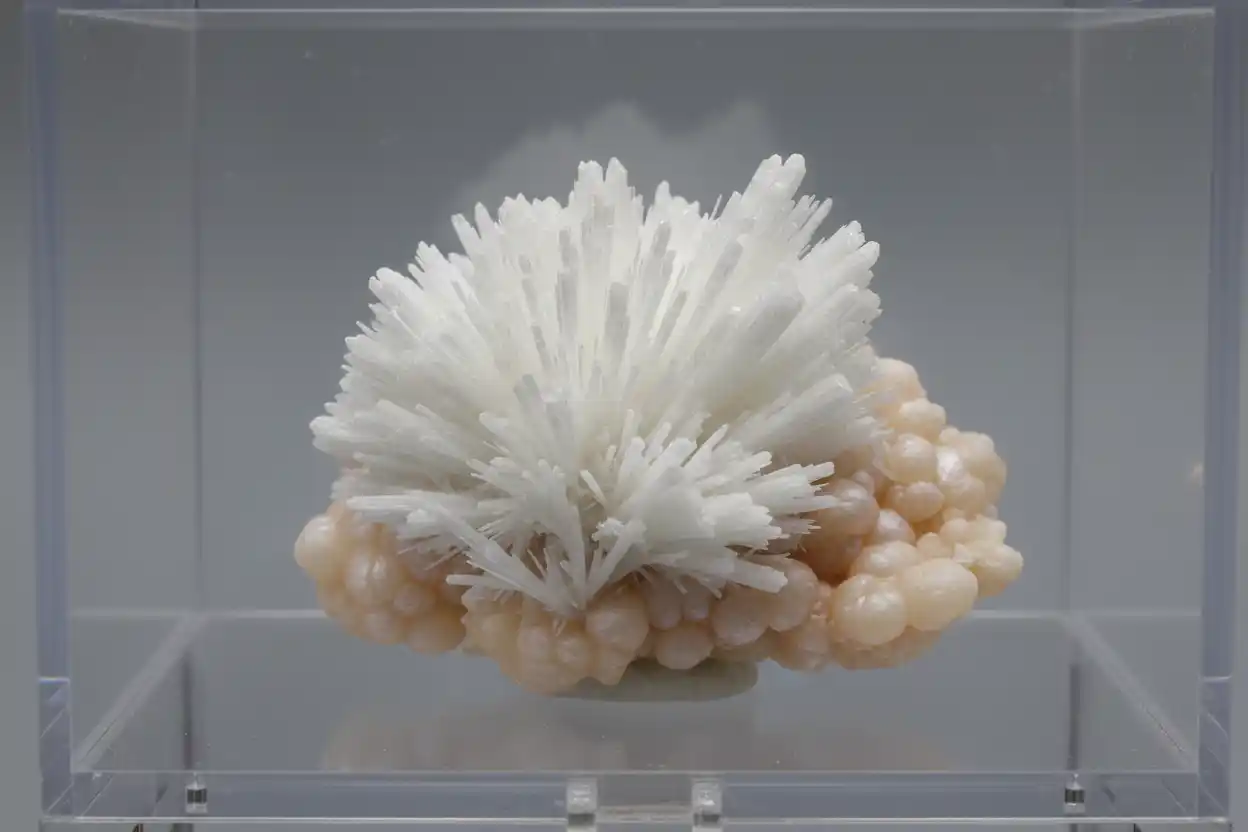
Scolecite: Meaning, Properties & Symbolism
Scolecite is a hydrated calcium aluminosilicate in the zeolite group, recognized by its slender white crystals, radiating sprays, fibrous aggregates, and delicate pearly-to-vitreous luster. It commonly lines cavities in basalt and other volcanic rocks, where it forms with stilbite, heulandite, apophyllite, calcite, and related secondary minerals.
Although scolecite has moderate hardness for a zeolite, its thin crystals, perfect cleavage, brittle tenacity, and water-bearing structure make most specimens far better suited to display than jewelry.
Scolecite at a Glance
| Property | Scolecite |
|---|---|
| Composition | Hydrated calcium aluminosilicate, CaAl₂Si₃O₁₀·3H₂O |
| Group or type | Natrolite subgroup of the zeolite group |
| Color | Colorless, white, cream, pink, salmon, pale red, occasionally greenish |
| Crystal system or texture | Monoclinic, commonly appearing pseudo-orthorhombic |
| Habit | Slender prismatic, acicular, radiating, fibrous, massive |
| Luster | Vitreous to silky or pearly |
| Transparency | Transparent to translucent |
| Mohs hardness | 5–5.5 |
| Cleavage | Perfect in one direction |
| Tenacity | Brittle |
| Common uses | Mineral specimens, carvings, cabochons, decorative objects, rare collector jewelry |
| Primary care concern | Fragile needles, cleavage, heat sensitivity, and dehydration risk |
What Is Scolecite?
Scolecite is one of the naturally occurring minerals known as zeolites. These minerals contain open aluminosilicate frameworks with channels and cavities that hold water molecules and exchangeable ions.
Its formula contains calcium, aluminum, silicon, oxygen, and structural water. The water is part of the mineral framework rather than ordinary surface moisture.
Scolecite belongs to the natrolite subgroup alongside natrolite, mesolite, and related minerals. These species can look very similar because each may form white needles or radiating sprays.
The name comes from the Greek word for worm. Early mineralogists observed that scolecite could curl or move in a worm-like way when heated strongly in a blowpipe flame.
As a mineral specimen, it belongs naturally beside other specialized entries in the types of gemstones guide, although it is not a mainstream faceted gem.
Zeolite Structure and Composition
Scolecite’s aluminosilicate framework contains channels occupied by calcium ions and water molecules. This porous structure gives zeolites their well-known ion-exchange and molecular-sieving behavior.
Natural scolecite normally remains chemically close to its calcium-rich formula. Minor substitutions can occur, but calcium distinguishes it from sodium-rich natrolite.
Water may leave the structure when heated. Excessive heat can therefore alter appearance, produce cracking, or cause permanent structural change.
Scolecite’s framework differs from the sheet structure of mica or the compact network of quartz. Consequently, its care requirements should not be inferred from harder silicate minerals.
The broader zeolite guide owns family-level discussion of zeolite structure and uses, while scolecite remains focused on this specific calcium-rich member.
How Scolecite Forms
Scolecite most often forms as a low-temperature secondary mineral in cavities and fractures within basalt, andesite, and related volcanic rocks. Groundwater circulates through the rock and reacts with volcanic glass and feldspar.
As fluids cool and their chemistry changes, zeolite minerals crystallize inside gas bubbles and fractures. Scolecite may appear late in the sequence, growing on earlier minerals.
Hydrothermal alteration, burial metamorphism, and low-grade metamorphic conditions can also produce scolecite. It occurs less commonly in alkaline igneous rocks and some metamorphic environments.
Crystal cavities may contain several zeolites together. Scolecite can therefore grow with stilbite, natrolite, mesolite, heulandite, chabazite, laumontite, and analcime.
Apophyllite and calcite are also frequent companions, although neither belongs to the zeolite group.
Crystal Habits
The classic scolecite specimen consists of radiating white needles arranged as a spray, fan, ball, or starburst. Individual crystals may be slender prisms with pointed terminations.
Twins are common and may create characteristic V-shaped or cross-like forms. Very fine crystals can aggregate into silky fibrous masses.
Some specimens form rounded nodules with crystals radiating outward from a central point. Others coat cavity walls as dense white clusters.
Thicker crystals may appear translucent and glassy, while fine needles look silky. Pink, peach, or salmon tones may result from inclusions, staining, or association with colored matrix minerals.
Because the crystals are fragile, a specimen’s apparent fullness may hide broken tips. Close inspection under side lighting reveals whether the spray retains intact terminations.
Important Localities
India supplies most of the scolecite specimens seen in the modern decorative and collector market. The basalt formations of Maharashtra contain abundant zeolite-bearing cavities.
Areas around Nashik, Pune, Jalgaon, Mumbai, and the Deccan Traps have produced sprays associated with stilbite, heulandite, apophyllite, calcite, and other cavity minerals.
Iceland, Scotland, the Faroe Islands, Germany, Italy, Norway, and other volcanic regions contain classic scolecite occurrences. Canada’s Bay of Fundy region has also produced notable zeolite assemblages.
Localities in the United States include volcanic districts in Colorado, Oregon, Washington, New Jersey, and elsewhere. However, attractive specimens from India remain much more common in retail channels.
A locality label should identify the district or quarry whenever possible. Simply stating “India” gives limited geological or collector information.
Scolecite Versus Natrolite and Mesolite
Scolecite, natrolite, and mesolite frequently cause confusion because all can form pale needle-like crystals.
Natrolite is sodium-rich and orthorhombic. Its crystals often appear straighter, sharper, and more glassy, although visual overlap remains considerable.
Mesolite contains both calcium and sodium. It commonly forms extremely fine, hair-like sprays that may look softer or more fibrous than typical scolecite.
Scolecite is calcium-rich and monoclinic, but repeated twinning can make crystals appear orthorhombic. It may form thicker radiating sprays and characteristic twinned shapes.
Visual identification alone is unreliable when crystals are small or intergrown. Raman spectroscopy, X-ray diffraction, or chemical analysis may be required for certainty.
Other Lookalikes
White selenite can form fibrous or bladed material, but it is much softer and belongs to the gypsum family. The selenite vs satin spar comparison helps separate gypsum textures from zeolite crystals.
Aragonite may form radiating sprays, yet it has a different composition, crystal system, density, and acid reaction. Aragonite also commonly shows pseudohexagonal twins.
Calcite can develop white needle-like or dogtooth crystals. It is softer, has rhombohedral cleavage, and reacts with dilute acid.
Quartz needles are harder and lack scolecite’s perfect cleavage and hydrated zeolite structure.
Synthetic fiber, resin casts, and glued crystal composites occasionally imitate radiating clusters. Repeated identical needles, visible adhesive, bubbles, or plastic luster may expose them.
How to Identify Scolecite
Scolecite commonly appears colorless or white, with slender monoclinic crystals in radiating groups. Its hardness of 5–5.5 is greater than many zeolites but lower than quartz.
Specific gravity is low, around 2.25–2.29. The mineral feels light compared with calcite, barite, or metallic minerals.
Perfect cleavage and brittleness make physical testing risky. Thin crystals may snap from pressure that would not damage a massive stone.
Under magnification, twinning, longitudinal striations, fibrous aggregation, and glassy terminations may provide clues.
Heating tests historically helped identify scolecite, but they are destructive and unsafe for collectible material. Modern analysis should use non-destructive methods whenever possible.
The how to identify crystals guide explains how to combine habit, hardness, density, association, and laboratory methods.
Treatments, Stabilization, and Imitations
Most natural scolecite specimens receive no color treatment. Cleaning, trimming, stabilization, or repair may occur before sale.
Broken sprays are sometimes glued back onto matrix. Adhesive may be visible under ultraviolet light or magnification, although not every repair is obvious.
Resin stabilization can strengthen porous or fractured material used for carving. Sellers should disclose stabilization because it changes care requirements.
Dyed scolecite is uncommon, but pale porous material can absorb color. Highly saturated blue, green, purple, or neon material deserves scrutiny.
Synthetic scolecite can be produced for research, but it is not a significant jewelry imitation. Glass, resin, gypsum, and other pale minerals are more common substitutes.
Cutting, Carving, and Jewelry Use
Fine scolecite sprays should not be cut because their value lies in natural form. Dense massive material may be shaped into cabochons, palm stones, carvings, or beads.
Lapidaries must work gently because cleavage, porosity, and internal fractures can cause chipping. Stabilized material generally cuts more predictably than untreated porous rough.
Polished scolecite often shows soft white, cream, or peach patterns rather than the sharp crystal habit associated with specimens.
Jewelry use remains limited. Pendants and earrings can work when the stone is dense, stabilized if necessary, and protected from impact.
Rings are a poor choice for untreated scolecite. Everyday contact with hard surfaces, water, cosmetics, and heat can dull or damage it.
Durability and Safety
A hardness of 5–5.5 provides moderate scratch resistance, but scolecite’s perfect cleavage and thin crystal habit make it fragile.
Heat can drive water from the mineral structure. Strong sunlight, steam, jewelry torches, and sudden temperature changes should be avoided.
Repeated soaking is also unwise. Although brief contact with clean water may not destroy a stable crystal, matrix minerals, repairs, and porous surfaces can respond unpredictably.
Fine zeolite dust should not be inhaled. Cutting or grinding requires wet methods, ventilation, respiratory protection, and professional lapidary controls.
Scolecite Value and July 2026 Asking Prices
Scolecite is usually sold by specimen rather than weight. Value depends on crystal sharpness, completeness, symmetry, size, luster, matrix contrast, locality, and associated minerals.
As of July 2026, small sprays, modest clusters, and common Indian specimens often carry asking prices around $15–$50. Attractive hand-sized clusters generally appear around $50–$150.
Larger undamaged sprays, unusual twin formations, high-quality pieces with stilbite or apophyllite, and well-balanced display specimens may ask approximately $150–$500.
Exceptional cabinet specimens with intact crystals, unusual associations, strong provenance, or classic locality status can exceed $500.
Mass-produced polished pieces often sell for less than fine natural sprays. Their value depends more on carving size, polish, stabilization, and decorative pattern.
Detailed seller selection and authenticity checks belong on the dedicated where to buy scolecite guide.
Buying Scolecite
Look first at the crystal tips. A large spray with many broken needles may be less desirable than a smaller cluster with complete terminations.
Request side-lit photographs from several angles. Bright front lighting can conceal broken tips and glued repairs.
Ask whether crystals were repaired, reattached, stabilized, acid-cleaned, or coated. Preparation is common in mineral collecting, but disclosure allows a fair comparison.
Inspect the matrix. Stilbite, heulandite, calcite, and apophyllite can add visual interest, although they also introduce different care concerns.
Shipping quality matters. Delicate sprays should be immobilized with clearance around every crystal rather than pressed into cotton.
Cleaning and Storage
Routine cleaning should use a soft air blower or very gentle dry brush. Avoid brushing across needle tips.
When necessary, briefly rinse a robust specimen in lukewarm water without soaking it. Dry it promptly in moving air at room temperature.
Do not use steam, ultrasonic equipment, bleach, acids, or hot water. Sudden temperature changes may damage the hydrated structure or associated minerals.
Keep the specimen inside a covered display case to reduce dust accumulation. A fitted specimen box should support the matrix without touching the crystals.
The general principles in how to store crystals safely are especially important for radiating zeolite sprays.
Scolecite Meaning and Symbolism
Scolecite has little documented ancient symbolic tradition compared with quartz, jade, or corundum. Most meanings associated with it come from modern crystal practices.
Its pale color and radiating form are commonly interpreted as symbols of calm, openness, clarity, reflection, and gentle communication.
Some practitioners associate the mineral with meditation, peaceful sleep, emotional release, or spiritual awareness. Others use the fan-like sprays as visual reminders of expansion and interconnectedness.
These ideas belong to personal or spiritual belief systems. Scientific evidence does not show that scolecite treats insomnia, anxiety, neurological conditions, or other health concerns.
A specimen can still serve as a meaningful object through its natural symmetry, rarity, locality, or personal association.
Frequently Asked Questions
1. Is scolecite a zeolite?
Yes. It belongs to the natrolite subgroup within the zeolite group.
2. Why does scolecite form needle-like sprays?
Its crystal structure favors elongated prismatic growth, and multiple crystals often radiate from a shared nucleation point.
3. Is scolecite always white?
No. It can also be colorless, cream, pink, salmon, pale red, or rarely greenish.
4. How does scolecite differ from natrolite?
Scolecite is calcium-rich and monoclinic, while natrolite is sodium-rich and orthorhombic.
5. Is mesolite the same as scolecite?
No. Mesolite contains both calcium and sodium and generally forms finer, more hair-like crystals.
6. Can scolecite be placed in water?
Brief rinsing may be acceptable for a stable specimen, but soaking is discouraged because of porosity, repairs, and associated minerals.
7. Does scolecite contain water?
Yes. Water molecules occupy channels within its zeolite framework.
8. Can scolecite be exposed to heat?
Strong heat should be avoided because it can dehydrate, crack, or structurally alter the mineral.
9. Is scolecite suitable for daily jewelry?
No. Thin crystals and cleavage make it too fragile, while massive polished material still requires careful wear.
10. Is pink scolecite natural?
Pale pink and salmon material can occur naturally, though vivid or uniform color may indicate staining or dye.
11. How should a scolecite spray be shipped?
The matrix should be immobilized in a rigid container with empty clearance around every exposed crystal.
12. What most affects scolecite value?
Complete terminations, spray symmetry, crystal luster, specimen size, attractive associations, minimal repair, and precise locality raise value.
Scolecite is most rewarding when treated as a delicate geological structure rather than a durable decorative stone, with intact crystal form taking priority over size alone.
Scolecite can release fine mineral dust if cut, drilled, or ground. Avoid inhaling dust, do not ingest the material, and use professional wet-cutting, ventilation, eye protection, and respiratory controls for any lapidary work.