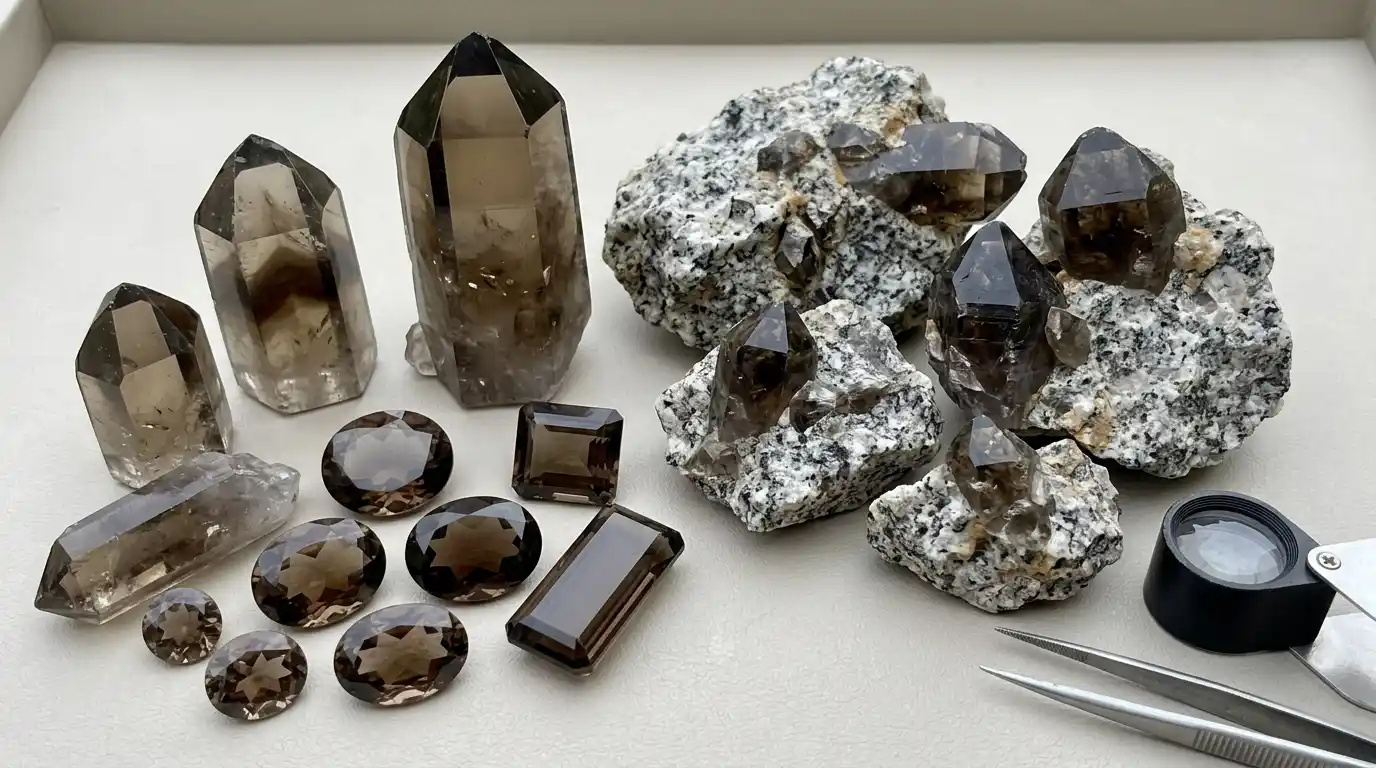
9 Hidden Smoky Quartz Benefits: Helpful Traditions, Hidden Facts, Responsible Use
Smoky quartz benefits begin with the genuine physical qualities of quartz rather than with claims about invisible energy. Smoky quartz is a gray, brown, or nearly black variety of crystalline silicon dioxide, SiO2, whose color develops when natural or artificial irradiation interacts with aluminum-related defects inside the quartz crystal lattice. The result can range from pale smoky gray through warm brown to extremely dark morion, while the underlying mineral remains quartz.
Its practical value comes from a combination of Mohs hardness 7, lack of true cleavage, attractive transparency, strong vitreous luster, abundant crystal forms, and enough durability for many types of jewelry. Like clear quartz, smoky quartz belongs to the same mineral species and shares the same fundamental crystal structure, but radiation-induced color centers create its distinctive darker appearance. This makes smoky quartz useful not only as an ornamental gemstone but also as a clear example of how trace defects and natural radiation can change color without changing the mineral species itself.
Modern traditions add grounding, emotional steadiness, stress relief, protection, cleansing, and practical focus to smoky quartz benefits. These interpretations can give a ring, pendant, crystal, or polished stone personal meaning, but they should remain separate from claims that smoky quartz medically lowers stress hormones, treats anxiety, removes toxins, blocks radiation, or changes the nervous system through ordinary contact.
9 Smoky Quartz Benefits at a Glance
- Mohs hardness 7 gives smoky quartz useful resistance to everyday scratching.
- Its lack of true cleavage supports practical use in rings, pendants, earrings, bracelets, and carved objects.
- Natural irradiation and aluminum-related color centers provide an excellent lesson in quartz color science.
- Gray, brown, and nearly black tones create substantial jewelry, carving, and collector appeal.
- Transparent crystals can preserve growth zoning, phantoms, inclusions, and other features useful for mineral study.
- Natural and treated smoky coloration provides a practical example of why gemstone treatment disclosure matters.
- Modern grounding traditions can use smoky quartz as a personal reminder to return attention to immediate responsibilities and practical facts.
- Stress-relief symbolism can support meditation or quiet routines without being confused with psychological or medical treatment.
- Responsible care, treatment awareness, and safe lapidary practices allow smoky quartz to be enjoyed without exaggerated health claims.
Smoky Quartz Benefits Begin With Real Quartz Mineralogy
Smoky quartz belongs to the trigonal quartz family and consists primarily of silicon and oxygen. Its hardness of 7 makes it substantially more resistant to scratching than feldspar, apatite, fluorite, calcite, and many softer ornamental stones, while the absence of true cleavage means it does not split readily along fixed structural planes. A sufficiently strong blow can still chip or fracture the crystal, especially around thin facet junctions or preexisting fractures, but sound smoky quartz is durable enough for frequent jewelry wear when treated sensibly.
The smoky color is scientifically more interesting than simply describing the stone as “brown quartz.” Small amounts of aluminum can substitute for silicon during crystal growth, and irradiation can then create defects known as color centers that absorb portions of visible light. Natural radioactive elements in surrounding rocks can provide that radiation over geological time, while commercial treatment can reproduce or deepen similar smoky coloration artificially.
This process does not mean naturally smoky quartz is dangerously radioactive. The coloration records radiation-induced changes within the crystal structure rather than turning an ordinary polished stone into a continuing source of harmful radiation. The distinction is important because the word irradiation can sound alarming when separated from the mineral physics that actually produce the color.
Color Variation Creates Jewelry and Collector Value
One practical smoky quartz benefit is the wide range of attractive neutral colors. Pale smoky crystals can appear almost colorless until placed against a white background, medium stones may show warm gray-brown or cognac-like tones, and very dark crystals can approach black. Morion is a traditional name used for especially dark smoky quartz, while Cairngorm historically refers to smoky quartz associated with the Cairngorm Mountains of Scotland.
Transparency remains important because smoky quartz is normally valued for color transmitted through the crystal rather than for a dark appearance caused by dense black inclusions. Some specimens show obvious zoning, phantom growth, skeletal forms, or varying color intensity between crystallographic sectors. These structures can be especially attractive to collectors because they preserve information about crystal growth and later exposure to natural radiation.
When choosing a cut stone, color should remain visible without becoming so dark that brilliance disappears. Transparency, cutting, fractures, color distribution, treatment disclosure, and overall face-up appearance all influence smoky quartz quality grading, and a lighter stone with lively internal reflections can be more attractive than an almost opaque-looking example with greater color saturation.
Natural Irradiation, Artificial Irradiation, and Heat
A major hidden fact behind smoky quartz benefits is that natural and treated coloration can arise through closely related physical mechanisms. Colorless quartz containing suitable aluminum-related defects can be irradiated artificially to produce smoky shades, and such treatment has long been used in the gem trade. GIA notes that irradiation is capable of producing smoky coloration in quartz, just as natural geological radiation can create the same broad color family.
Heat can weaken or remove smoky color centers. Depending on the crystal chemistry and treatment conditions, heating may produce lighter quartz or contribute to yellow, orange, or brownish colors in some treated stones. This is why jewelry repair involving substantial heat deserves care even though ordinary daily temperatures are not a concern.
Treatment does not automatically make smoky quartz synthetic or fake. A naturally grown quartz crystal remains natural quartz after irradiation, but sellers should disclose known treatments because natural color origin can matter to collectors and may influence how a specimen is valued. Responsible buying therefore separates three questions: whether the quartz is natural or laboratory-grown, whether its smoky color is natural or treated, and whether the seller has represented those facts accurately.
Smoky Quartz Benefits for Jewelry and Everyday Wear
Smoky quartz is one of the more forgiving transparent gemstones for everyday decorative use because its hardness allows it to retain a good polish under normal conditions. It can be faceted into large stones without the extreme cost associated with many rare gems, and the brown-gray color works easily with silver, gold, and other jewelry metals. Pendants, earrings, cufflinks, beads, and rings can all display smoky quartz effectively, although very large crystals are often preserved as collector specimens or carved into decorative objects.
Affordability is another practical benefit. Quartz is abundant compared with ruby, sapphire, emerald, and many rare collector gems, so attractive stones can often be purchased in substantial sizes without extremely high prices. The actual smoky quartz price still changes with transparency, cut quality, color, crystal form, locality, unusual inclusions, specimen aesthetics, size, and whether the piece has special historical or mineralogical significance.
Durability should still be understood realistically. Quartz can be scratched by harder gemstones such as topaz, sapphire, ruby, and diamond, and a strong blow can chip even a clean stone. Separate storage, secure settings, and removal during heavy manual work preserve the polish and prevent unnecessary impact damage.
Geological Formation Adds Scientific Interest
Smoky quartz can occur in several geological environments, but attractive crystals are especially familiar from granitic pegmatites, cavities in igneous rocks, and alpine-type fissures. Quartz grows when silica-rich fluids or melts crystallize under suitable temperature and pressure conditions, while aluminum enters the lattice in small amounts during crystal growth. Later radiation from surrounding radioactive elements can generate the color centers responsible for the smoky appearance.
This relationship explains why smoky quartz may occur beside feldspar, mica, amazonite, topaz, fluorite, and other minerals associated with granitic systems. In some deposits, natural crystals show zoning because different growth areas incorporated different concentrations of aluminum or later received different radiation exposure. GIA has even reported ametrine crystals with localized smoky zones linked to aluminum-rich growth sectors and subsequent natural irradiation.
For collectors, these geological relationships can be more meaningful than generic spiritual descriptions. A crystal with known locality, associated minerals, undamaged natural faces, unusual phantoms, or an interesting growth habit preserves a physical record of its geological environment and can have value well beyond its use as a cut gemstone.
Grounding as a Helpful Tradition Rather Than a Physical Effect
Grounding is one of the most familiar spiritual smoky quartz benefits. Brown and gray colors resemble soil, stone, wood, and other earthy tones, so modern crystal traditions naturally associate smoky quartz with stability, practical thinking, emotional steadiness, and returning attention to the present moment. A person may keep a crystal near a workspace as a reminder to finish immediate responsibilities before becoming distracted by possibilities that cannot yet be acted upon.
This symbolic use can be practical when it leads to an actual behavior. Someone feeling overwhelmed might hold a smoky quartz stone while writing down what is known, what remains uncertain, and which next action is possible. The mineral does not physically discharge emotions into the Earth or regulate the nervous system, but a familiar object can become linked with a deliberate pause and a more structured response.
Grounding therefore works best as a human practice rather than a biological claim. The quartz provides the symbol, while attention, breathing, planning, communication, sleep, exercise, professional support, and other real actions influence how a person manages stress and daily responsibilities.
Stress Relief and Healing Claims Need Clear Limits
Claims grouped under smoky quartz healing properties often include anxiety relief, emotional healing, detoxification, improved sleep, pain relief, protection from radiation, stronger immunity, and reduced stress. These ideas belong to crystal traditions and personal wellness practices rather than established medical effects of quartz. No reliable clinical evidence shows that wearing smoky quartz alters cortisol, treats anxiety disorders, removes toxins from organs, changes immune function, or protects the body from ionizing or non-ionizing radiation.
A quiet ritual involving a personally meaningful stone may still feel calming because it creates time away from stimulation and gives someone a consistent object on which to focus. The effect should be attributed to the practice, expectations, environment, and person’s own responses rather than to a medically active force inside the quartz. This allows people to preserve spiritual use without confusing symbolism with treatment.
Persistent anxiety, depression, sleep problems, pain, or other health concerns deserve appropriate professional assessment. Smoky quartz can accompany meditation, prayer, journaling, or relaxation, but it should not replace evidence-based healthcare or create pressure to delay treatment while waiting for a crystal to solve the problem.
Responsible Use Includes Treatment Awareness and Silica Safety
Intact smoky quartz is generally safe to handle and wear. The important occupational risk appears when quartz is cut, drilled, ground, or sanded because these activities can generate respirable crystalline silica dust. Long-term inhalation of fine quartz dust is associated with serious lung disease, so lapidary work should use appropriate wet cutting, local extraction, ventilation, eye protection, and respiratory controls instead of dry uncontrolled grinding.
Ordinary cleaning is straightforward. Warm water, mild soap, and a soft brush are suitable for most sound smoky quartz, while heavily fractured pieces or jewelry containing other delicate stones may require more conservative care. High heat should be avoided because smoky color centers can fade when heated strongly, and prolonged intense ultraviolet exposure may also lighten some specimens.
Responsible use also means avoiding claims that dark smoky color proves superior energy, greater protection, or stronger healing. Color intensity reflects crystal chemistry, radiation history, and sometimes treatment. A pale natural crystal and a nearly black treated stone are still quartz, and spiritual importance is personal rather than measurable through darkness alone.
Conclusion
Smoky quartz benefits include Mohs 7 hardness, useful jewelry durability, attractive gray-to-brown color, accessible large crystals, fascinating irradiation-driven color science, geological interest, and collector value. Grounding, emotional steadiness, and stress-relief traditions can serve as meaningful personal practices when they remain clearly separated from medical claims, radiation-protection promises, and unsupported ideas about detoxification or invisible energy.
FAQs
What are the main smoky quartz benefits?
Smoky quartz benefits include useful hardness, lack of true cleavage, jewelry versatility, attractive neutral color, mineral-collection value, and a scientifically interesting irradiation-based color mechanism. Modern crystal traditions also associate the stone with grounding, emotional steadiness, protection, and stress relief.
What causes smoky quartz to become brown or gray?
Smoky color develops when radiation interacts with aluminum-related defects inside the quartz crystal lattice, producing color centers that absorb visible light. The radiation can occur naturally over geological time or be introduced artificially as a gemstone treatment.
Is smoky quartz naturally radioactive?
Smoky quartz color can form through natural radiation, but the visible color does not mean an ordinary finished crystal remains a dangerous radioactive object. The coloration reflects radiation-induced changes within the quartz structure.
Is irradiated smoky quartz still real quartz?
Yes. A naturally grown quartz crystal remains natural quartz after artificial irradiation, although known treatment should be disclosed. Natural origin and natural color origin are separate questions.
Is smoky quartz durable enough for rings?
Yes. Mohs hardness 7 and lack of true cleavage make sound smoky quartz suitable for many rings, especially when the setting protects exposed edges. Strong impacts and harder gemstones can still damage it.
Does smoky quartz really relieve stress?
There is no scientific evidence that smoky quartz directly changes stress hormones or treats anxiety. A meaningful stone can still be used during meditation, breathing, journaling, or other calming routines.
Does smoky quartz protect against radiation or EMF?
There is no reliable evidence that wearing smoky quartz creates meaningful protection against ionizing radiation, phones, Wi-Fi, or other electromagnetic fields. Its own color can be radiation-induced, but that is unrelated to personal shielding.
Can smoky quartz fade?
Strong heating can weaken or destroy smoky color centers, and some specimens may also lighten with prolonged ultraviolet exposure. Ordinary indoor use is far less demanding than the temperatures required for major heat-related color change.
Can smoky quartz have personal meaning without spiritual beliefs?
Yes. Smoky quartz can represent a geological locality, collection milestone, family gift, travel memory, achievement, or appreciation of mineral science. Personal significance does not require a metaphysical explanation.
Disclaimer: Grounding, protection, stress-relief, healing, cleansing, chakra, and energetic descriptions of smoky quartz reflect spiritual beliefs and personal practices. Smoky quartz is not a medical or psychological treatment and cannot guarantee radiation protection, detoxification, stress reduction, or health outcomes.