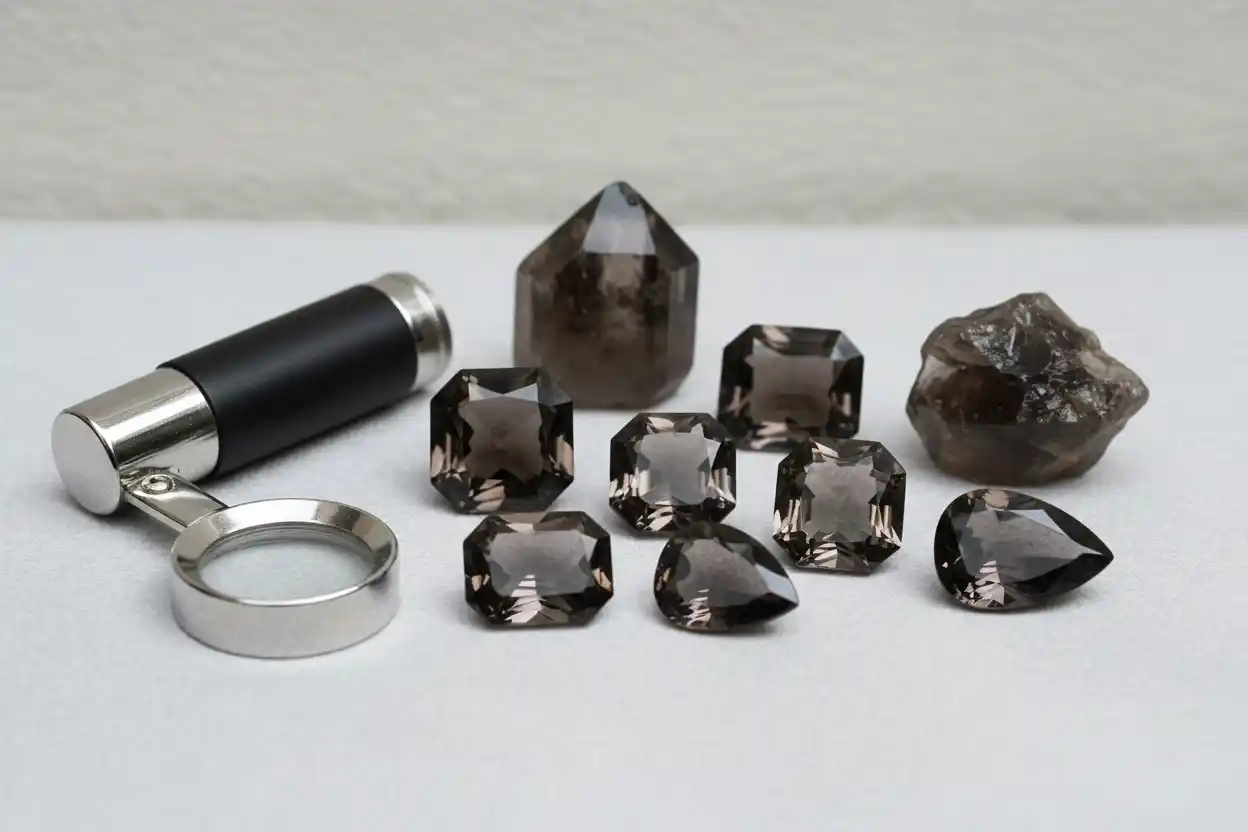
Smoky Quartz Price: 11 Critical Cost Drivers & Confident Value Checks
Smoky Quartz price is usually modest, with many current loose faceted stones selling around roughly $1.50 to $6 per carat and general retail guidance placing ordinary faceted Smoky Quartz broadly around $0.50 to $10 per carat. Large size does not create the steep price increases seen in Ruby, Sapphire, or rare Tourmaline because quartz crystals can grow large and clean enough to produce substantial finished stones.
Current listings illustrate the pattern. A 12.50-carat emerald-cut stone is offered around $21, which is roughly $1.65 per carat, while a 9.78-carat round costs about $32, or approximately $3.30 per carat. A 4.99-carat flower cut costs about $19, or roughly $3.80 per carat, and a pair totaling 6.22 carats with concave cutting is about $37, close to $6 per carat. Higher pricing can make sense for precision cutting, notable mineral specimens, historic locality, exceptional crystal form, or important jewelry design, but ordinary brown quartz remains readily available.
Current Smoky Quartz Price Per Carat by Size and Cut
| Current Smoky Quartz example | Weight | Cut or format | Asking price | Approx. price per carat |
|---|---|---|---|---|
| Brown baguette | 0.87 ct | Faceted | $6.07 | $6.98 |
| Warm brown flower cut | 4.99 ct | Faceted | $19.03 | $3.81 |
| Brown emerald cut | 5.51 ct | Faceted | $15.09 | $2.74 |
| Light brown concave-cut pair | 6.22 ct total | Faceted pair | $37.17 | $5.98 |
| Brown round | 9.78 ct | Faceted | $32.14 | $3.29 |
| Brown emerald cut | 12.50 ct | Faceted | $20.55 | $1.64 |
| Transparent Brazilian spheres | 43.78 ct total | Six-piece lot | $69.55 | $1.59 |
| Black-brown Brazilian spheres | 52.98 ct total | Seven-piece lot | $84.16 | $1.59 |
These examples show a broad downward tendency in per-carat cost as total weight increases, although cutting style, shape, matching, seller strategy, and individual appearance can reverse that pattern in particular stones. Smoky Quartz price per carat is therefore most informative when stones with similar cutting and quality are compared.
1. Smoky Quartz Color Price: Why Darker Brown Does Not Guarantee Higher Value
Smoky Quartz ranges from pale gray-brown and warm tan through cognac, chocolate brown, and nearly black. Market demand is driven mainly by appearance rather than a rigid color hierarchy.
Medium brown stones often provide an attractive balance because they retain visible color while allowing plenty of light to pass through. Extremely pale stones can resemble ordinary colorless quartz, while extremely dark stones can appear almost opaque unless strongly backlit.
A seller may describe very dark Smoky Quartz as Morion and use the name to imply rarity. Morion can have collector interest, especially as a crystal specimen with documented locality, but near-black color alone does not automatically create a large per-carat premium.
Smoky Quartz quality grading should therefore examine saturation, tone, transparency, color distribution, and brightness together rather than assuming that the darkest stone belongs at the top.
2. Smoky Quartz Clarity Price: Why Eye-Clean Stones Remain Affordable
Transparent Smoky Quartz is abundant enough that eye-clean faceted gems are common. Current inventory includes many stones described as VVS, VS, or transparent at only a few dollars per carat.
That abundance limits the premium for microscopic clarity. Once a stone looks transparent and clean without magnification, further improvements often contribute less to value than superior cutting or an appealing color.
Visible fractures, heavy clouds, open fissures, or internal features that disrupt the face can reduce value, particularly when clean alternatives are readily available.
Collectors may accept more inclusions in natural crystal specimens when those features document growth history or create unusual aesthetics, but those specimens belong to a different market from conventional loose faceted gems.
3. Smoky Quartz Cut Price: Precision Work Can Cost More Than the Rough
The quartz itself can be inexpensive while skilled cutting is not.
A standard commercial emerald cut or round may cost only a few dollars per carat, while a custom concave cut, fantasy cut, sculptural carving, or precision faceting job can carry a much higher total price because labor becomes the dominant cost.
This distinction is important when comparing two similar weights. A 6-carat precision-cut Smoky Quartz can legitimately cost several times more than a 10-carat commercial stone even though the rough is from the same general gem family.
Buying Smoky Quartz successfully means looking at symmetry, polish, face-up spread, windowing, and light return rather than assuming the lower per-carat figure always represents better value.
4. Smoky Quartz Size Price: Why Large Gems Often Cost Less Per Carat
Large quartz crystals are widely available, so weight alone does not create strong scarcity.
The current 43.78-carat transparent sphere lot and 52.98-carat dark sphere lot both work out to roughly $1.59 per carat, while smaller faceted stones in the same retail inventory can reach $3 to $7 per carat.
That is almost the opposite of Ruby or fine Sapphire pricing, where maintaining top quality at larger sizes can multiply the per-carat rate.
Large Smoky Quartz still has value for statement jewelry, carvings, spheres, and decorative pieces, but buyers should pay for the finished appearance rather than treating every large specimen as rare.
5. Natural Smoky Quartz vs Irradiated Quartz Price
GIA research explains that smoky color results when radiation interacts with aluminum-related defects in quartz. The radiation can occur naturally over geological time, while laboratory irradiation can also turn suitable colorless quartz smoky.
Both products can be genuine quartz.
Naturally colored stones may receive preference from collectors, particularly when locality and crystal history are important, but ordinary faceted Smoky Quartz is not expensive enough for natural color alone to create the enormous treatment premium seen in certain Ruby or Sapphire markets.
Disclosure still matters. A seller should not represent laboratory-created smoky color as naturally developed when the distinction is known.
GIA treatment guidance also requires sellers to disclose treatments that alter gem appearance.
6. Heat Stability and Smoky Quartz Value
The smoky color center is sensitive to high heat. GIA durability references note that strong heating can turn smoky quartz colorless, while laboratory research demonstrates that smoky color centers can be destroyed through heating.
This stability issue matters for jewelry repair, recutting, and careless exposure to strong heat.
A stone that has lost significant color may become less visually desirable even though it remains quartz.
For collectors, original appearance and known history can matter as much as the physical stone. Altering a documented crystal through unnecessary heating can therefore reduce both aesthetic and provenance value.
7. Brazilian Smoky Quartz Price and Origin Premiums
Brazil is one of the most visible sources in today’s commercial inventory, and many inexpensive faceted stones are explicitly sold as Brazilian. That abundance means Brazilian origin alone normally creates little price premium for ordinary jewelry gems.
Other well-known occurrences include Madagascar, Switzerland, Scotland, and parts of the United States.
Where Smoky Quartz is found becomes more financially relevant for mineral specimens where locality, crystal formation, associated minerals, and collecting history can attract specialist buyers.
A documented alpine crystal or historic Scottish piece may therefore sell on different criteria from an ordinary Brazilian faceted stone.
8. Cairngorm and Historic Smoky Quartz Provenance
Brown quartz from Scotland has a long association with the term Cairngorm and appears in traditional Scottish jewelry. Historic provenance can increase the value of an antique brooch, kilt pin, seal, or other piece even though modern loose Smoky Quartz is inexpensive.
The premium belongs partly to the complete object, history, workmanship, age, and documented origin rather than only to the quartz.
This distinction explains why an antique Cairngorm jewel can sell for far more than a modern loose stone of similar weight.
Country names and romantic trade terms should therefore be connected to real provenance before they are used to justify significant premiums.
9. Smoky Quartz Jewelry Price vs Loose Gem Price
Finished jewelry can make Smoky Quartz appear much more expensive than loose-gem data suggests.
A gold pendant may contain a center stone worth only a few tens of dollars while the gold, craftsmanship, accent diamonds, brand, and retail margin account for most of the final price. Sterling silver pieces also include design and setting costs that may exceed the loose gem cost.
A Smoky Quartz ring should therefore be compared with other complete rings rather than using the jewelry price to calculate an assumed loose-stone rate.
This is particularly important for designer jewelry, where the value of authorship and workmanship may dominate the gem itself.
10. Smoky Quartz Condition and Durability in Secondhand Pricing
Quartz has a Mohs hardness of 7 and good toughness, which makes Smoky Quartz practical for jewelry. Wear still affects value.
Scratched table facets, abraded facet junctions, chipped girdles, damaged points, worn polish, and fractures reduce the desirability of a previously owned stone. The cost of recutting can easily exceed the value of ordinary commercial Smoky Quartz, making replacement more practical than restoration.
The Smoky Quartz durability profile also explains why storage matters. Harder gems can scratch quartz, while abrupt thermal changes can produce fractures.
For jewelry, condition should be evaluated together with the setting rather than focusing solely on carat weight.
11. Smoky Quartz Seller Pricing: Recognize Premium Cutting and Avoid Artificial Scarcity
The ordinary Smoky Quartz market is inexpensive enough that unusually high prices require a clear explanation. A premium can be reasonable for precision faceting, exceptional carving, museum-quality crystal formation, documented historic locality, important jewelry design, unusual inclusions, or respected artistic authorship.
Generic terms such as AAAA, rare dark Smoky Quartz, investment grade, master healer grade, or premium energy crystal do not establish market value.
The Smoky Quartz meaning and symbolic traditions may matter personally, but they do not change the physical quality or scarcity of a gem. The same distinction applies to Smoky Quartz benefits described in crystal traditions, which should not be treated as proven medical effects or as a basis for financial premiums.
Smoky Quartz vs Citrine Price Differences
Smoky Quartz and Citrine are both quartz, but their retail demand and color markets differ. Citrine can attract stronger prices for particularly desirable yellow-orange or reddish orange hues, while ordinary Smoky Quartz remains plentiful in brown shades.
The Smoky Quartz vs Citrine distinction can become complicated in stones showing mixed brown and yellow zones. Heating can also change the appearance of quartz, so unusually marketed colors deserve careful disclosure.
A stone described as smoky citrine should be judged by its actual color distribution, transparency, cut, treatment history, and market comparables rather than assuming the combined name creates extra rarity.
Smoky Quartz Price FAQs
What is Smoky Quartz worth per carat?
Many current loose faceted examples fall around roughly $1.50 to $6 per carat, while general commercial ranges can extend from about $0.50 to $10 per carat.
Why is Smoky Quartz inexpensive?
Quartz is abundant, large crystals are available, and transparent brown stones can be cut in substantial sizes without creating strong scarcity.
Does dark Smoky Quartz cost more?
Not automatically. Extremely dark stones can lose transparency, while medium brown stones may provide better brilliance and face-up color.
How much is a 10-carat Smoky Quartz?
Current stones near 10 carats can cost roughly $25 to $45 in ordinary commercial faceted quality, although custom cutting can move higher.
Does Smoky Quartz price rise with size?
Usually not sharply. Larger commercial stones can have lower per-carat rates than smaller faceted gems.
Is natural Smoky Quartz worth more than irradiated Smoky Quartz?
Natural color may interest collectors, but ordinary Smoky Quartz is abundant enough that treatment status alone does not usually create a huge premium.
Is Brazilian Smoky Quartz expensive?
Ordinary Brazilian stones are widely available and generally affordable. Exceptional crystal specimens or artistic cuts can cost more.
Is Morion more valuable than ordinary Smoky Quartz?
It can attract collector interest, but very dark color alone does not guarantee higher value.
Why does custom-cut Smoky Quartz cost so much?
Skilled faceting or carving can cost far more than the rough stone. The premium reflects craftsmanship and design rather than quartz scarcity alone.
Does Smoky Quartz have strong resale value?
Ordinary loose stones face abundant replacement supply, while exceptional carvings, historic jewelry, precision cuts, and documented mineral specimens can appeal to narrower specialist markets.
Conclusion
Smoky Quartz price remains accessible because transparent brown quartz is widely available in substantial sizes. Many current faceted examples sit around a few dollars per carat, and large lots can fall below $2 per carat. The strongest premiums come from exceptional cutting, crystal form, provenance, jewelry craftsmanship, and unusual collector appeal rather than ordinary carat weight or very dark color.