11 Popular Snow Quartz Benefits: Meaningful Uses, Verified Facts, Important Cautions
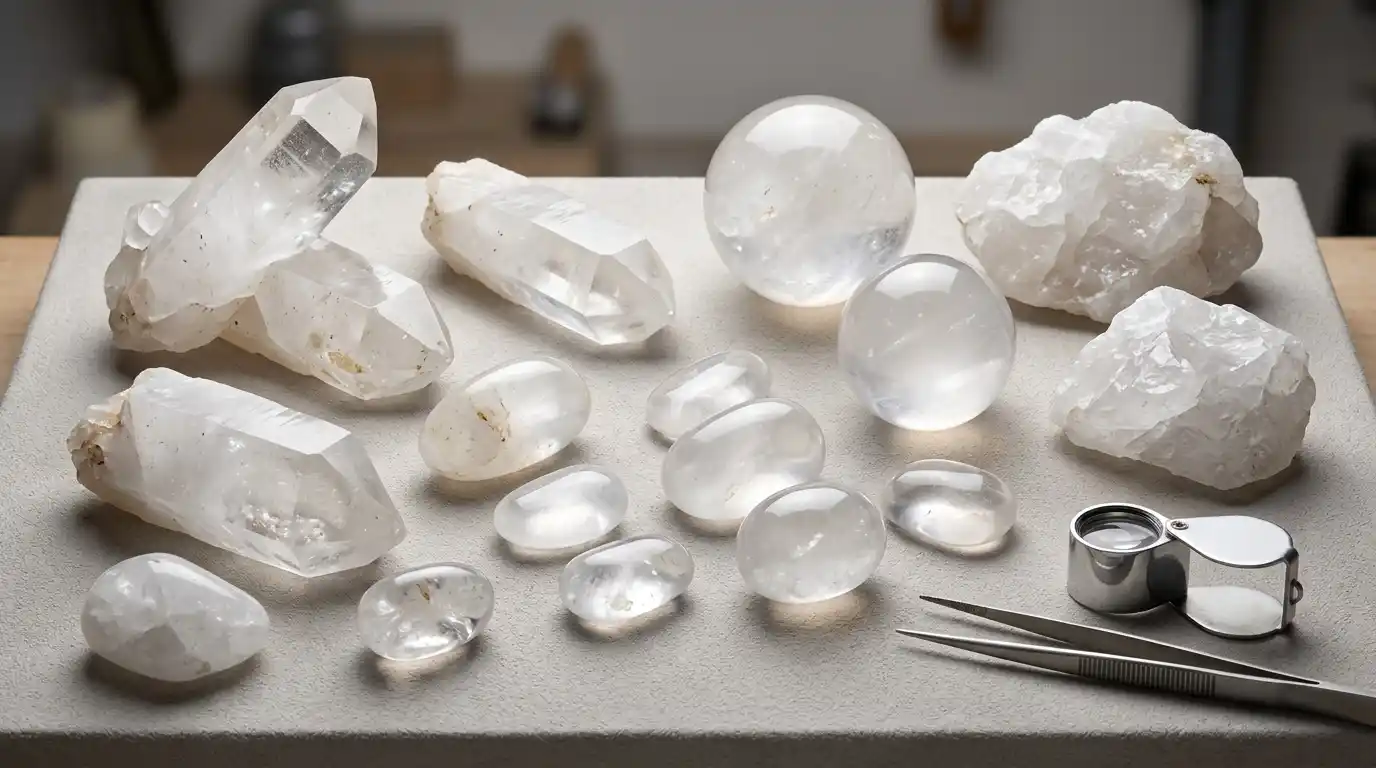
Snow quartz benefits begin with the familiar physical properties of milky white quartz rather than with the idea that it is a separate mineral species. Snow quartz is a trade name commonly used for milky quartz, a translucent to opaque white variety of crystalline silicon dioxide, SiO2. Its snowy appearance usually comes from abundant microscopic inclusions and internal light scattering rather than from a white pigment built into the quartz structure.
Because snow quartz and clear quartz are the same mineral species, their fundamental hardness, crystal chemistry, lack of true cleavage, and basic durability are essentially the same. The major visible difference is transparency: clear quartz allows light to pass with relatively little scattering, while snow quartz contains enough microscopic internal features to appear cloudy, soft white, or almost opaque.
Modern crystal traditions add purification, inner peace, emotional balance, patience, clarity, and gentle spiritual symbolism to snow quartz benefits. These interpretations can make a polished stone meaningful during meditation or reflection, but snow quartz does not physically detoxify the body, treat anxiety, improve brain function, purify drinking water, or create measurable spiritual energy.
11 Snow Quartz Benefits at a Glance
- Mohs hardness 7 gives snow quartz useful resistance to ordinary scratching.
- Its lack of true cleavage supports practical use in carvings, beads, pendants, cabochons, and many other decorative forms.
- White cloudiness provides a clear example of how microscopic inclusions and light scattering can alter quartz appearance.
- Large pieces of milky quartz can be polished or carved without the high cost associated with many rare gemstones.
- Natural fractures, fluid inclusions, growth zones, and mineral associations make snow quartz useful for geological study.
- Its relationship with clear quartz helps students understand how one mineral species can display very different transparency.
- White coloration gives the stone broad decorative appeal without requiring artificial dye.
- Modern purification symbolism can support intentional routines without implying physical detoxification.
- Inner-peace traditions can provide a focus for meditation or journaling without becoming psychological treatment.
- Quartz durability makes snow quartz comparatively easy to clean and preserve when strong impacts and silica dust are respected.
- Personal snow quartz benefits can come from geology, collecting, jewelry, gifts, décor, meditation, or private memories without requiring supernatural effects.
Snow Quartz Is Milky Quartz, Not a Separate Mineral Species
The most important fact behind snow quartz benefits is straightforward: snow quartz is quartz. Mindat lists snow quartz as a synonym of milky quartz, a white semi-transparent to opaque variety of SiO2 rather than a separate recognized mineral species.
This distinction matters because retail language can make common quartz varieties sound chemically unique when their differences mainly involve color, inclusions, crystal habit, or growth history. Snow quartz still has the familiar trigonal quartz structure, Mohs hardness 7, vitreous luster on suitable crystal faces, and conchoidal fracture expected from crystalline quartz.
Calling the stone snow quartz is useful as a visual trade description because the cloudy white appearance really can resemble packed or translucent snow. The name should simply not be turned into a claim that the stone contains a special mineral component called “snow” or that its white appearance proves greater purity than transparent quartz.
Why Snow Quartz Looks White and Cloudy
The white appearance is one of the most scientifically useful snow quartz benefits because it demonstrates the importance of internal light scattering. GIA has discussed white coloration in milky quartz as a scattering phenomenon, while abundant microscopic fluid and gas inclusions are also widely recognized as causes of cloudy or milky appearance in natural quartz.
As quartz grows, tiny pockets of fluid can become trapped within the crystal. Some are so small and abundant that individual inclusions cannot be seen without magnification, yet together they scatter enough light to make the crystal appear cloudy white. Other internal imperfections, microscopic fractures, minute mineral particles, or growth structures can contribute to turbidity in particular specimens, so every white quartz crystal should not be assumed to have exactly the same inclusion population.
This explains why snow quartz can range from softly translucent to nearly opaque. The cloudy appearance is not necessarily a defect when the stone is intentionally sold as milky or snow quartz because the whiteness is the defining visual feature people are choosing.
Snow Quartz Benefits for Jewelry, Carving, and Decorative Use
Quartz durability gives snow quartz practical value beyond spiritual traditions. Mohs hardness 7 allows it to maintain a polished surface far better than calcite, fluorite, gypsum, or many other pale ornamental stones, while the absence of true cleavage reduces the likelihood of the stone splitting along one predictable structural plane. Strong impacts can still chip it, especially where existing fractures reach the surface, but sound pieces are suitable for pendants, beads, earrings, bracelets, cabochons, carvings, and many rings.
Large massive pieces can also be fashioned into spheres, towers, freeforms, bowls, figurines, and decorative objects. Because milky quartz is relatively abundant, a large polished object can display an attractive natural white appearance without requiring the price associated with rare transparent gemstones.
The whiteness also makes snow quartz visually versatile. It can be combined with silver-toned metals, yellow gold, darker gemstones, colorful beads, wood, or natural décor without competing strongly with surrounding colors, which is one reason polished white quartz appears frequently in both jewelry and interior display.
Snow Quartz Helps Explain the Difference Between Transparency and Purity
A common misconception says clear quartz is “purer” and snow quartz is somehow spiritually softer because it is cloudy. The actual relationship is more interesting. Both are primarily SiO2, and a milky appearance often indicates abundant microscopic inclusions, internal scattering, or structural imperfections rather than a completely different chemistry.
Transparency is therefore not a simple measure of whether quartz is “good” or “bad.” A clear crystal may be more desirable for faceting because light travels through it with less scattering, while a cloudy specimen may be more attractive for carving because the whiteness produces an even, soft appearance.
The same principle helps when identifying imitations. Perfectly rounded gas bubbles, molded seams, an unusually uniform glassy texture, or hardness inconsistent with quartz can raise suspicion when comparing real and fake clear quartz, and similar observations can be useful when an opaque-white object is sold as natural snow quartz.
Geological Occurrence Gives Snow Quartz Scientific Value
Milky quartz occurs in numerous geological environments because quartz itself is one of Earth’s most widespread minerals. Large white quartz masses occur in veins, pegmatites, hydrothermal systems, metamorphic rocks, and igneous environments, while individual crystals can develop in cavities where silica-rich fluids have enough space to grow.
Abundant fluid inclusions can preserve evidence about the liquids present during crystal growth or later geological events. Under microscopic and analytical study, inclusions may provide information about temperature, salinity, pressure, dissolved components, and the sequence of geological processes that affected the quartz.
For collectors, a snow quartz specimen with known locality can therefore be much more interesting than an anonymous polished white stone. Host rock, associated feldspar, mica, tourmaline, calcite, sulfides, or other minerals can connect the quartz with a specific geological system and help explain how it formed.
Purification Is Symbolic, Not Physical Detoxification
Purification is one of the most common modern snow quartz benefits because white color has long been associated with cleanliness, simplicity, new beginnings, and clarity in many forms of human symbolism. A person may place snow quartz on a desk when reorganizing a workspace or use it during meditation to represent the intention to simplify routines and remove unnecessary distractions.
The snow quartz meaning often develops from these visual associations rather than from a measurable purifying force inside the crystal. White quartz does not remove medically defined toxins from organs, sterilize a room, purify blood, or clean drinking water simply by being present.
A purification ritual can still be personally useful when it supports a real action. Cleaning a room, reducing clutter, writing down priorities, ending an unhealthy routine, or setting a new boundary changes the person’s circumstances in ways that a passive stone cannot. Snow quartz can mark that decision without needing to cause it.
Inner Peace Works Best as a Reflective Practice
Inner peace is another popular snow quartz benefit. Its soft white appearance can fit naturally into a quiet meditation space, reading area, bedside display, or reflective routine, especially for people who find neutral colors visually calming.
A person might hold a smooth snow quartz stone while slowing their breathing or writing down thoughts after a stressful day. The gemstone provides a familiar tactile focus, while the calming elements come from quiet, breathing, attention, environment, expectations, and the individual’s own responses.
Claims grouped under snow quartz healing properties can extend into anxiety relief, sleep improvement, emotional healing, pain control, detoxification, immunity, or neurological benefits. Scientific evidence does not establish snow quartz as a treatment for these conditions, so persistent physical or psychological symptoms should be addressed through appropriate professional care rather than crystal use alone.
Gentle Symbolism Does Not Mean the Stone Has a Gentler Energy
Snow quartz is sometimes described as a “gentler” form of clear quartz, particularly in metaphysical writing. The description makes sense as symbolism because the cloudy white appearance is visually softer than a highly transparent crystal with sharp reflections, but mineralogically the two remain the same species.
There is no instrumentally established scale showing that snow quartz emits less intense spiritual energy than clear quartz. Its inclusions affect the way light passes through the crystal, not a measurable metaphysical vibration.
A person may still prefer snow quartz for meditation because the appearance feels calmer or less visually stimulating. That preference is real as an aesthetic and psychological response even though it does not require a different physical energy inside the quartz.
Important Cautions for Water, Heat, and Physical Care
Quartz itself is relatively stable in ordinary water, so brief washing with warm water and mild soap is generally suitable for sound snow quartz. The greater concern is the individual specimen: open fractures, attached matrix, dyes, coatings, adhesives, metal settings, or other associated minerals can make aggressive cleaning inappropriate. Long soaking, saltwater rituals, boiling, bleach, acids, or unnecessary chemical baths provide no practical advantage for routine care.
Strong thermal shock should also be avoided. Quartz can fracture when subjected to abrupt temperature changes, especially when fluid inclusions or internal cracks create local stress. A stone taken rapidly from very cold conditions into boiling water can fail even though its Mohs hardness remains 7.
Storage is simple but still matters. Sapphire, ruby, topaz, and diamond can scratch quartz, while snow quartz itself can scratch softer gems. Individual pouches or separated compartments preserve polished surfaces and prevent harder and softer stones from damaging one another.
Responsible Lapidary Work Means Controlling Quartz Dust
The most important safety issue with snow quartz does not come from wearing or touching a polished piece. It comes from creating fine crystalline silica dust during cutting, grinding, drilling, or sanding.
Quartz dust can become respirable when dry lapidary work creates very small airborne particles. Repeated occupational exposure to respirable crystalline silica can cause serious lung disease, so wet cutting, suitable extraction, ventilation, respiratory protection, and careful cleanup are essential during regular stone work.
This distinction is important because internet safety discussions sometimes focus on harmless spiritual rituals while overlooking real occupational exposure. An intact polished snow quartz pendant is not a silica inhalation hazard, while uncontrolled dry grinding of the same quartz can be.
Personal Meaning Can Be More Valuable Than Metaphysical Claims
Snow quartz does not need a universal spiritual definition to be meaningful. A white stone can represent a new home, personal reset, graduation, friendship, family gift, meditation routine, travel memory, geological interest, or a period when someone deliberately simplified an overloaded schedule.
Collectors may value a specimen because of its crystal form, inclusions, locality, or associated minerals. A jewelry owner may care more about the person who gave the stone than about any crystal tradition, while another person may simply enjoy its soft white appearance.
These uses are genuine because meaning can develop through human experience without requiring the quartz to alter physiology or control future events. The mineral supplies the physical object, while memory, symbolism, learning, and personal choice give it significance.
Conclusion
Snow quartz benefits include Mohs 7 durability, lack of true cleavage, carving and jewelry versatility, an attractive milky white appearance, abundant geological interest, and a useful lesson in how microscopic inclusions and light scattering change quartz transparency. Purification, inner peace, and gentle spiritual symbolism can support personal routines when they remain separate from medical claims, detoxification promises, and unsupported ideas about invisible energy.
FAQs
What are the main snow quartz benefits?
Snow quartz benefits include quartz durability, attractive white coloration, jewelry and carving versatility, geological interest, and useful examples of fluid inclusions and light scattering. Modern traditions also associate the stone with purification, peace, patience, and reflective practices.
Is snow quartz a real mineral?
Snow quartz is real quartz, but “snow quartz” is a trade name rather than a separate mineral species. It is generally another name for milky white quartz.
What makes snow quartz white?
The cloudy white appearance commonly results from abundant microscopic inclusions and internal light scattering. Fluid and gas inclusions, tiny structural imperfections, and other minute features can all contribute depending on the individual crystal.
Is snow quartz the same as clear quartz?
Both are crystalline SiO2 and share the same fundamental mineral properties. Snow quartz contains enough microscopic internal features to appear milky or opaque, while clear quartz transmits light with less scattering.
Is snow quartz durable?
Yes. It has the typical Mohs hardness of quartz, about 7, and no true cleavage. Strong blows, thermal shock, and harder gemstones can still damage it.
Does snow quartz purify the body?
There is no scientific evidence that snow quartz detoxifies organs, blood, or tissues. Purification is best understood as symbolic language connected with personal rituals or lifestyle changes.
Can snow quartz help with anxiety or inner peace?
Snow quartz has not been shown to treat anxiety or another psychological condition. A person may use it during meditation, journaling, breathing exercises, or other calming routines as a visual or tactile focus.
Can snow quartz go in water?
Brief washing with clean water is generally suitable for sound untreated quartz. Avoid prolonged soaking when the specimen contains fractures, attached matrix, coatings, dyes, adhesives, or other minerals whose behavior is uncertain.
Is snow quartz safe to wear?
Yes. Intact polished snow quartz can be worn normally. The significant mineral-health concern arises from inhaling fine crystalline silica dust generated during uncontrolled cutting or grinding.
Is snow quartz a gentler form of clear quartz?
It may look visually softer because of its milky white appearance, but there is no scientific evidence for a measurable difference in spiritual energy. Mineralogically, both are quartz.
Can snow quartz have personal meaning?
Yes. Snow quartz can represent a fresh start, quiet routine, friendship, personal achievement, geological interest, family gift, or private memory. Personal symbolism does not require a universal metaphysical explanation.
Disclaimer: Purification, inner-peace, healing, chakra, emotional, cleansing, and energetic descriptions of snow quartz reflect spiritual beliefs and personal practices. Snow quartz is not a medical or psychological treatment and cannot detoxify the body, guarantee emotional calm, or replace professional healthcare.