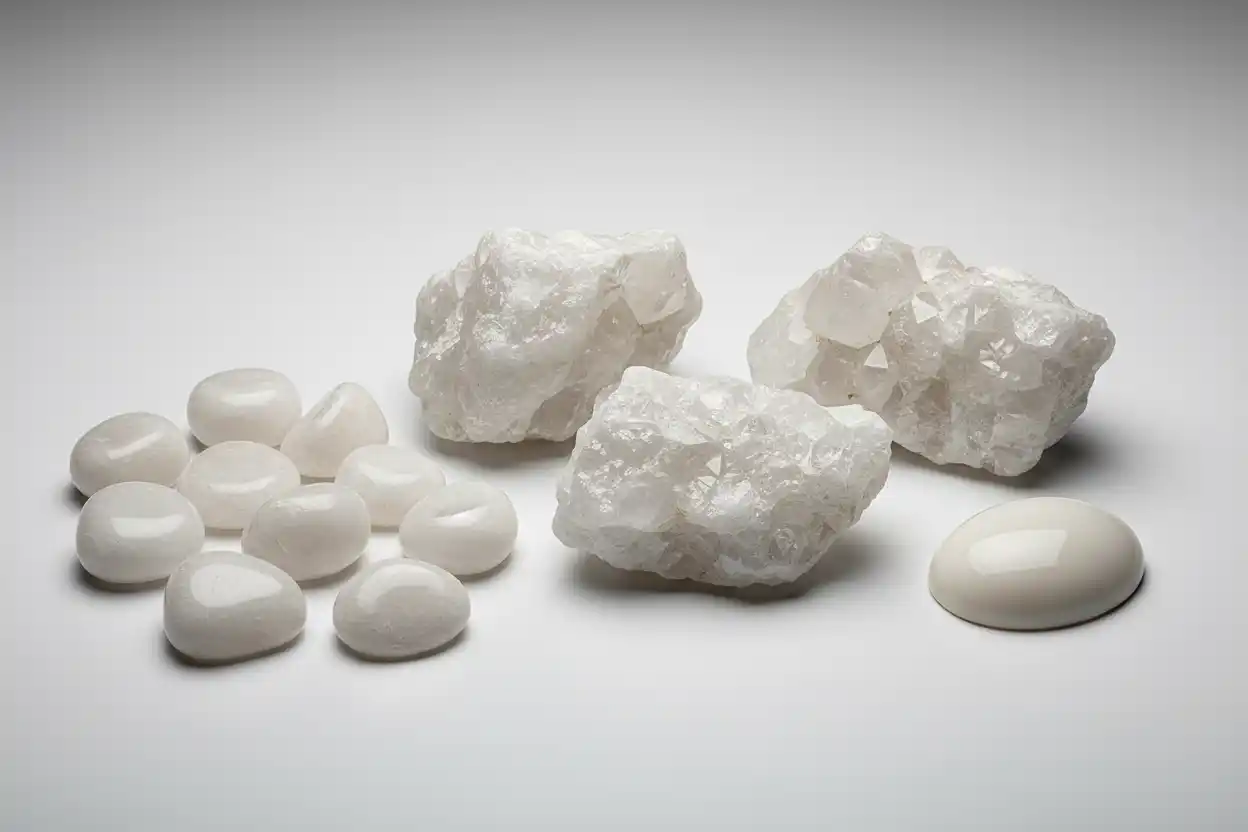
Snow Quartz: Meaning, Properties & Symbolism
Snow quartz is a commercial and collecting name for white, cloudy, translucent-to-opaque milky quartz. It consists of crystalline silicon dioxide whose snowy appearance usually comes from countless microscopic fluid or gas inclusions, internal veils, minute fractures, or other light-scattering features.
The name does not identify a separate mineral species. Snow quartz retains the crystal structure, hardness, chemical composition, and basic durability of quartz, although heavy inclusions and fractures can make an individual piece less transparent and more vulnerable to impact.
Snow Quartz at a Glance
| Property | Snow Quartz |
|---|---|
| Composition | Silicon dioxide, SiO₂ |
| Group or type | Milky macrocrystalline quartz; “snow quartz” is a commercial synonym |
| Color | Snow white, cloudy white, cream, pale grey, occasionally faintly yellow or pink |
| Crystal system or texture | Trigonal; crystalline, massive, veined, or visibly prismatic |
| Habit | Six-sided prisms, clusters, massive veins, granular masses, pebbles |
| Luster | Vitreous on crystal faces; waxy or dull on massive surfaces |
| Transparency | Translucent to opaque |
| Mohs hardness | 7 |
| Cleavage | None |
| Tenacity | Brittle |
| Common uses | Tumbled stones, beads, cabochons, spheres, carvings, decorative specimens, occasional faceting |
| Primary care concern | Internal fractures, chipping, thermal shock, undisclosed coatings or dye, and silica dust during cutting |
What Is Snow Quartz?
Snow quartz is mineralogically the same material that collectors and geologists call milky quartz. The quartz family page owns the wider discussion of quartz chemistry, crystal structure, major varieties, and geological importance.
The term “snow” describes appearance rather than a formally separate composition. Most genuine material is white because microscopic structures scatter visible light in many directions.
A natural crystal may be milky from base to termination, clear around the edges, or divided into transparent and cloudy growth zones. Massive material can appear uniformly white without recognizable external crystal faces.
Snow quartz should not be confused automatically with clear quartz. Both consist of SiO₂, but clear quartz transmits much more light because it contains fewer or less concentrated light-scattering inclusions.
It appears in the crystals that start with S and gemstones that start with S directories. It also belongs naturally within collections of white crystals and white gemstones.
Why Is Snow Quartz White?
Microscopic fluid inclusions are the most common explanation for milky-white quartz. These tiny cavities can contain water, carbon dioxide, other liquids, gas, or combinations of phases.
Each inclusion creates a boundary between quartz and another substance. Light reflects and refracts at those boundaries, producing diffuse white scattering.
Inclusions may be so small and numerous that individual cavities cannot be seen without magnification. Together, however, they make an otherwise colorless crystal appear cloudy or opaque.
Minute fractures and healed fracture networks can increase the effect. Their reflective surfaces form white veils, clouds, feather-like zones, and internal haze.
Microscopic mineral inclusions can also contribute. Feldspar, clay, mica, rutile, iron oxides, and other phases may be present in some deposits, although no single inclusion mineral defines snow quartz.
The intensity of whiteness depends on inclusion abundance, size, distribution, and orientation. A dense cluster of tiny fluid inclusions can look more uniformly white than a crystal containing a few larger fractures.
How Snow Quartz Forms
Snow quartz forms in many of the same geological settings as other macrocrystalline quartz.
Silica-rich hydrothermal fluids can enter fractures and cavities, then deposit quartz as temperature, pressure, or chemistry changes. Rapid fluctuations may trap abundant fluid inclusions during growth.
Granitic pegmatites frequently contain massive white quartz cores and milky crystals. These coarse-grained igneous bodies cool slowly, allowing quartz, feldspar, mica, and accessory minerals to grow to substantial sizes.
Metamorphic rocks can contain milky quartz veins formed as fluids move through fractures during deformation. Pressure changes, repeated cracking, and mineral growth contribute to internal veils and fluid inclusions.
Alpine-type fissures, volcanic cavities, sedimentary veins, and alluvial deposits also yield milky quartz. Weathering can free resistant crystals and rounded pebbles from their host rock.
Snow quartz is therefore widespread rather than restricted to one country or deposit. Attractive value depends on crystal form, pattern, locality, cutting, or provenance—not merely the fact that the quartz is white.
Crystal Habits and Internal Features
Snow quartz may form recognizable six-sided prisms terminated by pyramidal faces. Large crystals sometimes have clear tips above milky bases or alternating transparent and cloudy zones.
Clusters can contain intersecting points, contact marks, broken terminations, attached matrix, and smaller secondary growth.
Massive snow quartz lacks obvious crystal outlines and occurs as veins, pegmatite cores, irregular blocks, or granular rock. This material supplies most spheres, carvings, beads, and tumbled stones.
Common internal features include:
- Dense fluid-inclusion clouds
- Fine feathers and healed fractures
- Partially open cracks
- Transparent windows
- Growth zoning
- Mineral inclusions
- Iron-stained surfaces
- Rainbow interference along fractures
- Small cavities and pits
A rainbow does not indicate a separate variety. It occurs when light reflects from a suitably oriented internal fracture.
Snow Quartz, Milky Quartz, and Girasol Quartz
Snow quartz and milky quartz are normally synonyms. Sellers may prefer “snow quartz” for material with a clean white, winter-like appearance.
Girasol quartz is related but usually marketed for a softer opalescent glow. It often has a pale, watery, blue-white, or moonlit appearance rather than dense chalky whiteness.
The boundary can be subjective. A cloudy quartz from Madagascar may be sold as girasol by one dealer and snow quartz by another.
Clear quartz with isolated white veils is not necessarily snow quartz. Likewise, white quartzite, chalcedony, and calcite should not receive the name merely because they look snowy.
Commercial labels should remain secondary to material identification. The mineral is quartz first; “snow” describes its visual presentation.
Related Quartz Varieties
Snow quartz belongs to a large group of macrocrystalline quartz varieties, but it should retain a separate visual and search intent.
Rose quartz receives its pink color from microscopic inclusions or color centers, depending on the material. Very pale rose quartz can appear nearly white in poor photographs.
Smoky quartz develops grey-to-brown coloration through irradiation-related color centers involving aluminum. Cloudy smoky material may contain the same kinds of fluid inclusions found in snow quartz.
Druzy quartz describes a sparkling surface coating of tiny crystals rather than a white body color. A specimen can be both milky and druzy if it combines those separate features.
Candle quartz has a central crystal coated with smaller growths that create a wax-dripped texture. Milky color may occur, but texture defines the trade name.
Spirit quartz also carries many small crystals over a larger central form. Its South African locality and cactus-like growth separate it from ordinary snow quartz.
Important Sources
Brazil supplies abundant milky quartz from granitic pegmatites, hydrothermal veins, and crystal-producing districts. Material ranges from massive carving rough to large terminated crystals.
Madagascar is an important source of polished spheres, carvings, points, and cloudy quartz sold as snow quartz or girasol quartz.
India produces milky quartz in pegmatites and metamorphic veins, while Pakistan and Afghanistan supply crystal groups, massive vein material, and associated mineral specimens.
The United States has numerous sources, including Colorado, Arkansas, North Carolina, New Hampshire, Maine, California, and other quartz-bearing regions.
The European Alps produce milky and partially clear fissure quartz. Norway, Switzerland, Austria, France, Italy, Russia, Namibia, South Africa, and Australia also contain notable occurrences.
A country name alone rarely creates premium value because milky quartz is common. Precise locality matters most when the specimen has distinctive crystal form, mining history, unusual inclusions, or documented provenance.
How to Identify Snow Quartz
Snow quartz should show the physical properties of quartz despite its cloudy appearance.
It has Mohs hardness 7 and can scratch ordinary glass. However, scratch testing a polished item can leave permanent damage and does not rule out every quartz-rich imitation.
Quartz has no cleavage and breaks with conchoidal or irregular fracture. A fresh broken edge can be extremely sharp.
Specific gravity is approximately 2.65. Refractive indices commonly fall around 1.544–1.553, with uniaxial positive optical character and low birefringence.
Under magnification, natural material may show fluid-inclusion clouds, healed fractures, growth zones, mineral crystals, and irregular transparent areas.
Manufactured glass may contain rounded bubbles, flow lines, swirls, mold seams, or a more uniform interior. Natural quartz can contain negative-crystal cavities and bubbles inside fluid inclusions, so interpretation requires care.
Raman spectroscopy or refractive-index testing can confirm quartz. The how to identify crystals guide explains why visual appearance should be combined with hardness, optical properties, density, and microscopy.
Common Lookalikes
White calcite can resemble massive snow quartz but is much softer, has perfect cleavage, and reacts readily with acid.
Magnesite may appear white, opaque, and porous. It is softer and commonly accepts dye more readily than quartz.
Howlite is also white and often contains grey web-like veins. Its lower hardness and different composition separate it from quartz.
Selenite and satin spar are varieties of gypsum. They are much softer, scratch with a fingernail, and show prominent cleavage or fibrous texture.
White chalcedony consists of microcrystalline quartz rather than visibly macrocrystalline quartz. It may have a waxier luster, different texture, and more uniform translucency.
Quartzite is a metamorphic rock composed mostly of interlocking quartz grains. It can be snow white, but its granular rock texture differs from a single crystal or massive vein quartz.
Glass remains a common imitation for polished spheres and beads. Bubbles, seams, low-quality molds, and an overly uniform interior may reveal it.
Treatments and Enhancement
Natural snow quartz usually needs no treatment to become white. Its cloudiness forms during geological growth.
Some material is dyed in bright colors and sold under fantasy names. Dye may collect in fractures, pores, drill holes, and surface pits.
Crackle treatment uses heat and rapid cooling to create dense fractures. The result may look snowy, rainbow-filled, or webbed, but the treatment reduces durability.
Aura coatings deposit a thin metallic layer over the quartz surface. These coatings produce iridescent blue, rainbow, gold, or metallic colors that are not natural snow-quartz coloration.
Resin filling can enter fractures or stabilize damaged carvings. Wax and oil may temporarily improve polish or make cloudy material look more translucent.
Hydrothermally grown synthetic quartz is common for industrial applications and some gem uses. Deliberately produced milky synthetic decorative quartz is less significant because natural material is abundant and inexpensive.
The dedicated treated clear quartz guide owns detailed treatment and synthetic identification intent, while gemstone treatments explained covers general disclosure terminology.
The distinction between laboratory growth and glass simulation is addressed in lab-grown vs natural gemstones.
Cutting and Polishing Behavior
Snow quartz cuts well because it has no cleavage and accepts a bright polish. Its brittleness and hidden fractures remain the main lapidary concerns.
Massive material is fashioned into spheres, eggs, towers, bowls, figurines, beads, cabochons, massage tools, and ornamental objects.
Cabochon cutters often orient the rough to display soft clouds, transparent windows, veils, or internal rainbows. A high dome can increase depth, while a flat tablet may emphasize layered inclusions.
Faceting is uncommon because opacity limits brilliance. Partially translucent material can still be cut into checkerboards, beads, or simple faceted decorative stones.
Drilling requires steady support because pressure can open an internal fracture. Thin points and sharp carved edges chip more easily than rounded shapes.
Polish quality varies. Poorly finished pieces may retain scratches, flat spots, undercut pits, tool marks, or a wax coating that hides surface flaws.
Durability and Jewelry Suitability
Quartz hardness gives snow quartz good resistance to everyday scratching. It is harder than calcite, fluorite, feldspar, apatite, glass, and many decorative stones.
Nevertheless, it remains brittle. A sharp blow can create a conchoidal chip or extend an existing internal fracture.
Pendants, earrings, beads, brooches, and cabochons are practical uses. Rings can perform reasonably when the stone has a protective setting and limited surface-reaching cracks.
Heavily fractured or crackle-treated stones are less durable than solid massive quartz. A piece with a visible rainbow fracture may be attractive but should not be struck or exposed to sudden temperature changes.
Quartz can withstand ordinary hand cleaning, yet steam and ultrasonic methods are not appropriate for every specimen. Fractures, coatings, dye, glue, and metal settings can introduce additional risks.
Snow Quartz Value and July 2026 Asking Prices
Snow quartz is abundant, so most commercial material remains affordable. Price usually reflects size, workmanship, polish, crystal form, locality, and visual appeal rather than scarcity.
As of July 2026, small tumbled stones and simple bead pieces commonly carry asking prices around $1–$5 each. Palm stones and modest cabochons often appear around $5–$25.
Polished spheres measuring approximately 40–60 millimeters commonly ask $20–$50. Larger spheres around 70–100 millimeters may range from $50–$150, depending on weight, whiteness, internal pattern, and polish.
Commercial towers, carvings, and freeforms frequently appear around $15–$100. Large objects may cost more because cutting yield, labor, and shipping increase with size.
Natural crystal groups and terminated specimens commonly range from $15–$200. Unusual formations, documented localities, aesthetic associations, or historically significant specimens can exceed that range.
Bulk chips and low-grade rough may sell for only a few dollars per kilogram at wholesale quantities. Such material should not be compared directly with a well-formed natural crystal or carefully cut sphere.
Detailed seller evaluation, authenticity checks, and purchasing channels belong on the dedicated where to buy snow quartz page.
Buying Snow Quartz
Confirm that the seller means natural milky quartz rather than white glass, quartzite, calcite, chalcedony, or a coated product.
Ask whether the piece is natural-colored, dyed, crackle-treated, coated, filled, stabilized, reconstructed, or glued. “Natural quartz” can still contain an artificial coating or treatment.
For spheres and carvings, request photographs of every side. Cloud patterns, fractures, pits, flat spots, and transparent zones vary across one object.
Exact dimensions and weight help identify misleading scale. A close-up photograph can make a 25-millimeter sphere look much larger.
For natural points, inspect every termination, contact mark, chip, repair, and attachment point. A rehealed natural contact differs from a fresh shipping break.
Do not pay a rarity premium merely for the labels Himalayan, Lemurian, angel, ice, or master healer unless the seller provides meaningful geological or provenance information.
The real vs fake clear quartz guide provides additional checks relevant to glass, resin, and incorrectly represented quartz products.
Cleaning and Storage
Clean untreated snow quartz with lukewarm water, mild soap, and a soft brush or cloth. Rinse briefly and dry the piece thoroughly.
Avoid sudden temperature changes. Moving a cold sphere into hot water can expand internal fractures and cause breakage.
Do not use bleach, strong acids, abrasive powders, toothpaste, or rough polishing cloths. These methods can damage surface coatings, metal settings, and polished finishes.
An ultrasonic cleaner may be safe for flawless untreated quartz, but snow quartz often contains numerous fractures and inclusions. Hand cleaning is the safer default, as explained in gemstones in ultrasonic cleaners.
Brief water contact is generally suitable for solid untreated quartz. However, soaking is unnecessary when a piece contains dye, coating, resin, glue, or uncertain inclusions. The crystals you can put in water guide covers that distinction.
Store polished items separately from harder gems such as sapphire, topaz, and diamond. Protect crystal points from striking one another.
Snow Quartz Meaning and Symbolism
Snow quartz does not have a fully separate ancient tradition from quartz generally. Most symbolism attached specifically to the snowy white variety developed through modern crystal practices.
Its clouded appearance commonly represents patience, quiet reflection, simplicity, and accepting that clarity can emerge gradually rather than instantly.
White coloration is often associated with beginnings, openness, honesty, cleanliness, and creating space for a new decision.
The mixture of opaque clouds and clearer windows may serve as a personal metaphor for uncertainty, learning, or recognizing partial progress.
Some practitioners use snow quartz during meditation or intention-setting and associate it with calm, concentration, or gentle emotional steadiness.
These are personal and spiritual interpretations rather than scientifically measured effects. Snow quartz has no proven ability to cure disease, improve memory, balance hormones, or remove toxins.
Others appreciate it entirely as common but beautiful quartz whose internal inclusions preserve evidence of the fluids present during crystal growth.
Frequently Asked Questions
1. Is snow quartz a separate mineral?
No. Snow quartz is a commercial synonym for white or cloudy milky quartz.
2. What makes snow quartz white?
Countless microscopic fluid or gas inclusions, fractures, and other light-scattering features create its snowy appearance.
3. Is snow quartz the same as clear quartz?
They share the same composition and structure, but snow quartz contains enough inclusions or veils to appear cloudy or opaque.
4. Is snow quartz the same as girasol quartz?
Not necessarily. Girasol quartz usually has a softer opalescent glow, while snow quartz often appears denser and more uniformly white.
5. Can snow quartz contain natural rainbows?
Yes. Light reflecting from an internal fracture can create rainbow interference colors.
6. Is snow quartz rarer than clear quartz?
No. Milky quartz is widespread and generally more abundant than high-clarity rock crystal.
7. Can snow quartz scratch glass?
Yes. With hardness 7, it can usually scratch ordinary glass, although destructive testing is unnecessary on finished pieces.
8. Is snow quartz suitable for a daily ring?
Solid material can tolerate moderate wear, but heavily fractured stones and exposed edges may chip.
9. Is snow quartz commonly dyed?
Natural white material needs no dye, but porous or fracture-rich quartz may be artificially colored for decorative products.
10. Can snow quartz be synthetic?
Quartz can be grown hydrothermally, although intentionally milky synthetic decorative material is uncommon because natural snow quartz is inexpensive.
11. Can snow quartz go in water?
Brief cleaning is normally suitable for untreated solid quartz, but coated, dyed, filled, glued, or crackle-treated pieces should not be soaked.
12. What most affects snow quartz value?
Natural crystal form, locality, size, internal pattern, polish, carving quality, condition, and honest treatment disclosure matter more than whiteness alone.
A good snow quartz purchase should be judged as quartz, not as a mysterious separate species. Strong craftsmanship, natural internal character, and accurate disclosure provide more lasting value than invented rarity claims.
Cutting, drilling, grinding, or polishing snow quartz can create respirable crystalline silica dust, which can cause serious lung disease. Use wet methods, effective local exhaust ventilation, sealed eye protection, suitable respiratory protection, and controlled cleanup; never dry-sand quartz indoors.