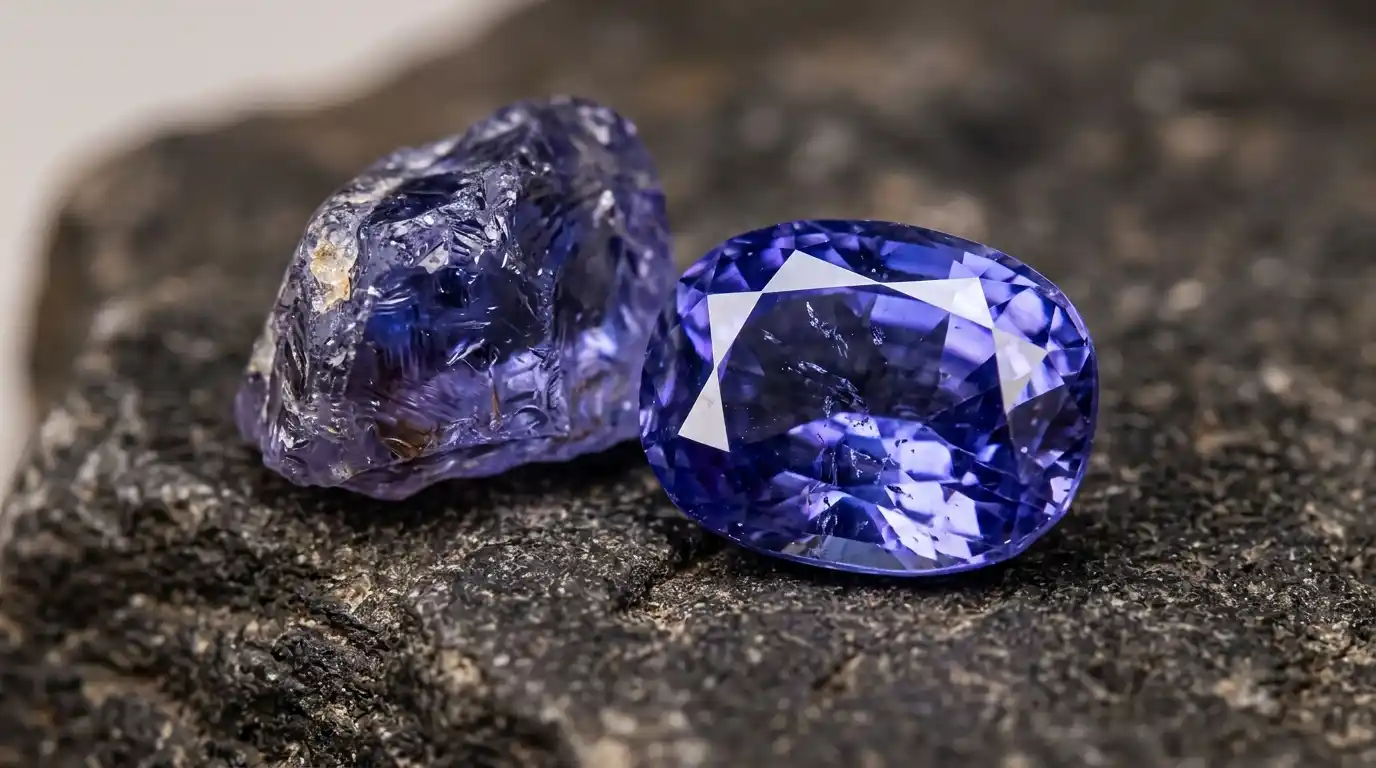
18 Tanzanite Benefits for Higher Consciousness & Intuition
Tanzanite benefits can be understood on two distinct levels. Gemologically, tanzanite is a rare blue-to-violet variety of zoisite prized for strong pleochroism, remarkable color, geographic exclusivity, collector interest, and its relatively recent entrance into the international gem trade. In modern crystal traditions, the gemstone is also associated with intuition, self-awareness, spiritual reflection, communication, transformation, and the symbolic idea of higher consciousness.
Those spiritual interpretations should remain separate from physical facts. Tanzanite does not scientifically increase intuition, activate consciousness, regulate emotions, or transmit a measurable spiritual frequency. A person may still use the gemstone as a visual anchor during meditation, prayer, journaling, or reflective decision-making, just as other meaningful objects can become reminders of chosen values and habits.
Mineralogically, tanzanite is zoisite, a calcium aluminum silicate with hydroxyl. It crystallizes in the orthorhombic system, has a Mohs hardness of approximately 6 to 7, and displays pronounced pleochroism, meaning different colors can appear when the crystal is viewed along different crystallographic directions. Gem-quality blue-violet tanzanite is commercially associated with the Merelani Hills of northern Tanzania, the locality that made the gemstone internationally famous.
18 Tanzanite Benefits at a Glance
- Reflective awareness: Tanzanite can serve as a physical reminder to examine thoughts and reactions before acting on them.
- Intuitive reflection: Modern spiritual traditions associate the gemstone with listening carefully to instincts while still checking them against evidence.
- Meditation focus: Its intense blue-violet color can provide a stable visual point during breathing, contemplation, or prayer.
- Symbolic transformation: Tanzanite’s dramatic color appearance makes it a natural metaphor for change, adaptation, and personal development.
- Thoughtful communication: Blue symbolism is often connected with speaking deliberately, listening carefully, and expressing difficult ideas clearly.
- Personal insight: Journaling with the gemstone can encourage examination of motives, assumptions, and recurring behavioral patterns.
- Spiritual contemplation: Some practitioners use tanzanite as a symbolic companion during non-medical spiritual or religious reflection.
- Appreciation of rarity: Its restricted commercial source can encourage gratitude for experiences, relationships, or opportunities that are difficult to replace.
- Intellectual curiosity: Tanzanite provides an accessible way to study zoisite mineralogy, pleochroism, heat treatment, gem cutting, and provenance.
- Color appreciation: Strong blue, violet, and purple optical effects make fine tanzanite visually rewarding even without metaphysical interpretation.
- Intentional decision-making: The stone can become a reminder to pause before important choices instead of responding automatically.
- Personal growth symbolism: Its twentieth-century rise from an unfamiliar zoisite variety to a celebrated gemstone makes transformation an intuitive metaphor.
- Creative inspiration: Shifting colors and facet reflections may inspire visual artists, jewelry designers, photographers, and collectors.
- Collector value: Fine tanzanite offers genuine mineralogical and geographic interest because commercially important supply is tied to one small mining district.
- Mindful routine: Using the same gemstone during a regular reflective practice can help create a consistent ritual cue.
- Symbolic resilience: Its geological journey from mineral formation to faceted gem can represent patience and long-term development.
- Responsible self-observation: Tanzanite can encourage questions about what a person feels, believes, and knows without treating those impressions as supernatural certainty.
- Conscious living: Its modern symbolism can remind a person to align daily behavior with deliberately chosen values.
What Tanzanite Really Is
Tanzanite is the blue-to-violet transparent gem variety of zoisite. Zoisite belongs to the epidote-group family of minerals and has the chemical formula Ca₂Al₃(SiO₄)₃(OH), sometimes written structurally in a more detailed form. The crystal system is orthorhombic rather than cubic, and that anisotropic structure contributes to the gemstone’s strong directional color behavior.
| Gemological Property | Tanzanite |
|---|---|
| Mineral species | Zoisite |
| Chemical composition | Calcium aluminum silicate with hydroxyl |
| Crystal system | Orthorhombic |
| Mohs hardness | About 6 to 7 |
| Specific gravity | Approximately 3.35 |
| Refractive index | Approximately 1.691 to 1.700 |
| Birefringence | Approximately 0.008 to 0.013 |
| Luster | Vitreous |
| Cleavage | Perfect in one direction |
| Typical gem colors | Violet-blue, blue-violet, violet-purple |
| Optical behavior | Strong pleochroism |
| Main commercial source | Merelani Hills, northern Tanzania |
These physical characteristics explain both tanzanite’s beauty and some of its limitations. A hardness of 6 to 7 gives reasonable resistance to ordinary scratching, but perfect cleavage means the gemstone can split if struck in an unfavorable direction. Hardness therefore should not be mistaken for overall toughness.
Pleochroism is one of tanzanite’s defining visual properties. Depending on crystal orientation and treatment state, a gemstone can show combinations of blue, violet, purple, brownish, reddish, or yellow-green directions. Cutters orient the rough carefully because orientation strongly influences the final face-up color. GIA notes that this directional color behavior allows cutters to emphasize violetish-blue or bluish-violet appearances.
Higher Consciousness as Symbolic Self-Awareness
One of the most repeated tanzanite benefits is “higher consciousness.” Taken literally as a measurable change caused by the gemstone, the claim is unsupported. There is no established gemological mechanism through which zoisite raises consciousness, alters neural function, or produces a special frequency that changes awareness.
As symbolism, however, the phrase can be interpreted more responsibly. Higher consciousness may simply mean becoming more aware of one’s assumptions, habits, emotional reactions, values, and long-term consequences. In that sense, tanzanite can function as a reminder to observe rather than react immediately.
A person using the stone during reflection might ask, “What am I overlooking because I have already decided what I believe?” Another useful question is, “Does my present behavior match the values I say are important?” These exercises require no supernatural explanation. Their value comes from deliberate attention and honest self-examination.
Modern claims about tanzanite healing properties sometimes go much further, linking the gemstone with physical recovery, psychological treatment, or biological changes. Such claims should not be treated as medical facts. Tanzanite may have spiritual significance to an individual, but it is not a replacement for healthcare.
Intuition Without Confusing Feelings With Evidence
Intuition is another central theme in modern tanzanite symbolism. Intuition can be useful in ordinary life because experience sometimes allows people to notice patterns before they can immediately explain them. It can also be wrong.
A balanced interpretation of tanzanite benefits treats intuition as a starting signal rather than unquestionable truth. If a situation feels wrong, the feeling may deserve examination. The next step is still to gather information, check assumptions, and consider alternative explanations.
The gemstone can therefore become a reminder of two complementary habits: listen inwardly, then verify outwardly. This is more useful than assuming that holding tanzanite automatically makes every impression spiritually correct.
For meditation, someone might hold or observe the gemstone while thinking about a difficult decision. Rather than asking the crystal for an answer, they can list what they know, what they only suspect, what they fear, and what evidence would change their conclusion.
Communication and the Symbolism of Blue-Violet Color
Blue gemstones are frequently connected with communication in modern crystal traditions, while violet is commonly linked with contemplation and spirituality. Tanzanite combines both color families, which helps explain why symbolic interpretations often join communication with inner reflection.
This symbolism becomes practical when applied to behavior. Tanzanite might remind someone to slow down before an emotionally charged conversation, listen completely before responding, distinguish observation from accusation, and choose language that reflects the actual issue.
The gemstone does not physically improve vocabulary or communication ability. Its usefulness comes from becoming associated with a deliberate practice.
Color also provides genuine aesthetic benefits. Fine tanzanite can show intense transitions between blue and violet as lighting, viewing direction, and cutting orientation change. That optical complexity is one reason the gemstone remains distinctive even for collectors who have no interest in spiritual symbolism.
Tanzanite and Symbolic Transformation
Transformation is particularly appropriate for tanzanite because both its geological appearance and trade history involve striking change. Much gem tanzanite begins with brownish, greenish, or mixed coloration and is heated to emphasize the blue and violet colors preferred in the market.
Most blue tanzanite offered commercially is understood to have been heated. The treatment is generally accepted in the trade, and GIA notes that heating commonly produces the attractive blue-to-violet appearance buyers recognize. In many cases, laboratories cannot conclusively determine whether heating occurred because natural geological heating can produce comparable results.
Understanding treated tanzanite is useful because treatment disclosure should be based on gemological practice rather than metaphysical assumptions. Heating changes color appearance, not the mineral species. A heated gemstone remains natural zoisite if the stone itself formed naturally.
Symbolically, people sometimes use this color transformation as a metaphor for personal change. The responsible lesson is not that tanzanite causes transformation, but that change may reveal qualities that were difficult to recognize previously.
Rarity, Gratitude, and Geographic Identity
Commercially significant tanzanite is famous for coming from a very restricted area near Merelani in northern Tanzania. That geographic concentration gives the gemstone an unusually strong association with place.
The geology behind where tanzanite is found helps explain why provenance is such an important part of its identity. Tanzanite did not become rare because of an artificial branding decision. Gem-quality blue-violet zoisite depends on unusual geological conditions that are concentrated in a very small mining district. GIA describes Merelani as the gemstone’s only commercial source.
This rarity can support a useful symbolic practice centered on gratitude. Instead of treating rarity only as exclusivity or prestige, someone can use it as a reminder to recognize what is difficult to replace.
That might include a friendship built over decades, a skill developed through years of work, time with aging relatives, or an unusual opportunity. The gemstone becomes meaningful through the association a person creates with it.
The Collector and Educational Benefits of Tanzanite
Tanzanite provides unusually rich learning opportunities because several gemological concepts appear in one familiar gemstone. It demonstrates pleochroism, directional cutting, heat treatment, provenance, cleavage, color grading, mineral variety nomenclature, and the relationship between scarcity and market value.
Pleochroism alone makes it a useful teaching gem. Rotate a suitable specimen and its apparent hue can shift noticeably. That behavior shows why color descriptions are not always simple and why crystal orientation matters to a cutter.
Treatment provides another lesson. Heating is often described negatively in popular gem discussions, but treatment must be evaluated according to what was done, whether it is stable, whether disclosure is appropriate, and how the market normally treats it. Routine heating does not make tanzanite synthetic.
The gemstone also illustrates why rarity and value are different ideas. A stone can be geographically rare yet still vary greatly in commercial value according to saturation, tone, clarity, cutting, carat weight, condition, and demand.
Meditation, Journaling, and Reflective Use
A practical meditation with tanzanite can begin by choosing one theme rather than attempting to activate several supposed powers at once. Communication, discernment, self-awareness, patience, or gratitude are all workable themes.
Place the gemstone where it can be viewed comfortably. Spend a few minutes breathing normally and observing its changing blue-violet appearance. When attention wanders, return to both the stone and the chosen theme. This creates a structured meditation without claiming that the mineral is changing brain chemistry or consciousness.
Journaling can make the exercise more specific. Someone focused on intuition might write, “What does my instinct say, and what evidence supports or challenges it?” Someone focused on communication might ask, “What needs to be said clearly, and what can be left unsaid?” Someone reflecting on transformation could ask, “Which change am I resisting because the familiar feels safer?”
These are human questions. Tanzanite simply provides the ritual anchor.
Tanzanite Durability and the Benefit of Appropriate Jewelry Use
Tanzanite is beautiful in jewelry, but understanding its physical limits is essential. Its hardness is moderate to good, yet perfect cleavage and sensitivity to sudden temperature changes make it less forgiving than sapphire, ruby, or diamond.
The practical question of whether tanzanite is durable depends heavily on how the jewelry will be worn. Pendants and earrings are generally easier environments for the gemstone because they receive fewer hard impacts. Rings require greater caution, especially for daily wear.
Protective settings can reduce exposure at vulnerable edges. Tanzanite should be removed before strenuous work, sports, heavy cleaning, or activities where the jewelry may strike hard surfaces.
Ultrasonic and steam cleaning are poor choices for many tanzanites because cleavage, fractures, inclusions, or thermal stress can create unnecessary risk. Lukewarm water, mild soap, and gentle cleaning are usually safer for an uncomplicated gemstone.
Does Tanzanite Provide Emotional Healing?
People sometimes describe feeling calmer, more reflective, or emotionally connected while holding a meaningful gemstone. Those experiences can be sincere without proving that the stone medically treats emotional conditions.
Objects can acquire strong associations. A family ring can trigger memories. A religious object can support prayer. A photograph can produce comfort. A gemstone may similarly become associated with a reflective routine.
That is different from claiming tanzanite treats anxiety, depression, trauma, panic disorders, or other psychological conditions. Such conditions deserve appropriate professional assessment and evidence-based care.
Responsible spiritual practice can coexist with healthcare. It does not need exaggerated medical claims to remain personally meaningful.
Conscious Living as the Most Practical Tanzanite Benefit
Many metaphysical ideas surrounding tanzanite can be translated into one practical principle: live with more conscious attention.
If intuition is the theme, examine instincts rather than blindly obeying them. If communication is the theme, choose words carefully. If spiritual awareness is the theme, make time for reflection. If transformation is the theme, identify the specific behavior that needs to change.
The gemstone cannot perform these actions. It can serve as a beautiful and memorable prompt to perform them yourself.
This approach respects both mineral science and personal spirituality. Tanzanite retains its rarity, color, geological interest, and symbolic richness without being assigned abilities that evidence does not support.
Conclusion
Tanzanite benefits include genuine gemological qualities such as remarkable pleochroism, rare geographic origin, visual beauty, collector interest, and educational value. Modern spiritual traditions additionally associate the gemstone with intuition, higher consciousness, communication, transformation, gratitude, and reflective awareness.
These spiritual benefits are most responsible when understood as symbolism and intentional practice. Tanzanite cannot medically heal the body or mind, guarantee intuition, or scientifically raise consciousness, but it can become a meaningful object for meditation, journaling, prayer, collecting, and conscious self-reflection.
FAQs
What are the main tanzanite benefits?
The most concrete tanzanite benefits include exceptional blue-violet beauty, strong pleochroism, collector interest, geographic rarity, educational gemological value, and suitability for carefully worn jewelry. Modern spiritual traditions also connect the gemstone with reflection, intuition, communication, transformation, and personal awareness.
Does tanzanite increase intuition?
There is no scientific evidence that tanzanite directly improves intuition or gives supernatural knowledge. A person may use it as a reminder to pay attention to instincts while also checking those impressions against evidence, experience, and reason.
Is tanzanite good for meditation?
Tanzanite can work well as a visual meditation object because its rich color and changing appearance provide a clear focus for attention. Any benefits come from the meditation practice, personal meaning, and sustained attention rather than a proven energy emitted by the gemstone.
Can tanzanite raise consciousness?
No scientific evidence demonstrates that tanzanite physically raises consciousness. In spiritual language, higher consciousness can instead be interpreted as greater self-awareness, deliberate reflection, and attention to values.
Does tanzanite have healing benefits?
Tanzanite has no proven ability to cure illness, treat psychological disorders, regulate hormones, strengthen immunity, or alter neurological function. Crystal rituals may provide personal comfort or spiritual meaning, but medical concerns require appropriate professional care.
Why is tanzanite considered rare?
Gem-quality blue-violet tanzanite is commercially associated with a small mining district in northern Tanzania rather than numerous mining regions around the world. That unusual geographic restriction contributes significantly to its rarity and collector appeal.
Is most tanzanite heat treated?
Yes, heating is widely used to bring out the blue and violet colors associated with commercial tanzanite. The treatment is well established in the trade and generally considered stable under normal wear, although the gemstone itself still requires sensible care.
Is tanzanite suitable for everyday jewelry?
It can be worn in jewelry, but daily ring wear requires caution because tanzanite has perfect cleavage and can be damaged by hard impacts. Pendants and earrings are generally less exposed to knocks, while rings benefit from protective settings and careful use.
Can tanzanite bring spiritual protection?
There is no scientific evidence that tanzanite produces a protective energy field or guarantees safety. Someone may use it symbolically as a reminder of personal boundaries, careful judgment, or spiritual faith, but practical safety measures remain essential.
Disclaimer: Spiritual, intuitive, energetic, emotional, protective, and healing interpretations associated with tanzanite reflect beliefs and personal practices rather than established medical or psychological effects. Tanzanite should not replace professional healthcare, diagnosis, therapy, or prescribed treatment.