9 Garnet Healing Properties: Traditional Claims, Evidence & Safe Limits
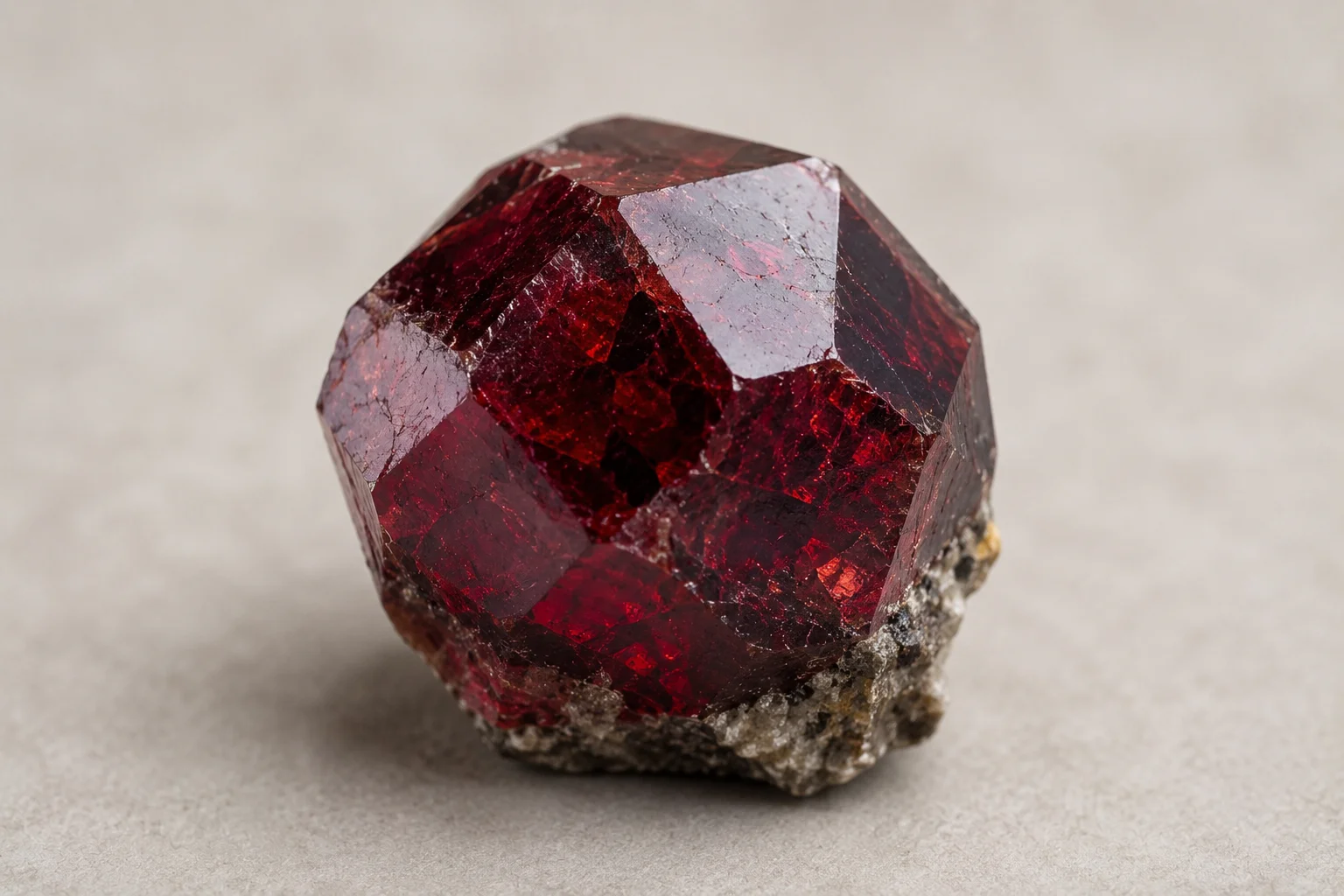
Garnet healing properties are traditionally and contemporarily associated with vitality, courage, grounding, emotional steadiness, confidence, motivation, relationships, resilience, and spiritual commitment. Unlike many modern trade-name crystals, garnet also has a genuine history extending thousands of years, with red garnets used in ancient Egyptian jewelry and Roman signet rings. That historical record establishes long human appreciation of the gemstone, not medical efficacy. Garnet has not been demonstrated to improve blood circulation, increase physical energy, treat anemia, enhance sexual function, cure depression, reduce inflammation, strengthen the heart, regulate hormones, or heal disease through a gemstone-specific mechanism. Mineralogically, “garnet” is not one single composition but a group of closely related minerals sharing a characteristic structure. Common gem species include almandine, pyrope, spessartine, grossular, and andradite, with many natural stones forming chemical mixtures between end members. Most gem garnets crystallize in the isometric system, have vitreous luster, lack useful cleavage, range roughly from Mohs 6.5 to 7.5, and are durable enough for many jewelry applications when ordinary impact precautions are followed.
9 Garnet Healing Claims Rooted in Strength, Commitment, and Red-Gem Symbolism
- Vitality and renewed personal energy
- Courage during difficult situations
- Grounding and emotional stability
- Confidence and self-trust
- Motivation and follow-through
- Relationship commitment and loyalty
- Passion and purposeful engagement
- Resilience after setbacks
- Spiritual dedication and reflection
These nine themes can function as different personal practices without being treated as nine measurable biological effects. Many garnet benefits make more sense when translated into actions the wearer controls, such as beginning a delayed task, preparing for a difficult conversation, reviewing a setback, maintaining a commitment, or deliberately reconnecting with a personal goal.
Garnet Mineral Science: A Diverse Gem Group Rather Than One Chemical Formula
Garnet is a mineral group composed of several related species rather than one gemstone with a single universal chemical formula. The general garnet structure is often represented as X₃Z₂(TO₄)₃, with different elements occupying those structural sites. In commercially important silicate garnets, silicon normally occupies the tetrahedral site, while magnesium, calcium, manganese, iron, aluminum, chromium, and other elements produce different species and varieties.
Almandine has the formula Fe₃Al₂(SiO₄)₃ and is one of the most familiar deep red garnets. Pyrope is Mg₃Al₂(SiO₄)₃ and can produce rich red to purplish-red gems. Spessartine is Mn₃Al₂(SiO₄)₃ and is known for orange to reddish-orange colors. Grossular is Ca₃Al₂(SiO₄)₃ and includes green tsavorite and orange-brown hessonite varieties, while andradite, Ca₃Fe₂(SiO₄)₃, includes highly dispersive green demantoid. Natural stones commonly fall between ideal end-member compositions rather than matching one formula perfectly.
Most familiar gem garnets crystallize in the isometric system, frequently forming dodecahedral or trapezohedral crystals. Their symmetry is one reason garnet crystals can look geometrically distinctive even before cutting. Gem-quality stones generally show vitreous to resinous-vitreous luster and may be transparent, translucent, or opaque depending on species and quality.
Garnet occurs in nearly every color. Red remains the color most people associate with the group, but orange, yellow, green, pink, purple, brown, nearly black, colorless, and rare color-changing examples also occur. The once-common statement that garnet exists in every color except blue has become outdated because blue and blue-green color-change garnets are known.
Hardness varies across the group, generally falling around Mohs 6.5 to 7.5. Garnet normally has no useful cleavage, which contributes to practical jewelry durability. Tenacity is brittle, however, and fracture is commonly uneven to conchoidal. A garnet ring can therefore resist everyday scratching reasonably well while still chipping after a sharp blow.
Most common gem garnets are not hydrated minerals. Water is not an essential component of the standard formulas for almandine, pyrope, spessartine, grossular, or andradite. The larger garnet supergroup does include unusual hydrogarnet substitutions and chemically different members, but those exceptions should not be generalized to ordinary gem garnet.
Garnet’s Ancient History, Name Origin, Geology, and Important Sources
Garnet has one of the strongest genuine antiquity records among familiar gemstones. Archaeological examples include red garnet beads from ancient Egypt more than five thousand years old. Garnets were worn by Egyptian elites and placed in burials, while ancient Roman artisans carved garnet intaglios for signet rings used to press images into wax. Garnet continued to appear prominently in European jewelry through the early medieval period and later became especially important in Bohemian jewelry traditions.
The modern word garnet is linked to Latin terminology associated with the pomegranate, whose deep red seeds resemble many almandine and pyrope stones. Older historical descriptions sometimes used the term “carbuncle” for red gemstones, but that word was not mineralogically precise and could refer to more than one red gem. Ancient textual references therefore require caution when identifying a specific garnet species.
Garnets form in several geological environments. Almandine and pyrope are strongly associated with metamorphic rocks formed under elevated pressure and temperature. Grossular and andradite can occur in calcium-rich metamorphic environments such as skarns, while certain garnets also form in igneous rocks, pegmatites, mantle-derived rocks, and other settings. Because garnet chemistry responds to geological conditions, geologists use some garnet compositions to interpret pressure, temperature, and rock history.
Important gem localities vary by species. India, Sri Lanka, Madagascar, Mozambique, Tanzania, Kenya, Namibia, Pakistan, Afghanistan, Russia, the Czech Republic, the United States, and several other countries have produced significant garnets. East Africa is especially important for tsavorite and other attractive varieties, while Russia has a celebrated demantoid history and the Czech lands are associated with Bohemian pyrope.
This real historical and geological diversity should remain separate from the idea that ancient use validates today’s healing claims. People valued garnet for beauty, symbolism, status, trade, sealing documents, and personal adornment long before modern crystal therapy developed.
Vitality, Courage, and Grounding Claims
1. Vitality as a Prompt to Re-Engage With Daily Habits
Red garnet is often described as energizing or revitalizing, and older symbolism around blood and life has helped reinforce that association. A gemstone does not increase cellular energy, oxygen transport, cardiovascular performance, or physical stamina through skin contact. Someone who likes the symbolism can use garnet as a cue to act on ordinary health-supporting behaviors already appropriate for them, such as taking a planned walk, preparing a meal, keeping an appointment, or beginning the task they have postponed. The action changes the day; the stone marks the intention.
2. Courage Before Difficult but Necessary Actions
Garnet is also associated with courage, especially when someone faces uncertainty or pressure. The mineral does not suppress fear circuits in the brain. A practical ritual is to hold the stone before a challenging conversation or decision and identify three things: what must be said, what can be controlled, and what consequence is realistically acceptable. Courage then becomes the willingness to act despite discomfort rather than an energy transmitted by the gem.
3. Grounding and Emotional Stability
Dark red and brown garnets are frequently described as grounding. There is no established mineral mechanism by which garnet stabilizes emotions or electrically anchors the body. A tactile gemstone can nevertheless support present-moment attention. Notice its temperature, weight, edges, reflections, breathing rhythm, and immediate surroundings. The shift toward concrete sensory information may help create a pause, but the stone itself is not regulating the nervous system.
Confidence, Motivation, and Relationship Commitment Claims
4. Confidence Through Preparation and Repetition
Garnet is often worn as a symbol of confidence and strength. It cannot biologically manufacture self-esteem. Before a meeting, examination, performance, or conversation, use it as a prompt to review the preparation already completed and identify the first action you will take. Repeated evidence of competence is a more plausible source of confidence than expecting a mineral to alter self-belief.
5. Motivation and Follow-Through
The deep colors of garnet have also encouraged associations with drive and persistence. The gem does not increase dopamine or create motivation through contact with the body. It can function as a commitment object: whenever the garnet is placed on a work surface, begin the predetermined task before doing anything unrelated. A clear cue linked with consistent action can support habit formation without requiring a metaphysical explanation.
6. Relationship Commitment and Loyalty
Garnet has accumulated symbolism involving friendship, fidelity, love, and safe return over centuries. No gemstone can guarantee another person’s loyalty or repair a relationship automatically. A more useful ritual is to treat garnet as a reminder of behaviors that make commitment visible: reliability, honest communication, boundaries, appreciation, and following through on promises. The relationship changes because of behavior, not because of garnet chemistry.
Passion, Resilience, and Spiritual Dedication Claims
7. Passion and Purposeful Engagement
Red garnet is frequently associated with passion, sexuality, and life force. There is no evidence that it increases libido, fertility, testosterone, estrogen, blood flow, or reproductive health through a gemstone-specific effect. The symbolic idea can instead prompt a useful question: “What activity, relationship, or goal genuinely matters enough for me to invest attention in it?” Passion becomes purposeful involvement rather than an assumed physiological response to a stone.
8. Resilience After Failure or Loss
Garnet is sometimes described as a stone of perseverance. It cannot biologically make someone resilient, but it can be used during a structured review after disappointment. Separate what happened from self-judgment, identify what was controllable, note what should change next time, and choose the smallest useful next step. The routine turns resilience into adaptation instead of treating it as a mystical quality bestowed by a gem.
9. Spiritual Dedication and Personal Commitment
Because garnet has accompanied human adornment and symbolic practice for millennia, modern spiritual users sometimes treat it as a stone of devotion, purpose, or commitment. Someone may hold it during prayer, meditation, or contemplation and use it to reflect on promises, values, or long-term responsibilities. Such practices can carry personal meaning, but they do not establish that garnet modifies consciousness through an invisible therapeutic force.
Garnet Chakra Associations Across Red, Orange, and Green Varieties
Red garnets such as almandine and pyrope are most commonly associated with the root chakra in modern crystal systems, where themes include stability, security, persistence, and embodiment. Orange spessartine may be connected with the sacral chakra, while green grossular or demantoid garnets are sometimes linked with the heart chakra. These associations largely follow color symbolism rather than mineralogical distinctions.
Chakras are a spiritual framework rather than anatomical structures. Garnet has not been shown to alter the spine, reproductive system, cardiovascular system, endocrine glands, or other organs through chakra placement. A person who values chakra practice can still use color differences to organize reflection around stability, creativity, or relationships while keeping those associations separate from biological claims.
Garnet Physical Care: Hardness, Fracture, Water Exposure, Heat, Chemicals, and Jewelry Use
Most gem garnets are durable enough for rings, earrings, pendants, bracelets, and other jewelry because their hardness generally falls between Mohs 6.5 and 7.5 and they lack strong cleavage. That durability is not identical across every species or specimen. Internal fractures, inclusions, thin edges, unusual treatments, and mounted jewelry can all affect how a particular stone behaves.
Garnet can scratch softer gems, while harder stones such as topaz, sapphire, ruby, and diamond can scratch garnet. Separate storage helps preserve polished surfaces. Hard impact should still be avoided because garnet is brittle and can chip along facet edges or break if struck forcefully.
Brief contact with plain water is generally safe for common untreated gem garnets. They are not water-soluble under ordinary household conditions and common species are not hydrated minerals. Warm water, mild soap, and a soft brush or cloth are suitable for routine cleaning of many garnets. Prolonged soaking is unnecessary, particularly for mounted jewelry with adhesives, coatings, fracture filling, or unknown treatments.
Steam and ultrasonic cleaning require more judgment. Sound untreated garnets may tolerate some commercial cleaning methods, but heat, vibration, internal fractures, assembled settings, or treatments can create avoidable risk. Gentle hand cleaning is the safer default when the treatment history is unknown.
Avoid harsh acids, strong alkalis, bleach, and aggressive jewelry chemicals. Rapid temperature changes can also stress a gemstone, particularly when fractures are present. Lapidary cutting or grinding should use wet methods and appropriate dust control because garnet dust, like other mineral dust, should not be inhaled.
Ritual Cleansing Garnet Without Confusing Symbolism With Physical Cleaning
Ritual cleansing can be handled without soaking, heating, salting, or chemically treating garnet. There is no verified negative energy that must physically leave the crystal before it can be used again.
A simple approach is to place the stone on a clean dry surface, use sound nearby, sit quietly with it, or state a new intention connected with the next period of use. Someone may also physically clean the stone first and then treat that moment as a symbolic reset, while recognizing that removing skin oils is not the same thing as removing an unseen energy.
Saltwater, flame, prolonged sun exposure, steam, harsh smoke residue, and chemical sprays are unnecessary. Dry reflective methods protect jewelry and preserve the distinction between ritual and gemstone maintenance.
Conclusion
Garnet does not need exaggerated healing claims to be significant. It is a diverse mineral group with multiple chemical species, a long archaeological record, striking colors, useful durability, and genuine importance in geology and jewelry history. Its nine healing themes can still serve as prompts for courage, commitment, relationships, resilience, and purposeful action, provided those symbolic practices are not presented as medical mechanisms.
Frequently Asked Questions About Garnet Healing Properties
What are the main garnet healing properties people claim?
Popular claims include vitality, courage, grounding, confidence, motivation, relationship commitment, passion, resilience, and spiritual dedication. These are traditional or contemporary symbolic beliefs rather than scientifically established therapeutic effects.
Is garnet one mineral?
No. Garnet is a mineral group containing several related species. Important gem garnets include almandine, pyrope, spessartine, grossular, and andradite, with many natural stones showing mixed compositions.
What is the chemical formula of garnet?
There is no single formula for all garnets. A useful general structural formula is X₃Z₂(TO₄)₃. Individual species have specific formulas, such as Fe₃Al₂(SiO₄)₃ for almandine and Mg₃Al₂(SiO₄)₃ for pyrope.
How hard is garnet?
Most gem garnets range from about Mohs 6.5 to 7.5. They generally lack useful cleavage and work well in jewelry, although they remain brittle enough to chip after hard impact.
Does garnet really improve circulation or blood health?
No reliable evidence shows that wearing or holding garnet improves circulation, treats anemia, changes blood pressure, or heals cardiovascular disease. Red color symbolism should not be confused with physiological action.
Does garnet have genuine ancient history?
Yes. Garnets were used thousands of years ago in ancient Egypt, and Romans used carved garnets in signet rings. That historical use demonstrates cultural importance, not proof of modern healing claims.
Which chakra is garnet associated with?
Red garnet is most commonly linked with the root chakra. Orange varieties may be associated with the sacral chakra, and green garnets are sometimes linked with the heart chakra. Chakras are spiritual concepts rather than anatomical structures.
Can garnet go in water?
Brief contact with plain water is generally safe for common untreated gem garnets. Mild soap and warm water can be used for cleaning, but prolonged soaking is unnecessary when treatments, adhesives, or unusual settings are present.
Is garnet suitable for everyday jewelry?
Many garnets are suitable for regular jewelry wear because of their good hardness and lack of strong cleavage. Rings still need protection from sharp impacts and harder gemstones. Buyers choosing a stone can use the workbook-verified buy garnet topic for quality considerations.
How should garnet be spiritually cleansed?
Sound, reflection, intention-setting, or dry placement are low-risk choices. There is no need to expose garnet jewelry to saltwater, flame, harsh chemicals, or aggressive physical treatments for symbolic cleansing.
Crystal healing claims are traditional or personal beliefs and should not replace qualified medical or mental health care.