Garnet Benefits: 10 Popular Uses, Deep Symbolism, Evidence, Safe Use & Clear Limits
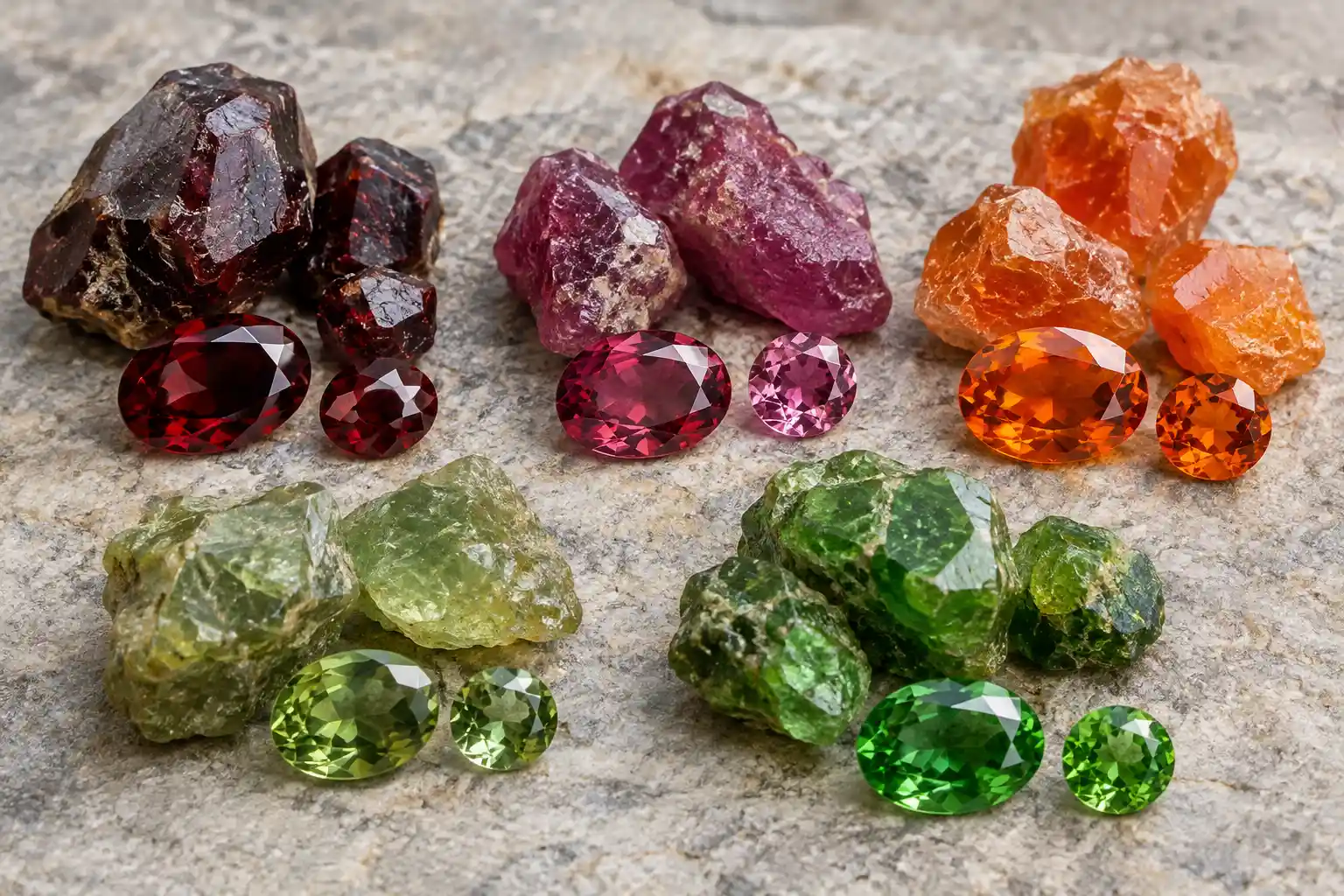
Garnet benefits extend far beyond the familiar image of a dark red January birthstone. Garnet is a mineral group rather than one single species, and members of that group occur in red, orange, yellow, green, purple, brown, pink, nearly black, and occasionally color-changing varieties. Important gem species and varieties include almandine, pyrope, spessartine, grossular, andradite, rhodolite, tsavorite, hessonite, demantoid, and others, each with its own chemistry, optical behavior, inclusions, geological origin, and market characteristics.
Most gem garnets combine useful hardness, lack of easy cleavage, good polish, strong color, and enough toughness for many jewelry applications. Depending on species, Mohs hardness generally falls around 6.5 to 7.5. Garnets are also scientifically valuable because certain compositions provide clues about metamorphic pressure, temperature, rock chemistry, and geological history. Beyond gemstones, industrial garnet is widely used as an abrasive in applications such as blasting, waterjet cutting, filtration, and surface preparation.
These measurable properties create substantial Garnet benefits in jewelry, geology, industry, collecting, gem identification, and historical study. Garnet also carries extensive symbolism involving protection, friendship, love, vitality, commitment, and safe travel across different historical and modern settings. Those traditions deserve cultural respect, but they should remain separate from claims that garnet medically improves blood, circulation, fertility, metabolism, sexual function, or emotional disorders.
10 Garnet Benefits at a Glance
- Wide color diversity gives garnet far more jewelry possibilities than red alone.
- Mohs hardness around 6.5 to 7.5 and absence of easy cleavage support practical jewelry use.
- Several garnet species offer distinctive optical effects, including strong dispersion and color change.
- Garnet composition can help geologists interpret metamorphic conditions and rock history.
- Industrial garnet provides effective abrasive grains for waterjet cutting, blasting, and surface preparation.
- Collectors can build highly varied suites based on species, color, locality, inclusions, crystal form, and chemistry.
- Gem identification teaches the difference between a mineral group, individual species, and commercial variety names.
- Long historical use gives garnet genuine cultural importance in jewelry, carving, seals, and personal ornament.
- Different species occupy different value ranges, allowing both accessible jewelry and rare high-end collector stones.
- Traditional symbolism involving commitment, protection, friendship, or vitality can remain meaningful when separated from medical claims.
Garnet Color Diversity Is Much Greater Than the Classic Dark Red Image
Color variety provides one of the strongest Garnet benefits. Almandine and pyrope commonly produce the red tones most people associate with garnet, but spessartine can range through orange and reddish orange, grossular includes yellow, orange, colorless, and vivid green forms, and andradite includes the brilliant green demantoid variety. Rhodolite commonly shows raspberry, purplish-red, or pinkish-red colors derived from mixed pyrope-almandine composition.
Tsavorite demonstrates how far the group can move from the traditional red stereotype. This chromium- and vanadium-colored grossular can display saturated green comparable in visual intensity with other prestigious green gemstones. Demantoid can combine green color with unusually high dispersion, producing spectral fire that distinguishes it even within the garnet family.
Color-change garnets add another level of complexity, with some stones shifting visibly under different light sources because of their trace-element chemistry and absorption behavior.
These Garnet benefits make the group exceptionally versatile in jewelry and collecting. Someone who dislikes dark red gemstones may still find vivid green, orange, pink, purple, or shifting-color garnet attractive.
Useful Hardness and Lack of Easy Cleavage Support Everyday Jewelry
Most gem garnets have sufficient hardness for rings, earrings, pendants, bracelets, and other jewelry, although durability differs somewhat across the group. Hardness generally lies around 6.5 to 7.5, providing reasonable resistance to ordinary scratching.
Garnet also lacks the prominent cleavage found in gemstones such as fluorite, topaz, or diamond. This improves toughness for many jewelry situations, although garnets can still fracture or chip under sufficiently strong impact.
These practical Garnet benefits make well-set stones suitable for regular wear when normal precautions are followed. Rings receive the greatest mechanical stress, so exposed corners and thin girdles deserve protection. Pendants and earrings are generally easier to maintain because they experience fewer direct impacts.
Cleaning is relatively straightforward for many untreated garnets using lukewarm water, mild soap, and a soft brush. Individual stones with fractures, unusual inclusions, or treatments may require more caution, so gemstone identity and condition still matter.
Durability should always be matched to the particular species and piece rather than assuming every garnet behaves identically.
Garnet Species Provide Different Optical Experiences
The garnet group contains enough chemical variation to produce dramatically different optical behavior. Demantoid, a green andradite, is famous for strong dispersion and can display intense rainbow fire. Some color-change garnets shift from greenish, brownish, or grayish tones in daylight-equivalent illumination toward redder or purplish colors under warmer light.
Other varieties emphasize body color rather than optical phenomena. Rhodolite can offer bright purplish-red transparency, while spessartine may display vivid orange with high brilliance. Hessonite is often recognized for warm honey, orange, or cinnamon-like colors and characteristic internal appearance.
These distinctions create Garnet benefits for both jewelry buyers and gemology students because one mineral group can demonstrate how chemistry influences refractive index, color, density, inclusions, and optical effects.
Anyone evaluating garnet quality should therefore identify the species or variety before applying simplified rules. The features that make demantoid desirable are not identical to those used for rhodolite, spessartine, or almandine.
Garnet Is an Important Mineral for Understanding Metamorphic Rocks
Geological interpretation is one of the most important Garnet benefits outside jewelry. Garnet commonly forms during metamorphism, and its composition can change according to pressure, temperature, and the chemistry of the surrounding rock.
Geologists can analyze variations from the center of a garnet crystal toward its rim to reconstruct aspects of metamorphic history. Changes in iron, magnesium, manganese, calcium, and other elements may preserve information about evolving conditions while the crystal grew.
Certain garnet-bearing rocks are therefore valuable in metamorphic petrology because mineral assemblages and garnet chemistry help constrain the pressure-temperature path experienced by the rock.
Garnet can also occur in igneous environments, skarns, sediments, and other geological settings, so the group is not limited to one formation process.
These scientific Garnet benefits make a common jewelry gem into an important geological archive. A crystal can serve both as an attractive specimen and as evidence about events that occurred deep within Earth’s crust.
Industrial Garnet Has Major Abrasive Uses
Not every garnet is destined for jewelry. Large quantities of garnet are mined and processed for industrial abrasives because the grains combine useful hardness, angular fracture, density, and durability.
Industrial Garnet benefits include abrasive blasting, surface preparation, coated abrasives, filtration, and especially high-pressure waterjet cutting. In waterjet systems, garnet particles added to a focused high-pressure water stream help cut metals, stone, composites, glass, and other substances.
The qualities needed for industrial garnet differ from those valued in gem rough. Transparency and attractive color may matter little, while grain size, hardness, cleanliness, density, fracture behavior, and consistency become crucial.
This industrial role illustrates a larger principle in mineral economics: aesthetic value is only one kind of value. A low-clarity garnet unsuitable for faceting can still have practical commercial importance through its mechanical properties.
Garnet Collecting Can Range from Affordable Crystals to Rare Gems
The diversity of the garnet group gives collectors enormous flexibility. A collection can focus on natural crystal forms, mineral species, chemical series, colors, localities, gem varieties, inclusions, or optical phenomena.
Almandine crystals in metamorphic matrix may be inexpensive and educational, while fine tsavorite, large clean spessartine, or exceptional demantoid can occupy entirely different market levels. Uvarovite commonly occurs as small vivid green crystals coating matrix rather than as large facetable stones, giving it yet another collecting style.
These Garnet benefits allow someone to build a scientifically meaningful collection without purchasing only expensive gems. Natural crystals can demonstrate dodecahedral or trapezohedral forms, while faceted stones reveal transparency, color, dispersion, and cutting.
Reliable locality information adds further value because garnet chemistry and geological setting can differ significantly among deposits.
A varied collection can therefore function almost like a miniature lesson in mineral groups and solid-solution chemistry.
Garnet Identification Teaches How Mineral Groups Actually Work
The word garnet describes a group of related minerals sharing a similar crystal structure rather than one fixed chemical composition. This makes identification one of the most educational Garnet benefits.
Major species include pyrope, almandine, spessartine, grossular, andradite, and uvarovite, but natural gem garnets frequently occupy intermediate compositions rather than fitting perfectly into one pure end member. Rhodolite, for example, generally represents a mixture dominated by pyrope and almandine components rather than a separate fundamental garnet species.
Professional identification may use refractive index, specific gravity, spectroscopy, microscopic inclusions, chemical analysis, and other tests to determine species or variety.
This complexity is important for buyers because the word garnet alone does not reveal quality, rarity, color origin, or value.
Someone preparing to buy garnet should therefore understand which garnet they are actually purchasing before comparing price or quality with unrelated members of the group.
Garnet Has Genuine Historical Importance Across Many Cultures
Garnet’s historical use gives it cultural depth extending far beyond modern crystal practice. Red garnets and garnet-like gems appear in ancient and medieval jewelry, seals, inlay, beadwork, religious objects, and personal ornaments across several regions.
Roman-era engraved gems, Migration Period cloisonné jewelry, medieval European ornament, and later Bohemian garnet traditions demonstrate that garnet remained important across different periods and societies.
Historical symbolism varied. Garnet has been associated at different times with protection, friendship, love, blood, light, safe travel, commitment, and status. These themes should be tied to actual cultural contexts rather than collapsed into one universal belief supposedly shared everywhere.
This real record gives Garnet benefits substantial historical value. A modern owner can appreciate the gemstone as part of a long human tradition while still distinguishing cultural belief from physical or medical effect.
Garnet Offers Both Accessible and Highly Valuable Gem Options
Price diversity is another practical Garnet benefit. Some red garnets are widely available and can provide attractive natural gemstones at comparatively accessible prices, while rare varieties such as fine demantoid or tsavorite can reach much higher values.
Color, species, transparency, cut, size, inclusions, origin, treatment status, rarity, and demand all influence garnet price. A large dark almandine and a much smaller vivid green demantoid therefore should not be compared simply by carat weight.
This range gives buyers more choice. Someone may select durable red garnet for everyday jewelry without paying for rarity, while a collector may pursue exceptional locality-specific stones where scarcity and documentation matter strongly.
The key is understanding the type of garnet being evaluated rather than treating the group as one uniform commodity.
Traditional Garnet Symbolism Can Be Meaningful Without Medical Claims
Modern and historical traditions commonly associate Garnet benefits with vitality, passion, friendship, commitment, courage, protection, and safe travel. Deep red varieties understandably encouraged connections with blood and life, while durable jewelry use supported themes of continuity and loyalty.
A person may wear garnet to symbolize an anniversary, friendship, family connection, or personal goal. These associations can become emotionally meaningful through repeated experience.
Beliefs surrounding Garnet healing properties sometimes extend into circulation, blood health, fertility, sexual function, metabolism, physical energy, or emotional disorders. These ideas belong to historical or spiritual traditions rather than established clinical medicine.
Iron within certain garnets does not transfer into the bloodstream as a nutritional treatment through skin contact. Likewise, red color does not establish an effect on blood or circulation.
The symbolic side of Garnet benefits remains valuable without crossing into unsupported physiology.
Safe Use Depends on Species, Condition, and Practical Care
Most garnets are straightforward to handle, but responsible use still requires ordinary gemstone precautions. Strong impacts can chip stones, harder gems can scratch some garnets, and heavily fractured or unusually included specimens may require gentler treatment.
Lukewarm water, mild soap, and a soft brush work for many stable untreated garnets. Steam and ultrasonic cleaning may be acceptable for some robust stones but are not universal recommendations when fractures, fillings, unknown treatments, or delicate settings are present.
Lapidary work introduces dust exposure, so wet cutting, ventilation, eye protection, and appropriate respiratory precautions remain sensible.
Garnet should also not be ground or ingested as a mineral remedy. Its geological chemistry is not a substitute for nutrients, medicine, or professional healthcare.
These limits help preserve the real Garnet benefits of durability, beauty, scientific importance, industry, and cultural symbolism without creating unnecessary risk.
Conclusion
Garnet benefits include exceptional color diversity, useful jewelry durability, distinctive optical behavior, geological importance, industrial abrasion, collecting variety, mineral identification, historical significance, accessible and rare gem options, and meaningful traditional symbolism.
The garnet group becomes far more interesting once it is understood as a family rather than a single red gemstone. Pyrope, almandine, spessartine, grossular, andradite, and related varieties differ substantially in color, chemistry, rarity, and value. Appreciating those differences allows the verified Garnet benefits to stand on solid mineralogical and historical foundations without unsupported medical claims.
FAQs
What are the main Garnet benefits?
The most verifiable Garnet benefits include jewelry use, color diversity, geological study, industrial abrasives, collecting, gemstone identification, historical importance, and personal symbolism.
Is garnet always red?
No. Garnets can be red, orange, yellow, green, purple, pink, brown, nearly black, or even color-changing depending on species and composition.
Is garnet one mineral?
Garnet is a mineral group containing several related species, including pyrope, almandine, spessartine, grossular, andradite, and uvarovite.
How hard is garnet?
Gem garnets generally fall around 6.5 to 7.5 on the Mohs hardness scale, although exact hardness varies by species.
Is garnet suitable for everyday jewelry?
Many garnets are suitable for regular jewelry wear because they have useful hardness and no easy cleavage, although normal protection from strong impact is still important.
What is garnet used for industrially?
Industrial garnet is widely used for abrasive blasting, waterjet cutting, surface preparation, filtration, and related applications.
Why is garnet important to geologists?
Garnet chemistry and zoning can preserve information about the pressure, temperature, and chemical conditions experienced by metamorphic rocks.
Which garnets are green?
Important green garnets include tsavorite grossular, demantoid andradite, and uvarovite, although their appearance and gem uses differ substantially.
Does garnet have historical symbolism?
Yes. Different cultures and periods have associated garnet with themes such as protection, friendship, love, vitality, commitment, and safe travel.
Does garnet have healing benefits?
There is no established clinical evidence that garnet treats blood disorders, circulation problems, fertility conditions, sexual dysfunction, depression, or other illnesses through ordinary wearing or handling.
Garnet benefits described as healing, blood-related, fertility-related, protective, vitality-enhancing, chakra, or energetic effects remain historical, spiritual, and personal beliefs and should not replace qualified medical or mental-health care.