Tanzanite vs Sapphire: Which Blue Gem Should You Buy?
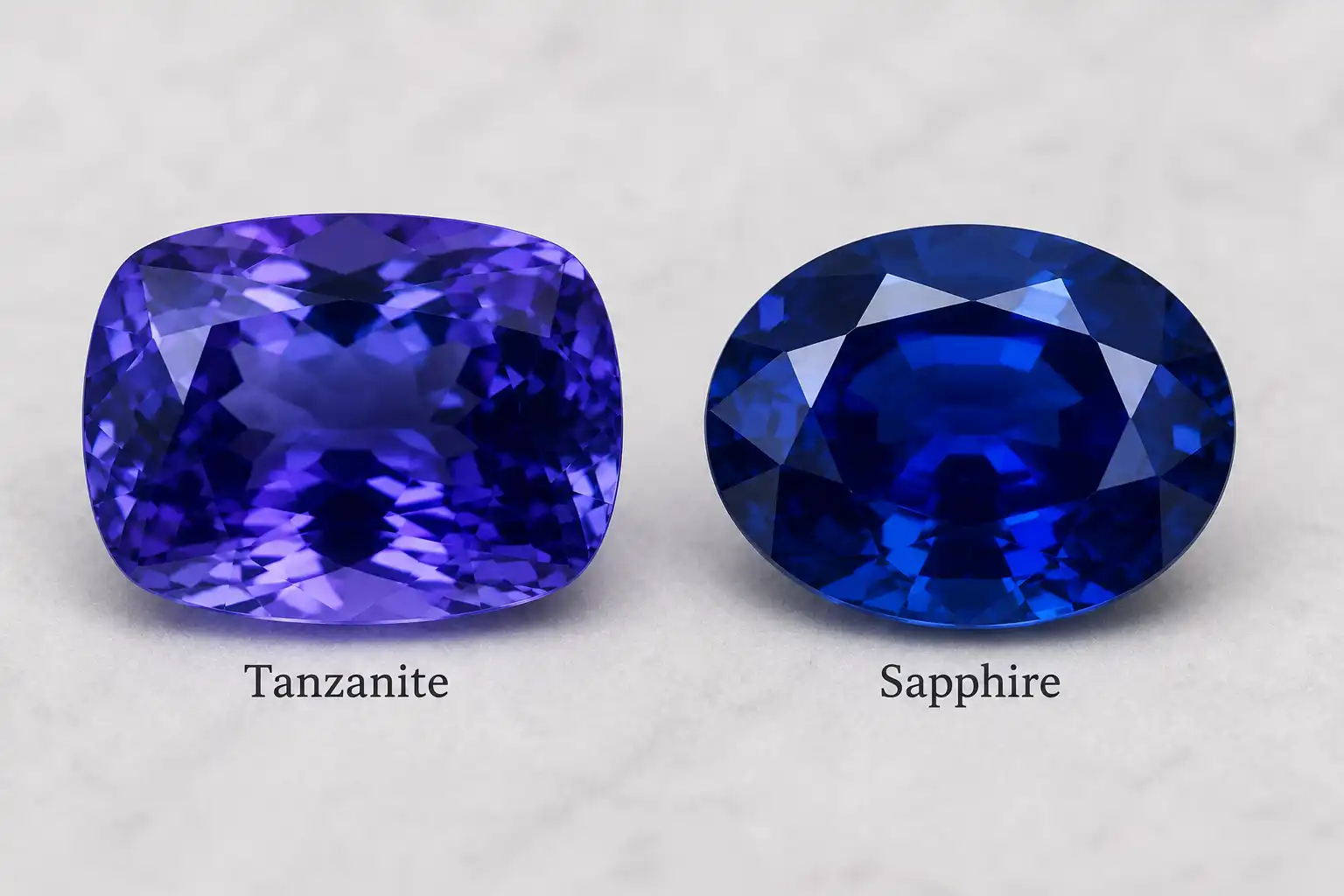
Tanzanite and blue Sapphire can overlap closely in violet-blue color, especially when a Tanzanite is cut to emphasize blue or a Sapphire contains a noticeable violet modifier.
They are otherwise very different gemstones. Tanzanite is the blue-to-violet variety of Zoisite and comes commercially from one small mining region in northern Tanzania. Sapphire is nonred corundum and occurs in numerous deposits worldwide.
Sapphire is harder, tougher, denser, and more suitable for daily ring wear. Tanzanite is more strongly pleochroic and often shows a recognizable mixture of blue and violet, but it has cleavage and lower hardness.
The easiest laboratory separation comes from refractive index. Tanzanite commonly measures around 1.691–1.700, while Sapphire measures approximately 1.762–1.770.
Tanzanite and Sapphire at a glance
| Property | Tanzanite | Blue Sapphire |
|---|---|---|
| Mineral identity | Blue-to-violet Zoisite | Blue corundum |
| Typical composition | Calcium aluminum silicate | Aluminum oxide |
| Crystal system | Orthorhombic | Trigonal |
| Optical character | Biaxial and strongly pleochroic | Uniaxial and pleochroic |
| Typical colors | Violet blue, blue violet, violet purple | Blue, violetish blue, greenish blue, grayish blue |
| Refractive index | About 1.691–1.700 | About 1.762–1.770 |
| Specific gravity | About 3.35 | About 4.00 |
| Mohs hardness | About 6–7 | 9 |
| Cleavage | Distinct structural cleavage | No cleavage |
| Toughness | Fair to poor | Very good |
| Common treatment | Heat | Heat; diffusion and filling also occur |
| Daily-ring suitability | Special-occasion or carefully protected wear | Excellent when structurally sound |
| Geographic source | Commercially associated with Merelani, Tanzania | Many global sources |
Different mineral families
Tanzanite is a variety of Zoisite. Its composition contains calcium, aluminum, silicon, oxygen, and hydroxyl groups.
The full material profile appears in Tanzanite: Meaning, Properties & Symbolism.
Sapphire belongs to corundum, the same mineral species as Ruby. Trace iron and titanium commonly contribute to blue color.
Its broader profile appears in Sapphire: Meaning, Properties & Symbolism, while Types of Sapphire owns the many blue and fancy-color varieties.
The mineral difference determines almost every practical distinction between the stones, including hardness, density, cleavage, refractive index, treatment market, and daily-wear suitability.
Tanzanite blends blue and violet
Tanzanite is strongly pleochroic. Its crystal directions can show blue, violet, and brownish, yellowish, greenish, or burgundy-related colors depending on treatment and orientation.
Most commercial stones are heated, reducing unwanted brown, yellow, or green components and emphasizing blue and violet.
Even after heating, the finished gemstone normally displays a blend rather than one completely uniform blue. Rocking the stone may shift it from blue toward violet or purple.
Cool daylight-equivalent illumination often emphasizes blue. Warm incandescent light may strengthen violet and purple.
A cutter can orient the stone to show a bluer or more violet face-up appearance. Bluer orientation may sacrifice more rough weight, which can affect price.
Sapphire’s blue range
Blue Sapphire may appear pure blue, violetish blue, greenish blue, grayish blue, navy, cornflower-like, royal blue, or nearly black.
Pleochroism commonly produces blue and greenish-blue or violetish-blue directions, but the effect is generally less dramatic than Tanzanite’s three-directional color display.
A violetish-blue Sapphire can resemble fine Tanzanite closely. Conversely, greenish or grayish Sapphire usually looks less like Tanzanite.
Color comparison remains subjective because cut, tone, extinction, lighting, and camera processing can dominate the visual result.
The Sapphire Buying Guide explains how hue, tone, saturation, cut, treatment, and zoning affect beauty and value.
Pleochroism helps but does not prove identity
A dichroscope can reveal Tanzanite’s strong directional colors. Blue and violet are often clearly visible, with a third direction depending on treatment and orientation.
Sapphire is also pleochroic, so seeing two colors does not establish Tanzanite.
The distinction lies in the complete pattern and strength of the reaction. Tanzanite is biaxial and can display three principal colors. Sapphire is uniaxial and produces two.
Mounted stones may limit useful viewing directions. Very dark color can also conceal the effect.
Refractive index and density should confirm the conclusion rather than relying on pleochroism alone.
Refractive index provides a clean separation
Tanzanite’s refractive indices lie around 1.691–1.700. Sapphire lies higher, approximately 1.762–1.770.
A standard refractometer can separate loose or accessible polished stones rapidly.
Tanzanite is biaxial, while Sapphire is uniaxial. Their birefringence values overlap less meaningfully than their absolute refractive ranges, so the main readings remain the easiest distinction.
A mounted stone may not provide access to a suitable facet. Reflectivity, spectroscopy, microscopy, and other methods can then support identification.
Sapphire is substantially denser
Sapphire’s specific gravity is close to 4.00, while Tanzanite is approximately 3.35.
A Sapphire and Tanzanite with identical dimensions and cutting proportions should therefore differ in carat weight. Sapphire will normally weigh more.
Visual size per carat can consequently differ. Tanzanite may face up somewhat larger than Sapphire at the same reported weight, depending on the cut.
Hand heft is not sufficiently precise for small gems. Hydrostatic measurement on loose stones provides stronger evidence.
Hardness is one of the largest practical differences
Sapphire ranks 9 on the Mohs scale. It resists ordinary scratching better than almost every natural jewelry gemstone except Diamond.
Tanzanite ranks approximately 6–7. Quartz-rich household dust can scratch it over time, and exposed facet edges may show abrasion with frequent wear.
The difference is not small. Sapphire is much more suitable for a ring expected to remain on the hand through everyday activity.
The Gemstone Hardness Chart explains their relative scratch resistance.
Tanzanite has cleavage
Tanzanite can split along a structural plane when it receives a sharp blow. Its toughness is generally described as fair to poor.
Sapphire has no true cleavage and is relatively tough. It can still chip at a pointed corner, inclusion, cavity, or thin girdle, but its overall resistance to wear is far stronger.
The practical consequences appear in Gemstone Cleavage Explained and Gemstone Toughness vs Hardness.
A Tanzanite ring should use a protective low setting, substantial prongs, a halo, or a bezel. Pear, marquise, princess, and other pointed shapes require extra protection.
Which is better for an engagement ring?
Sapphire is the clear default for daily wear.
Its hardness, toughness, established treatment market, broad supply, and extensive setting history make it one of the strongest colored center-stone choices.
Tanzanite can be used in an engagement ring, but the wearer must accept greater risk. It is better for someone who removes the ring during work, exercise, cleaning, cooking, gardening, and other impact-heavy activities.
The planned Tanzanite Rings Guide owns setting and style choices. The Sapphire Engagement Ring Guide owns Sapphire-specific design, buying, and maintenance.
Tanzanite also appears in Purple Gemstones for Engagement Rings, while Sapphire is considered across the Blue Gemstones for Engagement Rings guide.
Treatments
Most blue Tanzanite on the market has been heated. Heat removes or reduces brownish, yellowish, or greenish directions and emphasizes blue and violet.
The treatment is generally stable under normal wear. A heated Tanzanite remains naturally formed Zoisite.
Sapphire heat treatment is also common and generally accepted when disclosed. However, Sapphire can additionally receive lattice diffusion, fracture filling, dye, coating, and other treatments.
The treatment market for Sapphire is therefore more varied. Diffusion-treated stones generally occupy a different value category from conventionally heated or unheated material.
Tanzanite-specific treatment and simulant questions belong to How to Spot Treated or Synthetic Tanzanite. Sapphire treatment belongs to How to Spot Treated or Synthetic Sapphire.
Natural and laboratory-grown material
Laboratory-grown Sapphire is widely available. It has the essential structure and composition of corundum but formed through controlled production.
The Lab Sapphire Buying Guide owns purchase-specific laboratory-grown Sapphire questions.
Direct laboratory-grown Tanzanite matching natural Zoisite is not a routine mainstream jewelry product. Materials marketed as synthetic Tanzanite have often proved to be synthetic Forsterite, synthetic Sapphire, Spinel composites, or glass.
The broader identity risks appear in Real vs Fake Tanzanite and Real vs Fake Sapphire.
Inclusions
Tanzanite can contain mineral crystals, needles, liquid inclusions, growth structures, fractures, and cleavage-related features. Fine faceted stones are often eye clean.
Sapphire may contain rutile silk, crystals, healed fractures, color zoning, negative crystals, and fluid inclusions. Heat can alter several of these features.
Inclusions should not be compared through quantity alone. A clean Tanzanite is not automatically synthetic, while an included Sapphire is not automatically untreated.
Microscopy becomes most useful when the inclusion scene agrees with the stone’s refractive index, optical character, treatment evidence, and chemistry.
Brilliance and dispersion
Sapphire has a higher refractive index and can show strong brilliance when cut well.
Tanzanite’s refractive index is lower, but its vivid pleochroic colors can produce a rich face-up appearance. Its dispersion is modest, so it generally shows less rainbow fire than Zircon, Demantoid, or Sphene.
A poorly cut Sapphire may display large dark extinction areas. A poorly cut Tanzanite may window or show an unattractive mixture of violet, gray, and pale blue.
Cut quality should be judged through brightness, extinction, windowing, symmetry, color distribution, and shape rather than theoretical optical properties alone.
Size and availability
Tanzanite is available in larger transparent stones, although fine saturated examples become more expensive as size increases.
Sapphire occurs across a much broader global market, but fine large natural blue Sapphire can be exceptionally costly.
A large commercial heated Sapphire may still cost less than a small untreated fine-origin Sapphire. Likewise, a pale Tanzanite can be much less expensive than a deeply saturated, well-cut stone.
The Tanzanite Price Guide and Sapphire Price Guide own the separate value structures.
Source and origin
Commercial Tanzanite is associated with the Merelani Hills of northern Tanzania. That restricted source forms part of its trade identity.
Sapphire occurs in Sri Lanka, Madagascar, Myanmar, Australia, Montana, Kashmir, Thailand, Cambodia, Tanzania, and other regions.
Geographic origin can influence Sapphire value when exceptional quality and respected laboratory evidence align. The source name alone does not guarantee superior color or treatment status.
Tanzanite’s source is simpler conceptually, but a Tanzanian seller address or printed certificate does not prove the stone is Zoisite.
Care
Warm soapy water and a soft brush are appropriate for sound Tanzanite after treatment and construction have been confirmed. Ultrasonic and steam cleaning should be avoided because cleavage, fractures, and thermal shock create risk.
Sapphire is generally easier to clean. Warm soapy water is safe, while untreated or conventionally heated sound stones may tolerate professional mechanical cleaning.
Filled, dyed, coated, or fractured Sapphire requires more conservative handling.
The exact care method should follow the report and jeweler’s inspection rather than the gemstone name alone.
Laboratory reports
A report can establish whether a stone is Tanzanite or Sapphire, whether it is natural or laboratory grown where applicable, and whether detectable treatments are present.
For Sapphire, a laboratory may also provide a geographic-origin opinion when the evidence supports one.
GIA and other major laboratories do not apply universal A, AA, or AAA quality grades to these colored stones. Such labels are retailer-created.
The completed Gemstone Certification Labs Compared explains report scope. Use How to Read a Gem Lab Report to match the document to the stone and understand heat, diffusion, filling, and origin wording.
Which should you choose?
Choose Sapphire when the ring will be worn daily, maximum durability matters, or you want a broad range of blue shades, treatments, natural origins, and laboratory-grown options.
Choose Tanzanite when violet-blue color, strong pleochroism, larger visual size, and a single-source story matter more than low-maintenance wear.
The Tanzanite Buying Guide explains color orientation, cut, clarity, and seller selection. Sapphire-specific purchasing priorities appear in the Sapphire Buying Guide.
Before ordering either gemstone online, follow How to Buy Gemstones Online Without Getting Scammed.
Frequently Asked Questions
1. What is the easiest way to distinguish Tanzanite from Sapphire?
Refractive index is one of the clearest tests. Tanzanite measures around 1.691–1.700, while Sapphire is approximately 1.762–1.770.
2. Which gemstone is harder?
Sapphire is much harder at Mohs 9. Tanzanite is approximately 6–7.
3. Which is better for everyday ring wear?
Sapphire is the stronger choice because it is harder, tougher, and has no cleavage.
4. Does Tanzanite always look purple?
No. It may appear predominantly blue, violet-blue, blue-violet, or purple depending on orientation and lighting.
5. Can Sapphire look violet like Tanzanite?
Yes. Violetish-blue Sapphire can resemble Tanzanite closely.
6. Is Tanzanite heavier than Sapphire?
No. Sapphire is denser and should weigh more at equal dimensions and cut proportions.
7. Is heated Tanzanite fake?
No. Most commercial Tanzanite is heated natural Zoisite.
8. Is heated Sapphire fake?
No. Heated Sapphire is natural corundum whose color or clarity was modified.
9. Is laboratory-grown Tanzanite common?
No. Other laboratory-created materials are more commonly sold as Tanzanite simulants.
10. Can pleochroism identify Tanzanite by itself?
No. Sapphire, Iolite, Kyanite, and other gems can also show directional color.
11. Which gemstone usually costs more?
The answer depends on quality. Fine untreated Sapphire can be far more expensive, while pale commercial Sapphire or Tanzanite may occupy accessible price levels.
12. Do I need a report?
A report is advisable when natural origin, treatment, geographic source, laboratory growth, insurance, or purchase price creates a meaningful difference.
Conclusion
Tanzanite and Sapphire can share violet-blue color, but their structures create very different ownership experiences.
Tanzanite is strongly pleochroic Zoisite with moderate hardness and cleavage. It offers a distinctive mixture of blue and violet but requires protective settings and careful wear.
Sapphire is harder, tougher, denser, and more appropriate for a ring worn every day. Its color range is broader, and both natural and laboratory-grown markets are well established.
For visual individuality and occasional wear, Tanzanite can be compelling. For long-term daily durability, Sapphire is the more dependable choice.