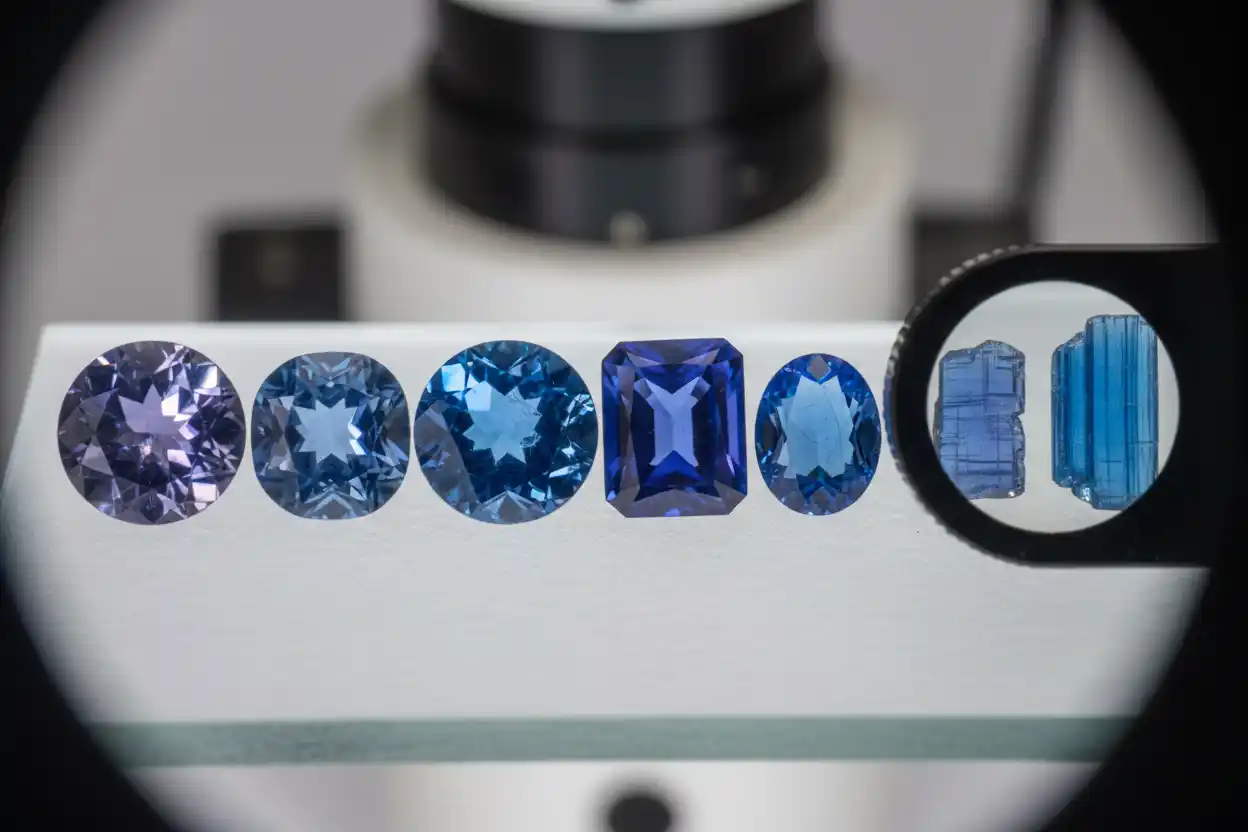
Real vs Fake Tanzanite: 9 Proven Tests for Real Blue-Violet Gems
Real vs fake tanzanite identification depends on proving that a blue-violet stone is the tanzanite variety of zoisite rather than judging color alone. Genuine tanzanite has a refractive index of about 1.691 to 1.700, birefringence around 0.008 to 0.013, specific gravity close to 3.35, and Mohs hardness of approximately 6 to 7. Its strong pleochroism is one of its most recognizable characteristics, allowing different blue, violet, and related hues to appear when the gem is viewed from different crystal directions.
Color creates the first trap. Glass, synthetic forsterite, synthetic corundum, YAG, and other gems can be made or selected to imitate tanzanite. GIA has documented several manufactured tanzanite imitations and shown that standard tests such as refractive index, optical character, specific gravity, spectroscopy, fluorescence, and pleochroism can separate them from genuine zoisite.
The real vs fake tanzanite question is somewhat different from ruby or sapphire authentication. Commercially important laboratory-grown counterparts are not the main concern. Gem-A states in its published tanzanite guidance that there is no known method for producing synthetic tanzanite and specifically warns about synthetic forsterite as a convincing simulant. The practical risk is therefore more often a different natural or manufactured substance being represented as tanzanite, along with undisclosed treatments or misleading quality claims.
9 Proven Real vs Fake Tanzanite Tests
- Look for strong blue-violet pleochroism as a screening clue.
- Measure refractive index near 1.691 to 1.700.
- Confirm birefringence within the expected zoisite range.
- Compare specific gravity with tanzanite near 3.35.
- Examine inclusions and internal structure under magnification.
- Separate tanzanite from synthetic forsterite and glass through optical testing.
- Treat heat treatment as normal disclosure, not automatic fakery.
- Avoid scratch, flame, impact, and other destructive tests.
- Request independent gemological identification when value justifies it.
Genuine Tanzanite Is a Blue-Violet Variety of Zoisite
Tanzanite is the violet-blue to blue-violet variety of zoisite. Its commercial source is extraordinarily restricted, with GIA identifying the Merelani Hills area of Tanzania as the location where tanzanite is mined commercially. Its chemical composition is Ca₂Al₃(SiO₄)₃(OH), and zoisite belongs to the orthorhombic crystal system.
This mineral identity gives real vs fake tanzanite testing a firm scientific foundation. A convincing imitation may reproduce the apparent color but still fail one or more optical or physical measurements.
Tanzanite is biaxial and strongly pleochroic. When a fashioned stone is tilted, blue and violet shades can become more or less prominent according to orientation and lighting. GIA explains that the face-up appearance depends partly on how the cutter positions the rough relative to its pleochroic crystal directions. Cool lighting can emphasize blue, while warmer lighting can make violet or purple more noticeable.
This color movement should not be confused with ordinary reflections from facets. Pleochroism arises because light behaves differently along different crystallographic directions within the anisotropic crystal. A dichroscope can make these directional colors much easier to observe than the unaided eye.
Strong Pleochroism Is Helpful but Not Unique to Tanzanite
The ability to show blue and violet from different directions is an excellent screening clue, but it cannot establish tanzanite by itself. Synthetic forsterite has been used specifically because it can imitate both the color and strong pleochroism of tanzanite. Gem-A warns that this simulant can appear convincing at first glance.
GIA has likewise documented cobalt-doped synthetic forsterite imitating tanzanite and notes that its refractive indices differ substantially from genuine tanzanite. That difference allows an apparently convincing stone to be separated using a refractometer rather than visual judgment alone.
Other imitations may show little or no true pleochroism. Certain glasses, for example, can possess attractive violet-blue color but lack tanzanite’s directional optical behavior. Yet relying only on visible pleochroism is still risky because cut, lighting, bodycolor, and the observer’s experience affect what is seen.
The best real vs fake tanzanite approach combines pleochroism with refractive index, birefringence, density, and microscopy.
Refractive Index Is One of the Strongest Routine Identification Tests
GIA gives tanzanite a refractive-index range of approximately 1.691 to 1.700. A properly performed refractometer test on a polished facet can therefore separate genuine tanzanite from many common imitations.
Forsterite, one of the better-known tanzanite simulants, has lower refractive indices. GIA reported values around 1.635 to 1.670 for a cobalt-doped synthetic forsterite imitation, making the difference measurable even when color and pleochroism look persuasive.
Birefringence adds another layer. Tanzanite generally falls around 0.008 to 0.013 according to GIA. An imitation may have a different optical character or a different separation between its principal refractive indices.
A refractometer does have practical limits. The stone needs a suitable polished surface, and certain mounted settings can make contact difficult. Readings also need correct interpretation. Even so, refractive index is far more meaningful than testing whether the gem “looks blue enough.”
Specific Gravity Helps Confirm Zoisite Identity
Tanzanite has a specific gravity close to 3.35. Mindat gives zoisite a measured density range of about 3.15 to 3.36, with 3.35 as a calculated value, while GIA lists 3.35 specifically for tanzanite.
Hydrostatic weighing can therefore provide useful independent evidence for a loose gem. If a supposed tanzanite has a density far outside the zoisite range, its blue-violet appearance should not override the measurement.
Density alone is not unique enough for final identification because another substance can have a similar value. Mounted jewelry can also be difficult or impossible to test accurately by this method. Real vs fake tanzanite identification becomes convincing when density agrees with refractive index, pleochroism, microscopic appearance, and optical character.
This combination is also why simple electronic testers have limitations. A handheld device may narrow a category according to thermal or electrical behavior without establishing the complete gemological identity.
Magnification Reveals More Than a Color Photograph
A 10× loupe is valuable for preliminary real vs fake tanzanite examination, while a gemological microscope provides substantially more information. Genuine natural stones may contain crystals, needles, fractures, growth-related features, or other inclusions. Their significance depends on shape and association rather than merely whether an inclusion exists.
A perfect-looking stone is not automatically fake. Much jewelry-quality tanzanite is relatively clean to the unaided eye, and GIA notes that eye-visible inclusions reduce value, particularly in lighter-colored gems.
Glass imitations may reveal rounded bubbles, flow features, or abundant polishing marks. Gem-A has documented artificial glass imitating tanzanite and emphasized the importance of checking expected pleochroism along with other gemological properties.
Synthetic corundum or synthetic forsterite will present different optical and microscopic behavior. This is why “no bubbles means real” is too simplistic. Some imitations have no obvious bubbles, while a natural gem can contain rounded-looking inclusions that need expert interpretation.
Natural Tanzanite, Heated Tanzanite, and Imitations Are Different Categories
| Identification feature | Natural tanzanite | Heat-treated natural tanzanite | Common tanzanite imitation |
|---|---|---|---|
| Mineral identity | Zoisite | Zoisite | Another natural or manufactured substance |
| Refractive index | About 1.691–1.700 | About 1.691–1.700 | Depends on substitute |
| Specific gravity | About 3.35 | About 3.35 | Varies |
| Pleochroism | Strong | Strong blue-violet appearance commonly emphasized | May be absent or may imitate it |
| Geological origin | Tanzania | Tanzania | Not natural Tanzanian tanzanite |
| Treatment status | Natural color state | Heated to modify color | Not applicable in the same way |
| Best verification | Combined gemological testing | Combined testing, though heat may be difficult to prove | Optical and physical tests usually reveal another identity |
The distinction between natural and heated tanzanite is particularly important. Heat treatment changes color but does not transform zoisite into an imitation.
Heat Treatment Is Normal for Tanzanite and Often Difficult to Detect
Untreated tanzanite is commonly brownish, and much of the tanzanite sold in jewelry has been heated to emphasize attractive blue and violet colors. GIA explains that the vast majority of commercial stones are assumed to have been heated and that the treatment usually has little effect on price. In many cases, gemological laboratories cannot conclusively determine whether heating occurred.
Heating modifies the pleochroic color combination by reducing yellow-green or brownish components, leaving the blue and violet appearance consumers associate with tanzanite. GIA describes this treatment as routine and stable.
This makes the phrase “unheated blue tanzanite” something that deserves careful documentation rather than automatic acceptance. Naturally blue stones can occur, but visual inspection alone cannot prove that a blue tanzanite escaped artificial heat.
A seller who calls heated tanzanite “fake” is using inaccurate terminology. It remains natural zoisite if the stone formed geologically. The treatment belongs in its description, but origin and treatment are separate questions.
Synthetic Forsterite Is One of the Most Important Tanzanite Simulants
Synthetic forsterite deserves special attention because its resemblance can extend beyond color. Both stones can show conspicuous pleochroism, which defeats the oversimplified claim that “pleochroism means real tanzanite.”
Fortunately, their refractive indices differ. GIA’s documented synthetic forsterite imitation gave readings below the tanzanite range, providing a straightforward gemological separation.
Other documented imitations include synthetic corundum, YAG, and different types of glass. GIA reports that these can generally be distinguished using refractive index, optical character, density, UV-visible spectroscopy, fluorescence, and pleochroism.
The lesson is important for real vs fake tanzanite buyers. An imitation can be a genuine manufactured crystal with impressive hardness and optical quality. The fact that it is not plastic or ordinary glass does not make it tanzanite.
Tanzanite and Sapphire Can Look Similar but Test Very Differently
Fine tanzanite can approach the vivid violetish-blue appearance associated with some sapphires. GIA even notes that top-quality tanzanite can have a color reminiscent of fine sapphire.
Mineralogically, however, the two gems are very different. Tanzanite is zoisite with hardness around 6 to 7, while sapphire is corundum with Mohs hardness 9. Their refractive indices, specific gravity, crystal systems, cleavage behavior, and optical properties also differ.
These distinctions make tanzanite vs sapphire much more useful than comparing only photographs. A blue gem that resembles tanzanite but produces corundum-range refractive-index readings is not tanzanite, regardless of how closely the color matches.
The durability difference is also important. Tanzanite has perfect cleavage in one direction as a variety of zoisite, which makes impact care more important than its hardness number alone suggests. A convincing imitation can therefore behave very differently during wear or repair.
Scratch Testing Is Particularly Risky for Tanzanite
Tanzanite’s Mohs hardness of about 6 to 7 is sufficient for jewelry when worn thoughtfully, but it is not an appropriate stone for destructive authentication. Scraping it across glass, steel, tile, or another gem can scratch the surface, chip a facet junction, or initiate damage along cleavage.
Hardness also cannot prove identity. Several minerals occupy overlapping hardness ranges, and a synthetic or natural simulant may produce a similar scratch result.
Flame tests are even more inappropriate. Heating jewelry directly can damage the stone, setting, coatings, fracture fillers, or nearby gems. Sudden temperature changes can be particularly dangerous for a gem with cleavage and existing fractures.
GIA recommends warm soapy water for cleaning tanzanite and advises against ultrasonic and steam cleaners. The gem can be worn in many jewelry styles when protected from hard blows, but durability should be taken seriously.
Color Alone Cannot Tell Whether Tanzanite Is Genuine
Deep blue-violet tanzanite is visually desirable, but color intensity is a value factor rather than an authentication test. Fine stones can show strong saturation, while lighter lavender-blue specimens are also genuine.
GIA emphasizes that tanzanite’s face-up color depends on pleochroism, cutting orientation, size, and lighting. Smaller stones commonly appear less saturated, while deeply colored gems are particularly prized.
These characteristics affect tanzanite quality grading, but a rich hue cannot prove identity. An imitation can be manufactured in an appealing blue-violet shade, while a natural tanzanite can be pale.
Commercial grading terms such as “AAA,” “AA,” or similar labels should also be interpreted carefully. GIA states that no standardized universal quality-grading scale exists for tanzanite using these commercial letter grades. Individual sellers may define their own systems.
Price Should Trigger Verification, Not Replace It
An unusually low price can be a warning, particularly for a large, strongly saturated, clean tanzanite, but price is not proof of authenticity. Sellers can overprice imitations just as easily as they can discount genuine stones.
The variables behind tanzanite price include color saturation, size, clarity, cut, market conditions, and the credibility of identification. Strong blue or violet color in larger sizes can carry considerable value, which creates an incentive for imitation.
When deciding whether to buy tanzanite, ask for a precise description rather than accepting terms such as “African blue stone,” “tanzanite color,” or “tanzanite-style gem.” Those descriptions may deliberately avoid stating that the stone itself is natural tanzanite.
For an inexpensive piece, a qualified local gemologist may be sufficient. For an important purchase, independent laboratory identification provides stronger protection.
When a Gemological Laboratory Report Is Worthwhile
Professional testing becomes particularly valuable when a tanzanite is large, vividly saturated, unusually clean, expensive, or accompanied by claims that significantly influence price. A laboratory can use refractometry, microscopy, spectroscopy, optical testing, and other analytical methods to determine the stone’s identity.
GIA’s colored-stone reports state the gemstone type, whether it is natural or laboratory-grown where applicable, and any detectable treatments.
A report should be checked independently rather than accepted solely because a seller provides a photograph of a certificate. Report numbers, measurements, weight, shape, and identifying details should correspond to the actual stone.
This final step is important because real vs fake tanzanite identification is not simply about catching obvious glass. High-quality simulants can have beautiful color and convincing cutting. Instrumental testing answers the mineralogical question much more reliably than appearance or price.
Conclusion
Real vs fake tanzanite identification works best when pleochroism is treated as the beginning of the process rather than the final answer. Genuine tanzanite is zoisite with refractive index around 1.691 to 1.700, specific gravity near 3.35, birefringence around 0.008 to 0.013, strong directional color, and characteristic optical behavior. Synthetic forsterite, synthetic corundum, YAG, and glass can imitate its appearance, but standard gemological measurements usually expose the difference. Heat-treated natural tanzanite remains genuine natural zoisite, while important purchases are safest when supported by independent gemological identification.
FAQs About Real vs Fake Tanzanite
How can I tell if tanzanite is real at home?
Look for believable blue-violet pleochroism by viewing the stone from several directions under neutral light, then examine it with a 10× loupe for obvious glass-like bubbles, unusual surface coatings, or other warning signs. These checks are only preliminary. Refractive-index and specific-gravity measurements provide much stronger identification.
Does real tanzanite change color when tilted?
Genuine tanzanite is strongly pleochroic and typically shows different proportions of blue and violet as viewing direction changes. Lighting also influences its appearance. However, synthetic forsterite can imitate strong pleochroism, so directional color alone does not prove tanzanite.
Is laboratory-grown tanzanite common?
No. Gem-A’s published guidance states that there is no known method for creating synthetic tanzanite and emphasizes simulants such as synthetic forsterite instead. Buyers are more likely to encounter a different substance imitating tanzanite than a true synthetic zoisite counterpart.
Is heat-treated tanzanite fake?
No. Most commercial blue-violet tanzanite is assumed to have been heated to modify naturally brownish or mixed colors. The gemstone remains natural zoisite if it formed geologically. Heating and natural origin are separate descriptive facts.
Can glass look like real tanzanite?
Yes. Colored glass can imitate tanzanite visually, and convincing glass imitations have been documented. Refractive index, optical character, density, pleochroism, magnification, and spectroscopy can distinguish glass from zoisite far more reliably than color.
Can tanzanite scratch glass?
Its hardness of about 6 to 7 may allow some specimens to scratch certain types of glass, but this is an unreliable and potentially damaging test. Several other minerals can produce the same result, while scratches or chips can permanently reduce the value of genuine tanzanite.
Is dark blue tanzanite always more authentic?
No. Color depth concerns quality and value rather than identity. Genuine tanzanite occurs in lighter and deeper colors, while imitations can be manufactured with intense blue-violet saturation. Identification requires mineralogical evidence.
Why does my tanzanite look purple indoors and bluer outside?
Tanzanite’s strong pleochroism and the spectral qualities of different light sources can change the balance of visible blue and violet. GIA notes that cooler daylight-like illumination tends to emphasize blue, while warmer incandescent illumination can make violet or purple more prominent.
Should an expensive tanzanite have a laboratory report?
Independent identification is particularly worthwhile for expensive, large, or exceptional stones. A recognized gemological laboratory can establish gemstone identity and report detectable treatment information, giving much stronger evidence than a seller’s verbal assurance alone.