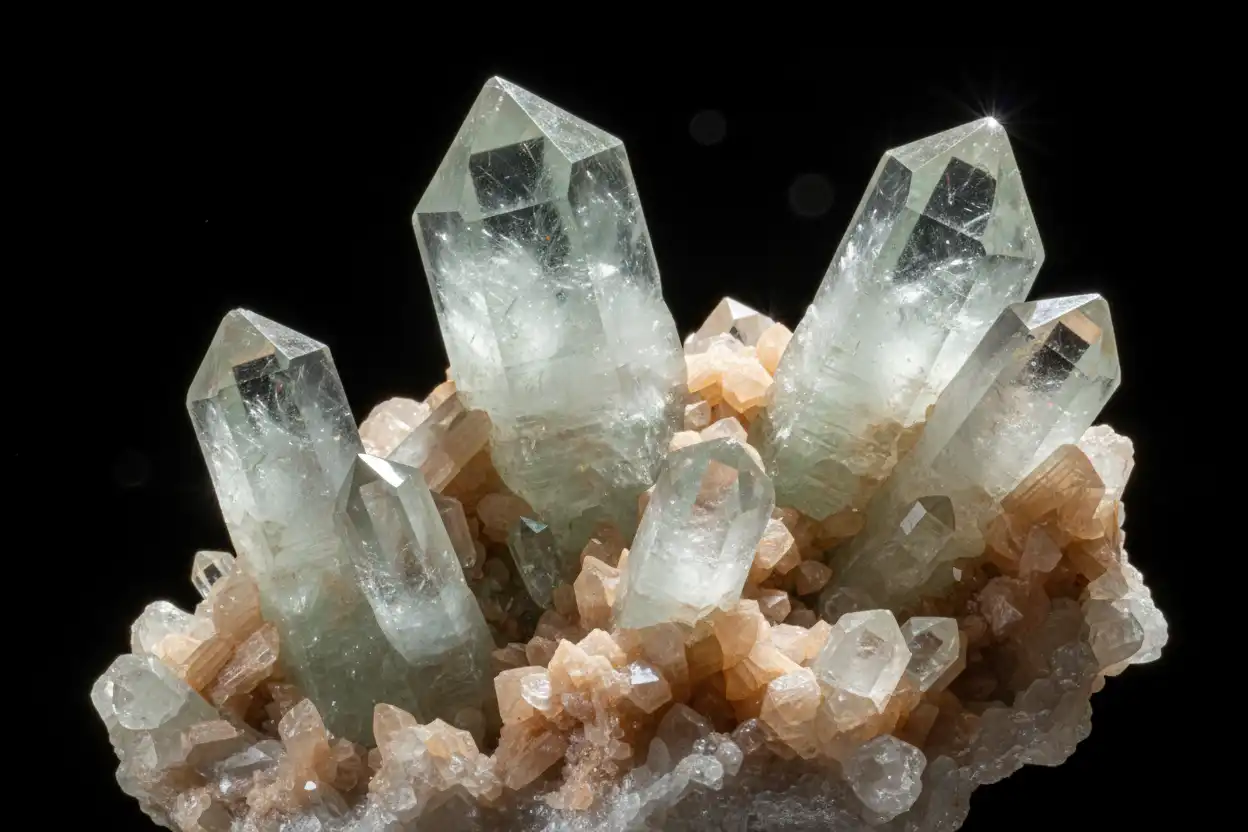
Apophyllite Meaning: Mineral Identity, History & Symbolism
Apophyllite meaning begins with a naming detail that many crystal descriptions miss: apophyllite is best understood as a mineral-group name rather than one chemically identical mineral species. The apophyllite group contains closely related hydrated calcium silicate minerals distinguished partly by whether potassium or sodium dominates a structural site and whether fluorine or hydroxyl is dominant in another. The transparent, white, colorless, and pale green crystals widely sold simply as “apophyllite” are commonly members such as fluorapophyllite-(K), but a photograph or shop label alone cannot establish the exact species.
This group identity matters because apophyllite’s appearance is distinctive enough to encourage overconfidence. Well-formed crystals can be extraordinarily clear, with square-looking prisms, sharp pyramidal terminations, glassy side faces, and a pearly basal surface that sometimes gives a crystal an almost manufactured precision. Yet the material is relatively soft, strongly cleavable, hydrated, and structurally more delicate than its bright crystal faces suggest.
Modern crystal traditions add another layer to apophyllite meaning. Clear and green specimens are often associated with clarity, intuition, meditation, emotional openness, spiritual awareness, or communication with non-physical beings. These associations are modern symbolic or metaphysical interpretations. Mineralogical measurements can establish composition, structure, hardness, cleavage, density, optical behavior, and geological occurrence; they do not demonstrate healing energy, chakra activation, supernatural communication, or predictable effects on health and life events.
The broader Gemstone Guides collection follows the same evidence boundary. This page defines apophyllite as a material first, then explains its formation, appearance, diagnostic limits, documented naming history, responsible symbolism, and safe ownership without absorbing the separate pages that own buying, microscopy, optics, geology, cutting, setting, provenance, or conservation.
Apophyllite Identity at a Glance
| Property | Apophyllite |
|---|---|
| Mineral status | Mineral-group name covering several closely related species |
| Common commercial identification | Frequently fluorapophyllite-(K), although exact species requires appropriate evidence |
| Mineral class | Hydrated silicate |
| Structural character | Sheet-like silicate framework with calcium, alkali elements, fluorine and/or hydroxyl, and structural water |
| Common crystal symmetry | Tetragonal in the most familiar potassium-rich species |
| Typical crystal habit | Square-prismatic, tabular, blocky, pyramidal, and combinations of these forms |
| Common colors | Colorless, white, pale green, yellowish, pinkish, and more rarely other subdued hues |
| Transparency | Transparent to translucent |
| Luster | Vitreous on many faces; distinctly pearly on good basal cleavage surfaces |
| Mohs hardness | Approximately 4.5–5 |
| Specific gravity | Commonly around 2.3–2.4, varying somewhat with species and composition |
| Cleavage | Perfect basal cleavage |
| Tenacity | Brittle |
| Important physical response | Heating can drive off structural water and promote flaking or exfoliation |
| Common geological setting | Low-temperature mineralization in volcanic-rock cavities and related hydrothermal environments |
| Frequent associates | Zeolites, calcite, prehnite, quartz, and other secondary minerals |
| Identification limitation | Crystal habit and color alone cannot establish exact apophyllite species, treatment, or locality |
The most important practical point is that the familiar word “apophyllite” often operates at a broader level than a modern species name. A specimen can be correctly recognized as belonging to the apophyllite group while still lacking the chemical evidence required to determine its exact member.
That is not an identification failure. It is an appropriate expression of evidentiary limits.
Apophyllite Is a Group, Not One Uniform Chemical Formula
Older mineral literature and much of the gem and crystal trade use “apophyllite” as though it describes one fixed substance. Modern mineral classification is more precise.
The group contains related structures in which chemical substitutions can change the dominant alkali element and the balance between fluorine and hydroxyl. Fluorapophyllite-(K), for example, is potassium- and fluorine-dominant, while other members differ in those structural positions.
For ordinary collectors, the broad word apophyllite remains useful because the crystals share recognizable structural and physical characteristics. Problems arise only when a broad visual identification is stretched into an exact compositional claim that was never tested.
A seller can reasonably say “natural apophyllite crystal” when the group identification is sound.
A seller claiming a specific apophyllite species is making a more precise mineralogical statement and should have evidence proportionate to that precision.
This distinction becomes especially important with old specimens because historical labels may use nomenclature that predates modern species definitions.
How Apophyllite Forms
Apophyllite is particularly well known from cavities in basalt and related volcanic rocks. After lava has solidified, fractures and empty vesicles can become pathways and growth chambers for relatively low-temperature mineral-bearing fluids. As the chemistry of those fluids changes, secondary minerals precipitate on cavity walls, sometimes producing spectacular open-space crystal groups.
Apophyllite frequently occurs with zeolite minerals and other low-temperature associates. Stilbite, heulandite, scolecite, calcite, prehnite, quartz, and related species can form striking combinations in the same cavity, although the exact sequence of crystallization differs among deposits.
This geological context explains why so many collector specimens consist of transparent apophyllite crystals standing on contrasting matrix rather than isolated loose crystals. The cavity provides open space for the mineral to express sharply developed crystal faces instead of growing as interlocking grains inside a solid rock.
Apophyllite also occurs in additional hydrothermal and metamorphic environments, so “basalt cavity mineral” should be treated as an especially characteristic setting rather than the only possible origin.
Detailed questions about fluid chemistry, basalt alteration, mineral sequence, host rocks, cavity development, and deposit interpretation belong in Apophyllite formation and deposit geology.
Why Apophyllite Crystals Can Look Almost Cubic
Many apophyllite crystals appear nearly cubic at first glance. Four vertical faces can form a square-looking prism, while broad basal faces or pyramidal terminations create a highly geometric outline.
The resemblance to a cube does not make the mineral cubic.
The common potassium-rich apophyllite species are tetragonal, so the horizontal axes can be equivalent while the vertical crystallographic direction differs. Combinations of prism, pyramid, and basal forms can nonetheless create visually box-like crystals.
This distinction matters because crystal shape is often used too casually as an identification shortcut. A square-looking transparent crystal can support an apophyllite interpretation, but morphology is not a substitute for mineralogical testing.
Damaged crystals can be even more deceptive. Cleavage may remove a termination and leave a flat reflective surface that looks like an original growth face, while intergrowths can hide the underlying symmetry.
Perfect Basal Cleavage Is One of Apophyllite’s Best Clues
Apophyllite has excellent cleavage parallel to its basal plane. When a crystal splits along this direction, it can expose an exceptionally flat surface with a noticeably pearly luster.
That surface can contrast with the more vitreous appearance of prism or pyramid faces.
The property is useful diagnostically but creates a practical vulnerability. A specimen may look robust because the crystal is thick, yet a force applied in an unfavorable direction can detach part of it cleanly along cleavage.
Cleavage should therefore be observed rather than deliberately tested on a valuable specimen.
Breaking an important crystal to prove that it cleaves is destructive and unnecessary. Existing damage, naturally detached pieces, microscopy, physical measurements, and analytical methods provide better evidence.
The Apophyllite microscope inclusion notebook owns the closer examination of cleavage traces, healed fractures, growth structures, inclusions, coatings, and other microscopic features.
Why the Name Apophyllite Refers to Flaking
The name apophyllite was introduced from Greek-derived language referring to leafing or flaking away.
The reference is physical.
When heated, apophyllite can lose structural water and separate or exfoliate along its cleavage. Early mineralogists recognized this characteristic behavior and used it as part of the material’s descriptive identity.
This documented naming history should not be converted into claims that the mineral “peels away emotional layers,” “removes negativity,” or “forces spiritual shedding” as though those ideas were the reason the mineral received its name.
Those may be modern metaphors inspired by the historical term, but the original observation concerned heat, hydration, and mineral structure.
The distinction is a useful example of responsible symbolism: a physical fact can inspire personal metaphor without the metaphor becoming a physical property.
Structural Water Does Not Make Apophyllite a Water Crystal
Apophyllite contains substantial structural water within its mineral structure. This fact is scientifically important because heating can disturb that structure and cause dehydration-related physical changes.
It does not mean the mineral stores mystical “water memory,” hydrates the human body, or transfers beneficial water energy through skin.
Structural water is part of the crystal chemistry.
That chemistry also does not mean an apophyllite specimen should be routinely boiled, steamed, heated, or subjected to rapid temperature changes. Strong heating can damage the material precisely because water is structurally involved.
Safe ownership therefore follows the mineral’s actual physical limitations rather than symbolic interpretations of the word water.
What Causes Green Apophyllite?
Pale to stronger green apophyllite is among the most popular material in the collector and metaphysical markets, particularly specimens associated commercially with Indian basalt localities.
The cause of green coloration should not be reduced to one universal explanation for every specimen.
Trace transition elements can contribute to color in silicate minerals, and vanadium has been associated with green coloration in some analyzed apophyllite-group material. Iron and other minor constituents, structural defects, microscopic inclusions, alteration, and interactions with associated minerals can also affect visible appearance in natural specimens.
A green crystal seen in a photograph does not reveal its complete trace-element chemistry.
Therefore:
“Green apophyllite” is a valid visual description.
“Vanadium-colored fluorapophyllite-(K)” is a significantly stronger analytical statement.
The second requires evidence capable of establishing both the species and the color-producing chemistry.
Detailed color mechanisms, optical directions, anomalous optical behavior, refractive data, and spectroscopy belong in Apophyllite optical properties and color behavior.
Clear Apophyllite Is Not Automatically Pure Apophyllite
Excellent transparency can make an apophyllite crystal look chemically pure.
Transparency is not a purity test.
A clear crystal can still contain trace substitutions, microscopic inclusions, defects, zoning, structurally incorporated water, and minor chemistry below the level visible to the eye. Conversely, a cloudy crystal can remain perfectly valid apophyllite while containing fractures, inclusions, alteration, or intergrowths.
The word “clear” should therefore describe appearance rather than chemical grade.
Likewise, metaphysical labels such as “high-vibration clear apophyllite” describe a belief system or sales language, not a mineralogical variety recognized through composition or crystallography.
Diagnostic Traits of Apophyllite
A convincing apophyllite identification relies on several properties working together.
A well-developed specimen may show square or rectangular-looking tetragonal forms, pyramidal terminations, excellent transparency, vitreous luster, pearly basal cleavage, hardness around 4.5–5, and relatively low density compared with many similarly brilliant gems.
The optical properties provide additional evidence. Many familiar apophyllite-group crystals have low refractive indices for their visual brilliance and comparatively modest birefringence. Some specimens display anomalous optical behavior related to structural complexity, strain, or chemical variation.
None of these observations should be used alone.
A transparent square crystal can be mistaken for other minerals. A pearly cleavage surface may occur in unrelated materials. Colorless crystals are particularly poor candidates for identification by color.
Raman spectroscopy, X-ray diffraction, and chemical analysis become appropriate when exact species-level identification matters.
Original Apophyllite Specimen and Photo Checklist
A photograph can be highly informative if the observer records what is visible rather than what the product title suggests.
| Observation | What it can reasonably support | What it cannot prove alone |
|---|---|---|
| Transparent square-prismatic crystal | Habit compatible with apophyllite | Exact species |
| Four-sided pyramidal termination | Strong morphological clue | Chemical composition |
| Broad pearly flat surface | Possible basal cleavage | Whether the surface is original growth or later cleavage |
| Colorless or white crystal | Common apophyllite appearance | Purity |
| Pale green crystal | Common commercial appearance | Vanadium as the color cause |
| Crystal on basaltic cavity matrix | Geologically compatible setting | Specific mine |
| Association with stilbite or heulandite | Plausible low-temperature paragenesis | Apophyllite identity by itself |
| Fine internal fractures | Condition observation | Treatment or repair |
| Glue visible at matrix contact | Evidence of repair or mounting | Whether the crystal itself is natural |
| Seller label naming exact species | A mineralogical claim requiring support | Proof of composition |
| Seller label naming a famous locality | Provenance evidence to investigate | Independent origin confirmation |
| Raman or XRD result matching an apophyllite species | Strong identification evidence | Full geographic provenance |
| Chemical analysis showing dominant K/F/OH relationships | Stronger species-level evidence | Whether the specimen has been repaired |
The checklist creates a useful separation between object observation and laboratory conclusion.
A square green crystal on stilbite can look highly characteristic of apophyllite. It may even be correctly identified from experienced visual examination. But exact species, treatment history, and locality remain independent questions.
Apophyllite Names and Claims That Need Reconciliation
Apophyllite has accumulated historical names, modern species names, color labels, and metaphysical terminology that are frequently mixed together.
| Name or claim | Evidence assessment | More accurate interpretation |
|---|---|---|
| Apophyllite | Valid group-level/common usage | Refers broadly to related apophyllite-group minerals |
| Fluorapophyllite-(K) | Specific accepted mineral species | Potassium- and fluorine-dominant apophyllite-group member |
| Hydroxyapophyllite-(K) | Specific accepted species | Potassium-rich member with hydroxyl dominance in the relevant structural position |
| Fluorapophyllite-(Na) | Specific group species | Sodium-dominant member rather than the common potassium-dominant composition |
| “Green apophyllite” | Descriptive color term | Does not define a separate species |
| “Clear apophyllite” | Appearance description | Does not prove chemical purity |
| “Fish-eye stone” terminology | Historical descriptive naming associated with apophyllite material | Historical terminology, not a separate modern metaphysical species |
| “Pyramid apophyllite” | Habit description | Crystal form, not a distinct mineral variety |
| “Zeolite crystal” | Frequently inaccurate classification | Apophyllite commonly occurs with zeolites but is not simply a zeolite species |
| “High-vibration apophyllite” | Metaphysical wording | No recognized mineralogical property called vibration level in this sense |
| “Apophyllite heals the lungs” | Unsupported medical claim | No established therapeutic effect |
| “Apophyllite opens portals” | Spiritual belief | Not a measurable mineral property |
| “Green apophyllite is always from India” | Unsupported | Geographic origin requires provenance |
The zeolite issue is particularly useful. Apophyllite often occurs in the same cavities and collections as zeolite minerals, which encourages sellers to call it a zeolite. Association does not make minerals taxonomically identical.
Apophyllite and Zeolites: Associated Does Not Mean Identical
Collectors frequently encounter apophyllite on specimens with stilbite, heulandite, scolecite, or other zeolites. The association is geologically natural because these minerals can grow from related low-temperature fluids within volcanic cavities.
Apophyllite itself should not simply be classified as “a zeolite” because it occurs beside them.
Mineral classification depends on structure and composition rather than cabinet association.
This distinction provides a broader collecting lesson: two minerals sharing a matrix may have formed under overlapping conditions while remaining different species or mineral groups.
The same caution applies when identifying matrix specimens from photographs. Recognizing one associated mineral does not automatically identify every crystal on the specimen.
Documented History Without Invented Ancient Use
Apophyllite has a documented mineralogical history built around its crystal form, cleavage, response to heating, chemical classification, and historical naming.
That history is enough.
Claims that ancient civilizations universally used apophyllite for astral travel, prophecy, angel communication, healing, or sacred pyramids require actual historical or archaeological evidence. Similar-looking clear crystals in an old cultural context cannot simply be relabeled as apophyllite centuries later without identification.
Modern metaphysical use appears much more prominently than demonstrable ancient tradition.
A responsible article therefore does not manufacture antiquity merely because an old origin story sounds more compelling than a modern one.
Apophyllite Symbolism: Where Evidence Stops
Modern apophyllite symbolism frequently centers on clarity, truth, openness, emotional release, spiritual reflection, intuition, and seeing situations more clearly.
Those ideas can be used responsibly as metaphors.
The mineral’s extraordinary transparency can symbolize clarity. Its sharply ordered external geometry can symbolize structure. Its perfect cleavage can serve as a reminder that an object may appear solid while still having directions of vulnerability. Its response to heat can inspire a metaphor about pressure revealing weaknesses.
These interpretations become problematic only when metaphor is turned into measurable causation.
There is no established scientific evidence that apophyllite changes personality, removes trauma, cures anxiety, opens chakras, activates psychic abilities, alters brainwaves through crystal energy, or causes spiritual awakening.
The general distinction between symbolic belief and scientific or medical evidence is stated in the Gems Lore disclaimer.
Claims About “High Vibration” Need Definition
“High vibration” is one of the most common expressions attached to apophyllite.
Minerals do physically vibrate at atomic and lattice scales, and spectroscopy can measure interactions associated with molecular and crystal vibrations. That scientific use of the word has defined physical meaning.
Metaphysical “high vibration” usually means something different: spiritual intensity, positive energy, elevated consciousness, or a subjective feeling attributed to the stone.
These two uses should not be blended.
A spectroscopic measurement does not prove a crystal is spiritually uplifting, and describing a personal experience as high-vibration does not constitute a mineralogical test.
Someone can use the phrase within a spiritual belief system, but it should not be presented as though gemological instruments have confirmed the metaphysical claim.
Apophyllite and Chakra Claims
Clear apophyllite is often assigned to crown or higher spiritual chakras, while green material may be connected with heart-centered symbolism.
These associations are part of modern metaphysical frameworks.
Mineralogical tests do not establish anatomical chakra structures, and no reliable physical measurement demonstrates that placing apophyllite on a particular part of the body activates such an energy center.
A person can still use the crystal in meditation or ritual if the symbolism is meaningful to them. The appropriate boundary is to avoid presenting the practice as medical treatment or as a scientifically proven physiological process.
Apophyllite and Claims About Angels or Spirit Communication
Clear apophyllite’s visual delicacy and modern metaphysical reputation have made it especially prominent in claims involving angels, spirit guides, psychic communication, or contact with non-physical entities.
These claims cannot be established through mineral identification.
A Raman spectrum can address mineral structure. Chemical analysis can help distinguish species. Microscopy can reveal inclusions and fractures.
None of those methods can demonstrate that a crystal creates supernatural communication.
People may incorporate apophyllite into prayer, contemplation, or private spiritual practices, but the experience should be described as personal belief or interpretation rather than a property inherent in the mineral.
Apophyllite Does Not Have Established Medical Healing Properties
Crystal-healing descriptions sometimes claim that apophyllite affects breathing, skin, allergies, fatigue, memory, stress, eyes, or other bodily systems.
There is no established clinical evidence that holding or wearing apophyllite treats these medical conditions.
The presence of calcium, potassium, fluorine, silicon, oxygen, or water in a mineral structure does not mean those substances are delivered safely or therapeutically through skin.
Do not ingest apophyllite, grind it into remedies, or prepare drinking-water treatments based on its elemental composition.
A specimen can remain meaningful as a symbolic object without becoming medicine.
Green Apophyllite Symbolism Versus Green Apophyllite Chemistry
Green apophyllite often receives separate symbolic meanings involving growth, compassion, abundance, emotional healing, or connection with nature.
Those associations are influenced heavily by the human symbolism of green.
The physical cause of green color is a separate issue involving crystal chemistry, impurities, defects, and potentially inclusions.
A trace-element analysis does not reveal emotional meaning.
Likewise, a symbolic association with the heart does not establish why a specimen is green.
Keeping those questions separate prevents color science and crystal symbolism from being presented as though they validate each other.
Readers interested in this general distinction can compare the dedicated Apatite color meaning guide, where physical color mechanisms and human color symbolism likewise require separate evidence.
Apophyllite Can Be Mistaken for Other Clear Crystals
Highly transparent apophyllite can resemble quartz, calcite, some zeolites, fluorite in particular orientations, or even manufactured glass in photographs.
The crystal habit often provides useful clues, but incomplete, cleaved, damaged, or polished specimens can lose much of that morphology.
Hardness provides another difference, although destructive scratch tests are inappropriate for valuable material.
Cleavage is especially useful when naturally visible. Quartz lacks apophyllite’s perfect basal cleavage, while calcite has a different rhombohedral cleavage pattern and different crystal morphology.
Instrumental measurements become preferable when visual observations conflict.
Is Apophyllite a Gemstone?
Transparent apophyllite can be faceted, but the mineral is primarily a collector material rather than an everyday jewelry gem.
Its hardness around 4.5–5 makes polished surfaces vulnerable to abrasion, while perfect cleavage and brittleness create additional risk during cutting, setting, and wear.
The optical result can be attractive because clean material may be extremely transparent and bright, but rarity of faceted examples does not automatically make them suitable for daily rings.
When transparent rough is deliberately fashioned, cleavage management, orientation, polishing heat, and preservation of usable material become specialized lapidary questions. Those belong in Apophyllite cutting, orientation, and polish.
Safe Ownership: Heat Is a Specific Concern
Apophyllite’s name itself points toward one of its practical vulnerabilities.
Strong heat can drive off structural water and cause flaking, clouding, cracking, or exfoliation. Steam cleaning is therefore an inappropriate default choice, and specimens should not be placed close to high-heat sources simply to “recharge,” sterilize, or dry them rapidly.
Sudden temperature changes are similarly unnecessary.
This guidance does not mean normal room temperatures are dangerous. The relevant distinction is between ordinary ownership and deliberate heating.
A specimen displayed in a cabinet does not need special thermal equipment; it simply should not be subjected to avoidable high heat.
Cleavage Makes Impact Risk More Important Than Size
A large apophyllite crystal can look mechanically substantial while remaining vulnerable along its perfect cleavage direction.
Dropping a specimen, striking a crystal termination, gripping a matrix cluster by one crystal, or applying setting pressure in an unfavorable orientation can split otherwise clean material.
For jewelry, the mechanical implications of protected edges, mounting pressure, prongs, bezels, and occasional wear belong in Apophyllite setting and wear engineering.
For collector specimens, support the matrix rather than lifting the piece by projecting crystals.
That single habit prevents more damage than elaborate cleansing rituals ever could.
Cleaning Should Respect the Whole Specimen
An apophyllite cluster may contain several mineral species on one matrix.
A cleaning method appropriate for apophyllite could still damage calcite, delicate zeolite sprays, altered basalt, adhesives, repairs, or labels.
Begin with the least aggressive approach. Remove loose dust carefully rather than automatically soaking the specimen, scrubbing it with a stiff brush, applying acids, or exposing it to steam.
A valuable specimen should not be chemically cleaned simply because a social-media photograph shows brighter crystals after treatment.
Long-term cleaning, storage, repair, matrix stabilization, humidity context, and documentation belong in the Apophyllite specimen conservation record.
Cutting and Grinding Require Normal Dust and Eye Protection
Mechanical processing creates a different exposure pathway from ordinary handling.
Sawing, grinding, sanding, or drilling apophyllite can generate fine mineral and matrix particles as well as sharp fragments. Use appropriate wet methods where suitable, local extraction, eye protection, respiratory controls matched to the operation, and careful cleanup.
The associated matrix deserves equal attention because a rough specimen may contain several minerals.
This is ordinary responsible lapidary practice, not evidence that touching an intact apophyllite crystal is inherently hazardous.
Repairs Are Common Enough to Check
Large crystal clusters are naturally vulnerable during extraction, shipping, preparation, and display. As a result, collector specimens may contain repaired crystals, reattached fragments, stabilized matrix, or other restoration.
A repair does not automatically make a specimen worthless or fraudulent.
Undisclosed repair is the problem.
Look for adhesive at crystal bases, mismatched contact surfaces, unnatural glossy films in fractures, isolated crystals positioned improbably on matrix, or ultraviolet responses inconsistent with surrounding material. None of these observations alone proves restoration, but they can justify closer inspection.
Microscopy is more useful than accusation.
Treatment and repair should also be distinguished. Reattaching a naturally broken crystal to its original matrix is not the same thing as changing the mineral’s color.
Provenance Cannot Be Read From Green Color
India is exceptionally well known in the collector market for beautiful apophyllite and zeolite specimens from basaltic rocks. That reputation sometimes leads sellers and buyers to assume that every green apophyllite crystal must be Indian.
Color cannot establish locality.
Apophyllite-group minerals occur in many countries and geological environments. Even within one broad region, separate quarries and districts can produce visually similar crystals.
A precise locality claim should rely on original labels, collection history, supplier records, field documentation, or other traceable evidence.
The Apophyllite provenance and disclosure checklist owns the detailed evaluation of those records.
An unlabeled green crystal may still be beautiful and genuine; its locality should simply remain uncertain rather than invented.
Original Evidence Ladder for Apophyllite Claims
The following hierarchy shows how far different forms of evidence can reasonably take an identification.
Level 1 — Visual description: color, transparency, crystal habit, matrix, luster, visible cleavage, fractures, and associated minerals.
Level 2 — Basic physical properties: hardness context, density, cleavage behavior, optical measurements, and other conventional mineralogical observations.
Level 3 — Microscopy: growth zoning, internal fractures, inclusions, coatings, repairs, intergrowths, surface alteration, and matrix relationships.
Level 4 — Group-level identification: Raman spectroscopy, X-ray diffraction, or equivalent evidence establishing apophyllite-group material.
Level 5 — Exact species assignment: chemical and structural evidence capable of distinguishing potassium versus sodium dominance and fluorine versus hydroxyl dominance where required.
Level 6 — Color mechanism: spectroscopy and chemistry appropriate to identifying the cause of green, yellow, pink, or other coloration in the individual specimen.
Level 7 — Geological interpretation: field relationships, host rock, associated minerals, alteration sequence, and paragenesis.
Level 8 — Provenance: original labels, field records, collector history, supplier chain, and other evidence supporting a precise locality.
Level 9 — Cultural or metaphysical claim: historical documentation can establish that people held a belief, but mineralogical testing cannot demonstrate the supernatural claim itself.
A product photograph is primarily Level 1 evidence. It cannot responsibly establish every conclusion through Level 9.
That evidence ladder provides the page’s original analytical framework and makes clear why attractive crystal form should not be confused with exact chemistry, provenance, or metaphysical proof.
Buying Questions Belong to a Different Decision
Once a specimen has been defined correctly, commercial questions begin: Is it repaired? Is the locality documented? Is the color natural? Is the asking price sensible? Is the crystal stable enough to ship? Is the exact species relevant to the purchase?
Those are transaction questions rather than parts of apophyllite meaning.
The dedicated where to buy apophyllite guide owns seller disclosure, purchase checks, authenticity concerns, and commercial decision-making so this reference can remain focused on the material itself.
Comparing Apophyllite With Aragonite
Aragonite meaning provides a useful contrast because aragonite is a calcium carbonate mineral, whereas apophyllite belongs to a hydrated silicate group.
Both can form beautiful collector crystals and both can be physically delicate, but the reasons differ. Aragonite’s chemistry, crystal system, stability relationships, and carbonate behavior are entirely different from apophyllite’s hydrated silicate structure and basal cleavage.
The comparison reinforces a basic rule: similar delicacy or crystal beauty does not imply mineralogical relationship.
What Apophyllite Meaning Can Responsibly Represent
Apophyllite has more than enough genuine characteristics to support thoughtful symbolism without inventing powers.
Its transparency can represent clarity.
Its precise geometry can represent structure and attention.
Its cleavage can remind an owner that outward strength does not eliminate directions of vulnerability.
Its water-bearing structure and response to heating can serve as a metaphor for how conditions affect stability.
Its growth inside volcanic cavities can represent the fact that complex structures can develop within previously empty spaces.
These interpretations are human-created metaphors. They are not measurable energies inside the stone.
That boundary allows symbolism to remain meaningful without claiming that apophyllite changes health, fate, relationships, finances, or supernatural access.
Frequently Asked Questions
What is apophyllite?
Apophyllite is a commonly used name for a group of closely related hydrated calcium silicate minerals. Many transparent crystals sold simply as apophyllite are fluorapophyllite-(K), but exact species identification requires appropriate evidence.
Is apophyllite one mineral?
Not in precise modern nomenclature. Apophyllite is a group containing several related mineral species distinguished by chemical differences.
Is apophyllite a zeolite?
Not simply. Apophyllite commonly forms with zeolite minerals and appears in many zeolite collections, but association does not make it a zeolite species.
What color is natural apophyllite?
Colorless and white material is common. Pale green is especially popular, while yellowish, pinkish, and other subdued colors can also occur.
What causes green apophyllite?
Trace chemistry can influence the green coloration, and vanadium has been associated with color in some analyzed material. The cause should not be assigned to every specimen without suitable analytical evidence.
Is every green apophyllite from India?
No. India is famous for apophyllite specimens, but color cannot establish geographic origin. Provenance requires documentation.
Why does apophyllite look cubic?
Many crystals combine tetragonal prism, basal, and pyramidal forms in proportions that create a nearly cubic appearance. The familiar potassium-rich species are not actually cubic.
What is apophyllite’s hardness?
Apophyllite is approximately 4.5–5 on the Mohs scale. It is substantially softer than quartz and many common jewelry gems.
Does apophyllite have cleavage?
Yes. Perfect basal cleavage is an important physical property and a significant durability consideration.
Why is apophyllite pearly on one surface?
Fresh basal cleavage surfaces can display a distinctive pearly luster, while other crystal faces may appear more vitreous.
Why is the mineral called apophyllite?
Its name refers to its tendency to flake or exfoliate when heated as structural water is lost. The naming history concerns physical mineral behavior rather than spiritual symbolism.
Does apophyllite contain water?
Yes. Apophyllite-group minerals contain structural water. This is part of their crystal chemistry and contributes to sensitivity to strong heating.
Can apophyllite be heated safely?
Strong deliberate heating should be avoided because dehydration can damage the mineral and encourage flaking, cracking, or structural alteration. Steam cleaning is not an appropriate default method.
Can apophyllite be faceted?
Transparent material can be faceted, but perfect cleavage, brittleness, and modest hardness make cutting challenging. Faceted apophyllite is better regarded as a collector gem than an everyday jewelry stone.
Is apophyllite suitable for a ring?
It can physically be mounted in a ring, but its hardness and cleavage make exposed frequent wear risky. Protective design and occasional use are more appropriate than treating it like sapphire or quartz.
How can real apophyllite be identified?
Crystal habit, cleavage, luster, hardness, density, optical properties, matrix associations, microscopy, Raman spectroscopy, X-ray diffraction, and chemical analysis can provide progressively stronger evidence.
Can a photograph identify exact fluorapophyllite-(K)?
Not reliably. A photograph can strongly suggest apophyllite-group material, but exact species names depend on chemical or structural distinctions that are not visible in ordinary images.
Is clear apophyllite chemically pure?
Not necessarily. Transparency is an appearance property and does not prove absence of trace substitutions, defects, microscopic inclusions, or chemical variation.
What does apophyllite symbolize?
Modern symbolism commonly associates apophyllite with clarity, openness, reflection, intuition, communication, and spiritual awareness. These themes are interpretations rather than scientifically demonstrated physical effects.
What does green apophyllite symbolize?
Green material is often connected symbolically with growth, compassion, renewal, abundance, or emotional openness. These associations come from modern crystal and color symbolism, not mineral chemistry.
Is apophyllite a high-vibration crystal?
“High vibration” is a metaphysical expression rather than a recognized gemological grade or scientifically demonstrated spiritual property. Physical lattice vibrations measured in spectroscopy are a different concept.
Does apophyllite open chakras?
There is no established scientific evidence that apophyllite activates an anatomical or measurable chakra system. Chakra use belongs to spiritual practice.
Does apophyllite help communicate with angels or spirits?
There is no scientific evidence that apophyllite establishes supernatural communication. Some people incorporate the stone into prayer, meditation, or spiritual ritual as a symbolic object.
Does apophyllite have healing properties?
There is no established scientific evidence that apophyllite treats disease or produces medical healing. It should not replace medical or mental-health care.
Is apophyllite safe to handle?
Normal handling of an intact specimen is generally straightforward. Protect crystals from impacts, cleavage damage, strong heat, and abrasion. Mechanical cutting or grinding requires normal mineral-workshop dust and eye protection.
Should I clean apophyllite with steam?
No. Strong heating is unnecessary and can damage hydrated apophyllite. Conservative cleaning appropriate to the full specimen and its associated minerals is preferable.
Should repaired apophyllite specimens be avoided?
Not automatically. Repairs can be acceptable in collector specimens when they are disclosed. The important issues are extent, quality, location of repair, stability, and transparency from the seller.
How should valuable apophyllite specimens be stored?
Support the matrix rather than projecting crystals, separate the specimen from harder materials, avoid strong heat and impact, preserve original labels, and document repairs. Detailed guidance belongs in the Apophyllite specimen conservation record.
Where can I ask about an unusual apophyllite specimen?
For a specific specimen, provide clear photographs, any original labels, known locality information, dimensions, and the exact claim being evaluated through Contact Gems Lore. Information submitted through the site is handled according to the Privacy Policy.
Apophyllite meaning becomes more precise once several different questions are separated. Mineralogically, apophyllite is a group of hydrated silicate minerals rather than one perfectly uniform substance. Geologically, its spectacular crystals commonly record low-temperature mineral growth inside volcanic cavities. Physically, its transparency and precise geometry contrast with perfect cleavage, modest hardness, brittleness, and sensitivity to strong heating. Historically, its name refers to a real dehydration-related tendency to flake rather than an ancient spiritual doctrine.
Modern symbolism adds a separate human layer. Apophyllite can represent clarity, vulnerability, structure, reflection, or spiritual intention because people choose those associations. The stone does not need scientifically unsupported healing or supernatural powers to make those ideas personally meaningful.
Keeping identity, geology, physical evidence, historical terminology, and symbolism distinct gives apophyllite a stronger story than treating every claim attached to the crystal as though it were equally factual.