7 Apophyllite Benefits: Crystal Beauty, Collecting & Geological Value
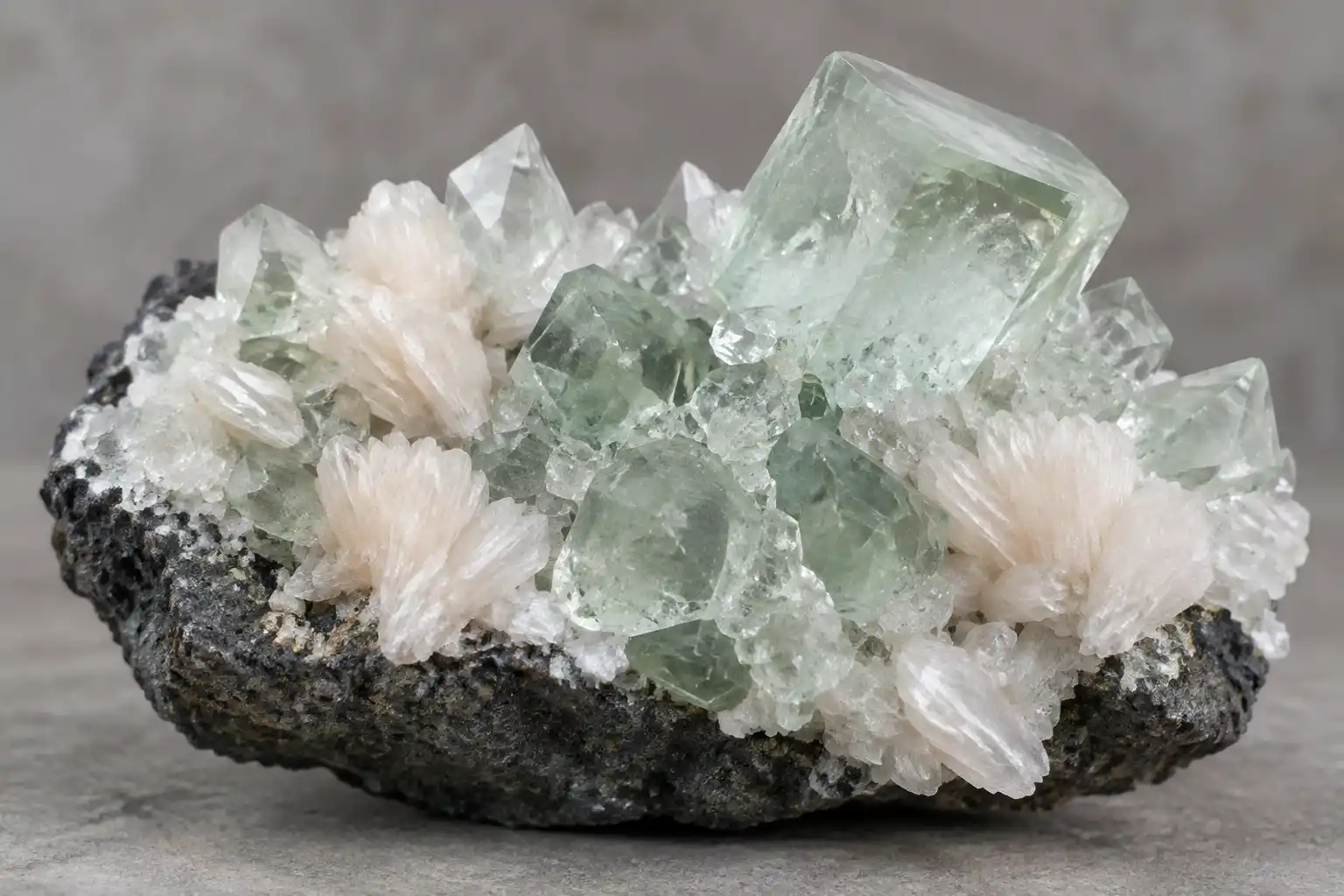
Apophyllite benefits begin with spectacular natural crystal form. Clear, white, pale green, pinkish, and occasionally yellowish specimens can develop highly reflective faces, sharply defined terminations, tabular crystals, and striking clusters that require little or no cutting to become visually impressive. Some crystals look almost cubic at first glance even though common apophyllite-group species crystallize in the tetragonal system.
The name apophyllite actually refers to a mineral group rather than one single mineral species. Fluorapophyllite-(K) is among the most familiar members seen in collections, while other members differ in dominant chemical components. These hydrated calcium silicates frequently occur as secondary minerals in cavities within basalt and related volcanic rocks, often beside stilbite and other zeolite-associated minerals.
The strongest apophyllite benefits are therefore mineralogical, geological, collectible, decorative, and educational. Its comparatively low hardness and perfect cleavage make it less practical for high-wear jewelry than quartz or sapphire, but those limitations do little to reduce the appeal of a well-formed natural cluster.
7 Apophyllite Benefits at a Glance
- Sharp crystal forms create impressive display specimens without faceting.
- Clear, white, green, and other colors provide substantial collecting variety.
- High surface luster can give natural crystals a bright, almost glass-like appearance.
- Basalt-cavity occurrences reveal interesting low-temperature mineral formation.
- Association with stilbite and other secondary minerals creates attractive multi-mineral specimens.
- The apophyllite group provides useful lessons in mineral classification, cleavage, hydration, and crystal structure.
- Modern spiritual symbolism can add personal meaning while remaining separate from proven medical effects.
Natural Crystal Form Leads the Most Visible Apophyllite Benefits
Among the most obvious apophyllite benefits is the fact that attractive specimens rarely need lapidary enhancement. Well-formed crystals can emerge from their host rock with flat reflective faces, sharp edges, pyramidal terminations, and enough transparency to catch light dramatically.
Many common crystals appear square in cross section because of their tetragonal structure. Some terminate in pyramid-like faces, while others form tabular shapes or clusters in which numerous crystals grow together. The combination can make an untreated specimen look unusually geometric.
Clear apophyllite can resemble glass or colorless gemstones at first glance, while green specimens add another level of visual interest. The surface luster may appear vitreous on many faces and distinctly pearly along cleavage surfaces.
These features explain why specimen collectors generally value natural form more than polishing. Cutting away the original faces can remove the very characteristics that make the crystal interesting.
Color Variety Gives Apophyllite Strong Collecting Appeal
Color adds another layer to apophyllite benefits. Colorless and white specimens are widespread, but pale green examples are particularly popular because their soft coloration combines with excellent transparency and reflective faces. Pink, yellowish, and other less common appearances can also occur within the group.
Color alone should not determine identification. Different apophyllite-group species can look similar, while other minerals can resemble apophyllite visually. Accurate classification may require chemical or structural analysis rather than simply deciding from a photograph.
For collectors, variation can become part of the appeal. One collection might focus on clear crystals with strong luster, another on green specimens, and another on combinations with stilbite, heulandite, calcite, or other associated minerals.
The visual diversity provides genuine apophyllite benefits without requiring claims that different colors possess different medical effects.
Reflective Faces Make Apophyllite an Excellent Display Mineral
A well-positioned apophyllite cluster can appear unusually bright because smooth crystal faces reflect light efficiently. This creates flashes and mirror-like reflections even when the mineral itself has modest refractive properties compared with high-brilliance faceted gems.
Clear specimens can also transmit light through the crystal while surface reflections define the geometry. Under soft directional lighting, a cluster may alternate between transparent areas, bright highlights, and internal reflections.
These qualities make apophyllite especially effective in mineral cabinets and natural-history displays. Unlike a gemstone whose appearance depends heavily on expert cutting, apophyllite can demonstrate crystallography in the form in which it actually grew.
Large clusters can become dramatic decorative objects, although stable supports are important because individual crystals are relatively brittle.
Basalt Cavities Give Apophyllite Geological Value
Geological context is one of the most important apophyllite benefits for anyone interested in how minerals form. Apophyllite-group minerals commonly occur as secondary crystals in cavities, fractures, and vesicles within basaltic volcanic rocks.
After lava solidifies, open spaces can remain where gas bubbles once existed. Mineral-rich fluids later move through the rock and deposit new crystals along cavity walls. Apophyllite may grow during these later stages together with zeolites and other secondary minerals.
The famous mineral-producing districts of Maharashtra, India, have supplied extraordinary apophyllite specimens, often associated with stilbite and other cavity-forming minerals. Similar occurrences exist in many other regions.
A cluster attached to matrix therefore preserves more than attractive crystals. It records a sequence of volcanic activity, cooling, open-space formation, fluid movement, and later mineral growth.
Apophyllite and Stilbite Create Distinctive Multi-Mineral Specimens
Apophyllite is frequently collected alongside stilbite, whose white, cream, peach, or pinkish crystals can create strong visual contrast with transparent or green apophyllite.
The minerals do not necessarily grow at exactly the same moment. Cavities can experience several episodes of mineral deposition, allowing one species to form before another. A finished specimen may therefore preserve a miniature history of changing fluid chemistry inside the host rock.
Collectors often value balanced arrangements where both minerals remain well formed rather than one completely covering the other. Crystal condition, aesthetics, locality, luster, color, and matrix all influence specimen appeal.
These combinations are among the most recognizable apophyllite benefits for mineral collectors because a single piece can display several crystal habits and colors at once.
Apophyllite Helps Explain Why Hardness Is Not the Same as Durability
Common apophyllite-group minerals typically fall around 4.5 to 5 on the Mohs scale. That places them well below quartz at 7 and means harder minerals can scratch their surfaces relatively easily.
The crystal hardness chart is only part of the durability story, however. Apophyllite also has perfect basal cleavage and is brittle. A specimen can therefore split along a cleavage plane or chip even when no obvious scratching occurs.
This is why handling should focus on both abrasion and impact. Do not stack loose crystals together, allow heavier specimens to press against delicate terminations, or pick up a cluster by one projecting crystal.
For educational collections, these limitations are useful. Apophyllite demonstrates clearly that a beautiful, well-formed crystal can still require far more careful handling than its appearance suggests.
The Apophyllite Group Teaches Better Mineral Classification
One of the most valuable educational apophyllite benefits is that the familiar name does not refer to one chemically uniform mineral. Apophyllite is a group containing several related species whose compositions differ.
Fluorapophyllite-(K) is a familiar potassium- and fluorine-bearing member. Hydroxyapophyllite-(K) contains hydroxyl in the position where fluorine dominates in the fluorine-rich species, while sodium- and other less common members expand the group further.
This distinction matters because commercial sellers often label all visually similar specimens simply “apophyllite.” That may be adequate for casual decorative use, but advanced collectors should understand that precise species identification can require more evidence.
Learning this difference helps prevent a common mineral-collecting mistake: assuming every trade name describes one simple chemical substance.
Heat Explains the Unusual Origin of the Apophyllite Name
The word apophyllite derives from Greek roots connected with flaking or leafing away. Early mineralogists noticed that the mineral could exfoliate or separate when heated, an observation related to its hydrated structure.
That behavior has practical consequences. Strong heating is not a sensible cleaning or identification method for valuable specimens. Heat can damage crystals, affect water contained within the structure, and encourage cleavage or flaking.
Steam cleaning is therefore unnecessary. Gentle dust removal with a soft brush or careful air movement is much safer for display specimens.
This naming history is one of the most interesting apophyllite benefits for students because an apparently abstract mineral name actually preserves an observation about physical behavior.
Apophyllite Is Better as a Specimen Than Everyday Jewelry
Transparent apophyllite can look gem-like, but beauty alone does not make a stone suitable for demanding jewelry. Hardness around 4.5 to 5, brittleness, and perfect cleavage create significant wear limitations.
Faceted examples exist mainly as collector gems rather than everyday jewelry stones. A pendant or carefully protected collector piece may survive occasional wear, but exposed rings and bracelets face scratches and impacts that apophyllite does not tolerate particularly well.
For most buyers, intact crystal clusters offer stronger apophyllite benefits than wearable gems. Natural specimens preserve crystallographic form and often retain associated minerals that would disappear during cutting.
If jewelry is chosen, protective settings and occasional wear make more sense than treating apophyllite like quartz.
Gentle Care Preserves Apophyllite Crystal Clusters
Apophyllite care should begin with minimal handling. Pick up specimens by stable matrix rather than projecting crystals whenever possible. Keep clusters in a cabinet or on a surface where vibration, pets, children, and accidental knocks are unlikely.
A soft brush can remove light dust. Avoid aggressive scrubbing, steam, high heat, sudden temperature changes, and prolonged immersion when the matrix or associated minerals are unknown.
Water may not instantly destroy every apophyllite specimen, but a multi-mineral cluster can contain more sensitive associated species, altered matrix, clay, or fragile attachments. Conservative dry cleaning therefore reduces unnecessary risk.
Proper storage is one of the simplest apophyllite benefits because a specimen protected from impact can preserve delicate natural crystal form for decades.
Modern Spiritual Use Adds Symbolism Without Medical Proof
Modern metaphysical traditions commonly associate apophyllite with clarity, spiritual connection, intuition, meditation, emotional release, and a feeling of openness. Clear crystals in particular are often linked with clarity, while green specimens receive additional symbolism involving growth or compassion.
These ideas can support personal rituals. A collector might keep a clear cluster near a meditation area because its geometry and reflective surfaces create a quiet visual focus.
Claims about apophyllite healing properties should remain distinct from the verified apophyllite benefits described by mineralogy. Apophyllite has not been scientifically established as a treatment for anxiety, respiratory disease, allergies, memory problems, fatigue, trauma, or other health conditions.
The natural crystals are already remarkable without requiring medical powers.
Conclusion
Apophyllite benefits include striking natural crystal form, varied colors, reflective surfaces, interesting basalt-cavity geology, attractive associations with stilbite, educational value, and strong mineral-collecting appeal.
Its softness, brittleness, cleavage, and heat sensitivity make it better suited to careful display than demanding everyday jewelry. Understanding apophyllite as a mineral group rather than one simple species also reveals a more interesting scientific story than the commercial label alone suggests.
FAQs
What Are the Main Apophyllite Benefits?
Apophyllite benefits include natural crystal beauty, collecting value, geological interest, reflective luster, color variety, educational mineralogy, and personal symbolism.
Is Apophyllite One Mineral?
Apophyllite is a mineral group containing several closely related species rather than one single chemical species.
How Hard Is Apophyllite?
Common apophyllite-group minerals are around Mohs 4.5 to 5, making them considerably softer than quartz.
Is Apophyllite Good for Jewelry?
It is usually better suited to mineral collecting. Softness, brittleness, and perfect cleavage make everyday rings and bracelets relatively risky.
Where Is Apophyllite Commonly Found?
Important specimens have come from basalt cavities in Maharashtra, India, although apophyllite-group minerals occur in many regions worldwide.
Why Is Apophyllite Often Found With Stilbite?
Both can crystallize as secondary minerals from mineral-rich fluids moving through cavities in volcanic rocks.
Why Is It Called Apophyllite?
The name comes from Greek roots associated with flaking or leafing away, referring to the mineral’s tendency to exfoliate when heated.
Can Apophyllite Be Washed in Water?
Brief contact may not harm every specimen, but delicate crystals, matrix, and associated minerals make conservative dry cleaning preferable for valuable clusters.
Does Apophyllite Have Proven Healing Benefits?
No reliable evidence establishes apophyllite as a medical treatment.
Modern symbolic apophyllite benefits are personal wellness beliefs and should not replace qualified medical or mental health care.