

Brucite is a soft magnesium hydroxide mineral and the defining member of the Brucite mineral group. Its perfect basal cleavage, pearly or waxy luster, flexible plates, and occasional vivid lemon-yellow crystal clusters distinguish it from harder yellow and green gemstones.
Brucite at a Glance
| Property | Details |
|---|---|
| Mineral group or material type | Hydroxide mineral; Brucite group |
| Composition | Magnesium hydroxide, Mg(OH)₂, with possible iron or manganese substitution |
| Colors | White, colorless, pale green, blue, gray, yellow, honey-brown, reddish brown, and deep brown |
| Crystal system | Trigonal, commonly described within the hexagonal family |
| Habit | Tabular plates, foliated masses, rosettes, fibrous aggregates, granular material, and massive forms |
| Luster | Waxy, vitreous, or pearly on cleavage surfaces |
| Transparency | Transparent to translucent |
| Mohs hardness | About 2.5–3 |
| Cleavage | Perfect basal cleavage |
| Tenacity | Sectile; thin plates may flex, while fibrous material can be elastic |
| Common use | Mineral specimens, geological study, limited ornamental use, and industrial magnesium applications |
| Main care concern | Extreme scratch sensitivity, easy cleavage, acids, fragile matrix, and possible hazardous associated fibers |
What Is Brucite?
Brucite has the chemical formula Mg(OH)₂, meaning its structure contains magnesium bonded with hydroxyl groups. The atoms form stacked layers, which explains the mineral’s perfect basal cleavage and tendency to separate into thin plates.
Fresh Brucite may appear colorless or white, while trace elements and inclusions can produce pale green, blue, gray, honey-yellow, orange-brown, or reddish material. Particularly bright yellow clusters from Pakistan transformed Brucite from a mainly specialist mineral into a widely recognized collector specimen.
The mineral was named for Archibald Bruce, an early American mineralogist. Although commercial sellers sometimes describe it as a gemstone, Brucite remains primarily a mineral specimen because its softness and cleavage sharply limit jewelry durability.
How Brucite Forms
Brucite commonly forms when magnesium-rich minerals react with water during geological alteration. In marbles, for example, it may replace periclase as rocks cool and interact with fluids.
Serpentinization provides another important formation route. Water reacts with magnesium-rich rocks such as dunite and peridotite, creating serpentine minerals and, under suitable conditions, Brucite.
Low-temperature hydrothermal veins in metamorphic limestone, dolomitic rocks, and chlorite schists also host the mineral. As a result, Brucite may occur with calcite, aragonite, dolomite, magnesite, hydromagnesite, talc, serpentine minerals, and chrysotile.
Formation conditions affect appearance. Open cavities allow tabular crystals and rosettes to develop, whereas replacement zones more often contain foliated, fibrous, granular, or massive Brucite.
Crystal Structure and Cleavage
Brucite consists of sheets of magnesium-centered octahedra separated by relatively weak bonding between layers. Consequently, the mineral cleaves perfectly parallel to its basal plane.
A crystal may split into thin, mica-like plates, although Brucite does not belong to the mica group. These plates can show a pearly sheen and limited flexibility, while fibrous aggregates may bend elastically.
Perfect cleavage creates a smooth reflective surface but also a major durability weakness. Even gentle pressure along an unfavorable direction can separate layers or bruise an otherwise attractive crystal.
The structure also contributes to Brucite’s low hardness. At approximately 2.5–3 on the Mohs scale, it can be scratched by many common metal objects and by nearly every popular jewelry gemstone.
Color and Visual Character
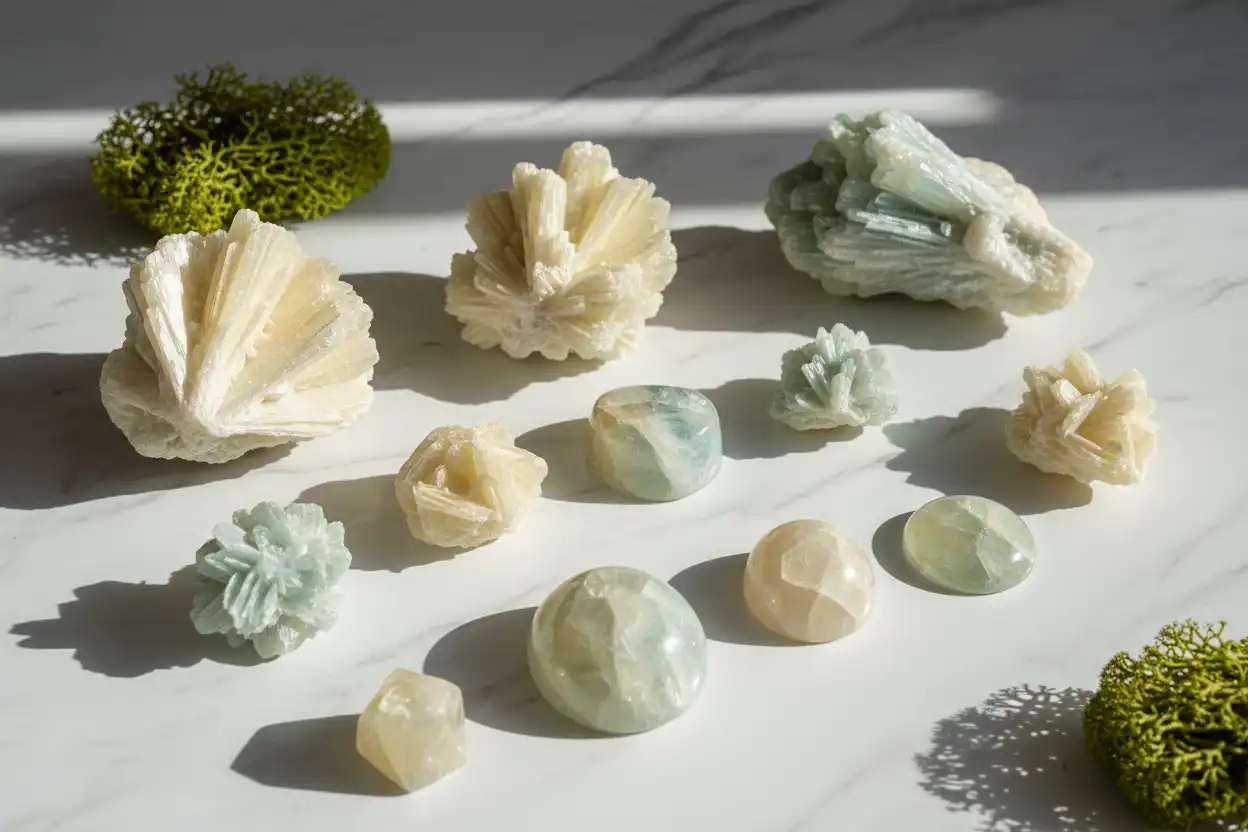
Traditional Brucite specimens often appear white, pale green, gray, or bluish. Their waxy luster and platy texture may resemble talc, serpentine, hydromagnesite, or soft calcite-rich material.
Yellow Brucite gained international attention after significant discoveries in Balochistan, Pakistan. Those specimens may form rounded rosettes, disks, botryoidal-looking clusters, layered blades, or sparkling groups with colors ranging from pale cream to saturated lemon yellow.
Manganese-bearing material can show honey-brown, reddish brown, or deeper brown colors. However, color terms alone provide little certainty because coatings, iron oxides, associated minerals, and lighting can change the visible appearance.
Thin transparent plates may look almost glassy from one direction and pearly from another. Therefore, photographs should include more than one angle to represent luster and translucency accurately.
Main Forms and Varietal Names
Brucite does not have a broad formal variety system, although several descriptive or historical names occur in collections.
Nemalite refers to fibrous Brucite, traditionally forming long, parallel fibers or lath-like aggregates. The material may appear white, pale green, gray, or brown depending on impurities and associated minerals.
“Manganoan Brucite” describes material containing appreciable manganese. Older labels may use names such as manganobrucite, but modern descriptions should clarify that manganese substitutes within Brucite rather than creating a visually defined gemstone variety in every case.
Ferroan Brucite contains iron substitution. Because exposure and oxidation can change iron-bearing material, specimens may develop brownish surfaces or complex alteration products.
Commercial phrases such as lemon Brucite, yellow Brucite, or Pakistani Brucite describe color and origin. They do not designate separate mineral species.
Important Brucite Localities
Wood’s Chrome Mine in Lancaster County, Pennsylvania, produced classic large Brucite crystals and historically important American specimens. Older examples with reliable provenance remain highly desirable to locality collectors.
Other North American occurrences include deposits in New Jersey, New York, Nevada, California, and Québec. The former asbestos-mining district around Val-des-Sources, historically called Asbestos, Québec, also produced Brucite associated with magnesium-rich altered rocks.
Zimbabwe’s Ethyl Mine supplied fine crystals, while South African localities such as Phalaborwa and the Kalahari manganese fields produced additional collector material. Sweden, Russia, Italy, Scotland, and Australia also contain documented occurrences.
Killa Saifullah District and nearby areas of Balochistan, Pakistan, dominate the modern yellow-Brucite market. Fine pieces display bright color, strong translucency, attractive rosettes, and enough crystal coverage to create dramatic cabinet specimens.
Is Brucite a Gemstone?
Brucite can be polished or mounted as an ornamental curiosity, but it performs poorly as a conventional jewelry stone. A hardness below 3 means even ordinary wear can scratch the surface rapidly.
Perfect cleavage introduces another limitation. Cutting pressure, setting force, and minor impact may separate layers or break a crystal along its basal plane.
Consequently, dealers usually sell Brucite as natural crystal specimens rather than faceted gems or durable cabochons. A complete yellow cluster often has more collector value in its original form than any polished piece produced from it.
Jewelry Suitability
Brucite is unsuitable for rings, bracelets, or other jewelry that experiences frequent contact. Even a protected setting cannot prevent gradual scratching when the surface encounters dust, metal, fabric contaminants, or harder stones.
A pendant-style specimen mount may work for display rather than routine wear. However, the mounting method should avoid drilling, strong adhesive penetration, and concentrated pressure on cleavage surfaces.
Owners should also consider associated matrix minerals. A Brucite cluster attached to serpentine, calcite, or fractured host rock may detach even when the visible yellow crystals remain intact.
Collectors who appreciate the color but need a wearable yellow gem should choose a harder material. Brucite itself is best treated as a display mineral.
Industrial Uses
Brucite has uses beyond collecting because magnesium hydroxide can serve as a source of magnesium compounds. Processed material may contribute to refractory products, environmental treatment, flame-retardant applications, and acid neutralization.
Industrial Brucite deposits differ from specimen deposits. Manufacturers prioritize tonnage, purity, processing behavior, and economics rather than crystal shape, color, or display quality.
A bright collector cluster should not be assumed to represent industrial-grade ore. Likewise, an industrial Brucite deposit may contain little material that appeals to mineral collectors.
How Brucite Is Sold
Retail sellers offer Brucite as miniature specimens, cabinet clusters, loose blades, fibrous pieces, massive rough, educational samples, and historic locality specimens. Yellow Pakistani clusters account for a large share of the current decorative market.
Small pieces often appear in mineral flats or crystal shops. Specialist dealers generally provide better locality documentation, condition reports, matrix descriptions, and disclosure of repairs.
Brucite is priced by the specimen rather than by carat. Measurements, crystal coverage, color, translucency, condition, provenance, and visual composition carry more importance than total weight.
Historic material may enter auctions and old-collection sales. In those cases, original labels and verifiable ownership history can contribute substantially to value.
Brucite Price and Value
Small common specimens or fragments often retail for approximately $10–$50. Attractive yellow miniatures and modest clusters commonly range from about $50 to $300.
Larger cabinet specimens with vibrant color, strong luster, good translucency, and limited damage may sell for $300–$1,000. Exceptional Pakistani clusters, unusual two-generation pieces, or high-quality classic localities can exceed that range.
Historic specimens from Wood’s Chrome Mine or other celebrated localities may reach several thousand dollars. One current high-end dealer listing for a large nineteenth-century Pennsylvania specimen approached five figures, illustrating how provenance can outweigh ordinary material value.
These figures represent asking prices rather than guaranteed sale values. Since Brucite crystals damage easily, condition differences can justify large price gaps between specimens of similar dimensions.
What Makes Brucite Valuable?
Collectors generally evaluate the following characteristics:
- Color: Saturated lemon-yellow material receives strong demand, although fine green, blue, white, fibrous, or historic specimens also have specialist appeal.
- Luster: Waxy-to-vitreous surfaces should appear fresh rather than chalky or weathered.
- Translucency: Light passing through crystal edges adds depth and visual interest.
- Crystal definition: Distinct plates, rosettes, disks, and layered forms carry more appeal than featureless massive pieces.
- Coverage: A well-composed cluster with crystals distributed across the matrix often outperforms a larger but visually empty specimen.
- Condition: Cleaved, crushed, bruised, or detached crystals reduce value unless the piece has exceptional historical importance.
- Locality: Pakistani yellow material, classic Pennsylvania pieces, and other documented deposits occupy different collector niches.
- Provenance: Original labels and trustworthy collection records strengthen confidence and may add historical value.
Size should be considered after quality. A compact specimen with bright undamaged crystals can be more desirable than a heavy block with dull or broken surfaces.
Treatments, Repairs, and Alterations
Brucite does not have a recognized routine gem-treatment market. Most specimens receive only extraction, trimming, cleaning, stabilization, or mounting.
Repairs are possible because individual plates and clusters detach easily. Adhesive may reconnect a broken crystal, secure matrix fragments, or reinforce an unstable base, and reputable sellers should disclose such work.
Wax, oil, or resin can temporarily intensify luster or hide surface dryness. Although not universal, these additions alter appearance and may attract dust or change cleaning requirements.
Dyed or coated material could imitate vivid yellow Brucite. Therefore, buyers should inspect fractures, crystal interiors, matrix contacts, and hidden areas for unnatural color concentration.
Brucite Imitations and Lookalikes
Yellow Brucite may resemble calcite, aragonite, sulfur, gypsum, hydromagnesite, or coated decorative minerals. Pale green material can also resemble talc, serpentine, or magnesite.
Brucite’s low hardness and perfect basal cleavage provide useful clues, yet testing should never involve scratching a valuable display crystal. Its relatively low specific gravity, pearly cleavage surfaces, and characteristic platy structure further support identification.
Calcite generally shows rhombohedral cleavage and reacts readily with weak acids. Nevertheless, acid testing can permanently damage both specimens and matrix, so collectors should not use vinegar or stronger acids as a casual home test.
Magnesite is harder and belongs to the carbonate class. Meanwhile, Serpentine represents a mineral group with different structures and a wider range of massive, fibrous, and ornamental forms.
How to Identify Brucite
Start by observing the crystal shape, cleavage, luster, locality, and associated minerals. Thin plates with a pearly basal surface and a hardness below 3 fit Brucite, although these characteristics are not conclusive on their own.
Specific gravity near 2.39 distinguishes it from several denser yellow or green minerals. Optical testing, Raman spectroscopy, X-ray diffraction, and chemical analysis can provide confirmation without relying on destructive scratch or acid tests.
Fibrous specimens deserve additional caution. Brucite itself is not an asbestos mineral, but it can form in serpentinite environments that also contain chrysotile or other fibrous phases.
The general crystal identification guide provides a safer observation framework. For valuable or fibrous specimens, professional identification remains preferable to cutting, sanding, or breaking the material.
Buying Guidance
Choose a specimen with clear photographs taken from the front, sides, back, and base. Hidden cleavage damage often appears only when the piece is viewed from below or across the crystal edges.
Ask whether any crystals have been repaired, stabilized, oiled, or reattached. Additionally, confirm whether the specimen sits on natural matrix, a reconstructed base, or removable mineral putty.
For yellow Pakistani material, compare the brightness under ordinary daylight rather than accepting heavily saturated photographs. Some listings increase color intensity through editing, warm lighting, or wet surfaces.
Historic specimens require dependable labels. A modern handwritten card claiming an old mine does not provide the same evidence as an original collection label supported by documented ownership.
Hardness and Durability
Brucite ranks among the softer collectible minerals. Its Mohs hardness of roughly 2.5–3 means copper, steel, quartz dust, and many everyday objects can leave scratches.
Perfect cleavage makes the mineral vulnerable even when the surface avoids abrasion. A light impact may split a plate or remove a crystal from the matrix.
Never stack Brucite specimens or allow them to touch harder minerals. Instead, provide a dedicated padded box or a stable acrylic base with clearance around every crystal.
Handling should remain minimal. Clean, dry hands or disposable gloves can reduce oil transfer, although gloves must not catch on projecting plates.
Water Safety
Pure Brucite is only sparingly soluble in neutral water, so a very brief rinse does not necessarily destroy an intact crystal. However, prolonged soaking can loosen fractured matrix, affect adhesives, trap residue between layers, and complicate drying.
Acids pose a greater concern because Brucite neutralizes acidic solutions and can dissolve or alter. Consequently, vinegar, lemon juice, acidic cleaners, and household descalers should never be used.
The broader crystal water-safety guide explains why chemical composition, cleavage, porosity, treatments, and matrix all matter. Brucite should not be selected for crystal-water bottles, elixirs, baths, or prolonged immersion.
Cleaning Brucite
Begin with a hand-operated air blower rather than a brush. If dust remains, use an exceptionally soft artist’s brush with almost no pressure and support the specimen from its matrix.
A short rinse with room-temperature distilled water may be acceptable only when the specimen has no repairs, fibrous associates, unstable matrix, old labels, or water-sensitive mounting compounds. Afterwards, let it drain and air-dry without heat.
Ultrasonic vibration can separate layers and detach clusters. Steam, pressurized air, stiff brushes, detergents, acids, solvents, and abrasive powders introduce unnecessary risk.
Fibrous or crumbly material should not be dry-brushed indoors. A conservator or qualified mineral specialist can recommend containment and cleaning methods when associated asbestos minerals remain possible.
Storage and Display
Place Brucite in a covered case to reduce dust accumulation. Since cleaning carries risk, preventing contamination is more effective than repeatedly removing it.
Support the specimen at its strongest matrix points rather than beneath projecting crystals. Moreover, keep it away from shelf vibration, direct airflow, and locations where doors or drawers may create shocks.
Moderate indirect lighting usually preserves appearance while avoiding heat buildup. Adhesives, labels, and associated minerals may respond poorly to intense sunlight even when Brucite itself shows no immediate color change.
Brucite Meaning and Symbolism
Modern spiritual communities sometimes associate Brucite with fairness, patience, cooperation, and approaching conflict with a calmer perspective. Yellow specimens may also inspire personal connections with motivation, confidence, or constructive action.
These interpretations developed through contemporary spiritual practice rather than controlled mineralogical research. Brucite has no scientifically demonstrated ability to treat illness, regulate emotions, purify the body, or change external events.
Someone may still use the specimen as a personal reminder or contemplative object. Its geological story—water transforming magnesium-rich rock—can provide symbolism without requiring claims of physical or medical efficacy.
Frequently Asked Questions
Is Brucite rare?
Brucite occurs in numerous magnesium-rich geological environments. However, transparent, brightly colored, well-formed, undamaged crystals remain much less common than massive or industrial material.
Why is yellow Brucite so popular?
Pakistani discoveries produced vivid lemon-yellow clusters with strong luster and attractive rosette forms. Their appearance differs dramatically from the pale, massive Brucite familiar to earlier collectors.
Is Brucite a gemstone?
It can be considered an ornamental or collector material, but its extreme softness and perfect cleavage make it unsuitable for conventional everyday gemstone jewelry.
Can Brucite scratch easily?
Yes. At approximately 2.5–3 on the Mohs scale, Brucite scratches more easily than calcite, fluorite, quartz, and nearly all familiar jewelry stones.
Can Brucite go in water?
Brief contact may be acceptable for a stable untreated specimen, but soaking is not recommended. Matrix minerals, cleavage layers, repairs, and possible fibrous associates create additional risks.
Is Brucite toxic?
Intact Brucite is not generally treated as a highly toxic display mineral. Nevertheless, dust should not be inhaled, and specimens from serpentinite environments may contain associated fibrous minerals that require professional identification.
Is Brucite the same as magnesium?
No. Brucite is a naturally occurring magnesium hydroxide mineral, not elemental magnesium metal.
How can I tell Brucite from calcite?
Brucite is softer and shows perfect basal cleavage, while calcite displays rhombohedral cleavage and different optical behavior. Laboratory testing offers a safer answer than scratching or applying acid to a collectible specimen.
Explore more entries in the crystals that start with B directory or continue through the Gemstone Guides collection.
Disclaimer: Spiritual meanings are cultural or personal interpretations rather than proven effects. Do not ingest Brucite or use it to prepare drinking water. Avoid cutting, grinding, or dry-brushing fibrous or unidentified matrix material because mineral dust and associated asbestos-form minerals may present an inhalation hazard.