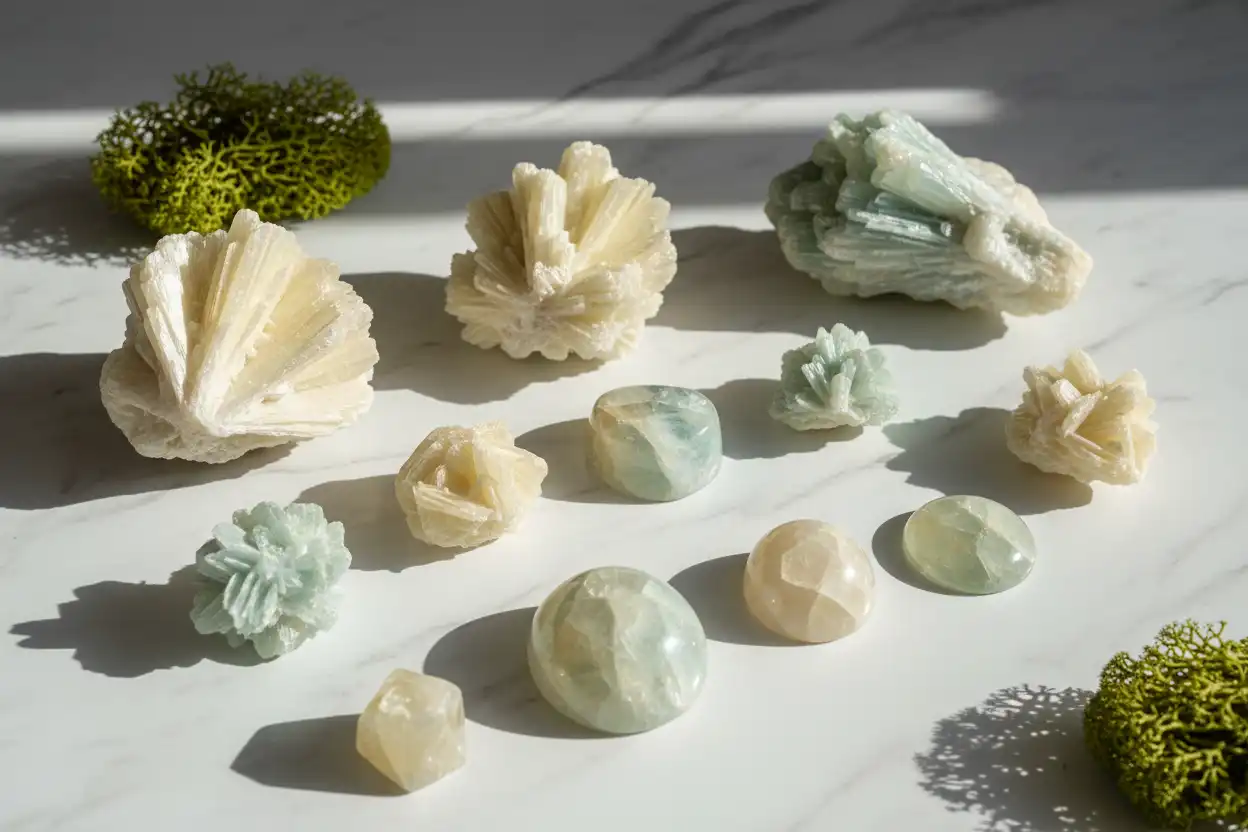
Brucite Meaning: Mineral Facts, History & Symbolism
Brucite meaning is commonly associated in modern crystal practice with simplicity, emotional steadiness, self-acceptance, patience, and clearing away unnecessary complications. Those ideas are symbolic interpretations rather than measurable effects of the mineral. Materially, brucite is magnesium hydroxide, Mg(OH)₂, a soft trigonal mineral that commonly occurs as platy crystals, foliated masses, compact aggregates, and fibrous forms in magnesium-rich geological environments.
Its real mineralogy is distinctive enough without metaphysical embellishment. Brucite has perfect basal cleavage, low hardness, relatively low density, a pearly to vitreous luster, and a layered crystal structure in which magnesium and hydroxyl groups are arranged in sheets. Those structural layers help explain why it separates so readily along one direction and why even attractive crystals can be much more delicate than their solid appearance suggests.
For other fact-first mineral references, browse the Gemstone Guides.
What Is Brucite?
Brucite is a recognized mineral species with the chemical formula Mg(OH)₂. It belongs to the hydroxide mineral class and crystallizes in the trigonal system. Its structure is built from sheets containing magnesium coordinated by hydroxyl groups, with comparatively weak bonding between adjacent layers. This layered architecture is responsible for its excellent basal cleavage and contributes to the soft, platy character seen in many specimens.
Pure brucite is colorless or white, but natural material can appear gray, pale green, bluish, yellow, brownish, pinkish, or nearly black depending on inclusions, impurities, associated minerals, alteration, and microscopic structural features. Bright yellow crystals have become especially familiar to mineral collectors, yet yellow is only one expression of a mineral with a much broader natural color range.
| Property | Brucite characteristics |
|---|---|
| Mineral species | Brucite |
| Chemical formula | Mg(OH)₂ |
| Mineral class | Hydroxide |
| Crystal system | Trigonal |
| Typical habit | Tabular, platy, foliated, compact, fibrous or massive |
| Common colors | Colorless, white, gray, pale green, blue-green, yellow, brown or pinkish |
| Mohs hardness | About 2.5 |
| Specific gravity | Approximately 2.35–2.40 |
| Cleavage | Perfect basal cleavage |
| Fracture | Uneven where cleavage does not dominate |
| Luster | Pearly on cleavage, vitreous to waxy elsewhere |
| Transparency | Transparent in thin crystals to translucent or opaque |
| Optical character | Uniaxial positive |
| Major geological setting | Magnesium-rich metamorphic and alteration environments |
| Separate mineral species? | Yes |
These properties distinguish brucite sharply from harder gemstones. A bright translucent yellow crystal may look gem-like under strong lighting, but its softness and cleavage make it fundamentally different from quartz, topaz, beryl, or corundum.
Why Brucite Has Such Perfect Cleavage
Brucite’s crystal structure is layered. Within an individual structural sheet, magnesium and hydroxyl groups are strongly organized, but the bonding between neighboring sheets is comparatively weak. Mechanical stress therefore tends to separate the mineral parallel to those layers.
This produces perfect basal cleavage. A crystal can split into thin plates or develop broad, flat cleavage surfaces that reflect light with a pearly sheen.
The property is diagnostically useful, but it also creates a durability limitation. A specimen does not need to be extremely soft to break easily along cleavage; hardness and cleavage describe different mechanical behaviors.
For brucite, both matter.
How Soft Is Brucite?
Brucite is approximately 2.5 on the Mohs scale. It can therefore be scratched much more easily than quartz, chalcedony, feldspar, beryl, or many conventional jewelry stones.
Even calcite, around Mohs 3, is slightly harder.
This low hardness means surface abrasion can quickly dull polished brucite. Rough crystals can also develop scratches from contact with harder minerals in a specimen drawer, while thin edges may bruise during ordinary handling.
A hardness value should not be used as an excuse to scratch-test a collector specimen. Crystal habit, cleavage, density, optical properties, geological association, and non-destructive analytical methods provide safer evidence when identification matters.
How Brucite Forms
Brucite forms where magnesium-rich rocks interact with water, heat, fluids, or metamorphic processes under conditions that allow magnesium hydroxide to become stable. It is particularly associated with altered ultramafic rocks such as serpentinite and with metamorphosed magnesium-rich carbonate rocks, including dolomitic limestone and marble.
In ultramafic settings, magnesium-rich precursor minerals such as olivine and pyroxene can undergo extensive alteration. Serpentine-group minerals, magnetite, brucite, carbonates, and related phases may develop as fluid-rock reactions reorganize the original mineral chemistry.
In carbonate-rich metamorphic settings, brucite can form through reactions involving magnesium-bearing carbonates. The exact mineral assemblage depends on temperature, pressure, fluid composition, silica activity, carbon dioxide activity, and the chemistry of the original rock.
Brucite can consequently occur with serpentine minerals, calcite, dolomite, magnesite, periclase-related alteration products, hydromagnesite, artinite, magnetite, and other magnesium-rich minerals depending on the deposit.
The detailed reaction pathways and host-rock relationships are explored in brucite formation and deposit geology.
Brucite and Serpentinite
One of the most important geological contexts for brucite is serpentinization, the alteration of magnesium-rich ultramafic rock by water-bearing fluids.
During serpentinization, minerals such as olivine react and produce new hydrous phases. Under appropriate chemical conditions, brucite can form alongside serpentine-group minerals and magnetite. The exact products depend heavily on the original ratio of magnesium, iron, and silica and on how fluids move through the rock.
This relationship is geologically important because brucite can participate in later reactions with carbon dioxide, producing magnesium carbonate minerals. That capacity has made magnesium-rich rocks and brucite-bearing systems scientifically interesting in discussions of natural mineral carbonation.
That geological reaction should not be confused with claims that brucite “absorbs negativity.” Chemical reaction with carbon dioxide is measurable mineral chemistry; metaphysical absorption is a different type of statement.
Brucite in Metamorphosed Carbonate Rocks
Brucite can also occur in metamorphosed dolomite-rich rocks. Under suitable conditions, magnesium carbonate minerals respond to heating and fluid interaction, creating new mineral assemblages.
Periclase, MgO, may form under high-temperature conditions and subsequently hydrate to brucite when water becomes available. Brucite can therefore occur as part of a reaction history rather than representing the original mineral present in the rock.
This matters when interpreting specimen textures. A brucite aggregate occupying the shape or position of an earlier mineral may preserve evidence of alteration that is more geologically informative than a simple statement that “brucite grew there.”
What Causes Brucite’s Color?
Pure magnesium hydroxide is not intrinsically bright yellow, green, or pink. Natural color can arise from trace substitutions, microscopic inclusions, associated minerals, structural defects, oxidation products, or a combination of these factors.
Iron and manganese are reasonable contributors to coloration in some brucite, but exact mechanisms should not be assigned to an individual stone merely from appearance. A lemon-yellow specimen does not reveal its trace-element chemistry by eye.
Likewise, pale green brucite may owe its color to minute inclusions or chemical substitutions, while darker material can contain significant associated phases.
The correct evidence level is therefore:
color can be observed directly;
candidate causes can be proposed from mineralogy;
exact color chemistry requires specimen-specific analysis.
The interaction between color, transparency, refractive behavior, crystal thickness, and surface luster is treated more fully in brucite optical properties and color behavior.
Yellow Brucite Is Not a Separate Mineral
Bright yellow brucite is visually distinctive enough that it is sometimes described as though it represented a special mineral variety with fundamentally different chemistry.
It does not.
Yellow brucite remains brucite when the mineral structure and chemistry are consistent with Mg(OH)₂. Color may influence collector desirability, but it does not create a new mineral species.
The same principle applies to pale green, white, gray, pinkish, or bluish material.
Color variety and mineral identity are separate concepts.
What Natural Brucite Looks Like
Natural brucite can take several forms, which is one reason identification based on online photographs is unreliable.
Well-developed crystals may be tabular or platy, sometimes forming stacked groups. Cleavage can produce thin sheets and broad pearly surfaces. Massive brucite can appear compact, granular, or foliated, while fibrous material develops elongated textures very different from plate-like crystals.
Common visual features include:
pearly cleavage surfaces;
vitreous crystal faces;
soft translucent edges;
stepped basal cleavage;
rounded or bruised crystal margins;
uneven color zoning;
associated carbonate or serpentine minerals;
small fractures;
foliated aggregates;
and variable transparency between thick and thin sections.
An exceptionally clean yellow crystal and a dull white foliated mass can therefore belong to the same mineral species.
An Original Brucite Specimen and Photo Checklist
The following checklist provides a non-destructive way to examine a purported brucite specimen before relying on trade descriptions.
Start with crystal or aggregate form
Determine whether the specimen is platy, tabular, foliated, massive, fibrous, or granular. Brucite can occupy several habits, so record the actual structure rather than requiring one idealized crystal form.
Look for strong basal cleavage
Broad flat surfaces that repeat in one dominant direction are highly relevant. Thin platy pieces may separate parallel to these surfaces.
Examine luster on different surfaces
Cleavage surfaces can look pearly, while other crystal faces may look more vitreous or subdued. One uniform artificial-looking gloss deserves additional examination.
Compare thick and thin areas
Thin plates may transmit considerably more light than thick aggregates. Pale color can become stronger or weaker as optical path length changes.
Inspect crystal edges
Brucite is both soft and cleavable. Small bruises, rounded abrasion, stepped breaks, and cleavage-related edge damage can be consistent with natural handling history.
Check for color zoning
Natural yellow, green, or gray coloration need not be perfectly uniform. Gradual changes and localized inclusions are plausible.
Examine the matrix
Serpentine-group minerals, carbonate rocks, magnetite, and other magnesium-rich phases can provide geological context. Matrix is supportive evidence, not proof of exact mineral identity.
Look for coatings
A surface coating, wax, resin, dye, or artificial gloss can alter appearance. Inspect cavities and damaged edges for differences between surface and interior.
Avoid casual scratch testing
Brucite’s softness is diagnostic, but intentionally scratching a collector specimen creates unnecessary damage.
Do not identify from yellow color alone
Sulfur, calcite, barite, fluorite, gypsum, smithsonite, resin, glass, and several other materials can occur in yellow forms.
Observe heft proportionately
Brucite is not especially dense compared with many metallic minerals. An unexpectedly heavy yellow specimen may contain substantial matrix or may belong to another mineral family.
Use magnification
A loupe can reveal cleavage, surface coatings, inclusions, fibrous textures, fractures, repairs, and relationships with matrix. More detailed observations are covered in the brucite microscope inclusion notebook.
Separate provenance from appearance
A specimen can look consistent with material from a famous source without that source being proven.
Preserve old labels
Original locality tickets, collection cards, specimen numbers, and acquisition records may contain evidence that cannot be reconstructed from the mineral itself.
Ignore metaphysical terminology during identification
Descriptions such as calming crystal, transformation stone, manifestation mineral, or high-vibration brucite do not provide mineralogical evidence.
A Source-Comparison Table for Common Brucite Claims
Brucite is frequently described with a mix of accurate mineral information, oversimplified chemistry, and metaphysical interpretations.
| Claim | Evidence status | More accurate interpretation |
|---|---|---|
| Brucite is magnesium hydroxide | Supported | Its ideal formula is Mg(OH)₂ |
| Brucite is a separate mineral species | Supported | It has a defined trigonal crystal structure |
| Brucite is very soft | Supported | Its Mohs hardness is about 2.5 |
| Brucite has perfect basal cleavage | Supported | Layered structure produces excellent cleavage |
| Every brucite specimen is yellow | Incorrect | White, gray, green, blue-green, brown, pinkish and other colors occur |
| Yellow brucite is a separate mineral | Incorrect | It is a color expression of brucite |
| All yellow color is caused by one trace element | Unsupported as a universal statement | Exact causes can vary and may require analysis |
| Brucite is a type of calcite | Incorrect | Brucite is Mg(OH)₂; calcite is CaCO₃ |
| Brucite and magnesite are the same mineral | Incorrect | Magnesite is magnesium carbonate, MgCO₃ |
| Brucite absorbs carbon dioxide | Context-dependent chemical statement | Brucite can react during mineral carbonation under suitable conditions |
| Carbon-dioxide reaction proves it absorbs negative energy | Unsupported inference | Chemical carbonation and spiritual symbolism are unrelated |
| Brucite calms anxiety biologically | Unsupported medical claim | Calmness belongs to modern symbolism or personal practice |
| Brucite helps manifestation | Metaphysical interpretation | No mineralogical measurement establishes this |
| Brucite heals the body because magnesium is essential | Unsupported reasoning | Magnesium bound in a mineral structure is not automatically delivered therapeutically through touch |
| Brucite activates chakras | Spiritual belief | Not a measurable mineral property |
The table illustrates an important boundary: a genuine chemical property does not validate an unrelated metaphysical mechanism merely because both use words such as absorption, release, balance, or transformation.
Brucite Versus Calcite
Brucite and calcite can overlap visually, particularly when both occur as pale, translucent, cleavage-rich material. They are chemically and structurally different.
Brucite is Mg(OH)₂ and has a hardness near 2.5. Calcite is CaCO₃ and is slightly harder, around Mohs 3. Calcite has characteristic rhombohedral cleavage and strong double refraction in suitable transparent crystals, while brucite has dominant basal cleavage reflecting its layered structure.
The cleavage geometry is especially useful. Calcite tends to break into rhombohedral forms; brucite tends toward plate-like separation.
Acid testing can distinguish carbonate minerals, but deliberately applying acid to a specimen is often unnecessary and can permanently damage it.
Brucite Versus Magnesite
Brucite and magnesite are both magnesium-rich minerals, but one is a hydroxide and the other a carbonate.
Brucite: Mg(OH)₂
Magnesite: MgCO₃
Their geological relationship can be interesting because magnesium hydroxide can participate in carbonation reactions that ultimately produce magnesium carbonate minerals under suitable conditions.
That does not make the two names interchangeable.
Magnesite is generally harder and has different crystallography, optical behavior, cleavage, and chemical response.
Brucite Versus Gypsum
The low hardness of brucite can create confusion with gypsum, another soft pale mineral.
Gypsum is calcium sulfate dihydrate, CaSO₄·2H₂O, and is approximately Mohs 2. Brucite is magnesium hydroxide and slightly harder.
Both may develop platy or cleavage-rich forms, but their density, chemistry, crystal system, optical behavior, geological associations, and cleavage characteristics differ.
Color alone contributes little to this comparison because both minerals can appear colorless, white, yellowish, gray, or otherwise tinted.
Brucite Versus Brookite
The preceding brookite meaning reference concerns titanium dioxide, TiO₂, an orthorhombic oxide with much greater density and higher hardness than brucite.
The names look superficially similar, but the minerals are unrelated.
Brookite commonly forms dark brown tabular crystals with strong luster, while brucite is a soft magnesium hydroxide commonly seen as pale, yellow, greenish, foliated, or platy material.
This is a useful reminder that similar mineral names do not imply similar composition.
Brucite Versus Bronzite
Bronzite meaning concerns iron-bearing enstatite, a magnesium-iron silicate pyroxene. Bronzite is significantly harder and is best known for bronze-colored schiller rather than perfect sheet-like cleavage.
Both can contain substantial magnesium, yet magnesium content does not make them closely equivalent minerals.
One is a hydroxide with a layered structure; the other is a silicate whose pyroxene structure and iron content create very different properties.
Brucite Versus Bustamite
Bustamite meaning concerns a calcium-manganese silicate mineral whose pinkish to reddish coloration and much harder silicate structure differ sharply from brucite.
The comparison is especially useful when polished ornamental material has lost its original crystal form. Once natural habit is removed, chemistry, refractive behavior, density, hardness, and microscopy become more important than broad color descriptions.
Brucite Versus Bytownite
Bytownite meaning describes a calcium-rich plagioclase feldspar rather than a hydroxide mineral. Bytownite is much harder, may show feldspar twinning, and forms within completely different igneous mineral systems.
A pale yellow or colorless polished object could potentially create superficial visual overlap, but gemological properties separate them readily.
Microscopy and Diagnostic Limits
Magnification can reveal cleavage traces, fractures, inclusions, growth features, coatings, and relationships between brucite and associated minerals. Fibrous material may show parallel or radiating texture, while platy specimens reveal stacked cleavage surfaces.
Microscopy also helps determine whether a glossy appearance comes from natural mineral luster or from wax, resin, or another applied substance.
What a microscope usually cannot do alone is quantify exact chemical composition or prove a specific mine locality. Fine-grained mixtures can also be difficult to separate visually.
When the stakes are high, instrumental analysis becomes more appropriate.
Laboratory Identification
Brucite can be identified confidently using several complementary analytical methods.
Raman spectroscopy can distinguish brucite through characteristic vibrational modes associated with hydroxyl groups and the Mg(OH)₂ structure.
X-ray diffraction can identify its layered trigonal crystal structure directly.
Chemical analysis can confirm magnesium-rich composition and detect substitutions or associated elements.
Infrared spectroscopy can provide information related to hydroxyl bonding.
Optical examination can support identification in sufficiently transparent material through refractive and birefringence behavior.
A matrix-rich specimen may require targeted analysis because testing the whole object indiscriminately could produce a mixed result from several minerals.
Treatments, Repairs, and Misidentification
Brucite is valued primarily as a natural collector mineral, so treatment is generally less central than it is for commercial transparent gemstones. Nevertheless, individual specimens can be repaired, stabilized, coated, dyed, waxed, oiled, or artificially mounted.
Fragile crystal clusters may be reattached to matrix. A disclosed repair does not automatically eliminate collector interest, but it changes the specimen’s condition history.
Bright yellow specimens deserve the same evidence-based approach as any other color: unusual saturation should encourage careful examination, not an assumption that every vivid specimen is treated.
Misidentification can be equally important. Soft yellow minerals can resemble one another in photographs, and a commercial label should not substitute for physical or analytical evidence.
Documented History of Brucite
Brucite was named in honor of Archibald Bruce, an American mineralogist associated with early mineralogical study and collecting.
That documented naming history belongs to scientific mineralogy.
Modern metaphysical narratives sometimes attribute highly specific ancient uses to brucite, but those claims require evidence demonstrating that historical cultures identified the material specifically as brucite rather than simply using an unidentified pale or magnesium-rich stone.
A genuine archaeological use of a mineral and a modern spiritual narrative about that mineral are not automatically the same thing.
Where historical evidence is absent, modern symbolism should simply be described as modern.
Brucite Meaning in Modern Symbolism
Modern brucite meaning commonly emphasizes simplicity, acceptance, patience, emotional steadiness, and reducing unnecessary complication.
Its layered structure provides a natural metaphor. A complex-looking crystal can separate along remarkably clear planes, suggesting the idea of dividing an overwhelming situation into manageable layers.
Someone might use a brucite specimen while journaling about which parts of a problem are essential, which are assumptions, and which can be addressed separately. Another person might associate its pale color and simple chemistry with reducing mental clutter or choosing a direct response instead of an elaborate one.
These are reflective uses. The stone does not chemically reorganize emotions through ordinary contact.
Simplicity as a Material-Inspired Metaphor
Brucite has a comparatively simple ideal formula:
Mg(OH)₂
That simplicity makes it tempting to translate chemistry directly into symbolism. It is reasonable to use the formula metaphorically—for example, as a reminder that a solution does not always need to be complicated.
What would be unsupported is claiming that simple chemistry causes psychological simplicity.
The formula describes atomic composition, not a biological effect on thought.
A useful symbolic exercise is therefore behavioral rather than supernatural: identify one action that can be completed, one assumption that needs evidence, and one complication that can be removed.
Brucite and Emotional Calm
Brucite is often marketed as calming or emotionally soothing. A pale, softly lustrous specimen may indeed look visually gentle to someone who prefers subdued mineral colors.
That aesthetic response can be personally meaningful.
It does not demonstrate that magnesium hydroxide crosses the skin, changes neurotransmitters, suppresses anxiety, or medically regulates mood.
A familiar stone can instead function as a cue to use an established calming practice such as slower breathing, journaling, stepping away from a stressful conversation, or seeking appropriate support.
Brucite and Acceptance
Acceptance is another common symbolic interpretation.
The mineral’s softness can inspire a metaphor that flexibility or reduced resistance is not necessarily weakness. Its layered cleavage can similarly suggest that separation and simplification sometimes reveal structure more clearly.
Someone can use that idea when distinguishing between circumstances that can be changed and those that currently cannot.
Again, the mineral supplies imagery. The psychological work remains human.
Chakra Associations
Contemporary crystal traditions may associate brucite with the solar plexus, heart, crown, or other chakras depending on color and the particular metaphysical system being used.
Those assignments are spiritual interpretations rather than mineralogical classifications.
A spectrometer can evaluate molecular vibrations, and diffraction can identify crystal structure. Neither determines whether a chakra is open, blocked, balanced, activated, or cleared.
People may still choose brucite as a meditation object within a chakra practice as long as the belief is not presented as measured anatomy or physiology.
Does Brucite Have Healing Properties?
Brucite should not be presented as a medical treatment.
Claims that it treats anxiety, depression, digestive disorders, magnesium deficiency, inflammation, muscle problems, sleep disorders, detoxification, neurological conditions, or other health concerns are not established by identifying the mineral as Mg(OH)₂.
Its measurable properties include magnesium-hydroxide chemistry, layered structure, hardness, cleavage, density, optical behavior, and geological formation.
Those properties do not demonstrate therapeutic action through ordinary handling.
A person may use a specimen during meditation or reflection without substituting it for appropriate healthcare.
Magnesium in Brucite Is Not a Supplement
The fact that magnesium is an essential nutrient does not mean brucite functions as a magnesium supplement through touch.
Magnesium in brucite is structurally bound in a mineral lattice. Nutrition depends on chemical form, route of exposure, dose, absorption, and biological context.
A mineral formula therefore cannot be converted into a health recommendation.
This same reasoning applies to other gemstones containing elements that are biologically important in completely different chemical forms.
Industrial Magnesium Hydroxide Is Not the Same Question
Magnesium hydroxide has legitimate industrial and chemical uses, including applications where its basic chemistry, thermal decomposition behavior, or acid-neutralizing capacity is useful.
Those applications involve controlled material processing, known composition, particle size, concentration, and defined chemical conditions.
A natural mineral specimen sitting on a shelf is not automatically performing those industrial functions in the human body.
Recognizing valid chemical applications should make the distinction between real chemistry and metaphysical claims clearer, not blurrier.
Cutting and Polishing Brucite
Brucite is not an easy conventional lapidary material. Its softness means abrasives can remove material quickly, while perfect cleavage creates a strong risk of splitting. A polished surface can also scratch readily after finishing.
Some compact or attractive translucent material may be cut for collectors, but sharp natural crystals are usually more valuable when their original form is preserved.
Before cutting a specimen, the cutter should consider whether it retains scientifically or aesthetically important crystal morphology, matrix relationships, locality documentation, or unusual habit.
Detailed lapidary considerations are covered in brucite cutting, orientation and polish.
Jewelry Durability
Brucite is poorly suited to exposed everyday jewelry.
A hardness around 2.5 means rings and bracelets would accumulate scratches quickly, while perfect cleavage creates additional vulnerability to impact and setting pressure. Thin crystals can also split during mounting.
If brucite is used decoratively, pendants, protected display jewelry, or collector-oriented settings are generally more practical than high-wear designs.
Even then, contact with harder jewelry components should be minimized.
The mechanical implications of cleavage, setting pressure, wear exposure, and stone orientation are covered in brucite setting and wear engineering.
Provenance and Famous Yellow Brucite
Collector demand can become strongly associated with visually distinctive material from particular mining regions, especially vivid yellow crystal groups.
Appearance is not enough to prove locality.
A bright yellow brucite specimen may be visually consistent with a known source while still requiring documentation before a precise mine claim is justified.
Useful provenance evidence includes:
original mine or dealer labels;
specimen numbers;
acquisition records;
photographs from the original parcel;
collection history;
supplier documentation;
or a traceable chain of custody.
The brucite provenance disclosure checklist provides a structured way to distinguish documented origin from assumption.
Conserving Brucite Specimens
Brucite’s softness and cleavage make physical protection especially important.
A crystal should not be stored loose with quartz, feldspar, garnet, or other harder minerals because ordinary contact can scratch or bruise it. Thin crystals and stacked cleavage plates also need support against crushing.
Collectors should document any existing edge damage, cleavage cracks, matrix instability, repairs, or surface coatings before changing storage or cleaning methods.
Baseline images are valuable because they allow future condition changes to be compared objectively.
The brucite specimen conservation record provides a structured framework for tracking those observations.
Cleaning Brucite Conservatively
The safest approach begins with the understanding that brucite is soft and easily damaged mechanically.
Aggressive brushing, abrasive powders, scraping, tumbling, harsh chemical cleaning, or prolonged soaking of unknown matrix material can alter a specimen.
A delicate crystal cluster may also contain associated minerals whose chemical behavior differs from brucite.
Physical cleaning should therefore be minimal and tailored to the actual specimen rather than copied from a universal crystal-cleaning ritual.
Symbolic “cleansing” does not require exposing a mineral specimen to water, salt, heat, acids, or other potentially damaging materials.
Safe Ownership and Handling
Normal handling of an intact brucite specimen does not require treating magnesium hydroxide as inherently dangerous. Exposure route and physical form matter.
The more relevant risks involve fragile crystals and mineral dust.
Sawing, grinding, drilling, polishing, or crushing any mineral specimen can create fine particulate matter, while the matrix may contain other minerals with different hazards. Appropriate wet methods where suitable, local extraction, eye protection, and respiratory controls should be used for specimen preparation or lapidary work.
Fibrous brucite varieties deserve particularly conservative dust control because elongated mineral particles should not be deliberately generated or inhaled.
Do not grind brucite into powder for consumption or use specimens to prepare drinking-water crystal elixirs.
Ordinary possession of a stable specimen and inhalation of respirable mineral dust are fundamentally different exposure scenarios.
A Practical Evidence Ladder for Brucite Claims
Brucite claims become easier to assess when each question is matched with evidence capable of answering it.
Direct observation can document color, crystal habit, cleavage, luster, matrix, fractures, dimensions, and visible condition.
Basic mineral testing can assess low hardness, specific gravity, cleavage behavior, and other expected physical properties.
Microscopy can reveal layered cleavage, inclusions, fibrous textures, coatings, repairs, alteration, and matrix relationships.
Optical examination can evaluate refractive properties and anisotropy in sufficiently transparent material.
Raman or infrared spectroscopy can identify hydroxide-related vibrational features characteristic of brucite.
X-ray diffraction can confirm the trigonal layered Mg(OH)₂ structure.
Chemical analysis can establish magnesium-rich composition and investigate trace constituents associated with coloration.
Geological evidence can determine whether the mineral association is consistent with serpentinite alteration, magnesium-rich metamorphic carbonate rock, or another plausible setting.
Provenance documentation is required for mine, district, collection, and ownership claims that appearance alone cannot establish.
Historical evidence supports the mineral’s naming and scientific documentation but does not automatically validate modern spiritual stories.
Symbolic interpretation includes simplicity, patience, acceptance, emotional steadiness, manifestation, and chakra associations. Those meanings can be personally useful while remaining distinct from mineral physics.
What Brucite Meaning Can Reliably Include
Brucite meaning becomes most useful when mineral facts, documented history, and modern symbolism are separated clearly.
Materially, brucite is Mg(OH)₂, a soft trigonal hydroxide mineral characterized by perfect basal cleavage and a layered crystal structure. It occurs particularly in magnesium-rich geological environments, including altered ultramafic rocks and metamorphosed carbonate rocks, and it can appear as white, pale green, gray, yellow, bluish, brown, pinkish, platy, massive, foliated, or fibrous material.
Its layered structure explains several of its most recognizable physical features. Weak bonding between structural sheets contributes to easy basal cleavage, while the mineral’s low hardness makes sharp specimens vulnerable to abrasion. These are measurable properties, not evidence of emotional or spiritual effects.
Historically, the name honors mineralogist Archibald Bruce. Modern themes such as simplicity, patience, acceptance, and emotional steadiness are later symbolic interpretations and should not be projected backward into undocumented ancient traditions.
Readers moving through related mineral references can compare brucite with the preceding brookite, the following bustamite, or the structurally unrelated feldspar described in bytownite meaning.
Gems Lore explains its material-first approach on the About page. Health, spiritual, and informational limitations are set out in the Disclaimer, while factual corrections or supporting mineralogical evidence can be submitted through Contact.
Brucite needs no exaggerated claims to be interesting. A simple magnesium hydroxide formula produces a layered crystal structure with exceptionally clear cleavage, varied habits, colorful collector specimens, important relationships with serpentinite and magnesium-rich metamorphic rocks, and genuine relevance to mineral alteration and carbonation processes. Brucite meaning is strongest when those facts come first and its symbolism remains the human interpretation inspired by them.