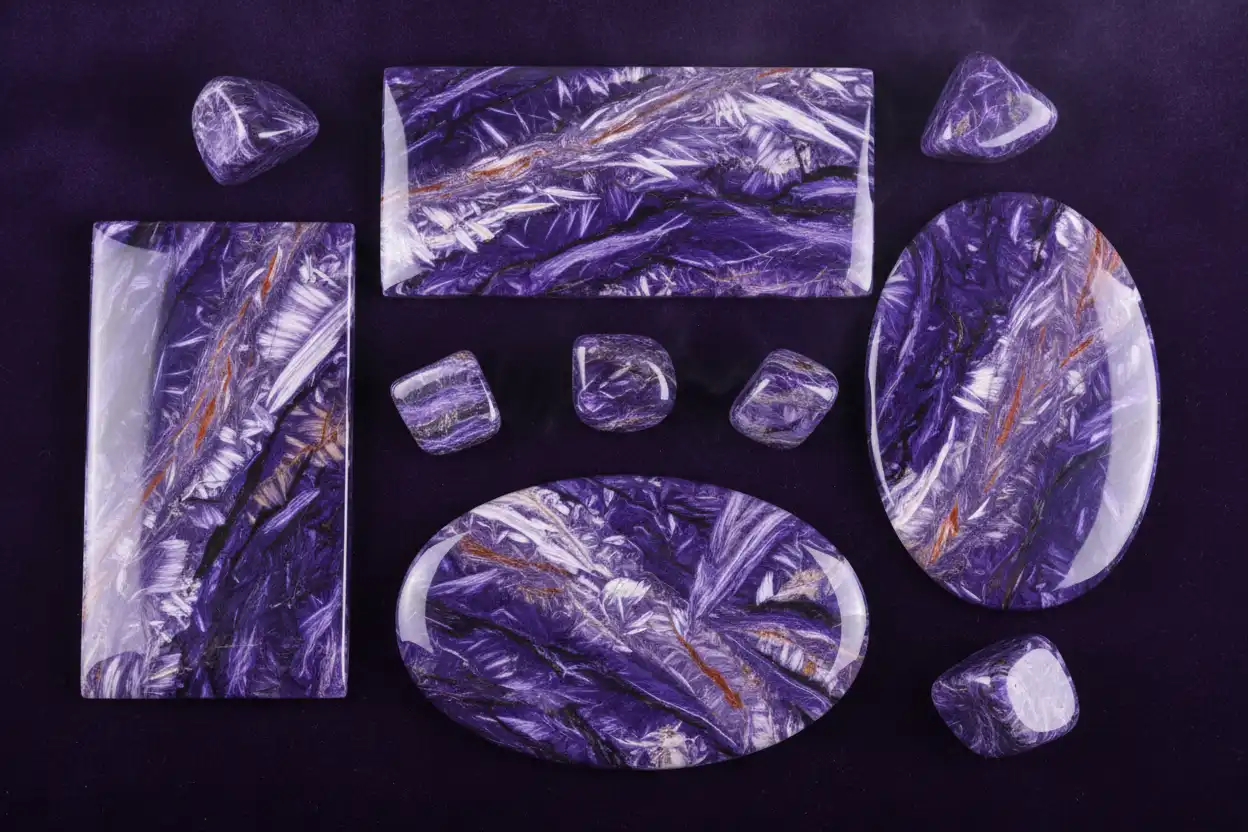
Charoite Meaning: Mineral Facts, History & Symbolism
Charoite meaning is commonly associated in modern crystal practice with transformation, courage, perspective, acceptance, resilience, and adapting thoughtfully when circumstances change. Those themes are symbolic interpretations rather than measurable effects produced by the mineral. Materially, charoite is a complex hydrated silicate mineral, usually violet to deep lilac, that occurs characteristically as fibrous or massive material and is best known from the Murunskii Massif near the Chara and Tokko river region in Russia. Mineralogical references classify charoite as monoclinic, with Mohs hardness around 5–6, measured specific gravity near 2.54, good cleavage in several directions, and vitreous-to-silky luster.
The familiar polished stone adds an important complication: much of what is sold commercially as “charoite” is not a chemically pure mass of one mineral. Ornamental material can be a multiphase rock in which charoite forms the dominant purple fibrous component alongside feldspar, aegirine-augite, tinaksite, and other associated minerals. Gemological references specifically caution that common ornamental charoite material can be a rock composed of several phases rather than a uniform single-mineral substance.
That distinction makes charoite especially useful for understanding the difference between a mineral species, an ornamental rock, a trade name, and a symbolic crystal description. A reliable charoite meaning guide therefore begins with what the purple material physically is, explains what the characteristic swirls can and cannot prove, and only then considers documented history and modern symbolism.
For other material-first mineral references, browse the Gemstone Guides.
What Is Charoite?
Charoite is a valid mineral species with a highly complex silicate structure containing potassium, calcium, sodium, silicon, oxygen, hydroxyl, fluorine, water, and variable amounts of elements including strontium, barium, and manganese. Modern structural descriptions are considerably more complex than the simplified formulas still repeated in some older gemological references.
That complexity matters because charoite should not be described as merely “purple quartz,” “purple feldspar,” or a simple manganese silicate.
| Property | Typical charoite characteristics |
|---|---|
| Mineral species | Charoite |
| Mineral class | Complex hydrated silicate |
| Crystal system | Monoclinic |
| Typical habit | Fibrous, massive; commonly intergrown in ornamental rock |
| Typical color | Violet, lilac, deep purple; also whitish-gray to brown material |
| Transparency | Commonly translucent, locally opaque |
| Luster | Vitreous to silky |
| Mohs hardness | About 5–6 |
| Measured specific gravity | About 2.54 |
| Gemological SG range | Common references give approximately 2.54–2.78 |
| Refractive index | Commonly around 1.545–1.560 |
| Optical character | Biaxial positive |
| Birefringence | About 0.009 |
| Cleavage | Good/distinct in multiple directions |
| Common ornamental texture | Purple fibrous swirls mixed with contrasting minerals |
| Main locality association | Murunskii Massif, Russia |
| Separate mineral species? | Yes |
| Commercial material always monomineralic? | No |
The mineral’s moderate hardness makes it suitable for polished ornamental use, but cleavage, fibrous structure, fractures, and associated minerals can influence actual durability.
Charoite Mineral Versus Charoitite Rock
One of the most useful distinctions in charoite identification is the difference between charoite and charoitite.
Charoite is the mineral species.
Charoitite is a rock in which charoite is an essential component.
The familiar polished purple slabs and cabochons often contain a visually complex mixture rather than one perfectly homogeneous mineral. Gemological references describe common ornamental “charoite” as material containing charoite together with phases such as feldspar and aegirine-augite, while other documented associates include tinaksite.
This does not make commercial charoite fake.
Many ornamental stones are rocks or mineral aggregates rather than single crystals. Jadeite jade, nephrite, lapis lazuli, jasper, and various patterned stones likewise require attention to texture and constituent phases.
The useful description is therefore precise:
A polished object may be sold correctly as charoite while technically consisting of charoite-rich ornamental rock containing several minerals.
That is a more informative statement than pretending every purple and white swirl has identical chemistry.
Why Charoite Is Purple
The characteristic violet-to-deep-lilac color is associated with manganese in the material. Mineralogical references specifically note that vivid purple type-locality charoite is related to trace manganese.
The exact appearance of a polished piece depends on more than one variable.
Color can be influenced by:
manganese-bearing components;
concentration of charoite;
fiber density;
associated white feldspar;
dark aegirine-rich minerals;
orange or brown accessory phases;
translucency;
surface polish;
thickness;
and illumination.
That means two genuine charoite-rich pieces can look strikingly different.
One may be nearly solid deep violet.
Another may consist of lavender swirls through large areas of white and black mineral matter.
A third may include purple, gray, cream, orange, and dark green-black patches.
The detailed behavior of color, transmitted light, fibrous sheen, refractive properties, and orientation belongs in charoite optical properties and color behavior.
Why Charoite Has a Swirling Appearance
Charoite’s famous visual movement comes primarily from its fibrous and sheaf-like mineral texture combined with complex intergrowths.
Fine fibers can curve, diverge, interlock, or occur in differently oriented bundles. When polished, those structures reflect and scatter light differently according to viewing direction.
The result can resemble:
feathers;
flowing silk;
smoke;
flames;
waves;
brush strokes;
clouds;
or interlocking purple ribbons.
This appearance is structural.
It is not literal movement inside the stone.
The strongest pieces may seem almost three-dimensional because bright silky areas shift visually against darker or more translucent zones as the object rotates.
Is Charoite Chatoyant?
Some charoite can display a moving silky sheen that is loosely described as chatoyant in commercial language.
Strict gemological terminology deserves more caution.
Classic chatoyancy produces a relatively concentrated cat’s-eye band from strongly oriented parallel structures. Charoite more often displays broader fibrous shimmer, silky directional reflection, and irregular moving patches rather than one clean eye.
A specimen can therefore show a convincing chatoyant-like effect without forming a textbook cat’s eye.
The distinction becomes easier when the polished stone is rotated under one directional light source.
Broad patches moving in different directions usually reflect the complex fibrous fabric.
A single sharp mobile band suggests a more organized optical effect.
How Charoite Forms
Charoite is associated with an unusual alkaline geological environment. Mineralogical references place it in potassium-rich metasomatic rocks related to the interaction of alkaline syenitic rocks and carbonate-rich rocks within the Murunskii Massif.
Metasomatism is crucial to understanding this setting.
Unlike ordinary sediment deposition or simple cooling of one homogeneous magma, metasomatism involves chemically active fluids changing the composition of existing rock. Elements are added, removed, and redistributed while new minerals become stable.
In the charoite-bearing environment, unusually alkaline, potassium-rich fluids interacted with pre-existing rocks under conditions that produced a distinctive suite of silicate minerals.
The resulting charoitite can contain complex textures and several mineral generations rather than one simple crystal-growth event.
The full petrological treatment of the Murun complex, metasomatism, alkaline rocks, carbonate interaction, and associated mineral assemblages belongs in charoite formation and deposit geology.
Metasomatism Is Different From Ordinary Weathering
It is easy to describe every secondary-looking stone as weathered material, but charoite’s geological story is much more specialized.
Weathering generally refers to alteration under relatively near-surface environmental conditions involving water, oxygen, temperature changes, and biological or chemical processes.
Metasomatism involves more substantial chemical exchange between fluids and rock.
An existing rock can be transformed mineralogically while retaining parts of its broader structure.
That process helps explain why charoite-bearing rock can be so texturally complicated: different components record chemical reactions, replacements, recrystallization, and evolving fluid conditions.
The swirling appearance is therefore visually dramatic, but the real geological story occurs at the level of mineral reactions and rock transformation.
Charoite’s Locality Is Part of Its Identity Story
Charoite is strongly associated with the Murunskii Massif near the Chara and Tokko river region of Russia, which mineralogical references identify as its type locality.
This geographic concentration contributes to the mineral’s collector interest.
It also creates a frequent marketing shortcut: a purple swirling stone may be assumed to have that provenance merely because it resembles familiar charoite.
Appearance is not provenance.
A documented source claim should rely on:
original mine or regional labels;
supplier documentation;
collection records;
acquisition history;
parcel information;
or another traceable chain connecting the object to its source.
The charoite provenance disclosure checklist provides a structured way to separate evidence of origin from appearance-based assumptions.
The Name Charoite
The mineral’s name refers to the Chara River region associated with its locality. Mineralogical references explicitly connect the name with the type locality near the Chara River.
This deserves attention because another story is frequently repeated in crystal literature: that the name comes from a Russian word meaning charm, enchantment, or magic.
The river-based mineralogical explanation is the documented one.
Similarity between “charoite” and words associated with charm can encourage later wordplay, but linguistic resemblance should not replace the formal naming record.
This is a good example of how attractive folklore can spread because it sounds appropriate to an unusual-looking mineral.
Charoite Is Not Chaoite
Charoite and chaoite are completely different minerals despite the nearly identical spelling.
Charoite is the purple complex silicate discussed here.
Chaoite is a rare carbon mineral with the formula C and entirely different structure, color, hardness, density, and geological occurrence. Mineral databases explicitly list the names as potentially confusable.
The distinction is simple:
Charoite — complex purple silicate.
Chaoite — carbon mineral.
A missing letter changes the mineral completely.
This is particularly important in automated listings, copied mineral databases, and poorly edited product descriptions where spelling errors can create false information.
Original Charoite Specimen and Photo Checklist
The following checklist provides a first-pass framework for evaluating rough charoite, polished cabochons, slabs, beads, carvings, and seller photographs.
Look for fibrous directional structure
Natural charoite commonly shows flowing, feathered, flame-like, or swirling structures rather than completely flat uniform purple coloration.
Rotate polished material under one light
Silky fibrous areas may brighten and darken as orientation changes.
This directional response is useful evidence of internal texture.
Examine purple-to-white contacts
Natural ornamental material often contains white or cream feldspar-rich regions intergrown irregularly with purple charoite.
Perfectly painted-looking boundaries deserve closer inspection.
Look for dark associated minerals
Green-black or black aegirine-rich material can occur within genuine charoite-bearing rock.
Its presence supports a multiphase rock interpretation rather than reducing quality automatically.
Check for orange or brown accessory phases
Small contrasting areas may belong to associated minerals within charoitite.
Do not assume every non-purple region is staining or damage.
Compare rough and polished surfaces
A freshly polished face can show stronger purple color and silky movement than a weathered rough exterior.
Inspect thin edges for translucency
Charoite ranges from translucent to more opaque depending on thickness, fiber density, and associated minerals.
Watch for artificial uniformity
A perfectly homogeneous bright-purple plastic-like body without natural structural variation deserves further examination.
Check the fracture pattern
Natural stone can contain irregular fractures cutting across multiple mineral phases.
These should not automatically be interpreted as treatment.
Examine drill holes
Beads and pendants can reveal interior texture through drill holes.
A surface coating that does not continue into the hole deserves investigation.
Look for resin or fracture filling
Polished material can contain stabilized fractures or surface-reaching voids.
Disclosure matters even when the underlying material is genuine.
Use magnification
Fibrous bundles, mineral boundaries, inclusions, fractures, polish features, and accessory phases become clearer under a loupe or microscope. The charoite microscope inclusion notebook develops these observations more fully.
Do not identify by purple color alone
Several minerals, rocks, glasses, composites, and dyed materials can be purple.
Preserve locality documentation
The unusual geographic association gives original labels genuine value.
Ignore metaphysical terminology during identification
Words such as transformation stone, high-vibration charoite, soul stone, fear-release crystal, or crown-chakra mineral provide no material evidence.
Claim Versus Evidence: Common Charoite Statements
| Claim | Evidence status | More accurate interpretation |
|---|---|---|
| Charoite is a valid mineral species | Supported | It is a complex monoclinic silicate |
| Charoite is simply purple quartz | Incorrect | Its chemistry and structure are unrelated to quartz |
| Charoite is always one chemically uniform material | Incorrect for common ornamental pieces | Charoite-rich rock commonly contains several associated minerals |
| Commercial charoite can technically be charoitite | Supported | The ornamental rock may contain charoite with feldspar, aegirine-related minerals and other phases |
| Charoite is monoclinic | Supported | Mineralogical references classify it as monoclinic |
| Charoite has Mohs hardness around 5–6 | Supported | Individual rock constituents may behave differently |
| Purple color is associated with manganese | Supported | Trace manganese is linked with vivid purple material |
| Every purple swirling stone is charoite | Incorrect | Identification requires physical and mineralogical consistency |
| Charoite is named from a word meaning magic | Poorly supported | The documented mineral name refers to the Chara River locality |
| Charoite and chaoite are the same mineral | Incorrect | Chaoite is carbon |
| Charoite occurs commonly worldwide | Misleading | Its recognized occurrence is unusually geographically restricted |
| Every white patch in charoite is fake filler | Incorrect | Feldspar and other associated minerals can occur naturally |
| Every black patch lowers authenticity | Incorrect | Dark associated minerals can belong naturally to charoitite |
| Charoite scientifically removes fear | Unsupported | Fear-release is a symbolic interpretation |
| Charoite medically treats neurological or emotional disorders | Unsupported medical claim | Mineral identity does not establish therapeutic efficacy |
This distinction is important because charoite’s genuine geological rarity and complex texture already provide substantial information without needing unsupported additions.
Charoite Versus Sugilite
Sugilite is one of the better-known purple ornamental materials that can be confused with charoite.
The two are mineralogically distinct.
Charoite usually displays fibrous, swirling, flame-like textures and can contain conspicuous white, black, and orange-associated minerals.
Sugilite more often appears massive with relatively smooth purple, pink-purple, reddish-purple, or mottled coloration, although natural material varies widely.
Color alone is unreliable.
When polished stones are strongly patterned, charoite’s fibrous directional texture is often the more useful visual clue.
For expensive or atypical material, refractive behavior, density, microscopy, spectroscopy, and mineralogical context are stronger than appearance.
Charoite Versus Purple Fluorite
Purple fluorite can overlap broadly in hue but behaves very differently.
Fluorite has Mohs hardness 4 and perfect octahedral cleavage. Transparent material commonly shows a glassier, more crystalline appearance rather than charoite’s fibrous swirling aggregate.
Charoite is generally harder and structurally much more complex in polished ornamental material.
A purple polished object should therefore not be identified from hue.
Texture, cleavage, refractive behavior, and mineral association matter.
Charoite Versus Lepidolite
Lepidolite is a lithium-bearing mica-group mineral commonly found in lilac, pink-purple, or gray-purple material.
Its platy mica structure is the major distinction.
Lepidolite can show obvious flaky cleavage, pearly luster, and layered texture. Charoite’s typical polished pattern is fibrous and swirling rather than micaceous.
Massive intergrown specimens can make visual identification more difficult.
Again, microscopy and physical behavior provide more useful evidence than the shared purple color.
Charoite Versus Chevron Amethyst
The mapped chevron amethyst meaning reference concerns quartz showing repeated purple-and-white growth zoning.
Chevron amethyst is predominantly SiO₂ and has quartz-family hardness around 7.
Charoite is a more complex silicate, commonly softer and dominated by fibrous swirling texture.
The white areas are also fundamentally different.
In chevron amethyst, white and purple patterns typically reflect quartz growth zoning.
In charoite-rich ornamental rock, white patches commonly represent associated mineral phases or variations within a complex metasomatic rock.
A purple-and-white photograph can therefore conceal two entirely different geological stories.
Charoite Versus Chalcopyrite
The preceding chalcopyrite meaning page provides an extreme contrast.
Chalcopyrite is opaque metallic CuFeS₂ and can develop purple-blue surface tarnish.
Charoite is a nonmetallic silicate whose purple appearance belongs within the stone rather than merely to a thin metallic alteration film.
A photograph dominated by purple can make unrelated minerals look superficially comparable.
Luster resolves the difference quickly: chalcopyrite is metallic, while charoite is vitreous to silky.
Treatments and Imitations
Charoite is usually valued for its natural purple color and distinctive fibrous pattern, but commercial objects can still be treated, stabilized, assembled, coated, or imitated.
Possible concerns include:
resin filling of fractures;
surface impregnation;
composite construction;
purple-dyed stone;
dyed carbonate or silica materials;
polymer imitation;
reconstructed material;
and photographs with extreme purple saturation.
Treatment should not be assumed without evidence.
Natural charoite can be exceptionally vivid.
The correct question is whether the observed features are consistent with known material and whether any intervention affecting value or care has been disclosed.
Resin Does Not Automatically Mean the Stone Is Fake
A fractured natural stone can sometimes be stabilized with polymer to improve cutting yield or prevent breakage.
If the underlying material is genuine charoite-rich rock, stabilization does not transform it into synthetic charoite.
It does change the commercial description.
A buyer may reasonably distinguish:
untreated charoite;
stabilized charoite;
assembled material containing charoite;
and imitation material containing no natural charoite.
Those categories should not be blurred.
Magnification around fractures, pits, drill holes, and polished voids can reveal useful treatment clues.
Can Charoite Be Synthetic?
Laboratory synthesis for scientific structural study is conceptually different from a commercially widespread synthetic gemstone market.
The more practical consumer concerns are generally imitation, misidentification, composite material, dyed substitutes, and inaccurate trade labeling rather than large-scale gem-quality synthetic charoite production.
That means a suspicious inexpensive purple object should not automatically be called “synthetic charoite.”
It may simply be another material imitating charoite’s appearance.
Accurate terminology requires identifying what the object actually contains.
Laboratory Identification
Charoite’s distinctive texture makes many specimens recognizable, but laboratory methods become valuable when the material is atypical, high-value, strongly treated, or lacking provenance.
Useful approaches include:
Refractive testing. Suitable polished surfaces can produce values around the reported charoite range, although multiphase rock complicates interpretation.
Specific gravity. Measurements can support the expected density range, but associated minerals can shift the bulk value.
Microscopy. Fibrous texture, mineral boundaries, inclusions, fractures, polish, and treatment features can be examined directly.
Raman spectroscopy. Spectra can identify charoite and distinguish associated or imitation minerals.
X-ray diffraction. Structural analysis can confirm crystalline phases in suitable material.
Electron microscopy and chemical analysis. These can characterize fine intergrowths and the unusually complex chemistry of the mineral.
A key limitation should remain explicit:
A test performed on one purple fiber does not necessarily describe every white, black, or orange phase in a charoitite slab.
The object may be a rock containing several minerals.
Why Bulk Testing Can Be Misleading
Imagine an XRF measurement taken from a polished charoite slab.
The analyzed area includes purple charoite, white feldspar, dark aegirine-rich material, and a small orange accessory phase.
The resulting elemental spectrum represents all of those components within the instrument’s sampling area.
It may show potassium, calcium, sodium, silicon, iron, manganese, strontium, and additional elements.
That does not mean one homogeneous mineral contains every element at the measured concentration.
For multiphase ornamental stones, analytical scale matters.
Microanalysis and mineral mapping can separate individual phases much more effectively than a broad bulk measurement.
Cutting Charoite
Charoite is primarily fashioned as cabochons, beads, carvings, slabs, inlays, and decorative objects because its strongest visual feature is the fibrous pattern rather than transparent faceting performance.
A cutter has to consider:
fiber direction;
moving silky reflection;
purple concentration;
contrasting white or black minerals;
fractures;
soft or harder accessory phases;
undercutting during polish;
thickness;
and orientation.
A slab rotated only slightly can reveal a very different pattern.
The best cut therefore does more than maximize purple area. It organizes natural movement into a coherent face-up design.
Detailed orientation and polishing decisions are covered in charoite cutting, orientation and polish.
Why Charoite Can Polish Unevenly
Multiphase ornamental rock can present a lapidary challenge because different minerals may not respond identically to grinding and polishing.
One phase can abrade faster than another.
Fibrous charoite may polish differently from feldspar-rich patches or dark associated minerals.
Small pits or relief can therefore develop if the technique, abrasive sequence, pressure, or support is poorly matched to the material.
An uneven polished surface is not automatic evidence of fake stone.
It can reflect genuine mineralogical heterogeneity.
Charoite in Jewelry
With hardness around 5–6, charoite is practical for many jewelry forms but deserves more protection than quartz, sapphire, or spinel.
Pendants and earrings generally experience less impact.
Bracelets and rings are exposed to harder surfaces more frequently.
Durability also depends on the particular object because a heavily fractured charoitite cabochon containing several mineral phases may behave differently from a dense, well-cut piece.
Protective bezels, sufficient thickness, rounded profiles, and good backing support can reduce mechanical risk.
The detailed relationship among cleavage, fiber direction, mounting pressure, abrasion, and everyday use belongs in charoite setting and wear engineering.
Buying Charoite
Purchase-specific decisions should evaluate much more than purple saturation.
Useful questions include:
Does the texture look naturally fibrous?
Is the polish good?
Are fractures disclosed?
Is resin stabilization present?
Does the object contain attractive contrasting minerals?
Is the photograph heavily saturated?
Is the locality claim documented?
Is the material solid stone or composite?
Does the seller provide dimensions and weight?
Are both front and back shown?
Those questions are handled more fully in where to buy charoite.
For this meaning page, the most important buying boundary is that phrases such as “high vibration,” “healing grade,” “soul stone,” or “transformation quality” are not gemological quality grades.
Physical Cleaning Versus Symbolic Cleansing
Charoite’s actual care needs should be separated from metaphysical cleansing rituals.
Physical cleaning concerns:
dust;
skin oils;
fractures;
polish;
associated minerals;
treatments;
adhesives;
and jewelry settings.
Symbolic cleansing concerns a person’s spiritual practice.
The two should not be confused.
Because commercial charoite can be a multiphase rock and may contain fractures or stabilization, aggressive chemicals, prolonged soaking, ultrasonic cleaning, or unnecessary heat should not be treated as universal solutions.
The dedicated guide on how to cleanse charoite separates conservative specimen care from optional symbolic practices.
Conserving Important Charoite Specimens
A significant rough specimen, slab, or historic lapidary object can preserve information that repolishing removes.
Before altering one, record:
original surface texture;
fibrous orientation;
associated minerals;
fractures;
dimensions;
existing repairs;
old polish;
labels;
locality information;
and previous ownership documentation.
This is particularly important when the piece contains a distinctive natural assemblage rather than homogeneous purple material.
The charoite specimen conservation record provides a structured framework for tracking those characteristics before cleaning, repair, cutting, or storage changes.
Charoite’s Documented History Is Primarily Mineralogical
Charoite has a much more specific mineralogical history than generic claims about “ancient purple crystals” suggest.
Its documented identity is tied closely to the distinctive alkaline geological environment of the Murunskii Massif and to mineralogical characterization of the unusual purple silicate found there.
The name itself is connected with the Chara River region.
Claims that ancient civilizations specifically used charoite for transformation, psychic development, chakra work, fear release, or dream communication require evidence that the historical material was actually charoite.
A generic reference to purple stone is not enough.
Amethyst, fluorite, dyed materials, glass, purple mica, and other minerals have all appeared in human material culture.
Modern charoite symbolism should therefore be presented as modern unless a specific historical claim is independently documented.
Purple Does Not Establish Ancient Charoite Use
This principle deserves emphasis because color-based historical claims spread easily.
An archaeological object described as purple cannot be identified as charoite merely because charoite is purple.
Reliable identification would need information such as:
mineralogical analysis;
provenance;
archaeological context;
geological plausibility;
and documentation showing that the object is genuinely charoite-bearing material.
Without those elements, the most accurate description remains “purple stone” or whatever material the actual evidence supports.
Historical storytelling should follow identification rather than replace it.
Charoite Meaning in Modern Symbolism
Modern charoite meaning commonly centers on transformation, adaptability, courage, perspective, acceptance, intuition, and moving through uncertainty.
Its physical appearance makes several of those metaphors intuitive.
The stone does not usually present one flat purple field. Instead, fibers, colors, and mineral phases twist through one another, creating a visually complex whole.
Someone may interpret that as a reminder that change rarely develops in a perfectly straight line.
New circumstances can interact with older structures.
Several influences can exist simultaneously.
A difficult transition can therefore involve reorganization rather than complete replacement.
That is symbolism inspired by texture and geology.
Transformation as a Metasomatic Metaphor
Charoite’s geological formation gives transformation symbolism a particularly grounded metaphor.
Metasomatism changes rock through chemical interaction with fluids.
The original geological system is not simply erased.
Its chemistry is reorganized as certain elements move, reactions occur, and new minerals become stable.
A person might use that process as a metaphor and ask:
What actually needs to change?
What remains useful?
Which outside influence is affecting the situation?
Am I resisting a structural change that has already begun?
Which new arrangement would work better under present conditions?
The geological transformation is real.
The personal interpretation is chosen.
Courage Without Magical Claims
Charoite is frequently called a stone of courage or fear transformation.
A grounded interpretation treats courage as behavior rather than an energy emitted by the mineral.
Courage may involve:
making a necessary decision without perfect certainty;
asking for evidence;
admitting that a plan no longer works;
speaking clearly in an uncomfortable conversation;
learning an unfamiliar skill;
or acting according to values despite anxiety.
A person can associate a charoite object with one of those actions.
The stone does not have to suppress neurological fear responses for the symbol to be useful.
Acceptance and Complex Patterns
Charoite’s patterns are rarely perfectly symmetrical.
White, black, violet, gray, and orange areas may interrupt one another. Fibers curve, overlap, and change direction.
That complexity makes acceptance an intuitive symbolic theme.
Acceptance in this context need not mean approving of everything that happens.
It can simply mean identifying what is already true before deciding what to do next.
A useful reflective prompt might be:
Which part of this situation am I trying to solve before I have accurately described it?
The mineral becomes a reminder to observe complexity without immediately forcing it into a simpler story.
Perspective and the Moving Silky Sheen
A polished charoite cabochon can look different when rotated because fibrous regions reflect light directionally.
An area that appears dark from one angle may brighten dramatically from another.
This gives perspective symbolism a clear visual anchor.
The material has not changed composition when the viewer turns it.
The viewing geometry changed.
As a metaphor, that can encourage examining a problem from more than one position before concluding that its first appearance is complete.
Again, the optical observation is physical.
The personal lesson is interpretive.
Charoite and Intuition
Modern metaphysical descriptions frequently associate charoite with intuition, insight, psychic development, dreams, or spiritual awareness.
Intuition can be discussed responsibly as a human cognitive experience.
What is not established is that charoite transmits a mineral energy that increases extrasensory perception.
A person may choose to use the stone during journaling or reflection and ask what they notice before analyzing a situation more formally.
That can be a personal practice.
Claims of telepathy, clairvoyance, supernatural communication, or guaranteed prophetic dreams remain metaphysical beliefs rather than mineralogical properties.
Charoite and Chakra Associations
Contemporary crystal traditions commonly connect charoite with the crown chakra, third-eye chakra, or both because of its purple color.
Some systems extend the stone to other energy centers based on the pattern of the individual piece.
These assignments belong to spiritual frameworks.
Gemological instruments can examine:
refractive index;
density;
birefringence;
mineral phases;
chemical composition;
and structural orientation.
They cannot determine whether a chakra is blocked, open, aligned, activated, cleansed, or healed.
A person can include charoite in a private spiritual practice while describing that practice accurately as symbolic or metaphysical.
Does Charoite Have Healing Properties?
Charoite should not be presented as a medical treatment.
Claims that it treats neurological disease, anxiety disorders, insomnia, heart conditions, liver problems, pain, inflammation, addiction, immune disease, blood pressure, or other health concerns are not established by charoite’s mineralogical properties.
Its measurable characteristics include:
complex silicate chemistry;
monoclinic structure;
fibrous habit;
hardness;
density;
optical properties;
color;
associated minerals;
and geological formation.
Those characteristics describe a mineral and rock assemblage.
They do not demonstrate therapeutic effects through ordinary contact.
A personally meaningful object may still be used during reflection, meditation, or journaling without replacing appropriate medical or mental-health care.
Manganese Does Not Become a Therapy Through Touch
Manganese contributes to the color of vivid purple charoite.
That mineralogical fact should not be converted into a nutritional claim.
Biological effects depend on:
chemical form;
concentration;
dose;
exposure route;
solubility;
and metabolism.
Trace manganese incorporated into a silicate structure is not equivalent to a controlled nutritional supplement.
Likewise, potassium, calcium, sodium, and silicon in the stone should not be interpreted as therapeutic ingredients delivered through the skin.
A chemical formula explains material identity.
It is not a medical prescription.
Safe Ownership and Handling
Normal handling of intact polished charoite is generally straightforward.
The more important distinction appears during lapidary work.
Cutting, drilling, grinding, or sanding silicate-rich rock can create fine mineral dust. Because commercial charoite material may contain several minerals rather than one pure phase, the composition of generated dust can be more complex than the name on the label implies.
Use appropriate wet methods where suitable, local extraction, eye protection, and suitable respiratory controls rather than uncontrolled dry grinding.
Do not deliberately pulverize charoite for inhalation or ingestion.
There is also no need to put geological specimens into drinking water to obtain symbolic benefit.
An Evidence Ladder for Charoite Claims
Different charoite claims require different levels of evidence.
Direct observation can document purple color, fibrous swirls, translucency, white and dark associated phases, fractures, polish, and specimen condition.
Magnification can reveal fiber bundles, mineral boundaries, inclusions, fractures, resin, polish differences, and accessory phases.
Gemological testing can assess refractive behavior, density, and hardness compatibility in suitable material.
Raman spectroscopy can identify charoite and individual associated minerals at specific points.
X-ray diffraction can confirm crystalline phases and help characterize complex samples.
Microchemical analysis can examine the mineral’s complex potassium-calcium-sodium-strontium-bearing chemistry and distinguish neighboring phases.
Petrographic examination can show how charoite relates texturally to feldspar, aegirine-rich minerals, tinaksite, and other constituents in charoitite.
Geological evidence can establish whether the mineral assemblage fits the metasomatic environment associated with the Murunskii Massif.
Provenance documentation supports specific locality and collection claims.
Historical evidence supports the river-based naming history and mineralogical discovery context without automatically validating modern spiritual narratives.
Modern symbolism includes transformation, courage, acceptance, perspective, intuition, chakra work, and fear-release themes. These are interpretations rather than intrinsic physical powers.
What Charoite Meaning Can Reliably Include
Charoite meaning becomes clearest when material identity, rock context, documented history, and modern symbolism remain separate.
Materially, charoite is a complex monoclinic hydrated silicate, generally violet to deep lilac, with fibrous-to-massive habit, hardness around 5–6, silky-to-vitreous luster, and measured specific gravity near 2.54. Its chemistry is substantially more complicated than many simplified gemstone formulas imply.
Commercial ornamental material also requires a rock-versus-mineral distinction. The familiar swirling purple stone commonly contains charoite together with feldspar, aegirine-augite, tinaksite, and other minerals rather than representing a perfectly homogeneous block of pure charoite.
Geologically, charoite is associated with unusual potassium-rich metasomatic rocks in the Murunskii Massif, where alkaline igneous activity and chemically active fluids interacted with surrounding rocks to create an uncommon mineral assemblage.
Historically, the documented name refers to the Chara River locality rather than proving a linguistic origin in words for magic or enchantment. That evidence-based history is more useful than later folklore constructed from the stone’s extraordinary appearance.
Symbolically, modern users may interpret charoite as representing transformation, courage, acceptance, perspective, or adapting to complexity. Its metasomatic geological origin provides a grounded transformation metaphor, while the shifting silky appearance of its fibers can represent reconsidering a situation from another angle.
Those meanings can remain personally useful without claiming that charoite treats illness, suppresses fear neurologically, transfers manganese as medicine, activates chakras scientifically, or creates psychic perception.
Gems Lore explains its material-first approach on the About page. Health, metaphysical, identification, and informational limitations are set out in the Disclaimer, while factual corrections or supporting mineralogical evidence can be submitted through Contact.
Charoite does not need exaggerated mythology to be remarkable. A complex silicate can form within an unusual metasomatic rock system, develop flowing fibrous purple textures, coexist with contrasting feldspars and dark silicates, and produce polished patterns that seem to move when the viewing angle changes. Charoite meaning is strongest when that real mineral and geological story comes first and symbolism remains the human interpretation inspired by it.