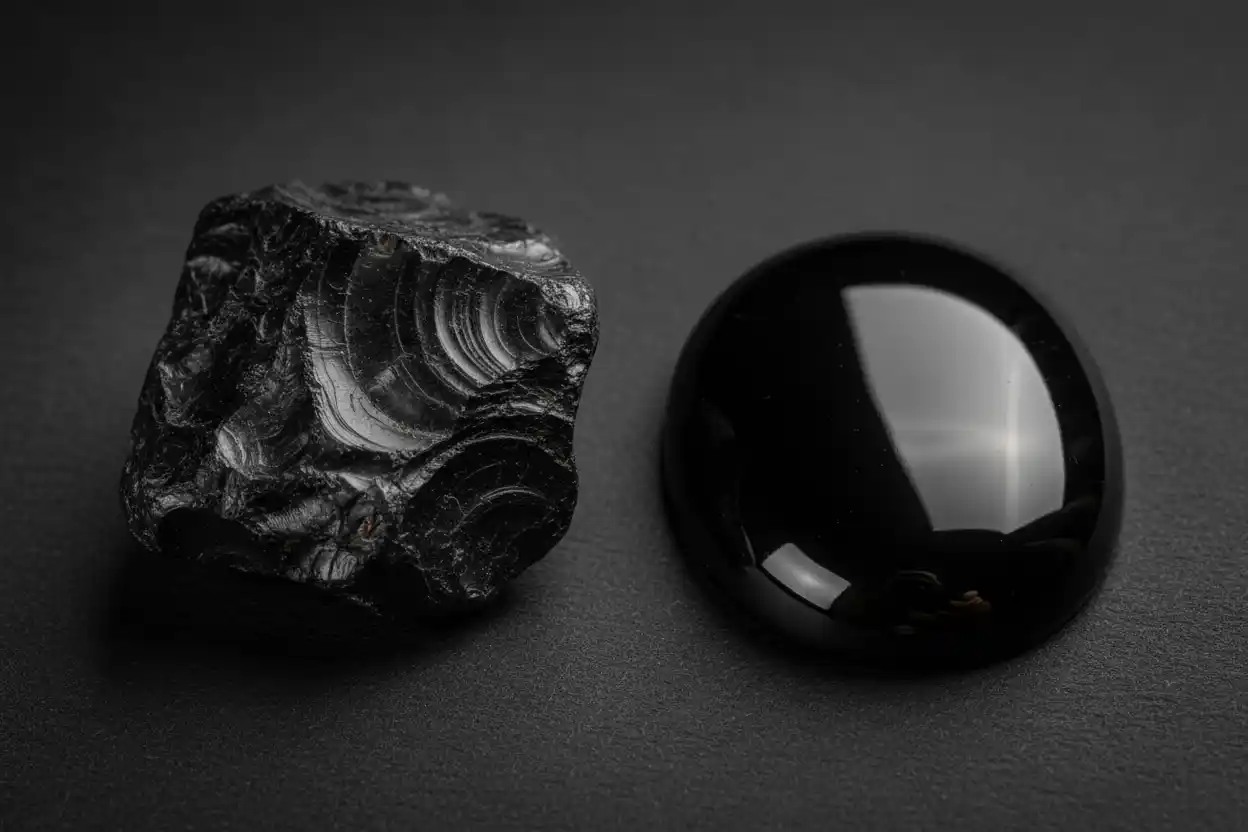
Jet: Meaning, Properties & Symbolism
Jet is a lightweight, carbon-rich organic gem material formed from ancient waterlogged wood that underwent burial, compression and chemical alteration. It can take a deep liquid-black polish, yet its low hardness and brittle structure require much gentler care than black onyx, obsidian or spinel.
Jet at a Glance
| Property | Jet Characteristics |
|---|---|
| Material type | Organic mineraloid derived from altered fossil wood |
| Composition | Variable carbon-rich organic material with oxygen, hydrogen, sulfur and trace elements |
| Colors | Deep black, brownish black and occasional dark brown |
| Crystal system | None; noncrystalline organic material |
| Habit or texture | Compact seams, flattened wood fragments, irregular nodules and worked beads or carvings |
| Luster | Dull in rough form; vitreous, resinous or liquid-like after polishing |
| Transparency | Opaque |
| Mohs hardness | Approximately 2.5–4 |
| Cleavage | None |
| Tenacity | Brittle |
| Common uses | Beads, brooches, necklaces, bracelets, cameos, rosaries, mourning jewelry and carvings |
| Main care concern | Scratching, brittle edges, heat, perfume, solvents and confusion with historic simulants |
What Is Jet?
Jet is an organic gem material produced from altered wood. It is often described as a compact form of lignite, although gem-quality jet differs in texture, stability and workability from ordinary fuel coal.
Because it comes from once-living plant material, jet is not a mineral. It has no fixed chemical formula or crystal structure.
The educational distinction in types of gemstones places jet beside amber, pearl, coral and other organic gem materials rather than crystalline silicates and oxides.
Jet’s combination of low weight, deep black color and ability to accept detailed carving made it important long before modern plastic. The familiar expression “jet black” comes from the intensity of its polished surface.
How Jet Forms
Jet begins as wood that falls or washes into waterlogged sediment. Low-oxygen conditions slow ordinary decay while mud, pressure and chemical change transform the organic structure.
Over millions of years, the wood loses volatile components and becomes richer in carbon. Compression reduces pore space, while mineral-rich fluids and surrounding sediment affect sulfur, oxygen and trace-element content.
The process preserves little of the recognizable grain seen in ordinary petrified wood. Instead, good jet becomes dense, uniform and fine enough for carving.
Jet should not be confused with silicified fossil wood. In petrified wood, minerals replace much of the original organic structure. Jet remains carbon-rich organic material.
That distinction also separates jet from fossil coral and Orthoceras fossils, which are mineralized remains rather than altered wood used as a carbon-rich gem.
Jet and Coal
Jet belongs broadly to the geological spectrum of coalified plant material, but not every piece of coal can function as jet.
Gem-quality jet must be sufficiently compact, homogeneous and stable to cut, turn, carve and polish. Ordinary lignite may be porous, crumbly, strongly layered or too unstable for durable ornament.
Anthracite and cannel coal can resemble jet visually, yet their density, fracture, texture and polishing behavior differ.
The term jet should therefore describe material with the physical and historical characteristics of an ornamental organic gem rather than any black combustible rock.
Whitby Jet
Whitby jet from North Yorkshire, England, is the most famous and historically influential variety.
The material occurs in the Jet Rock unit of the Whitby Mudstone Formation, deposited during the Early Jurassic approximately 181 million years ago. Ancient wood entered a marine environment, became buried in dark organic-rich mud and gradually transformed into stable black jet.
Coastal erosion releases pieces from the cliffs and shale. Collectors may find loose fragments along selected beaches, although legal access, cliff safety and local collecting rules must always be respected.
Whitby jet is prized for its uniform black color, low weight, fine texture and ability to take sharp carved detail. The best material develops a smooth, liquid-like polish rather than a coarse coal-like surface.
A Whitby origin should rely on documented collection or a trustworthy artisan supply chain. Black appearance alone cannot establish the locality.
Other Jet Sources
Asturias, Spain
Northern Spain produces jet known as azabache. Asturian material has a long history in beads, devotional objects and pilgrimage souvenirs associated with routes to Santiago de Compostela.
Fine Spanish jet can be attractive, although some material is less stable than the best Whitby jet and may develop cracks with age or temperature change.
Oltu, Türkiye
Oltu stone from Erzurum Province is a black organic lapidary material used for prayer beads, jewelry and carved objects.
Trade descriptions often call it jet, although deposit-specific composition and properties should be evaluated rather than assumed to match Whitby material exactly.
North America
Jet and related carbon-rich ornamental materials occur in New Mexico, Utah and Colorado. Indigenous communities in the American Southwest used regional black materials in ornaments before European arrival.
Additional occurrences exist in France, Germany, Poland and other coal-bearing regions. Provenance and material stability vary substantially.
Hard Jet and Soft Jet
Traditional jet literature distinguishes hard jet from soft jet.
The terms do not mean that one material has a dramatically higher Mohs hardness. Instead, they describe differences in structural stability and response to environmental change.
Hard jet generally accepts a sharper polish and resists cracking more effectively. Soft jet may craze or split after exposure to heat, dryness or repeated temperature changes.
The distinction has often been linked with different burial-water conditions, but actual stability depends on deposit history, chemistry and internal structure.
A vintage necklace can contain beads from several jet sources or even several different black materials. Therefore, one intact bead does not guarantee that the entire piece shares the same stability.
Jet’s Role in Ancient Jewelry
Jet has been worked for thousands of years.
Prehistoric communities in Britain and Europe used it for beads, pendants, buttons and personal ornaments. Its low weight allowed large pieces to be worn comfortably, while the deep polished color created strong visual contrast.
Roman craftspeople also used jet for rings, beads, hairpins and carved objects. Some ancient pieces were valued symbolically, although their exact meanings varied with region and context.
Archaeological jewelry once labeled entirely as Whitby jet has sometimes proved to contain mixtures of jet, lignite, shale and other black materials. Modern analytical methods therefore add useful precision to historic classifications.
Victorian Mourning Jewelry
Jet became especially prominent during the nineteenth century.
British mourning customs encouraged black clothing and jewelry after the deaths of prominent public figures. Demand expanded greatly after Prince Albert died in 1861 and Queen Victoria entered prolonged mourning.
Whitby workshops produced:
- Carved brooches
- Long bead necklaces
- Bracelets
- Earrings
- Lockets
- Crosses
- Hair ornaments
- Cameos and portrait frames
Although mourning drove much of the market, not every Victorian jet object was funereal. Jet also appeared in fashionable evening jewelry because its light weight allowed large, dramatic designs.
The industry’s success encouraged a large simulant market, making identification an essential part of antique buying.
How to Identify Real Jet
Jet feels unusually light for its size. It also warms quickly in the hand because it conducts heat poorly.
A polished surface can appear deep black and glossy, while carved areas retain crisp detail without the glassy chips associated with black glass.
Under magnification, genuine jet may show subtle woody or organic structure, fine polishing lines and occasional mineral inclusions. It should not display round gas bubbles, molded seams or repeated machine-perfect patterns.
A brown streak on unglazed porcelain is traditionally associated with jet, but the test damages the object and can produce similar results from bog oak, vulcanite and lignite. Hot-needle and burning tests are even more destructive and should never be used on jewelry or antiques.
Professional identification may use microscopy, infrared or Raman spectroscopy, X-radiography and elemental analysis. The process in how to identify crystals should therefore be adapted for an organic material rather than relying on mineral hardness alone.
Jet Simulants
French Jet
French jet is black glass rather than jet.
It feels colder and heavier, and chipped edges may show sharp glassy fracture. Faceted glass beads commonly show abrasion around their edges because glass and jet wear differently.
Vulcanite
Vulcanite is hardened rubber widely used in Victorian jewelry.
Fresh pieces can look convincingly black, but prolonged light exposure may turn the material brown or khaki. Molded repetitions, screw fittings and sulfur odor from rubbing can provide clues.
Pressed Horn
Horn can be heated, pressed and dyed black. Layering or translucency along damaged edges may reveal its biological structure.
Bog Oak
Bog oak is darkened waterlogged wood rather than coalified jet. Visible grain, growth rings and a more textured polish distinguish many examples.
Black Onyx and Obsidian
Onyx and black obsidian are much denser and harder.
They feel cooler, weigh more and do not show jet’s organic response to heat and friction.
Plastic and Reconstituted Material
Modern plastics can be molded into black beads and carvings. Jet fragments may also be mixed with binder and pressed into composite objects.
The checks in how to spot fake crystals help identify mold seams and resin, although antique construction methods require specialist experience.
Is Jet a Gemstone?
Jet is accepted as an organic gemstone or ornamental gem material despite lacking crystalline structure.
It appears naturally within the black gemstones market because its polished color can be extraordinarily deep.
However, jet differs from the harder minerals and glasses represented in black crystals. It scratches easily and gains value from origin, craftsmanship, age and cultural history rather than brilliance or crystal clarity.
Jet suits necklaces, earrings, brooches and pendants particularly well. Its low weight allows large beads and carvings to remain comfortable.
Rings and exposed bracelets are less practical because normal contact can scratch and chip the surface.
Hardness and Durability
Jet’s Mohs hardness generally falls between 2.5 and 4 on the gemstone hardness chart.
Metal, dust and most gemstones can scratch it. Facet edges on beads may gradually round, while carved details lose sharpness after repeated rubbing.
The material has no cleavage, yet it remains brittle. As explained in gemstone toughness versus hardness, a lightweight organic gem can still crack after a short fall.
Old pieces may contain hidden repairs, drilled stress fractures and unstable beads from mixed sources. Condition should therefore influence value as strongly as surface shine.
Treatments, Repairs and Antique Alterations
Modern jet generally receives cutting, carving and polishing. Artisans may apply a light wax to improve surface luster or protect the finish.
Antique objects can contain glue repairs, replacement beads, restrung sections and later metal fittings. Some fragments have been pressed with binder into molded components.
Dye is more relevant to horn, wood and other simulants than to naturally black high-quality jet. Nevertheless, surface coloring can conceal brown material or repair areas.
The broader gemstone treatments guide provides useful language for distinguishing ordinary polishing, waxing, filling and composite construction.
Restoration does not automatically make an antique undesirable. However, the seller should disclose extensive repairs, replaced elements and mixed materials.
Jet Price and Value
Jet prices vary according to source, age, carving, condition and whether the object is an antique or modern artisan piece.
| Jet Material or Object | Broad Current Asking Range |
|---|---|
| Small loose bead, cabochon or rough fragment | $5–$30 |
| Simple modern jet pendant or earrings | $30–$150 |
| Better documented Whitby jet jewelry | $100–$500 |
| Antique Victorian brooch or necklace | $150–$1,000 |
| Fine carved mourning jewelry or matched suite | $750–$3,000+ |
| Exceptional historic, gold-mounted or museum-quality object | Several thousand dollars or more |
Low-cost bead strands advertised as natural jet may contain dyed stone, glass, coal, plastic or poorly documented material.
Condition has a major effect. A modest intact brooch can be more desirable than a heavily repaired complex carving.
Historic provenance, maker attribution and original fitted cases may also create premiums unrelated to the raw material’s weight.
Buying Jet
The where to buy real jet guide should own the full purchase checklist.
For modern jewelry, ask whether the material is Whitby jet, Spanish jet, Oltu material or an unspecified source. A seller should explain how provenance was established and whether the item contains reconstructed or mixed material.
Antique buyers should inspect the reverse, fittings, drill holes and edges under magnification. Screw fittings, molded repetition and brown discoloration can indicate vulcanite or horn.
Weight and warmth provide useful initial clues, but they cannot replace professional testing when an important Victorian piece commands a high price.
The presence of a nineteenth-century fitting does not prove that the black material is jet. Simulants circulated widely during the same period.
Cleaning Jet Jewelry
Jet should be cleaned with a soft dry cloth. When necessary, use a barely damp cloth and dry the piece immediately.
Avoid soaking, hot water, household jewelry dips, alcohol, perfume and strong detergents. Liquids can enter drill holes and old repairs, while solvents may damage wax, glue or adjacent materials.
Steam and ultrasonic cleaning are inappropriate. The warnings in gemstones and ultrasonic cleaners apply especially strongly to brittle organic jewelry and historic repairs.
Apply cosmetics and fragrance before putting on jet jewelry. Skin oils are less damaging than perfume and hairspray, but a gentle wipe after wear prevents residue from building up.
Store pieces flat in a lined box, away from harder jewelry. Long necklaces should not hang under their own weight for extended periods because old string and drilled beads may fail.
Jet Meaning and Symbolism
Jet has a longer and better-documented cultural history than many modern crystal-shop stones.
Its black color and organic origin have supported associations with mourning, remembrance, protection, dignity and continuity. Victorian mourning culture reinforced those themes, but it did not create all of them.
Ancient and regional uses varied. A jet bead could function as ornament, trade object, amulet, status marker or devotional item depending on time and place.
Modern interpretations often connect jet with honoring loss without remaining trapped by it. Others use its transformation from wood to black gem material as a symbol of endurance and change.
These meanings remain cultural, spiritual or personal interpretations. Scientific research does not show that jet absorbs negative energy, treats grief or protects the body through measurable forces.
Its material history already carries a powerful theme: organic wood entered dark sediment and emerged millions of years later as a lightweight, polishable gem.
Frequently Asked Questions About Jet
Is jet a mineral?
No. Jet is a carbon-rich organic mineraloid formed from altered ancient wood.
Is jet the same as coal?
It belongs broadly to lignite-like coalified material, but gem-quality jet has the compact texture and stability needed for carving and polishing.
What is Whitby jet?
Whitby jet is high-quality Jurassic jet from the coastal geology around Whitby in North Yorkshire, England.
Why is jet so lightweight?
Its carbon-rich organic structure has much lower density than glass, onyx, obsidian and most mineral gemstones.
How can I distinguish jet from black glass?
Jet feels lighter and warmer. Black glass is colder, denser and may show bubbles or sharp glassy chips.
What is French jet?
French jet is black glass made to imitate jet, especially in nineteenth-century jewelry.
Is all Victorian black jewelry made from jet?
No. Victorian makers also used vulcanite, pressed horn, bog oak, glass, coal and other simulants.
How hard is jet?
Jet generally ranks about 2.5–4 on the Mohs scale and scratches easily.
Can jet be worn every day?
Pendants, earrings and brooches can tolerate careful wear. Exposed rings and bracelets scratch more quickly.
Can jet go in water?
Avoid soaking. Use a dry or barely damp soft cloth and dry the item immediately.
Can jet go in an ultrasonic cleaner?
No. Vibration, liquid and heat can crack jet or damage antique repairs.
What makes jet valuable?
Documented origin, carving quality, age, condition, historic importance and original construction determine value.
Jet’s cultural and material history makes it more than a generic black ornament. Its alphabetical context appears in Crystals That Start With J and Gemstones That Start With J, although it belongs scientifically with organic gems rather than crystals.
Safety disclaimer: Do not burn, hot-needle test, grind or dry-cut jet. Heating can release smoke and organic decomposition products, while dust can irritate the eyes and respiratory tract. Antique jewelry may also contain old adhesives, mixed materials or metal fittings that require specialist conservation.