Vanadinite Meaning, Properties, Value and Safety
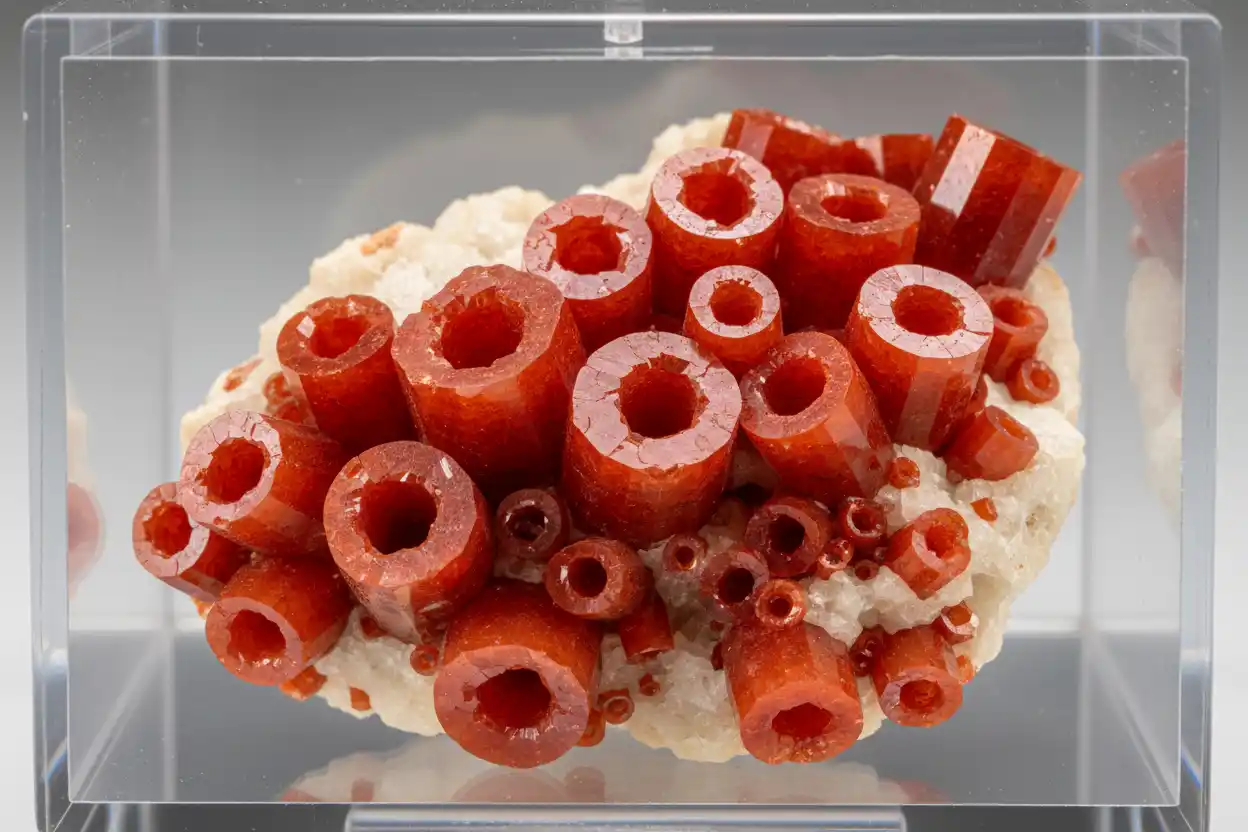
Vanadinite is a dense lead chlorovanadate mineral best known for vivid red, orange and brown hexagonal crystals. It forms as a secondary mineral in the oxidized portions of lead deposits, especially where arid conditions help preserve vanadium-bearing alteration products.
Its brilliant color makes it a highly desirable mineral specimen, but vanadinite is unsuitable for routine jewelry and requires careful handling because it contains a high proportion of lead. It should remain a display and study mineral rather than a material for elixirs, ingestion or children’s collections.
Vanadinite at a Glance
| Property | Vanadinite |
|---|---|
| Mineral group | Apatite group |
| Chemical formula | Pb₅(VO₄)₃Cl |
| Mineral class | Lead chlorovanadate |
| Common colors | Red, orange-red, scarlet, reddish brown, brown, yellow and gray |
| Crystal system | Hexagonal |
| Common habit | Short hexagonal prisms, barrel-shaped crystals, hollow crystals, crusts and granular masses |
| Luster | Adamantine to resinous |
| Transparency | Transparent to opaque |
| Refractive index | Approximately 2.35–2.42 |
| Specific gravity | Approximately 6.8–7.1 |
| Optical character | Uniaxial negative |
| Mohs hardness | About 2.5–3 |
| Cleavage | None or indistinct |
| Tenacity | Brittle |
| Common use | Mineral specimens and scientific study |
| Main care concern | Soft, brittle and lead-bearing; dust and residues must be avoided |
What Is Vanadinite?
Vanadinite consists of lead, vanadium, oxygen and chlorine, with the ideal formula Pb₅(VO₄)₃Cl. Lead accounts for much of its unusually high density.
The mineral belongs to the apatite structural group and forms a series with pyromorphite and mimetite. In those related minerals, phosphate or arsenate replaces part or all of vanadinite’s vanadate component.
Natural crystals may therefore contain mixed vanadate, phosphate and arsenate chemistry. Exact composition can vary even within one specimen.
Vanadinite is a legitimate mineral species rather than a trade name. However, labels such as ruby vanadinite, cherry-red vanadinite and orange vanadinite describe color or quality, not separate varieties.
Why Is Vanadinite Red?
Vanadinite’s best-known color ranges from orange-red to deep scarlet. Its color arises from the vanadate anion and electronic interactions within the crystal structure, while trace elements and substitutions influence tone.
Some specimens appear brown, yellow, gray or nearly colorless. Iron oxides, surface coatings and included matrix can further modify the apparent color.
The finest Moroccan crystals often display intense red or orange-red colors with a bright adamantine luster. Dark crystals may appear nearly opaque until strong light passes through thin edges.
Color alone cannot confirm identity because crocoite, wulfenite, realgar and synthetic materials can produce similar red or orange appearances.
Crystal Forms and Habits
Hexagonal Prisms
Classic vanadinite forms six-sided prismatic crystals with flat terminations. The crystals may be short and tabular or elongated.
Well-developed examples resemble tiny barrels because the prism faces bulge or narrow toward the ends.
Barrel-Shaped Crystals
Barrel-shaped vanadinite is particularly popular in the specimen market. Rounded prism faces and flat terminations create a robust geometric appearance.
Large barrels with intact corners and bright luster receive substantial collector premiums.
Hollow or Skeletal Crystals
Some crystals develop hollow centers, stepped faces or skeletal growth. These forms reflect rapid or uneven deposition during crystal growth.
Hollow crystals are visually interesting but mechanically fragile. Their thin walls can break during cleaning or transport.
Botryoidal and Granular Vanadinite
Vanadinite may also occur as crusts, granular coatings or rounded aggregates without obvious individual crystals.
These forms are generally less valuable than sharp crystals unless they show unusual color, locality or association.
Vanadinite’s Name and History
The mineral was named for vanadium, one of its essential elements. Vanadium itself received its name from Vanadís, an epithet associated with the Norse goddess Freyja, because of the varied colors produced by vanadium compounds.
Older mineral literature may use the synonym “vanadate of lead.” The modern accepted name is vanadinite.
Although vanadinite can serve as an ore of vanadium and lead, modern industrial production usually relies on larger and more economical resources. Collector-quality crystals are valued primarily for mineralogical and aesthetic reasons.
How Vanadinite Forms
Vanadinite forms in the oxidation zone above or around primary lead deposits. These deposits commonly begin with minerals such as galena, a lead sulfide.
Oxygen-rich groundwater reacts with galena and other primary minerals, releasing lead into near-surface fluids. Vanadium must also be supplied by vanadium-bearing wall rocks, silicates, sulfides or circulating solutions.
When the chemistry becomes favorable, lead, vanadate and chloride combine to precipitate vanadinite along fractures, cavities and weathered ore surfaces.
Arid climates favor preservation because limited rainfall reduces leaching and allows secondary minerals to accumulate. Consequently, many famous vanadinite deposits occur in dry regions.
Vanadinite may grow with barite, calcite, cerussite, mimetite, pyromorphite, wulfenite, descloizite and iron oxides.
The Vanadinite-Pyromorphite-Mimetite Series
Vanadinite shares its crystal structure with pyromorphite and mimetite.
Pyromorphite contains phosphate, mimetite contains arsenate and vanadinite contains vanadate. Natural crystals can contain intermediate mixtures rather than pure end-member compositions.
A red crystal may therefore be vanadinite-rich but contain measurable phosphate or arsenate. In some deposits, crystals show compositional zoning between members of the series.
Visual appearance alone cannot establish which component dominates. Raman spectroscopy, X-ray diffraction or chemical analysis may be necessary.
Important Vanadinite Localities
Morocco is the dominant modern source of fine collector vanadinite. Deposits around Mibladen and nearby mining districts have produced vivid red and orange crystals, often on contrasting barite.
Moroccan specimens range from small sparkling crusts to large cabinet pieces covered with well-formed hexagonal barrels. The best material combines bright color, sharp form, strong luster and minimal damage.
Arizona and New Mexico in the United States have produced historically important specimens. Arizona localities include several lead-mining districts known for red, brown and orange crystals.
Mexico has yielded vanadinite from multiple oxidized lead deposits, sometimes with calcite, barite or other secondary minerals.
Namibia, South Africa, Zambia, Argentina, Australia and parts of Europe also host documented occurrences.
Locality influences collector interest, but aesthetic quality generally matters more than country alone unless the deposit is historically important or no longer producing.
Inclusions, Coatings and Internal Features
Vanadinite crystals may contain fluid inclusions, iron oxides, barite, calcite and remnants of earlier lead minerals.
Growth zoning can appear as color bands, hollow cores or changes in transparency. These features record fluctuations in fluid composition during crystal development.
Iron-oxide coatings may darken the surface or occupy cavities between crystals. Calcite or barite can create a pale matrix that enhances visual contrast.
Some crystals are naturally dull, while others lose luster through weathering, abrasion or chemical cleaning. A freshly glossy surface should not be assumed to be coated, although artificial enhancement is possible.
Repair adhesive may occur on large display specimens where crystals or matrix fragments were reattached after mining. Restoration should be disclosed.
How to Identify Vanadinite
Vanadinite’s hexagonal habit, red-orange color, high density and adamantine-to-resinous luster provide strong visual clues.
The mineral feels unusually heavy for its size because its specific gravity approaches 7. However, handling should remain minimal, and density testing should not involve unnecessary immersion or abrasion.
Its hardness of approximately 2.5–3 means it scratches easily. Destructive scratch testing should never be performed on a valuable specimen.
Laboratory identification may use Raman spectroscopy, X-ray diffraction, scanning electron microscopy or chemical analysis. These methods also separate vanadinite from mixed pyromorphite-mimetite material.
The broader crystal identification guide explains why visual matching and home hardness tests cannot provide a definitive answer.
Vanadinite Lookalikes
Wulfenite
Wulfenite is lead molybdate and commonly forms orange, red or yellow tabular crystals. Its thin square plates differ from vanadinite’s hexagonal prisms.
Crocoite
Crocoite is lead chromate and often forms vivid orange-red prismatic crystals. Its crystals are usually elongated and splintery rather than short hexagonal barrels.
Pyromorphite
Pyromorphite can form green, yellow, brown or orange barrel-shaped crystals with the same general structure. Chemical analysis may be required when colors overlap.
Mimetite
Mimetite commonly forms yellow, orange or brown hexagonal crystals. Its arsenate chemistry distinguishes it from vanadinite.
Realgar
Realgar can show bright red-orange color but forms different crystal shapes and contains arsenic sulfide. It also has separate light-sensitivity and safety concerns.
Dyed or Manufactured Specimens
Resin crystals, painted barite and glued fragments can imitate specimen surfaces. Mold seams, repeated forms, color accumulation and visible adhesive are warning signs.
Treatments, Repairs and Imitations
Vanadinite is not normally heat-treated, irradiated or dyed. Its natural color and crystal habit already create its commercial appeal.
Repairs are more common than gem treatments. Individual crystals or broken matrix sections may be reattached with adhesive, especially on large fragile pieces.
Some specimens are assembled by gluing loose vanadinite crystals onto unrelated matrix. These constructed pieces should be clearly disclosed.
Surface oil, lacquer or resin may temporarily increase luster. Such coatings can trap dust, age poorly and complicate safe cleaning.
No meaningful jewelry market exists for synthetic vanadinite. Laboratory-grown crystals may be produced for research, while collector-market imitations are more likely to be resin, glass or assembled natural fragments.
The gemstone treatment guide provides broader terminology, although vanadinite evaluation focuses primarily on repairs and specimen construction.
Is Vanadinite a Gemstone?
Vanadinite is generally considered a mineral specimen rather than a practical gemstone. Its softness, brittleness and lead content make it unsuitable for ordinary faceted jewelry.
Transparent crystals can theoretically be cut, but faceting destroys rare natural forms and creates hazardous dust. Finished stones would also scratch rapidly.
The material’s strongest value lies in undamaged natural crystals on matrix. This differs from gems evaluated primarily for transparency, carat weight and cut.
The types of gemstones guide explains why some attractive minerals remain collector specimens rather than wearable gems.
Hardness and Durability
Vanadinite measures only about 2.5–3 on the Mohs scale. The gemstone hardness chart places it among minerals that can be scratched by many common objects.
It is also brittle. Crystal corners, hollow growths and attachment points can break from light impact.
Do not carry loose vanadinite in a pocket, pouch or mixed specimen box. Contact with quartz or most common minerals can damage it.
The specimen should remain in a stable display case where it cannot fall, rub or release dust.
Vanadinite Prices in 2026
Vanadinite is sold by specimen rather than carat weight. Prices vary widely according to crystal size, color, luster, coverage, matrix, locality and repair history.
Small Moroccan thumbnail specimens commonly retail for approximately $15–$50. Better miniature specimens with sharp red crystals may range from $50–$200.
Attractive cabinet specimens commonly sell for $200–$800, particularly when they feature bright crystals on contrasting barite.
Exceptional large pieces with undamaged, highly lustrous crystals can exceed $1,000. Museum-quality specimens from notable localities may reach several thousand dollars.
Common brown, damaged or poorly crystallized material costs much less. Size alone does not create value if crystals are dull, repaired or heavily chipped.
The dedicated where to buy real vanadinite guide retains seller and authenticity checks.
What Determines Vanadinite Value?
Color is one of the strongest factors. Bright red and orange-red crystals generally receive more attention than dull brown or gray material.
Luster should be bright and reflective. Weathered or chemically etched surfaces appear less vivid even when the color remains strong.
Crystal size and definition matter, but a surface of many undamaged smaller crystals can be more attractive than one large damaged barrel.
Contrast with matrix adds visual impact. White or cream barite can make red crystals stand out dramatically.
Condition is critical. Chipped terminations, missing crystals, repaired matrix and adhesive reduce value unless fully reflected in the price.
Classic locality and old collection provenance can add collector appeal, especially when labels and acquisition history remain intact.
Buying Guidance
Purchase from a specialist mineral dealer who provides dimensions, locality and restoration disclosure.
Review close photographs from multiple angles. Bright frontal lighting can hide chips, repairs and dull rear surfaces.
Ask whether crystals or matrix have been glued, coated or reconstructed. Restoration is not automatically unacceptable, but undisclosed repairs are a serious concern.
Confirm how the specimen will be packed. Each crystal-bearing surface needs clearance so padding cannot press directly against fragile barrels.
Choose a display location before buying. Vanadinite should remain inaccessible to children and pets and should not be placed in kitchens, bathrooms or frequently handled areas.
Do not buy loose crushed material for crafts, tumbling, wire wrapping or “crystal water.” These uses create avoidable lead exposure.
Safe Handling
Vanadinite contains a large amount of chemically bound lead. Intact specimens do not normally create the same exposure as loose dust, but responsible handling remains essential.
Handle the specimen as little as possible and hold it by a stable matrix section. Wear disposable nitrile gloves when cleaning, repacking or examining damaged material.
Wash hands with soap and water after handling, even when gloves were used. Do not eat, drink, smoke or touch the face during specimen work.
Never lick the mineral, place it against the skin for extended periods or allow children to handle it.
Avoid cutting, grinding, drilling, tumbling or sanding. These processes generate lead-bearing dust that can be inhaled or transferred to surfaces.
The broader toxic crystals safety list provides context for other lead-, arsenic-, mercury- and copper-bearing collector minerals.
Cleaning Vanadinite
Routine wet cleaning is not recommended. Water can move contaminated dust and residue into sinks, work surfaces or drains.
Use a hand air blower inside a controlled workspace to remove loose surface dust. Avoid compressed-air cans, which can scatter particles and damage crystals.
A very soft brush may be used only when necessary, while wearing gloves and working over a disposable liner. Do not scrub or apply pressure.
Never use acids, bleach, household chemicals, ultrasonic cleaners or steam. These methods can attack the crystal, damage associated minerals and increase contamination risk.
If a specimen is heavily soiled, seek guidance from an experienced mineral conservator rather than experimenting at home.
Vanadinite should not be treated as one of the crystals that can go in water.
Heat, Sunlight and Storage
Vanadinite’s natural color is generally stable under ordinary indoor display conditions. However, excessive heat can damage the specimen or its matrix.
Keep it away from direct sunlight that could overheat a closed display cabinet. The general sunlight safety guide is useful for planning specimen displays, even though vanadinite’s primary concern is handling safety rather than fading.
Store the specimen in a sealed or well-fitted display case that limits dust and accidental contact. A case also reduces the need for cleaning.
Use stable supports that do not press against crystal faces. Acid-free labels and inert mounting materials are preferable for long-term storage.
Do not store vanadinite beside jewelry, cosmetics, food, medicine or children’s collections.
Meaning and Symbolism
Modern crystal traditions sometimes associate vanadinite with motivation, concentration, creativity and disciplined action. Its vivid red-orange color and geometric crystal forms encourage symbolic interpretations involving energy and organization.
Some collectors use it only as a visual focus object without direct skin contact. That approach respects the mineral’s personal symbolism while acknowledging its lead content.
These meanings are spiritual, cultural or personal rather than scientifically proven effects. Vanadinite should never be used as a medical treatment, ingested preparation or crystal elixir.
Dry, contact-free display is safer than ritual practices involving water, oils, prolonged handling or placement on the body. The general crystal cleansing guide should be adapted by choosing only contact-free methods for lead-bearing specimens.
Frequently Asked Questions
1. What is vanadinite made of?
Vanadinite is lead chlorovanadate with the ideal formula Pb₅(VO₄)₃Cl.
2. Why is vanadinite red?
Its vanadate-based crystal chemistry produces strong red, orange and brown colors, while substitutions and impurities modify the exact tone.
3. Where does vanadinite form?
It develops in the oxidized zones of lead deposits, especially in arid environments where lead and vanadium-bearing fluids react.
4. Is vanadinite a gemstone?
It is primarily a mineral specimen. Its softness, brittleness and lead content make it unsuitable for ordinary jewelry.
5. Is vanadinite toxic to touch?
Intact specimens present less risk than dust, but they contain substantial lead. Minimize handling, use gloves when needed and wash hands afterward.
6. Can vanadinite go in water?
It should not be soaked or used in water. Wet cleaning can spread lead-bearing residue, while acids and chemicals can damage the mineral.
7. Can vanadinite be used in a crystal elixir?
No. Never place vanadinite in drinking water or ingest any liquid that contacted it.
8. Can vanadinite be cut or polished?
It should not be cut, drilled, sanded or tumbled outside a properly controlled professional facility because these processes generate hazardous lead-bearing dust.
9. How is vanadinite different from wulfenite?
Vanadinite is lead chlorovanadate and commonly forms hexagonal prisms. Wulfenite is lead molybdate and usually forms thin square or rectangular plates.
10. Why is Moroccan vanadinite popular?
Moroccan deposits produce abundant bright red and orange crystals, often on contrasting white barite, with excellent form and luster.
11. How much does vanadinite cost?
Small specimens commonly cost $15–$50, while fine cabinet specimens may sell for several hundred dollars. Exceptional museum-quality pieces can exceed $1,000.
12. Does vanadinite have scientifically proven healing properties?
No. There is no scientific evidence that it produces healing effects, and its lead content makes direct-contact or ingestion-based practices unsafe.
Vanadinite’s combination of vivid color, geometric form and unusually high density makes it one of the most recognizable secondary lead minerals. Its safest and most appropriate role is as a carefully enclosed collector specimen that can be studied and appreciated without unnecessary contact.
Vanadinite appears in Crystals That Start With V and Gemstones That Start With V.
Safety disclaimer: Vanadinite contains lead. Do not ingest it, lick it, place it in drinking water, use it for crystal elixirs, or cut, grind, drill or tumble it. Minimize handling, keep it away from children and pets, and wash your hands thoroughly after contact.