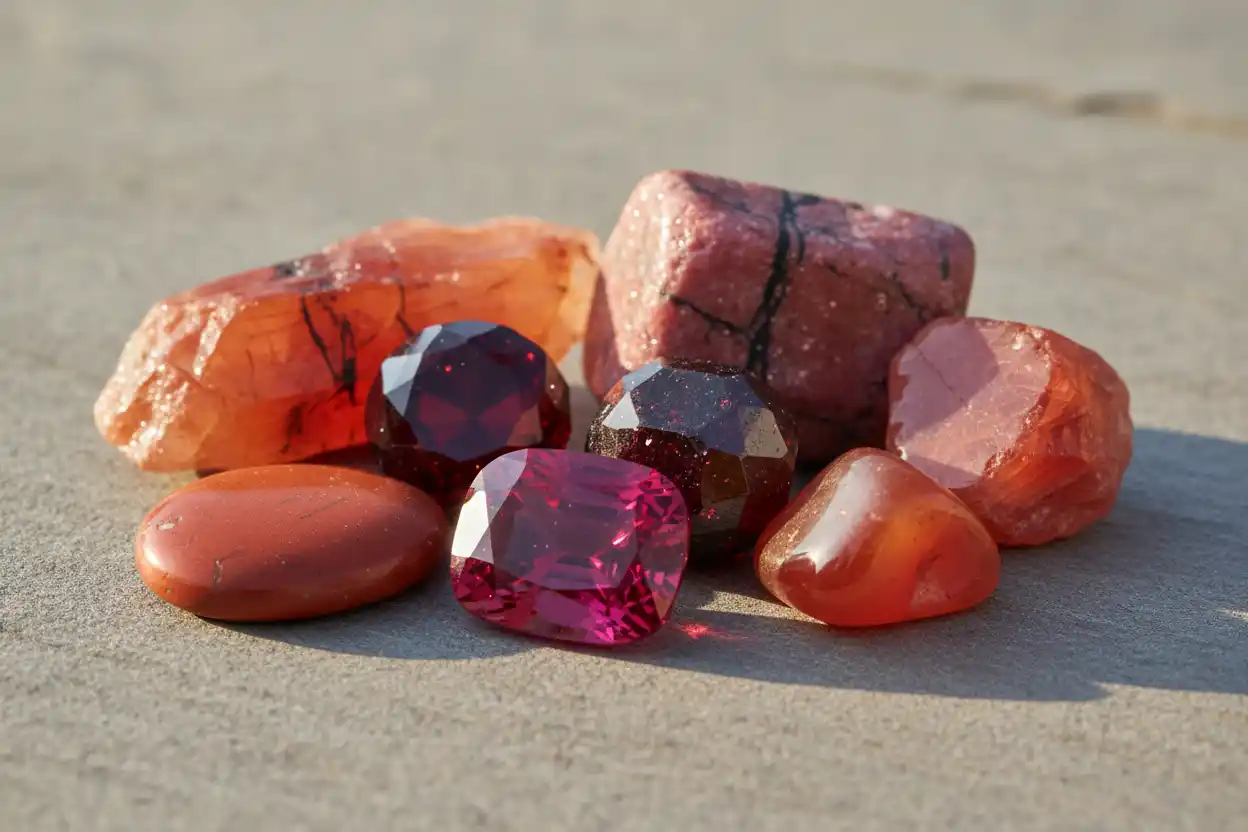
Red Crystals: Meanings, Uses and Complete Stone List
Red crystals are traditionally associated with vitality, courage, grounded action, passion and physical presence. Their shared color creates a recognizable symbolic group, although they do not belong to one mineral family and do not possess one set of physical properties.
A red ruby crystal, opaque red jasper, translucent carnelian, soft red calcite and hazardous realgar specimen require entirely different handling. Therefore, color symbolism should never replace mineral identification, durability knowledge or safety precautions.
This guide owns the crystal-healing and belief-based intent of the red color family. It explains traditional meanings, practical ways people use red stones and how to choose among them by appearance and intention. Readers interested primarily in gem species, cutting, jewelry durability and buying should use Red Gemstones: Names, Meanings and Uses.
Metaphysical associations in this guide reflect historical and contemporary crystal traditions. They are not established medical or scientific effects.
What Do Red Crystals Symbolize?
Across many modern crystal traditions, red represents life force, movement, determination and embodied confidence.
It is often chosen when a person wants a symbolic reminder to act rather than postpone, remain present during uncertainty or reconnect with practical priorities.
Deeper burgundy stones such as garnet are frequently associated with commitment, endurance and mature passion. Brighter orange-red crystals such as carnelian are linked with creativity, sociability and expressive confidence.
Opaque earthy reds, especially jasper, are commonly interpreted as grounding and stabilizing. Transparent vivid reds such as ruby and spinel tend to carry themes of intensity, leadership and devotion.
These meanings come from symbolism, historical use, color psychology and modern spiritual practice. The stone’s color does not demonstrate that it changes physiology or treats disease.
Why Crystals Become Red
Red coloration arises through several unrelated mechanisms.
Chromium creates red in ruby and many red spinels. Iron oxides and iron-bearing inclusions produce earthy reds in jasper, aventurine, tiger’s eye and numerous quartz materials.
Manganese contributes pink, red and orange shades in minerals such as rhodochrosite and selected garnets. Copper-bearing and organic structures can produce red in other materials.
Some stones are naturally red throughout. Others contain red inclusions, surface staining, dyed fractures or heat-altered color.
Consequently, two red stones may look similar while differing completely in composition, hardness, toxicity and care.
Complete List of Red Crystals
| Red crystal | Typical appearance | Traditional association | Practical note |
|---|---|---|---|
| Ruby | Transparent to opaque vivid, purplish or brownish red | Vitality, devotion and courageous leadership | Hard corundum; natural, synthetic and treated material occur |
| Garnet | Deep red, purplish red, orange-red or brown-red | Commitment, endurance and grounded passion | A mineral group rather than one species |
| Red jasper | Opaque brick, rust or earthy red | Stability, persistence and practical action | Durable microcrystalline quartz used in carvings and beads |
| Carnelian | Translucent orange-red to brownish red | Creativity, confidence and motivation | Chalcedony; heat and dye may influence color |
| Red aventurine | Sparkling orange-red or brick-red quartz | Determination, optimism and constructive momentum | Color and sparkle come from mineral inclusions |
| Red tiger’s eye | Chatoyant red-brown with a moving band | Focus, confidence and directed action | Much market material is heated tiger’s eye |
| Red calcite | Translucent coral, brick or orange-red | Emotional movement and gentle activation | Soft and acid-sensitive |
| Red beryl | Transparent vivid red to purplish red | Rare purpose, resilience and concentrated intention | Extremely rare facetable beryl |
| Rubellite | Transparent pink-red to deep red tourmaline | Love, emotional honesty and expressive confidence | A red-to-pink tourmaline trade variety |
| Red spinel | Transparent vivid red, pink-red or orangish red | Renewal, enthusiasm and self-trust | Historically confused with ruby |
| Rhodonite | Opaque rose-red or pink with black veining | Compassion with boundaries and emotional steadiness | Manganese silicate; often used as cabochons |
| Rhodochrosite | Pink to red with white bands | Self-kindness, emotional warmth and remembrance | Soft carbonate requiring gentle care |
| Fire opal | Transparent to translucent yellow-orange or red-orange | Creative spark, pleasure and spontaneity | May or may not show play-of-color |
| Precious red coral | Opaque organic red, orange-red or pink | Protection, ancestry and life symbolism | Organic gem; trade and species restrictions apply |
| Sardonyx | Layered red-brown, orange, white and black chalcedony | Discipline, loyalty and structured confidence | Frequently dyed or treated |
| Sunstone | Peach, orange, copper-red or reddish brown with sparkle | Optimism, independence and personal warmth | Feldspar with reflective inclusions |
| Ruby in zoisite | Red ruby crystals in green and black zoisite rock | Balancing intensity with growth | Mixed mineral rock with variable hardness |
| Ruby in fuchsite | Red ruby in green mica-rich matrix | Heart-centered courage and renewal | Soft matrix requires careful handling |
| Realgar | Bright orange-red to scarlet crystals | Transformation and focused awareness in collector traditions | Arsenic sulfide; light-sensitive and hazardous |
| Cinnabar | Scarlet to brown-red mineral, often massive | Transformation, prosperity symbolism and intensity | Mercury sulfide; avoid dust and ingestion |
| Red agate | Banded or uniform translucent red chalcedony | Confidence, protection and steadiness | Often dyed or heat-treated |
| Strawberry quartz | Transparent to translucent quartz with red or pink inclusions | Joy, appreciation and affectionate connection | Glass imitations are common |
| Red zircon | Transparent orange-red, brown-red or purplish red | Renewal, clarity and enthusiasm | Natural zircon, not cubic zirconia |
| Red tourmaline | Pink-red to crimson tourmaline | Emotional expression and devotion | Rubellite represents the stronger red trade range |
The phrase complete list cannot include every red mineral known to science. Here it refers to the principal red stones encountered in crystal collections, jewelry and contemporary metaphysical practice.
Ruby
Ruby is the red variety of corundum.
Its vivid color and exceptional hardness made it a historical symbol of authority, protection, passion and committed purpose.
In modern crystal practice, ruby is often chosen as a reminder to pursue demanding goals with confidence. Its intensity may appeal to people who want an assertive rather than calming symbol.
Natural ruby, laboratory-grown ruby, heated ruby and glass-filled material can look similar. Spiritual use does not remove the need for clear identification and treatment disclosure.
Garnet
Garnet is a family of closely related minerals.
Red members include almandine, pyrope and many mixed compositions. Rhodolite commonly contributes a brighter purple-red or raspberry appearance.
Traditional garnet symbolism emphasizes protection during travel, enduring affection, commitment and strength through long projects.
Its often-dark red color suits people seeking a more grounded and sustained form of motivation than the bright outward energy associated with carnelian.
Red Jasper
Red jasper is opaque microcrystalline quartz colored largely by iron-bearing material.
Modern crystal traditions associate it with steadiness, practical courage and the ability to continue through repetitive or difficult work.
Its earthy appearance makes it a popular grounding stone. Unlike transparent gems that attract attention through brilliance, red jasper communicates solidity and permanence.
It is comparatively durable, although dyed and reconstructed jasper products occur.
Carnelian
Carnelian is translucent orange-to-red chalcedony.
Its warm color has long been connected with eloquence, confidence, creativity and social energy.
People commonly choose carnelian before performances, presentations or creative work as a symbolic prompt to participate fully.
Heat treatment is common within the broader chalcedony trade, and pale agate may be dyed or heated to imitate fine carnelian.
Red Aventurine
Red aventurine is quartz containing reflective mineral inclusions that create a subtle sparkle.
Its traditional themes combine the practical steadiness of quartz with ambition, optimism and forward movement.
The stone is often selected for long-term projects that require repeated effort rather than one brief burst of motivation.
Color can range from peach-red to brick red. Dyed quartz and glass may imitate the appearance, especially when sparkle is excessively uniform.
Red Tiger’s Eye
Red tiger’s eye shows a moving chatoyant band over red-brown material.
Much commercial red tiger’s eye begins as golden or brown tiger’s eye that receives heat treatment.
In belief-based use, its directional optical band is associated with focus, confidence and decisive movement.
The material is often chosen when someone wants to narrow attention to one objective rather than divide energy across many plans.
Red Calcite
Red calcite is a soft carbonate mineral ranging from coral red to orange-red and brick red.
Its gentler visual character leads many practitioners to associate it with gradual emotional movement rather than forceful activation.
Calcite scratches easily and reacts with acids. It should not be worn in high-impact jewelry or cleaned with vinegar, citrus, harsh chemicals or prolonged water exposure.
A spiritual association never overrides those physical limitations.
Red Beryl
Red beryl is an exceptionally rare red beryl colored principally by manganese.
Its scarcity has inspired modern themes of concentrated purpose, resilience and valuing what is difficult to obtain.
Most collectors encounter small crystals, included faceted stones or photographs rather than large jewelry gems.
Glass, synthetic red beryl and red simulants require laboratory separation when the value is substantial.
Rubellite
Rubellite is a commercial name for strongly saturated pink-to-red tourmaline.
It is traditionally linked with affection, emotional honesty, confidence in relationships and the willingness to communicate directly.
The material should remain red or pink-red under different ordinary lights rather than becoming primarily brown.
Rubellite can contain visible inclusions, and fractures may be filled. The emotional symbolism does not establish whether a stone is untreated or natural.
Red Spinel
Spinel occurs in vivid red, pink-red and orangish red.
Red spinel was historically confused with ruby, including in important royal collections.
Contemporary symbolism often emphasizes renewal, enthusiasm and regaining energy after disappointment.
Its brilliance and toughness make it suitable for jewelry, while natural, laboratory-grown and treated spinel remain separate market categories.
Rhodonite
Rhodonite commonly combines rose-red or pink material with black manganese-oxide veins.
The contrast has encouraged themes of compassion supported by boundaries, emotional steadiness and responding without losing self-respect.
It is often selected after interpersonal conflict or during work that requires patience with other people.
Rhodonite is softer than quartz and may contain fractures. Beads and cabochons should be protected from impact and harsh chemicals.
Rhodochrosite
Rhodochrosite ranges from pale pink to vivid red and often displays white bands.
Its traditional associations center on self-kindness, emotional warmth, memory and the ability to acknowledge feelings without becoming defined by them.
The stone is comparatively soft, has perfect cleavage and reacts with acid.
Its visual similarity to rhodonite, calcite and manufactured imitations makes careful identification important.
Fire Opal
Fire opal is opal with yellow, orange or red bodycolor.
Some stones display play-of-color, while others are valued entirely for their warm transparent or translucent bodycolor.
Crystal traditions connect fire opal with spontaneity, pleasure, creative risk and expressive confidence.
Opal can be vulnerable to impact, rapid temperature change and treatment-related instability. It should not be soaked as a routine spiritual method.
Red Coral
Coral is an organic gem material produced by marine organisms.
Red coral carries long-standing symbolism connected with protection, blood, ancestry, life and the sea.
However, coral is not simply another mineral crystal. It is porous, soft and vulnerable to perfume, acids and heat.
Trade legality depends on species, source, age and jurisdiction. Documentation is part of responsible ownership, and imitation or reconstructed coral may be preferable for some buyers.
Sardonyx
Sardonyx is layered chalcedony combining sard-colored red-brown or orange-brown bands with white, black or other layers.
Its orderly bands have inspired associations with discipline, loyalty, reliability and promises maintained through action.
It suits people who prefer structured symbolism rather than the dramatic intensity of ruby.
Natural and dyed material occur, particularly in cameos and beads.
Sunstone
Sunstone is feldspar that may display orange, copper-red, peach or reddish-brown color with reflective aventurescence.
Its bright optical effect is traditionally linked with optimism, autonomy, visibility and warmth.
Sunstone can serve as a symbolic reminder to accept recognition rather than minimizing personal contributions.
Different feldspar varieties and locality products vary in color, inclusions, durability and value.
Ruby in Zoisite
Ruby in zoisite combines red corundum with green zoisite and commonly black amphibole.
The contrasting colors are often interpreted as a balance between passionate action and growth.
Because it is a mixed rock, different areas respond differently to polishing, wear and impact.
Large red areas do not necessarily represent transparent gem-quality ruby.
Ruby in Fuchsite
Ruby in fuchsite contains ruby crystals within a green chromium-bearing mica matrix.
Modern symbolism links it with courage expressed through care rather than force.
The fuchsite matrix is soft and can flake, while ruby areas are much harder.
This hardness contrast makes the material unsuitable for aggressive cleansing, tumbling or daily-impact jewelry.
Realgar and Cinnabar
Realgar and cinnabar belong in specialist mineral collections rather than casual handling routines.
Realgar contains arsenic and changes under light. Cinnabar contains mercury and can create hazardous dust if cut, crushed or abraded.
Historical symbolism around transformation, wealth or power should never encourage ingestion, skin elixirs or powdered use.
Keep specimens labeled, enclosed where appropriate and away from children, pets, food-preparation areas and direct sunlight.
The completed toxic crystals list provides broader material-safety guidance.
Red Crystals and the Root Chakra
Modern chakra systems commonly connect red stones with the root chakra.
The symbolism centers on safety, survival, physical presence, home, resources and belonging.
Opaque red jasper, dark garnet and red tiger’s eye are frequently selected because their earthy or deep colors fit grounding practices.
The planned root chakra crystals guide owns the full chakra-specific selection and balancing methods.
These associations are spiritual frameworks rather than anatomical or medical conclusions.
Red-Orange Crystals and the Sacral Chakra
Orange-red carnelian, fire opal, sunstone and selected red aventurine are also linked with the sacral chakra.
In that framework, the focus shifts toward creativity, pleasure, emotional movement and connection.
The planned sacral chakra crystals guide retains the full list and practice boundaries.
A person may interpret the same stone differently according to culture, experience and intention. There is no universal requirement to assign one crystal to one energy center.
Choosing a Red Crystal by Intention
For grounding and persistence, red jasper, dark garnet and red tiger’s eye offer a visually steady presence.
Carnelian, sunstone and fire opal are better suited to symbolism centered on creativity, visibility and movement.
Ruby, red spinel and rubellite carry more intense themes of devotion, confidence and emotional courage.
Rhodonite and rhodochrosite suit reflective practices involving compassion, self-kindness and relationships.
Red calcite can represent gradual activation, while sardonyx emphasizes discipline and loyalty.
The most useful choice is one whose appearance, meaning, cost and care requirements fit the practice realistically.
Raw, Tumbled and Jewelry Forms
Raw crystals preserve natural growth, fracture and matrix features. They often appeal to collectors but can be sharp, crumbly or light-sensitive.
Tumbled stones are convenient for carrying, although polishing removes many identification clues.
Jewelry keeps a symbolic object present through the day. Before wearing it, consider hardness, cleavage, porosity, treatment and metal security.
Ruby and spinel tolerate jewelry wear far better than red calcite, rhodochrosite or realgar.
Form should follow the material rather than forcing every red stone into a pocket or bracelet.
How to Use Red Crystals
A red crystal can serve as a visual cue during planning, journaling or meditation.
Place red jasper beside a written long-term goal, carry carnelian before creative work or wear garnet as a reminder of a commitment.
A stone on a desk can mark the boundary between preparation and action. During reflection, its color may help focus attention on what requires courage or practical follow-through.
These uses work as symbolic rituals and attention-setting practices. They should not replace medical care, therapy, financial planning or necessary safety decisions.
Combining Red Crystals
Red stones can be paired with clear quartz for visual contrast or with smoky quartz and black tourmaline in grounding-focused arrangements.
A gentler emotional combination might use rhodonite with rose quartz.
Using several intense stones is not inherently better. A simple pairing creates clearer symbolism and reduces the risk of collecting without purpose.
Physical compatibility matters too. A hard ruby can scratch soft calcite or rhodochrosite when stored together.
Wrap individual stones or use divided storage compartments.
Cleansing and Water Safety
No cleansing method suits every red crystal.
Quartz-based stones such as jasper and carnelian tolerate brief gentle cleaning more readily than calcite, coral, rhodochrosite, realgar and cinnabar.
The completed crystal water-safety guide explains why hardness, solubility, toxicity, dye and metal settings must all be considered.
Avoid saltwater, acids, prolonged soaking and direct elixir preparation unless the exact mineral and treatment are known to be safe.
Dry methods, sound used at a distance, intention-setting and careful placement avoid many physical risks.
Frequently Asked Questions
1. What do red crystals traditionally symbolize?
They are commonly associated with vitality, courage, grounded action, passion, commitment and physical presence.
2. Are all red crystals connected with the root chakra?
Many modern systems make that association, but orange-red stones are also linked with the sacral chakra, and interpretations vary.
3. Which red crystal is best for grounding?
Red jasper, dark garnet and red tiger’s eye are common traditional choices.
4. Which red crystal is associated with creativity?
Carnelian, sunstone, fire opal and red aventurine are frequently linked with creative expression.
5. Which red crystal is associated with love?
Ruby, rubellite, garnet, rhodonite and rhodochrosite carry different love and relationship traditions.
6. Are red crystals scientifically proven to increase energy?
No. Their energetic meanings belong to spiritual practice, symbolism and personal experience rather than established medical science.
7. Can every red crystal be carried in a pocket?
No. Realgar, cinnabar, fragile crystals and soft stones require protective or display-only handling.
8. Can red crystals go in water?
Some stable quartz materials tolerate brief water exposure, but calcite, coral, rhodochrosite, toxic minerals, dyed stones and unknown treatments require caution.
9. Is carnelian the same as red jasper?
No. Carnelian is generally translucent orange-red chalcedony, while red jasper is opaque and usually more earthy.
10. Are ruby and red spinel the same mineral?
No. Ruby is red corundum, while spinel is a separate cubic mineral species.
11. Can a red stone’s meaning identify it?
No. Color symbolism cannot determine mineral identity, treatment or authenticity.
12. How should I choose a red crystal?
Choose according to the symbolism that resonates with you, then confirm the mineral’s authenticity, safety, durability and care requirements.
Red crystals share a powerful visual language without sharing one mineral identity or one effect. Ruby, carnelian, jasper, garnet and rhodochrosite can all represent action or vitality while asking for very different handling. The most responsible practice combines personal symbolism with accurate identification and respect for the material’s physical limits.
Crystal meanings and chakra associations are spiritual and cultural beliefs, not medical claims. Do not ingest crystals, prepare direct crystal elixirs from unknown materials or use hazardous minerals such as realgar and cinnabar in skin-contact practices.