
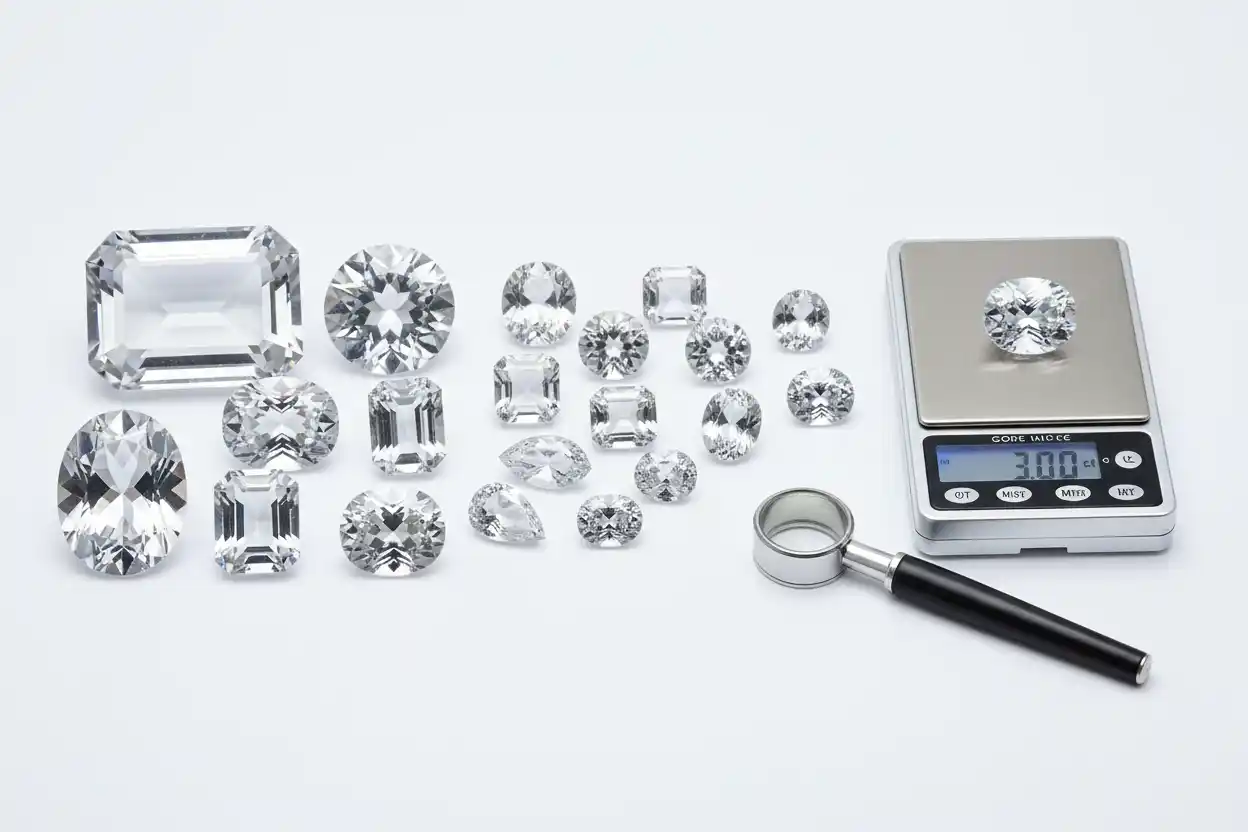

Goshenite prices in 2026 commonly range from approximately $5 to $50 per carat. Most eye-clean commercial stones cost about $10 to $30 per carat, while precision-cut, unusually large or collector-quality examples may reach $50 to $100 per carat or more.
The colorless beryl remains affordable because clean crystals can occur in large sizes and demand is limited compared with Diamond, Aquamarine, Emerald and Morganite. Consequently, cutting quality often contributes more to a Goshenite’s price than carat weight.
Goshenite Price per Carat in 2026
The following ranges represent broad U.S. retail expectations for loose natural Goshenite. Individual stones may fall outside them because custom cutting, locality documentation and retailer positioning can add substantial premiums.
| Goshenite quality | Typical characteristics | Approximate 2026 retail price |
|---|---|---|
| Entry commercial | Included, poorly cut, slightly gray or visibly windowed | $3–$10 per carat |
| Good commercial | Colorless to near-colorless, eye-clean and conventionally cut | $10–$30 per carat |
| Fine | High transparency, good brilliance, balanced proportions and polish | $30–$60 per carat |
| Precision-cut or specialty | Custom faceting, unusual shape or superior optical performance | $50–$100 per carat |
| Collector or provenance material | Exceptional crystal, documented locality or recognized lapidary work | $100–$200+ per carat |
Large mass-produced stones can cost less per carat than smaller precision-cut gems. A 20- or 40-carat Goshenite therefore does not automatically belong to the premium tier.
The full relationship among rarity, appearance and demand appears in How Gemstone Prices Are Determined.
What Is Goshenite?
Goshenite is the colorless to near-colorless variety of beryl. Chemically pure beryl is colorless, while trace elements create the blue of Aquamarine, green of Emerald, pink of Morganite and yellow of Heliodor.
The name comes from Goshen, Massachusetts, where the material was historically described. However, commercial Goshenite now comes from multiple beryl-producing regions.
As a member of the beryl family, Goshenite has a Mohs hardness of approximately 7.5 to 8. It offers useful scratch resistance, although fractures and brittle tenacity can still create damage risks.
The completed Goshenite guide owns its complete mineral identity. The completed Beryl guide explains its relationship with the colored beryl varieties.
Why Goshenite Is Inexpensive
Colorless transparency does not automatically produce a valuable gemstone. Goshenite lacks the intense color that creates scarcity premiums in Emerald, Aquamarine, Morganite, Heliodor and Red Beryl.
Gem-quality beryl crystals can also grow to substantial sizes. Cutters may obtain large eye-clean stones without encountering the same supply constraints found in rare colored gems.
Consumer recognition remains limited. Buyers seeking a colorless stone more commonly ask for Diamond, laboratory-grown Diamond, Moissanite, White Sapphire, White Topaz or Cubic Zirconia.
Lower demand keeps prices moderate even when the material is natural, durable and well cut.
Clarity Is Expected, Not Rare
Faceted Goshenite should generally appear eye-clean. Since transparent colorless rough is available, visible fractures, clouds and dark inclusions reduce value significantly.
Minor internal features may be acceptable in a rare crystal specimen or an unusually large artistic cut. In ordinary jewelry stones, however, clean transparency is a basic expectation rather than a premium feature.
Surface-reaching fissures deserve particular attention. They can collect dirt and create vulnerability during setting.
Buyers should inspect side and pavilion views because dark backgrounds can conceal internal fractures. A colorless gem may look clean face-up while showing a fissure network from the side.
Cut Quality Controls Goshenite’s Appearance
Goshenite has less dispersion and brilliance than Diamond, so cutting must work harder to create visual life. Poor proportions can make the stone appear watery or glass-like.
A shallow pavilion produces a large transparent window. Excessive depth hides weight below the setting while reducing the stone’s face-up size.
Precision faceting can add meaningful value. Concave, Portuguese, fantasy and custom brilliant cuts may produce stronger scintillation than mass-market ovals or emerald cuts.
The premium reflects lapidary labor rather than rough scarcity. A respected cutter may charge hundreds of dollars for a finished stone even when the underlying Goshenite rough was inexpensive.
Symmetry and polish also matter. Scratched facets, uneven girdles and poorly aligned junctions should reduce the price.
Does Goshenite Have Fire?
Goshenite can show brilliance, but its dispersion is modest compared with Diamond, Demantoid, Sphene or Cubic Zirconia. It usually produces cleaner white reflections rather than strong rainbow fire.
Marketing photographs sometimes use concentrated spotlights to exaggerate spectral flashes. The stone should also be viewed under diffuse indoor light.
A well-cut Goshenite can look crisp and elegant, particularly in a large design. Buyers expecting Diamond-like scintillation may nevertheless find it quieter.
Its optical character should be treated as a feature of colorless beryl rather than judged by how closely it imitates Diamond.
Goshenite Size and Price
Large Goshenite stones are relatively available. Price per carat therefore rises slowly and may even decrease for oversized commercial material.
| Example stone | Approximate per-carat range | Approximate total price |
|---|---|---|
| 2 ct commercial Goshenite | $5–$20 | $10–$40 |
| 5 ct good eye-clean Goshenite | $10–$30 | $50–$150 |
| 10 ct fine Goshenite | $20–$50 | $200–$500 |
| 20 ct precision-cut Goshenite | $40–$100 | $800–$2,000 |
| Large documented collector stone | $50–$200+ | Individually evaluated |
A large stone may require a custom setting, which can cost more than the Goshenite itself. Wearability also limits demand for extremely large gems.
Dimensions should be compared with weight. A deep 15-carat stone can face up smaller than an efficiently cut ten-carat gem.
Origin and Locality
Goshenite occurs in Brazil, Madagascar, Pakistan, Afghanistan, Sri Lanka, Namibia, China, Russia, Canada and the United States, among other beryl-producing regions.
Ordinary geographic origin rarely creates a substantial price premium. Colorless appearance and similar properties make locality difficult to appreciate visually.
Provenance matters more for mineral specimens. A well-formed crystal from a classic mine can attract collectors because of its habit, associations, damage-free termination and documented label.
A faceted stone should not receive a major premium simply because a seller states “Brazilian” or “Pakistani.” The visible quality and cutting must support the price.
Goshenite vs Aquamarine Prices
Aquamarine is blue to greenish-blue beryl, and desirable color creates a much stronger market. Fine Aquamarine commonly costs tens to hundreds of dollars per carat, while exceptional saturated material can exceed $1,000 per carat.
Goshenite lacks that color premium. Even when the two stones have similar clarity and size, the colorless stone generally costs less.
A faint blue modifier can create a classification question. Near-colorless material may still be sold as Goshenite, while recognizably blue stones enter the Aquamarine market.
Current Aquamarine ranges appear in the Aquamarine Price Guide. A seller should not price barely tinted Goshenite as fine Aquamarine.
Goshenite vs Emerald Prices
Emerald receives its value from rare green color, geological formation and strong global demand. Even included Emeralds can cost much more than clean Goshenite.
The comparison demonstrates why clarity alone does not determine gemstone price. A flawless colorless beryl may remain inexpensive, while a visibly included but vividly green beryl can command thousands of dollars per carat.
Current green-beryl pricing appears in the Emerald Price Guide. Treatment and fissure filling also play a much larger commercial role in Emerald than in Goshenite.
Goshenite vs Morganite and Heliodor
Morganite receives a premium for pink to peach color. Heliodor and golden beryl are valued for yellow to golden tones.
Both varieties can occur in large, clean stones, so their prices remain moderate compared with Emerald. Nevertheless, desirable color usually places them above ordinary Goshenite.
The planned Morganite Price Guide and Heliodor Price Guide own their separate 2026 markets.
Rare Red Beryl sits at the opposite end of the family. Its limited supply and intense color make it far more valuable than colorless beryl.
Goshenite vs Diamond
Diamond has greater hardness, refractive index, dispersion and global market recognition. Those characteristics create much stronger brilliance, fire and resale demand.
A natural Diamond of one-carat visual size can cost thousands of dollars. A Goshenite of similar dimensions may cost tens of dollars.
Goshenite should not be represented as a “white Emerald” or a scarce Diamond substitute. It is a legitimate natural beryl with its own optical appearance.
Natural Diamond pricing belongs to the Diamond Price Guide. Buyers prioritizing geological origin and large size at low cost may still find Goshenite appealing.
Goshenite vs White Sapphire and White Topaz
White Sapphire is harder and generally shows better long-term abrasion resistance. It may still appear less brilliant than Diamond, particularly when poorly cut.
The completed White Sapphire guide owns its identity. Natural White Sapphire usually costs more than commercial Goshenite because clean colorless corundum has stronger demand.
White Topaz is also affordable but has perfect cleavage, making it vulnerable to certain impacts. The completed White Topaz guide explains its material properties.
Goshenite sits between these alternatives as a durable but relatively quiet colorless gem. Choice should depend on optical preference, setting and wear pattern rather than name alone.
Goshenite vs Cubic Zirconia
Cubic Zirconia usually costs less than Goshenite and shows stronger dispersion. However, CZ is laboratory manufactured and can accumulate surface abrasion during frequent wear.
Goshenite provides natural geological origin, lower density and beryl-family durability. Its appearance is subtler and less fiery.
The Cubic Zirconia Price Guide owns CZ pricing. The two materials should not be sold interchangeably merely because both are colorless.
Treatments and Color Modification
Natural colorless Goshenite is commonly sold without treatment. Its lack of color generally provides little reason for routine heat enhancement.
Beryl can respond to irradiation, coatings or other processes that alter color. Once a stone displays a stable marketable blue, yellow, green or pink appearance, it may be sold under another description rather than as ordinary colorless Goshenite.
Foil backs and colored settings have also been used historically to make colorless stones imitate more valuable gems. Mounted antique material should therefore be examined from the back when possible.
The universal disclosure framework appears in Gemstone Treatments Explained.
Laboratory-grown beryl can also exist. The broader origin distinction belongs to Lab-Grown vs Natural Gemstones.
Synthetic and Imitation Material
Colorless glass, Quartz, Topaz, Sapphire, CZ and other materials can resemble Goshenite. Visual appearance alone does not establish beryl identity.
Refractive-index testing, specific gravity and other standard gemological methods can separate many of these materials. Advanced laboratory analysis may be needed when the stone is mounted or the result has significant financial importance.
An inexpensive Goshenite usually does not justify a premium laboratory report. However, a seller charging heavily for rarity, origin or an unusual designer stone should support those claims.
The Gemstone Certification Labs comparison explains what identification reports can confirm.
Goshenite Jewelry Prices in 2026
| Jewelry type | Broad U.S. retail range | Main cost drivers |
|---|---|---|
| Sterling-silver earrings or pendant | $40–$250 | Silver, stone size and production |
| Sterling-silver statement ring | $75–$400 | Large stone, setting and cutting |
| Gold Goshenite pendant | $300–$1,500 | Gold weight, custom setting and gem cut |
| Gold Goshenite ring | $400–$2,500 | Metal, workmanship and accent stones |
| Precision-cut designer jewel | $1,000–$5,000+ | Lapidary work, gold or platinum and brand |
The setting commonly represents most of the retail price. A $2,000 Goshenite ring may contain a center stone worth only a few hundred dollars.
That distinction matters during resale. A secondhand dealer may value the gold, designer signature and workmanship more strongly than the loose gem.
Is Goshenite Suitable for an Engagement Ring?
Goshenite has enough hardness for jewelry, but it is not as resistant to abrasion as Sapphire or Diamond. Internal fractures can also lower toughness.
A protective bezel or halo can reduce edge damage. Buyers should avoid extremely high settings that expose a large stone to repeated impact.
Large Goshenite offers impressive visual size at low cost, making it suitable for occasional-wear or budget-conscious designs. Someone expecting Diamond-like sparkle and long-term market value may prefer another material.
The broader colorless-jewelry landscape appears in White Gemstones for Engagement Rings.
Certification and Appraisal
Most commercial Goshenite does not need laboratory certification. Standard gemological testing can usually identify colorless beryl, and the report fee may exceed the stone’s value.
A report becomes more reasonable when the seller claims:
- An important historic locality
- An exceptional untreated or natural-origin status
- A very high value based on rarity
- A famous cutter or documented provenance
- A distinction from laboratory-grown material
Identification does not establish retail value. An appraisal should separate the loose stone, setting metal, accent gems and designer premium.
Does Goshenite Hold Its Value?
Ordinary loose Goshenite has limited resale strength. New eye-clean stones remain affordable, and consumer demand is relatively small.
Precision-cut gems may retain more value within lapidary and collector communities, especially when the cutter is recognized. Mineral specimens from classic localities can also follow a separate collector market.
Finished jewelry may retain value through gold, platinum, craftsmanship or brand rather than the Goshenite itself.
The wider resale framework appears in Do Gemstones Hold Their Value?.
Price Guide vs Buying Guide
This page owns Goshenite’s current price bands and explains why colorless beryl remains affordable. Detailed cut inspection, setting suitability and seller questions belong to the Goshenite Buying Guide.
Online buyers should request side views, neutral-background video, dimensions and a clear return policy. The broader verification process appears in How to Buy Gemstones Online Without Getting Scammed.
The Buying & Value hub connects Goshenite pricing with certification, treatment and related beryl guides.
Frequently Asked Questions
1. How much is Goshenite worth per carat in 2026?
Most loose Goshenite costs approximately $5 to $50 per carat. Precision-cut or collector examples may reach $50 to $100 per carat or more.
2. Why is Goshenite inexpensive?
Clean colorless beryl occurs in relatively large crystals, and consumer demand is much lower than for Diamond or colored beryl varieties.
3. Is Goshenite rare?
Gem-quality Goshenite is less familiar than many gems, but commercial colorless beryl is not scarce enough to command a major rarity premium.
4. Does large Goshenite cost more per carat?
Usually only modestly. Large clean stones are available, so cutting quality and design often matter more than size.
5. What makes Goshenite valuable?
High transparency, excellent cutting, distinctive lapidary work, documented locality and attractive jewelry design create the strongest premiums.
6. Is Goshenite more expensive than Aquamarine?
Usually not. Desirable blue color gives fine Aquamarine a substantially stronger market.
7. Is Goshenite a Diamond substitute?
It can provide a natural colorless appearance, but it has less brilliance, fire and hardness than Diamond.
8. Is Goshenite the same as White Sapphire?
No. Goshenite is beryl, while White Sapphire is corundum. Their optical properties, hardness and prices differ.
9. Is Goshenite normally treated?
Colorless Goshenite is commonly untreated, although coatings, irradiation-related color modification and misleading settings can occur.
10. Does Goshenite need a certificate?
Most inexpensive stones do not. Certification becomes more useful when the price depends on origin, natural status or significant provenance.
11. Is Goshenite suitable for everyday jewelry?
It can be worn regularly with a protective setting, although it scratches and chips more easily than Sapphire or Diamond.
12. Is Goshenite a good investment?
Commercial Goshenite has limited resale demand. Collector crystals and recognized precision cuts may perform better, but appreciation is not guaranteed.
Goshenite’s Value Comes From Cutting, Not Scarcity
Goshenite offers natural beryl, useful hardness and large eye-clean sizes without a rare-color premium. That combination makes it appealing for understated jewelry and ambitious custom cuts.
In 2026, ordinary faceted stones remain within the $10-to-$30-per-carat range, while superior lapidary work can raise the price well beyond the raw material’s value. Buyers should pay for visible craftsmanship and transparency rather than unsupported claims that colorless beryl is a rare Diamond equivalent.