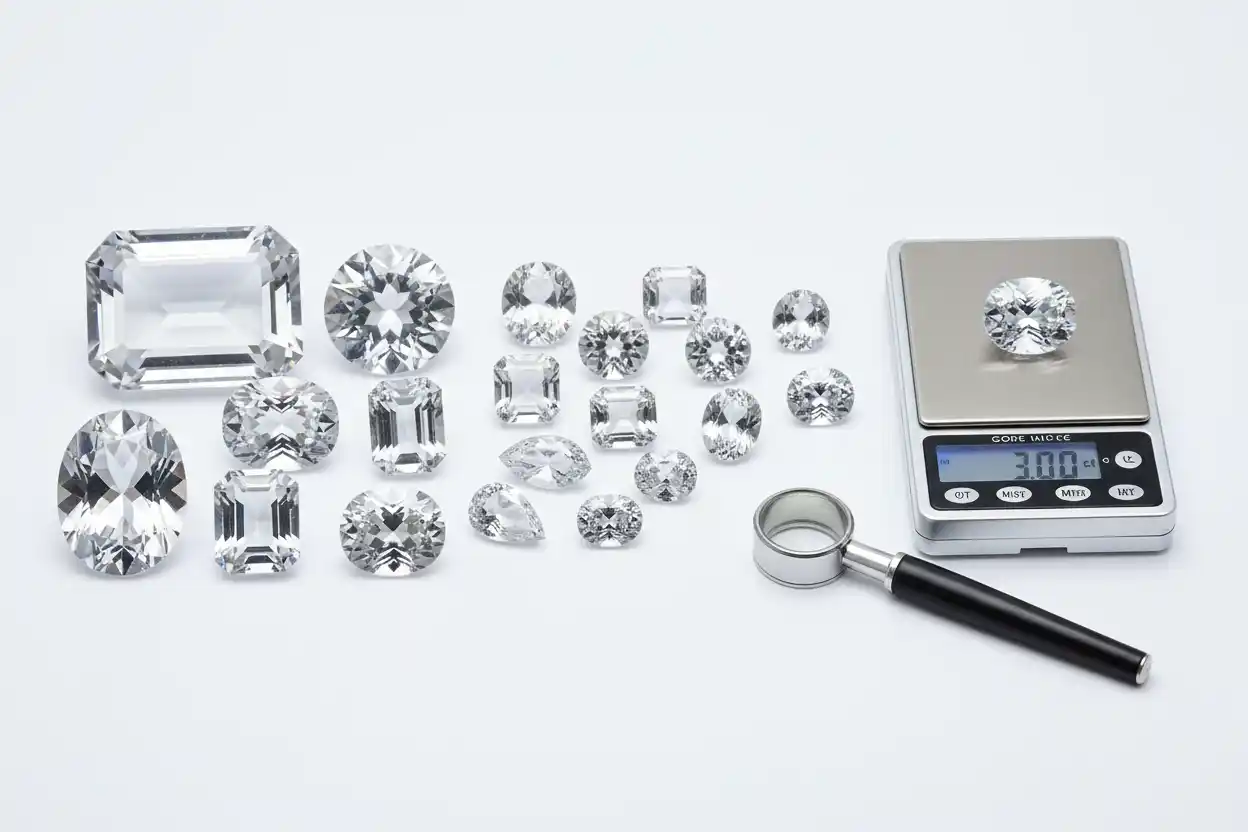
Goshenite Price: What Influences Value, Rarity, Demand & Treatments
Goshenite price is influenced primarily by transparency, clarity, cutting, size, face-up dimensions, condition, treatment status, provenance, jewelry craftsmanship, and seller context rather than by one standardized price-per-carat figure. Goshenite is the colorless to near-colorless variety of beryl, and GIA explains that chemically pure beryl is naturally colorless while trace elements produce the better-known blue, green, yellow, and pink beryl varieties.
That lack of strong bodycolor gives goshenite an unusual position within the beryl family. Aquamarine can command premiums for blue saturation, emerald for vivid green, and morganite for attractive pink, whereas goshenite has no equivalent color premium to dominate valuation. Consequently, the best-cut, cleanest, most transparent stones can stand apart mainly because of workmanship and optical presentation. Buyers should use the Gems Lore buy goshenite guide to establish natural versus laboratory-grown status, clarity, treatment, dimensions, and seller claims before attempting to interpret goshenite price.
Goshenite Price At a Glance
| Value Factor | Stronger Value Signals | Factors That Can Lower Value |
|---|---|---|
| Transparency | Bright, transparent appearance | Haze, cloudiness, weak light transmission |
| Clarity | Minimal distracting inclusions or fractures | Central fractures, reflective inclusions, heavy clouding |
| Cut | Precise symmetry, brightness, good polish, limited windowing | Poor proportions, excessive depth, weak polish |
| Size | Larger clean stone with attractive face-up spread | Large weight without corresponding beauty |
| Face-Up Dimensions | Efficient visible size for the weight | Hidden weight below the girdle |
| Color | Clean colorless to near-colorless appearance | Unattractive gray, brown, or unintended tint |
| Natural/Synthetic Status | Natural goshenite when sold in natural-gem category | Laboratory-grown beryl represented ambiguously |
| Treatment | Clear and accurate disclosure | Undisclosed irradiation, coating, dye, or other modification |
| Condition | Crisp facet junctions and undamaged surface | Chips, scratches, abrasion, repairs |
| Provenance | Documented mineral-collector or historic context | Unsupported prestigious-source claim |
| Craftsmanship | Precision cutting, custom design, fine setting | Mass-produced cutting with weak performance |
| Jewelry Context | Valuable metal, designer work, antique provenance | Setting contributes little independent value |
| Documentation | Independent identification for significant stones | Seller-only certificate with unclear independence |
Goshenite Does Not Have a Color Premium Comparable to Emerald or Aquamarine
The beryl family demonstrates how trace elements can create dramatically different markets from one basic mineral structure. GIA identifies colorless goshenite, blue aquamarine, green emerald, yellow heliodor, and pink morganite within the broader beryl group.
Emerald and aquamarine can derive a substantial portion of their value from rare or desirable color. Goshenite is valued differently because the desired appearance is essentially the absence of strong bodycolor.
This does not make goshenite worthless. It means color is less likely to create the extreme rarity premium found in certain colored beryls, so quality differences become concentrated in transparency, cutting, clarity, size, provenance, and jewelry presentation.
Transparency Has an Outsized Effect on Goshenite Price
Transparent colorless gems show internal imperfections easily. A bright clean goshenite can therefore appear elegant and crisp, while one with noticeable haze or reflective fissures can look substantially less refined.
Natural beryl can contain fingerprints, two-phase inclusions, crystals, needles, and other internal features. GIA’s beryl inclusion research documents a broad variety of such micro-features across natural stones.
A premium for clarity is most defensible when the difference is visible in ordinary viewing. Paying a dramatic markup for microscopic perfection that produces no noticeable improvement should be a personal choice rather than an automatic rule.
Clarity Labels Do Not Have Diamond-Style Standardization
Goshenite sellers may use words such as flawless, eye-clean, VVS, AAA, AAAA, or top grade. These descriptions can communicate a retailer’s view of the stone, but they are not standardized GIA colored-stone grades.
GIA explicitly states that there is no broadly accepted universal grading system for colored stones and that it does not provide overall colored-stone quality grades.
Goshenite price should therefore be based on actual visible clarity, transparency, cutting, dimensions, and condition rather than an impressive grade label.
Cut Can Create More Value Than Additional Carat Weight
Without strong bodycolor, goshenite’s facet pattern is visually exposed. Windowing, excessive depth, misaligned facets, flat brilliance, poor polish, and asymmetry can all be obvious.
A precision-cut goshenite may cost substantially more than a mass-produced stone of similar weight because the buyer is paying for skilled labor, greater rough loss, facet accuracy, design, and optical performance.
That premium is legitimate craftsmanship value rather than evidence that the raw goshenite is exceptionally rare.
Carat Weight Should Not Be Used as a Standalone Rarity Indicator
Beryl crystals can grow large, and substantial fashioned goshenite exists. GIA’s Gübelin Gem Project includes a 31.46-carat goshenite from Sri Lanka, alongside numerous large examples of other beryl varieties.
This means that a seller presenting a large goshenite as rare solely because it weighs twenty, thirty, or more carats should provide additional reasons for the premium.
Size becomes more commercially meaningful when the large stone also retains excellent transparency, clean appearance, strong cutting, attractive face-up spread, and desirable provenance.
Face-Up Spread Can Matter More Than the Number on the Scale
Two goshenites with identical carat weights can look different in size because one may have a deeper pavilion, thicker girdle, or more inefficient proportions.
A deep stone can preserve rough and increase total weight while presenting a smaller visible surface. Another stone may weigh less yet appear larger once mounted because its proportions distribute the mass more efficiently.
Compare millimeter dimensions with weight before concluding that the heavier gem offers better value.
Goshenite Can Be Used for Large Statement Jewelry Without Extreme Rarity Pricing
Because substantial colorless beryl can occur, goshenite can be attractive for large pendants, cocktail rings, custom cuts, and designer jewelry where a buyer wants significant transparent gemstone volume.
The economic value of such pieces may come more from design and craftsmanship than from raw gem rarity. Precision faceting, unusual fantasy cuts, hand engraving, gold or platinum, and labor-intensive mounting can all add substantial retail cost.
A finished jewel should therefore not be reduced to goshenite price per carat.
Natural Versus Laboratory-Grown Status Changes the Comparison Group
GIA has documented hydrothermally grown synthetic beryl and explains that synthetic gems may have essentially the same chemical, physical, and optical properties as naturally occurring counterparts while being created in controlled growth environments.
Natural goshenite and laboratory-grown beryl should therefore be priced within separate origin categories.
A synthetic stone can be beautiful and technically sophisticated without having the same geological rarity or collector market as mined material. Correct disclosure allows both categories to coexist honestly.
Laboratory Identification Can Reduce Identity Risk
A colorless transparent stone can be difficult for an untrained buyer to identify from appearance alone. GIA emphasizes the importance of gemological testing when materials may be natural, synthetic, treated, or imitations.
The current Colored Stone Identification Report can identify polished goshenite material, state whether it is natural or laboratory-grown, list detectable treatments, and record weight, dimensions, cutting style, color, and a photograph.
For ordinary inexpensive material, the report cost may represent a large percentage of the gem’s value. For an unusually expensive, precision-cut, historically important, or supposedly rare specimen, independent identification may be more economically sensible.
Treatment Can Affect Price Even Though Goshenite Is Colorless
GIA notes that some beryls can be irradiated to change or deepen color and that certain irradiated beryl colors may fade under strong light. GIA has also documented dyed and coated natural beryl in the trade.
This is important because a stone that began as near-colorless beryl could potentially be altered into a more commercially valuable appearance. If such treatment exists, the resulting product should no longer be compared casually with untreated goshenite.
For stones sold as colorless goshenite, treatment may have less obvious commercial purpose, but the broader beryl treatment history is still a reason to demand accurate disclosure rather than assume.
Origin Usually Matters Less Than Individual Quality in Faceted Goshenite
Goshenite can occur in multiple beryl-producing regions. GIA research includes material from Pakistan, Sri Lanka, and other beryl localities.
For ordinary faceted jewelry, geographic origin generally carries less obvious market weight than transparency, cut, size, and condition. Collector crystals from a documented pegmatite or famous mineral locality can be different because specimen provenance itself may have value.
A seller charging a major premium for a specific origin should provide documentation explaining why that locality matters.
Standard GIA Origin Reporting Is Not Available for Goshenite
Current GIA Colored Stone Identification & Origin Reports are restricted to selected stones such as alexandrite, demantoid, emerald, jade, opal, Paraíba tourmaline, peridot, red spinel, ruby, and sapphire. Goshenite is not included in that standard geographic-origin list.
A GIA identification report on goshenite should therefore not be misrepresented as a country-of-origin report.
This distinction matters when sellers attach large premiums to claims such as Brazilian goshenite, Pakistani goshenite, or Sri Lankan goshenite.
Collector Crystals and Cut Gemstones Follow Different Markets
A transparent faceted goshenite intended for jewelry is valued mainly for appearance and workmanship. A well-formed natural crystal specimen can be valued for crystal habit, termination, transparency, associated minerals, locality, rarity of occurrence, condition, and collection history.
A damaged but exceptionally documented mineral specimen might still interest collectors even though it would be poor faceting rough. Conversely, a clean precision-cut goshenite can be highly attractive jewelry material while having little mineral-specimen significance.
Using one market to benchmark the other can produce misleading prices.
Condition Can Reduce Goshenite Price Quickly
Colorless transparent stones make scratches and facet abrasion easy to see. Pre-owned goshenite should be checked for worn junctions, table scratches, chipped girdles, damaged points, fractures, or signs of poor repolishing.
Beryl has a Mohs hardness of approximately 7.5 to 8, giving it good scratch resistance compared with many gems, but it is not immune to wear or hard impact.
A heavily abraded stone may require recutting before it regains a crisp appearance, and that process can reduce weight.
Jewelry Metal Can Dominate the Total Retail Price
A modest-value loose goshenite set in platinum, high-karat gold, or a complicated diamond-accented mounting can become an expensive finished jewel.
The total price may include:
- Precious-metal weight.
- Hand fabrication or casting.
- Side stones.
- Setting labor.
- Precision cutting.
- Designer branding.
- Warranty and service.
- Retail margin.
A consumer should separate those components before concluding that a high finished-jewelry price proves the goshenite itself is exceptionally valuable.
Goshenite Versus Aquamarine Pricing
Goshenite and aquamarine share beryl identity, but aquamarine can receive meaningful premiums for blue saturation and quality. GIA identifies aquamarine as greenish-blue to blue beryl, while goshenite is colorless to near-colorless.
The Gems Lore aquamarine price guide therefore should not be used as a direct goshenite per-carat benchmark. The two varieties share hardness and basic mineral structure but serve different consumer preferences.
Goshenite Versus Emerald Pricing
Emerald occupies a radically different market because vivid green color, transparency, treatment, origin, and rarity drive substantial premiums. The Gems Lore emerald price guide explains that color can dominate emerald valuation.
A colorless beryl cannot inherit emerald pricing simply because both are beryl. Mineral species determines physical identity, but variety-level scarcity and demand determine commercial markets.
This is a useful reminder that species and monetary value are not interchangeable concepts.
Goshenite Versus Diamond Pricing
Goshenite can provide a large natural colorless gemstone appearance without entering diamond’s pricing structure. Diamond has its own standardized 4Cs market, much higher hardness, different optical properties, and different supply economics.
The Gems Lore diamond price guide explains why diamond pricing depends on cut, color, clarity, carat weight, origin category, documentation, and highly developed market thresholds.
A goshenite seller may reasonably describe the stone as a visual alternative in a design context, but diamond price is not a valid benchmark for goshenite rarity.
Retail Price and Resale Value Are Different
Retail goshenite price can include cutting, photography, setting labor, inventory carrying cost, packaging, return rights, warranty, and merchant margin.
A dealer buying the same stone from a consumer must consider verification, condition, resale time, recutting risk, and future margin. The cash offer may therefore be much lower than the original retail purchase price.
Insurance appraisal may produce yet another figure because its purpose can be replacement rather than immediate liquidation.
AAA Goshenite Has No Universal Price Meaning
No broadly accepted universal colored-stone grading system exists, and GIA does not issue overall quality grades for colored stones.
An AAA goshenite from one merchant may therefore have no direct equivalence to another seller’s AAAA stone.
A defensible valuation substitutes actual observations for the grade: transparency, clarity, cut, dimensions, condition, natural or synthetic status, treatment, and provenance.
What Usually Raises Goshenite Price?
Stronger prices are easiest to justify when a stone combines high transparency, limited distracting inclusions, precise cutting, strong polish, useful face-up dimensions, sound condition, natural origin, and documentation appropriate to the asking price.
Precision cutting, an unusual optical phenomenon, historically important provenance, an exceptional crystal locality, designer jewelry, or antique significance can create additional premiums.
Size contributes most when those other qualities remain strong.
What Usually Lowers Goshenite Price?
Cloudiness, reflective fractures, poor symmetry, large windowing, excessive depth, weak polish, chipped girdles, abrasion, ambiguous natural-versus-synthetic disclosure, unsupported origin claims, or inflated retailer grades can reduce market appeal.
Large size cannot automatically compensate for poor cutting or weak transparency.
A lower-priced stone can still offer excellent value when its compromises are clear and match the buyer’s intended use.
How to Compare Goshenite Prices Fairly
Compare:
- Natural versus laboratory-grown beryl.
- Colorless versus near-colorless appearance.
- Transparency.
- Visible inclusions and fractures.
- Cut design and polish.
- Carat weight.
- Length, width, and depth.
- Face-up spread.
- Treatment disclosure.
- Condition.
- Provenance.
- Laboratory identification.
- Loose gemstone versus finished jewelry.
- Retail, appraisal, or resale context.
Only after these variables are reasonably similar does price per carat become useful.
Conclusion
Goshenite price is governed less by bodycolor than the prices of many other beryl varieties because goshenite is specifically the colorless to near-colorless end of the beryl family. GIA confirms that chemically pure beryl is colorless and that other familiar beryl colors arise from trace elements.
Transparency, clarity, cutting, dimensions, condition, natural-versus-synthetic status, provenance, craftsmanship, and jewelry design consequently carry much of the valuation burden. Size should not be treated as an automatic rarity premium because substantial fashioned goshenite exists, while seller-defined AAA grades have no universal gemological meaning.
A sound goshenite valuation compares equivalent natural material, separates loose-gem value from finished-jewelry value, verifies unusual treatment or provenance claims, and distinguishes identification reports from appraisals. Those steps provide a more useful understanding of goshenite price than any generic per-carat table.
Frequently Asked Questions
How much is goshenite worth per carat?
There is no universal goshenite price per carat. Transparency, clarity, cut, size, face-up dimensions, condition, natural-versus-synthetic status, treatment, craftsmanship, and provenance can produce meaningful differences between stones.
Is goshenite rare?
Goshenite is a natural colorless variety of beryl, but substantial cut stones exist. GIA’s Gübelin Gem Project includes a 31.46-carat goshenite example. Rarity should therefore be judged in the context of quality, provenance, and size rather than from the variety name alone.
Does a larger goshenite cost much more per carat?
Not automatically. Larger weight adds material, but size alone does not create a universal scarcity premium. Transparency, cutting, clarity, dimensions, and craftsmanship remain important.
What makes goshenite more valuable?
High transparency, limited distracting inclusions, excellent cutting, strong polish, useful face-up dimensions, natural origin, sound condition, and exceptional provenance or craftsmanship can raise value.
Is goshenite more valuable than aquamarine?
There is no universal rule, but aquamarine has a separate market in which desirable blue color can command significant premiums. Goshenite lacks that color factor and should be valued within its own category.
Is goshenite more valuable than emerald?
Fine emerald generally occupies a much higher-value market because vivid green color, rarity, origin, treatment status, and demand create strong premiums. Both belong to beryl, but species membership does not make their markets equivalent.
Does AAA goshenite have an official meaning?
No. GIA states that there is no broadly accepted universal colored-stone grading system and does not issue overall colored-stone quality grades.
Can synthetic beryl affect goshenite pricing?
Yes. Laboratory-grown beryl exists and belongs to a different market category from naturally mined goshenite. GIA has documented hydrothermal synthetic beryl.
Can GIA identify goshenite?
Yes. GIA’s Colored Stone Identification Report can identify polished material, state natural versus synthetic status, and list detectable treatments.
Can GIA confirm goshenite geographic origin?
Goshenite is not currently among the gemstone types eligible for GIA’s standard Colored Stone Identification & Origin Report.
Is goshenite a good investment?
There is no guaranteed appreciation. Future resale depends on quality, craftsmanship, provenance, condition, demand, transaction costs, and market liquidity.