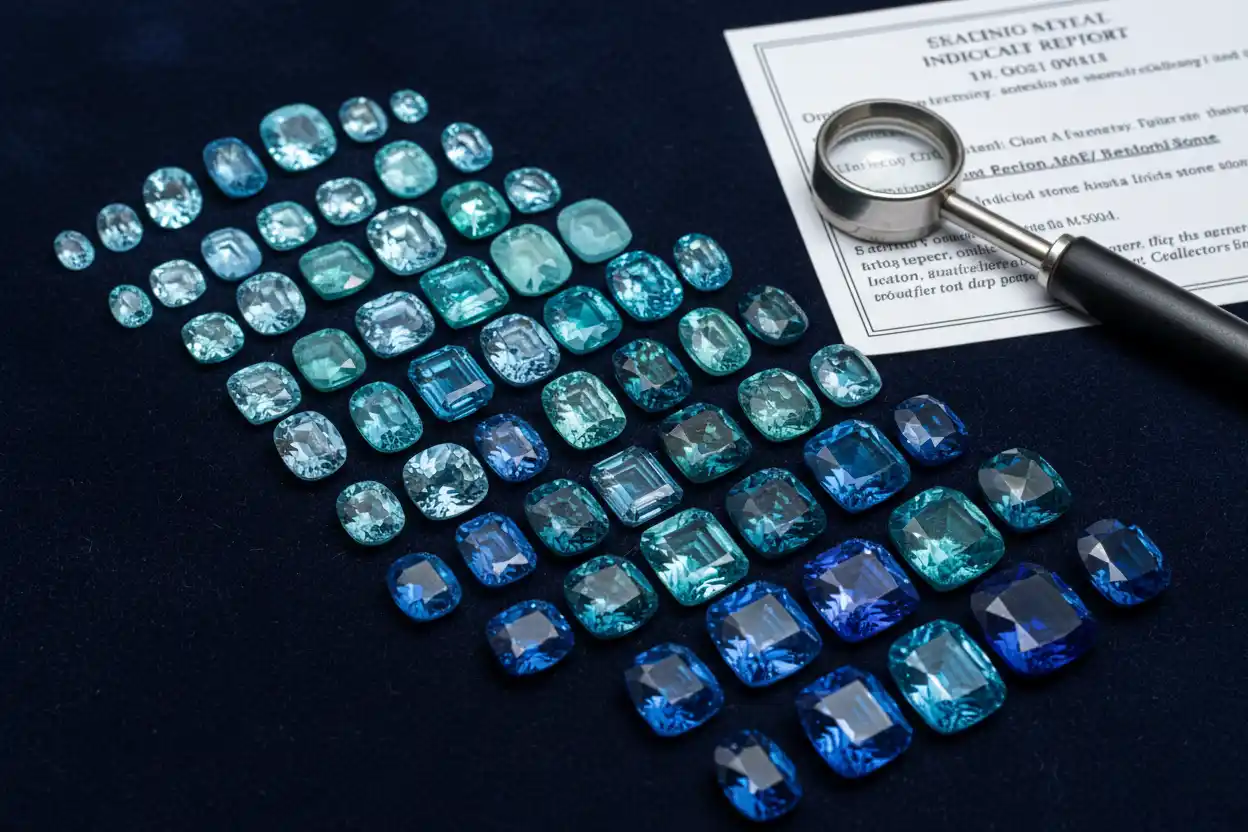
Indicolite Price: What Buyers Pay For, Market Demand, Grade & Origin
Indicolite price depends on the quality of an individual blue tourmaline rather than a universal rate per carat. Color is usually the leading factor, followed by tone, saturation, transparency, clarity, pleochroic orientation, cut, size, treatment, condition, documentation, and market demand. GIA identifies bright pure blue and green tourmalines among the more valued colors and notes that iron can produce the blue coloration commonly associated with indicolite, while copper-bearing Paraíba-type tourmaline belongs to a separate and substantially more specialized market.
That distinction is essential because a fine iron-colored indicolite and an electric copper-bearing Paraíba tourmaline can both appear blue in photographs while having very different chemistry, rarity, saturation, documentation requirements, and prices. GIA’s Paraíba research states specifically that iron can cause blue indicolite, whereas the intense blue associated with Paraíba tourmaline is principally linked to copper and manganese. Buyers researching the market should therefore establish whether the stone is ordinary blue tourmaline or copper-bearing material before comparing numbers, and the Gems Lore buy indicolite guide provides the appropriate starting framework for that distinction.
Indicolite Price At a Glance
| Value Factor | What Usually Raises Indicolite Price | What Can Lower Indicolite Price |
|---|---|---|
| Identity | Confirmed natural blue tourmaline | Ambiguous blue gem or poorly documented material |
| Color | Attractive pure blue or lively slightly greenish blue | Gray, brown, muddy green, or weak saturation |
| Tone | Medium-light to medium-dark with visible life | Excessively dark stone that appears almost black |
| Saturation | Strong vivid color | Weak or washed-out color |
| Pleochroism | Skilled orientation showing attractive blue face-up | Poor orientation dominated by dark or unattractive axis |
| Transparency | Bright transparent material | Cloudiness or poor light transmission |
| Clarity | Relatively clean appearance for blue tourmaline | Distracting fractures, tubes, clouds, surface-reaching inclusions |
| Cut | Good symmetry, polish, brightness, and face-up spread | Windowing, extinction, excessive depth, poor polish |
| Size | Larger fine stone retaining strong color and clarity | Added carat weight accompanied by darkness or weak cutting |
| Treatment | Clear disclosure of heating or irradiation | Undisclosed modification or unstable irradiated color |
| Copper Status | Accurate separation from Paraíba-type material | Paraíba premium implied without copper-bearing evidence |
| Condition | Crisp facets and intact girdle | Chips, abrasion, scratches, fractures |
| Documentation | Independent identification and treatment findings | Undefined seller grade or unverifiable certificate |
| Market Context | Comparison with equivalent natural indicolite | Comparison with Paraíba, aquamarine, or unrelated blue gems |
Color Is the Most Important Indicolite Price Factor
GIA identifies color as tourmaline’s most important quality factor, and bright pure blue is among the more desirable tourmaline colors. Strongly saturated slightly greenish-blue stones can also be attractive, while excessive darkness, grayness, or weak saturation generally reduces visual appeal.
Indicolite should therefore be valued by what the buyer actually sees rather than by the word blue alone. Two stones can both be called blue tourmaline while one is vivid and luminous and the other is so dark that its color is visible only in intense lighting. GIA notes that colored gemstones becoming so dark that light cannot pass through them readily are generally harder to sell, which can materially reduce value.
A balanced medium tone can consequently command more demand than a deeper stone with apparently stronger saturation but extensive black extinction. Video under ordinary neutral illumination is far more useful for price comparison than one backlit photograph designed to make a dark stone appear brighter.
Indicolite and Paraíba Tourmaline Must Be Priced Separately
The greatest potential pricing error in blue tourmaline is confusing ordinary indicolite with Paraíba-type copper-bearing material. GIA explains that iron produces blue color in indicolite, whereas Paraíba tourmaline is defined by blue-to-green coloration associated mainly with copper and manganese and can display much higher saturation at comparatively lighter tone.
GIA also notes that the best Paraíba tourmalines can surpass other tourmalines substantially in price because of their exceptional hue, saturation, and rarity. An ordinary iron-colored indicolite therefore should not receive a Paraíba premium merely because it photographs as bright blue, cyan, or greenish blue.
Conversely, calling indicolite “non-Paraíba” does not make it low quality. Fine blue tourmaline can be beautiful and valuable in its own market. The key is to compare the stone with similarly colored iron-bearing tourmaline rather than using copper-bearing gems as the benchmark.
Paraíba Chemistry Requires More Than Visual Appearance
A tourmaline can look intensely blue without being copper-bearing. The accepted Paraíba category incorporates chemistry as well as color, and GIA’s research emphasizes that copper-bearing status requires analytical confirmation rather than visual judgment.
This matters financially because the difference between fine indicolite and fine Paraíba can be enormous. A seller using phrases such as “Paraíba color,” “neon indicolite,” or “Paraíba-like” should not be interpreted as offering actual Paraíba tourmaline unless the material meets the appropriate gemological requirements.
The buyer should pay for documented material identity, not resemblance to a more expensive category.
Tone Can Change the Value of an Otherwise Attractive Blue
Tourmaline is strongly pleochroic, and GIA notes that crystal orientation can make a stone appear much darker in one direction than another. Some tourmaline rough that appears relatively light across the crystal can look almost black along its strongest absorption direction.
This optical behavior means that dark tone can come from both the rough itself and the way the cutter oriented it. A stone with excellent blue saturation but an unfortunate face-up orientation may show heavy extinction and reduced brilliance, lowering the amount buyers are willing to pay.
A fine indicolite price generally makes more sense when the blue remains visible in normal indoor light rather than only under a powerful flashlight or photographic backlighting.
Pleochroic Orientation Can Create a Real Cutting Premium
Tourmaline’s pleochroism requires cutters to decide which crystallographic direction should dominate face-up. GIA explains that cutters may deliberately orient dark or light tourmaline rough differently to control the resulting tone and color intensity.
A well-oriented indicolite can display lively blue across the table while minimizing overly dark areas. Poor orientation can leave an expensive piece of rough with a nearly black center or unattractive green-gray direction dominating the face.
Precision orientation is therefore a legitimate value factor. The buyer may reasonably pay more for a somewhat lighter stone that has been cut for visible beauty rather than a heavier stone cut primarily to preserve weight.
Blue Tourmaline Usually Has Relatively Strict Clarity Expectations
GIA notes that green-to-blue tourmalines are generally expected to be cleaner than pink or red tourmalines, which more commonly show visible inclusions. This means a prominent inclusion can affect indicolite price more strongly than it might affect certain other tourmaline colors.
Common tourmaline inclusions include liquid-filled cavities, tubes, growth features, and fractures. Small internal characteristics may be acceptable in a richly colored stone, but highly reflective fractures or white inclusions crossing the center can interrupt transparency and reduce brilliance.
Surface-reaching features deserve additional attention because GIA notes that they can interfere with polish and luster. A clean transparent stone therefore has both aesthetic and market advantages when color is equally strong.
Phenomenal Indicolite Belongs to a Different Collector Segment
Tourmaline can occasionally display chatoyancy when inclusions are suitably aligned, creating a cat’s-eye effect. GIA recognizes chatoyancy among the optical effects occurring in the tourmaline group.
A cat’s-eye blue tourmaline should not be priced with ordinary transparent faceted indicolite solely by carat weight. The sharpness, centering, movement, contrast, bodycolor, and completeness of the eye become additional value factors.
Phenomenal material can be more included by necessity because the aligned inclusions create the effect, so normal faceted-gem clarity expectations do not transfer perfectly to that niche.
Cut Quality Can Affect Indicolite Price as Much as Size
GIA advises buyers not to compromise on tourmaline cutting because poor cutting reduces brilliance and marketability. Tourmaline crystals are frequently elongated, which encourages long rectangular shapes and other cuts designed partly around rough yield.
A heavier stone can consequently carry substantial depth underneath the girdle without displaying a proportionate face-up size. Windowing can make the center look transparent or washed out, while extinction can make broad areas appear dark.
A well-cut indicolite should present its blue color attractively across the face, show good polish, maintain reasonable symmetry, and provide useful visual spread for its weight. Skilled cutting deserves a premium because it improves both color presentation and apparent size.
Carat Weight Can Raise Price More Strongly Beyond Certain Sizes
GIA notes that fashioned tourmalines of similar color and clarity can rise considerably in per-carat value as size increases and that prices often rise more sharply once stones pass roughly the five-carat level, although the exact effect varies by variety and quality.
This does not mean every six-carat indicolite is automatically expensive. A large dark stone with substantial extinction and poor cutting can remain less desirable than a smaller vivid blue gem.
Size acts as a multiplier only after color, transparency, clarity, cutting, and condition are sufficiently strong. That is why universal indicolite price-per-carat charts can be misleading when they ignore quality.
Millimeter Dimensions Should Accompany Every Meaningful Size Comparison
Tourmaline’s elongated crystal habit can encourage deep or long cuts that preserve weight. Two stones weighing five carats can therefore have very different face-up dimensions.
A buyer should compare length, width, and depth rather than assuming the higher carat weight provides greater visible size. This is particularly important once fine blue tourmaline enters a size range where GIA notes per-carat values can rise substantially.
If a listing supplies carat weight but no dimensions, request them before comparing value.
Treatment Can Influence the Appropriate Price Category
GIA identifies heating and irradiation as two important tourmaline treatments. Heat can alter color and is generally considered stable, while irradiation-related color may fade with exposure to heat or bright light.
Natural tourmaline and treated tourmaline are not necessarily good-versus-bad categories. A heated stone can remain attractive and durable, and a treatment may allow a buyer to obtain a desired appearance at a lower price.
The critical issue is accurate disclosure. An untreated premium should not be paid merely because a seller says “natural,” since natural gemstone identity and treatment status are separate questions.
Irradiated Color Stability Deserves Special Attention
GIA warns that irradiation-related color changes in tourmaline can fade under heat or bright light. This matters when a particular vivid blue or related appearance forms a major part of the asking price.
A buyer should not attempt to expose the gemstone deliberately to intense heat or sunlight as a home treatment test. That could permanently change the stone.
Professional laboratory evaluation and seller disclosure provide a safer basis for determining whether treatment is known or detectable.
Heat Treatment Can Be Difficult to Detect
GIA notes that heat treatment can be used to alter tourmaline color and that heat-related results can be stable. In some tourmalines, detecting historical heating conclusively can be difficult.
This means an “unheated indicolite” premium needs a reasonable evidentiary basis rather than absolute language unsupported by gemological testing.
The buyer should distinguish what is known from what the seller merely assumes.
Origin Generally Matters Less Than Quality in Ordinary Indicolite
Blue tourmaline occurs in multiple gem-producing regions, and tourmaline more broadly is mined in many parts of the world. For ordinary indicolite, color, tone, clarity, size, cut, and condition usually matter more than country name unless the locality has unusual mineralogical or historical collector significance.
GIA’s tourmaline buyer guidance warns that a famous mine does not automatically imply high gemstone quality.
A weak blue stone from a prestigious tourmaline region should therefore not receive a major premium simply because the source name sounds desirable.
Ordinary Indicolite and Paraíba Origin Reporting Are Different Issues
GIA currently allows Paraíba tourmaline to be submitted for its Colored Stone Identification & Origin Report, whereas ordinary indicolite does not receive the same dedicated geographic-origin framework.
This matters because a dealer may correctly know that an indicolite came from Brazil, Namibia, Afghanistan, Pakistan, Nigeria, Mozambique, Madagascar, or another locality through supplier documentation, but such provenance should not automatically be described as a GIA country-of-origin determination.
Laboratory identity and seller provenance are different forms of evidence.
GIA Evaluates Tourmaline but Does Not Give It an Overall Grade
GIA states explicitly that it evaluates tourmaline but does not issue an overall quality grade. Its colored-stone reports document characteristics such as weight, dimensions, cutting style and color, identify natural or laboratory-grown status, and list detectable treatments.
AAA, AAAA, top indicolite, investment grade, and collector grade are therefore retailer-defined labels rather than universal gemological grades.
A buyer should translate those terms into measurable qualities before deciding whether they justify a premium.
Condition Can Matter Strongly in the Secondary Market
Tourmaline has a Mohs hardness of about 7 to 7.5 and fair toughness. GIA notes that heat and sudden temperature changes can cause damage and recommends warm soapy water rather than steam or ultrasonic cleaning.
Pre-owned indicolite should be checked for chipped facet edges, girdle damage, scratches, abrasion, fractures around prongs, and evidence of poor repolishing.
A damaged rare blue stone may remain desirable, but its resale value should reflect the cost and risk of restoration.
Indicolite Price Versus Aquamarine Price
Indicolite and aquamarine can overlap visually in blue and greenish-blue colors, but indicolite is tourmaline and aquamarine is beryl. The Gems Lore aquamarine price guide explains the separate beryl market, while buy aquamarine covers treatment, color, clarity, and buying considerations specific to aquamarine.
Tourmaline’s stronger pleochroism can make face-up orientation more important, while aquamarine follows different treatment and size expectations. A simple comparison based only on blue color or carat weight is therefore unreliable.
Indicolite Price Versus Grandidierite Price
Certain grandidierites can resemble blue-green indicolite but occupy a much rarer mineral market. Gems Lore’s grandidierite price guide explains why transparent faceting-quality grandidierite should be evaluated separately from ordinary blue tourmaline.
A rare name should never be assigned from appearance alone. Laboratory identity must come before price comparison.
Indicolite Price Versus Paraíba Tourmaline Price
Paraíba should be considered an entirely separate valuation category. GIA states that its exceptionally saturated copper-bearing colors and rarity allow the best Paraíba tourmalines to command prices far above ordinary tourmalines.
An indicolite can still be exceptional without belonging to that category. Paying indicolite prices for indicolite and Paraíba prices only for properly documented copper-bearing material protects buyers from one of the most expensive classification errors in blue tourmaline.
Retail Asking Price, Appraisal, and Resale Value Are Different
Retail indicolite price can include sourcing, cutting, laboratory costs, insurance, photography, inventory carrying costs, warranties, return privileges, and merchant margin. A dealer purchasing the same stone secondhand must account for verification, possible repolishing, capital tied up in inventory, marketing, and future profit.
An insurance appraisal can create another number because its purpose may be retail replacement rather than immediate cash liquidation.
These figures are not interchangeable, and a high appraisal does not guarantee an equivalent resale offer.
What Usually Raises Indicolite Price?
Indicolite price generally strengthens when a stone combines attractive blue or slightly greenish-blue color, strong saturation, controlled tone, good transparency, limited distracting inclusions, excellent pleochroic orientation, effective cutting, larger fine size, crisp condition, and credible documentation.
Precision cutting can add a separate craftsmanship premium, while unusually large fine stones can become more expensive per carat because GIA notes that tourmaline prices can rise sharply as facet-quality size increases.
The strongest stones are balanced rather than simply dark, large, or heavily saturated.
What Usually Lowers Indicolite Price?
Grayness, excessive green if a pure-blue premium is being requested, very dark tone, black extinction, cloudiness, prominent surface-reaching fractures, poor cutting, large windows, excessive depth, chipped facets, treatment uncertainty, unsupported Paraíba claims, or retailer-defined grades can all reduce value.
A lower-priced stone can still be an excellent purchase when the compromise is visible and intentional. A buyer may prefer a lighter greenish-blue stone with greater sparkle over a darker pure-blue gem carrying a higher premium.
How to Compare Indicolite Prices Fairly
A meaningful comparison should align the stones by natural tourmaline identity, iron-colored indicolite versus copper-bearing status, hue, tone, saturation, transparency, clarity, pleochroic orientation, carat weight, dimensions, cut quality, treatment, condition, documentation, and transaction type. Only after those variables are reasonably similar does a per-carat comparison become useful.
Conclusion
Indicolite price is driven first by the quality of the blue color and then refined by tone, saturation, transparency, clarity, pleochroism, cut, size, treatment, condition, and documentation. GIA recognizes blue tourmaline as an iron-colored category distinct from the copper-bearing Paraíba market and emphasizes that bright pure blue and related saturated colors are among tourmaline’s more desirable appearances.
The strongest valuation therefore avoids two shortcuts: assuming that every dark blue stone is fine indicolite and assuming that every vivid cyan tourmaline is Paraíba. A proper comparison evaluates what the gemstone actually is, how it faces up under normal lighting, how efficiently it is cut, whether treatment is known, and whether the price is retail, appraisal, or resale.
For buyers who maintain those distinctions, indicolite offers a compelling blue-gem market that can provide rarity, individuality, and strong color without requiring the extraordinary premiums associated with copper-bearing Paraíba material.
Frequently Asked Questions
How much is indicolite worth per carat?
There is no universal indicolite price per carat. Color, tone, saturation, transparency, clarity, pleochroic orientation, size, cut, treatment, condition, and documentation can produce large differences between stones.
What color indicolite is most valuable?
Bright, saturated blue and attractive slightly greenish-blue stones generally attract strong demand when they are not excessively dark. GIA identifies bright pure blue among the more valuable tourmaline colors.
Is darker indicolite always worth more?
No. Tourmaline can become so dark that substantial areas appear black, and overly dark colored stones can be harder to sell. A somewhat lighter stone with strong saturation and brilliance can be more valuable.
Is indicolite the same as Paraíba tourmaline?
No. Indicolite’s blue color is commonly iron-related, while Paraíba tourmaline is copper- and manganese-bearing and occupies a distinct market.
Why is Paraíba more expensive than indicolite?
The best Paraíba tourmalines combine exceptional saturation, lighter tone, copper-bearing chemistry, and rarity. GIA notes that top Paraíba prices can easily surpass other tourmalines.
Does larger indicolite cost more per carat?
It can. GIA notes that fashioned tourmalines of similar color and clarity can rise substantially in per-carat price as size increases, particularly beyond approximately five carats. Quality must remain strong for the premium to apply.
Is indicolite usually eye-clean?
Blue-to-green tourmalines generally face stricter clarity expectations than pink and red tourmalines, which more commonly contain visible inclusions.
Can indicolite be heated?
Yes. Heating is one of the major treatments used for tourmaline and can alter color. Treatment disclosure should remain separate from natural gemstone identity.
Can indicolite be irradiated?
Yes. Irradiation is another tourmaline treatment, and GIA notes that irradiation-related color may fade with heat or bright light.
Does GIA grade indicolite AAA?
No. GIA evaluates tourmaline but does not issue an overall quality grade. AAA and similar labels are retailer-defined.
Is an indicolite appraisal the same as resale value?
No. Appraisal, retail asking price, auction realization, private sale, and dealer purchase offers represent different markets and valuation purposes.
Is indicolite a guaranteed investment?
No. Fine blue tourmaline can be valuable and collectible, but future performance depends on quality, treatment, condition, size, documentation, demand, and market liquidity.