Buy Tourmaline: 5 Proven Checks for Better Quality & Confident Value
If you want to buy tourmaline confidently, identify the variety before comparing carat weight or price. Tourmaline spans black stones worth only a few dollars per carat, attractive green and pink gems in the tens or hundreds per carat, fine indicolite and rubellite in substantially higher ranges, and copper-bearing Paraiba tourmaline that can reach exceptional prices when color, clarity, size, and documentation align. Calling all of these stones simply tourmaline hides the differences that matter most to a buyer.
Color should lead the decision, followed by transparency, clarity, cut, size, treatment status, durability, and seller documentation. Strong saturation without excessive darkness usually creates the most attractive result. The tourmaline price changes sharply between varieties, so a 2-carat olive-green stone and a 2-carat electric blue Paraiba should never be evaluated with the same price expectations.
Tourmaline Color Quality: Identify the Variety Before Comparing Value
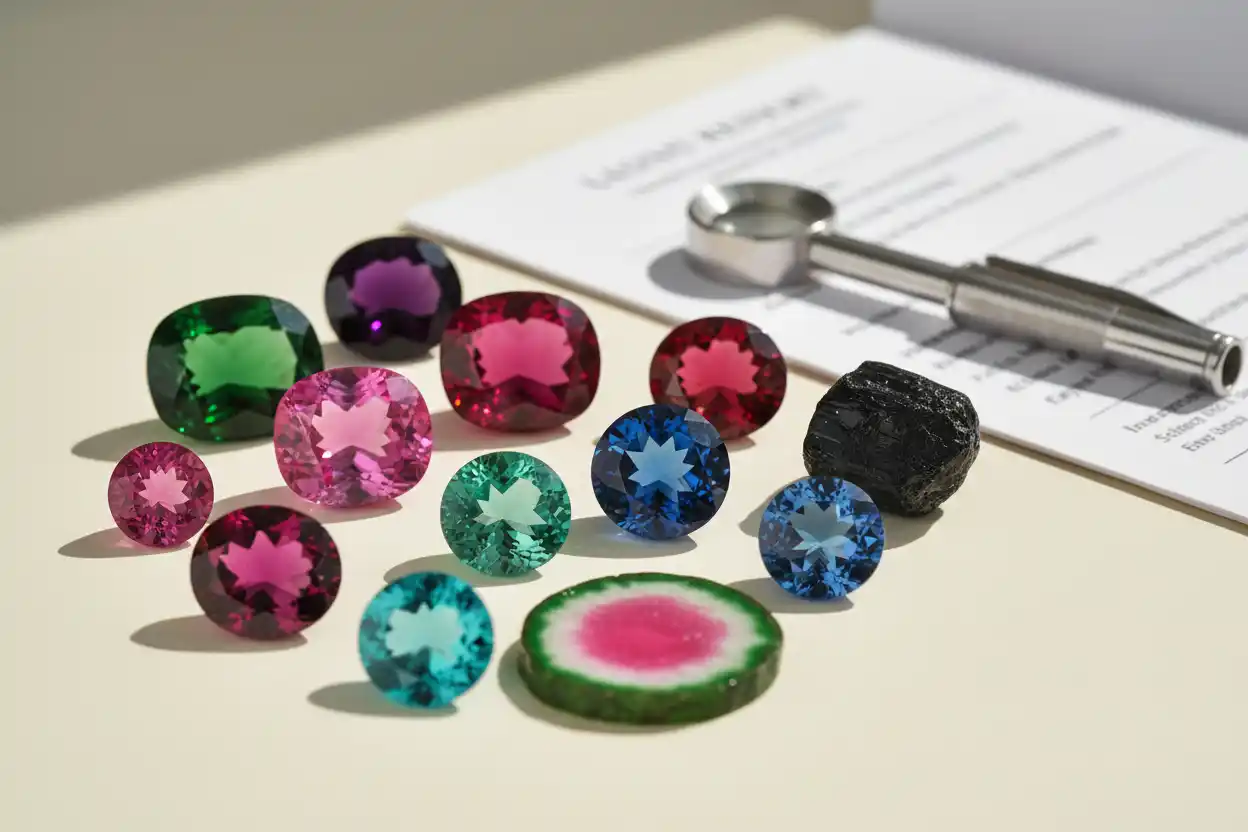
Tourmaline occurs in one of the widest color ranges of any gem. Green, pink, red, blue, yellow, orange, violet, brown, black, bicolor, and multicolor stones all occur, and each color has its own supply and demand pattern. The strongest values usually concentrate in vivid, attractive colors with enough brightness to remain lively face up.
Green tourmaline can range from yellowish or olive green to rich forest green. Many good green stones remain reasonably accessible, while vivid chrome-green examples can command stronger premiums. Blue tourmaline, commonly called indicolite, is generally rarer and often more expensive when the color is open, saturated, and not excessively dark.
Red and intensely pink tourmaline can enter the rubellite category when the color remains rich under different lighting. The buy rubellite decision therefore requires more than accepting any pink tourmaline with a red-sounding trade name. Fine rubellite should show convincing saturation rather than weak pink or brownish red.
Copper-bearing Paraiba tourmaline occupies its own high-value category because vivid blue, turquoise, green-blue, and neon-like colors can be exceptionally scarce. Anyone planning to buy Paraiba tourmaline should place much greater emphasis on laboratory identification, copper and manganese chemistry, color quality, and geographic-origin claims.
Bicolor and watermelon stones should be judged by how clearly and attractively their colors divide across the gem. The buy watermelon tourmaline process should focus on strong contrast, useful transparency, and a cut that displays the zoning intentionally rather than hiding it.
Tourmaline Clarity: Different Colors Have Different Inclusion Expectations
Clarity standards are not identical across tourmaline varieties. Pink and red tourmaline commonly contain more visible inclusions because they often grow in environments rich in fluids. Thread-like cavities, liquid inclusions, growth tubes, and healed fractures can occur naturally.
Fine rubellite can therefore retain considerable value with some eye-visible inclusions if the color is exceptional. Strong red or pink saturation may compensate for clarity features that would be less acceptable in a pale stone. The key question is whether the inclusions interfere with transparency, brightness, polish, or durability.
Green and blue tourmalines are usually expected to be cleaner. A visible whitish inclusion through the center of a green stone can reduce value significantly because cleaner examples are available. The same logic applies to fine indicolite. When you buy indicolite, prioritize open blue color and enough clarity for light to return cleanly through the gem.
Surface-reaching fractures deserve additional caution. They can affect polish, reduce durability, and sometimes indicate clarity enhancement. A heavily fractured stone with attractive color can still be suitable for a pendant or collector piece, but the price should reflect the condition.
The tourmaline quality grading should therefore treat clarity as part of a color-specific evaluation rather than imposing one standard on every tourmaline variety.
Tourmaline Cut Quality: Pleochroism, Darkness, and Crystal Shape Affect the Result
Tourmaline is strongly pleochroic, meaning different colors or color strengths may appear along different crystal directions. Many crystals are also elongated, which explains why rectangular, emerald-style, baguette, oval, and elongated cushion cuts are common.
A cutter can use orientation to control darkness. When rough is pale, the table may be positioned to strengthen color. When the crystal is very dark, the cutter can orient it to allow a lighter direction to dominate face up. This makes cutting especially important in green and blue tourmalines, which can become nearly black if the wrong direction is emphasized.
Look for even light return rather than a large transparent window through the center. Windowing can make a strongly colored stone look weak, while heavy extinction creates dark zones that remain lifeless as the gem moves.
Unusual proportions are not automatically poor cutting. Tourmaline crystals can be narrow, long, or color-zoned, so cutters sometimes preserve an elongated outline to retain fine color and size. The finished gem should still look balanced and lively.
For watermelon and other bicolor stones, orientation becomes part of the artistic appeal. A well-cut gem can position the boundary between pink and green across the face so both colors remain obvious. Poor orientation can leave the strongest color hidden in the pavilion.
Tourmaline Treatment and Certification: Ask More Questions as the Price Rises
Heat treatment is used on some tourmalines to lighten overly dark color or alter undesirable tones. Irradiation can also modify color in certain stones. These treatments may be accepted within the trade, but disclosure remains important because treatment history can affect price and care.
Paraiba tourmaline demands particularly careful documentation. Copper-bearing chemistry establishes the Paraiba-type color mechanism, while geographic origin may distinguish Brazilian, Mozambican, or Nigerian stones. A premium based on famous Brazilian origin should be supported by an appropriate independent laboratory opinion.
The gemstone certification question matters most when the price depends on claims that cannot be judged reliably from photographs. A report can help confirm natural identity, detectable treatments, and in qualifying cases geographic origin.
Be cautious with seller-created labels such as AAA, investment grade, royal blue, neon quality, or collector grade. These descriptions do not belong to one universal tourmaline grading system. The stone itself should support the claimed quality through visible color, transparency, cut, and documented identity.
A seller should also provide exact dimensions and weight. Tourmaline can hide significant weight in a deep pavilion, so a heavier stone is not necessarily larger from the top.
Tourmaline Price Per Carat: Match the Price to the Exact Color Category
Current price ranges illustrate how dramatically tourmaline categories separate. Black tourmaline can sit around $4 to $6 per carat, while many green stones around one carat fall near $15 to $80 per carat. Pink tourmaline commonly moves into roughly $60 to $150 per carat around one carat, with larger fine pink stones reaching higher levels.
Rubellite and watermelon tourmaline often occupy ranges around $100 to $400 per carat at smaller sizes when color is attractive. Blue tourmaline can span roughly $200 to $1,000 per carat around one carat, depending on saturation, clarity, cutting, and whether the color is genuinely fine indicolite.
The tourmaline price per carat becomes especially important once stones move into rare blue, red, chrome-green, or copper-bearing categories. Fine Paraiba can sit far above ordinary blue tourmaline, particularly when the color is vivid, the stone is large for the variety, and laboratory documentation supports its identity.
Carat weight only becomes meaningful after color category and quality are established. A 5-carat ordinary green stone can cost less than a 1-carat fine Paraiba, while a large intensely saturated rubellite can outprice much larger commercial pink stones.
Tourmaline Durability: Mohs 7 to 7.5 Works for Jewelry With Sensible Care
Tourmaline ranks about 7 to 7.5 on the Mohs scale and has fair toughness. The crystal hardness chart places it above many softer collector gems and makes it practical for rings, earrings, pendants, and bracelets when reasonable care is used.
Heat deserves more caution than ordinary light exposure. Sudden temperature changes can cause fracturing, while strong heat can alter color in some tourmalines. Stones with numerous liquid inclusions deserve particularly gentle handling because internal fluids can increase thermal risk.
Warm soapy water is the safest cleaning method. Steam and ultrasonic cleaners are not the best choice, especially for included stones or gems whose treatment history is uncertain.
For rings, examine the girdle and corners before setting. Long rectangular and emerald-style cuts can have exposed corners that benefit from protective prongs or a partial bezel. Fine Paraiba, rubellite, and indicolite deserve settings that reduce impact risk because replacement can be difficult.
Tourmaline Seller Checks: Color Photos, Video, Dimensions, and Returns Matter
Tourmaline photographs can be misleading because pleochroism and lighting strongly influence apparent color. A dark green stone can look brighter under strong illumination, while a violet-blue stone may photograph as pure blue. Ask for daylight-equivalent images and video showing the stone rotating naturally.
Return policies are valuable because color preference is personal. A tourmaline that looks electric on a screen can appear darker or more gray in hand. This matters most when the seller charges a premium for terms such as neon, vivid, electric, or royal.
Exact measurements reveal whether carat weight is providing useful face-up size. Compare length, width, and depth across stones rather than assuming the heavier gem is visually larger.
For expensive purchases, retain invoices, laboratory reports, treatment disclosures, and provenance records. The question do gemstones hold value becomes more relevant as you move from ordinary green or pink stones into rare rubellite, indicolite, chrome, and Paraiba categories.
Conclusion
To buy tourmaline well, identify the variety first, then judge saturation, tone, clarity expectations, cut orientation, size, treatment, and documentation. Ordinary green, pink, and black tourmaline can provide attractive color at accessible prices, while fine rubellite, indicolite, watermelon, chrome, and Paraiba stones enter progressively stronger collector categories. The best purchase is the stone whose visible color and quality justify its exact variety and price.
FAQs
What tourmaline color is most valuable?
Fine copper-bearing Paraiba blue to green colors can command the highest prices. Vivid rubellite red, fine indicolite blue, and chrome green can also be highly valuable.
Is pink tourmaline the same as rubellite?
Not always. Rubellite is generally reserved for strongly saturated pinkish-red to red tourmaline that retains attractive color under different lighting.
Is indicolite tourmaline expensive?
Fine indicolite can be expensive because saturated open blue is much scarcer than common green or pink tourmaline. Dark or grayish stones usually cost less.
Is Paraiba tourmaline always from Brazil?
Copper-bearing Paraiba-type tourmaline also occurs in Mozambique and Nigeria. Geographic origin can affect price, especially for fine Brazilian stones.
Should tourmaline be eye-clean?
Green and blue tourmaline are generally expected to be relatively clean. Red and pink stones often contain more inclusions, and strong color can make some visible features acceptable.
Is tourmaline treated?
Some tourmalines are heated or irradiated to modify color. Treatment should be disclosed, particularly when it influences price.
Is tourmaline suitable for everyday rings?
Tourmaline can work well in rings because it has Mohs hardness around 7 to 7.5, but fair toughness means protective settings and sensible wear are advisable.
Does bigger tourmaline cost more per carat?
Fine large stones can rise sharply in price because high-quality rough becomes scarcer as size increases. Commercial colors may show a much smaller size premium.
How can I tell whether expensive tourmaline is worth the price?
Compare the exact variety, saturation, tone, clarity, cutting, dimensions, treatment disclosure, laboratory documentation, and seller return terms before comparing price.