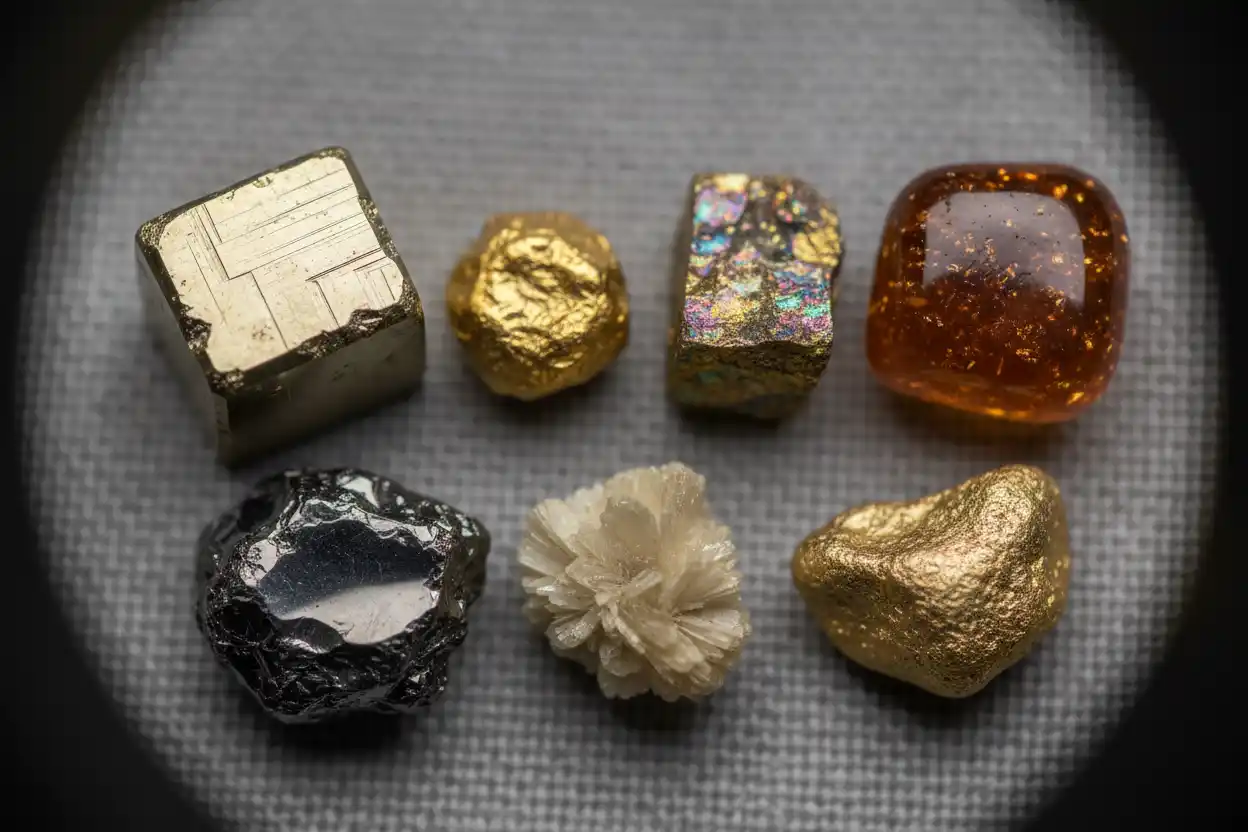
Real vs Fake Pyrite: Mineral Tests and Fool’s Gold Imitations
Real pyrite is iron disulfide, FeS₂. It is an opaque metallic mineral with pale brass-yellow color, a greenish-black to brownish-black streak, brittle tenacity and hardness of approximately 6–6.5.
Well-formed crystals commonly appear as cubes, pyritohedrons, octahedrons or combinations of these forms. Crystal faces may carry straight parallel striations whose direction changes from one adjoining face to another.
Fake pyrite is not one standardized product. Imitations include metallic-painted resin, plastic, ceramic, brass-colored glass, molded clusters, glued crystal assemblies, goldstone and unrelated metallic minerals. Natural chalcopyrite, marcasite, hematite and even native gold can also be confused with pyrite without being manufactured fakes.
A complete identification should therefore establish whether the object is FeS₂, whether its crystals formed naturally, whether the cluster has been assembled or coated and whether a related mineral has been mislabeled.
This page owns the direct authenticity workflow. The completed treated and synthetic pyrite guide retains artificial tarnish, metallic coatings, repaired specimens, composites and laboratory-grown-material boundaries.
Genuine Pyrite vs Common Lookalikes
| Feature | Genuine pyrite | Chalcopyrite | Marcasite | Goldstone or metallic glass | Painted resin or plastic |
|---|---|---|---|---|---|
| Material | Iron disulfide, FeS₂ | Copper iron sulfide, CuFeS₂ | Iron disulfide, FeS₂, with different structure | Manufactured glass with metallic particles | Manufactured polymer |
| Fresh color | Pale brass yellow | Richer yellow to golden yellow | Pale brass to tin-white or bronze | Brown, blue, green or other glass color with sparkle | Any metallic paint |
| Crystal system | Cubic | Tetragonal | Orthorhombic | Amorphous glass | No mineral crystal system |
| Typical habit | Cubes, pyritohedrons, octahedrons, disks and granular masses | Irregular masses, tetrahedral forms and grains | Cockscomb, spear, radiating and tabular forms | Beads, cabochons and molded objects | Molded clusters and decorative forms |
| Mohs hardness | About 6–6.5 | About 3.5–4 | About 6–6.5 | Commonly around 5–6 | Much softer |
| Streak | Greenish black to brownish black | Greenish black | Dark gray to black | Glass powder or material-dependent | Paint or polymer mark |
| Density | Close to 5.0 | Lower, commonly around 4.1–4.3 | Similar to pyrite | Glass-dependent | Usually much lower |
| Tenacity | Brittle | Brittle | Brittle and often less stable | Glass-like fracture | Cuts, dents or peels |
| Main clue | Hard, dense, naturally geometric metallic mineral | Softer and commonly more yellow or tarnished | Different crystal habit and greater instability | Sparkles suspended within glass | Seams, bubbles, low weight or flaking paint |
| Best confirmation | Microscopy, density, streak on expendable material, Raman or XRD | Mineral testing | Structural testing | Glass identification | Material analysis |
Natural lookalikes should be identified accurately rather than dismissed as fake stone.
What Is Genuine Pyrite?
The recently drafted pyrite meaning guide owns geology, symbolism, uses and general properties.
Pyrite is the most widespread sulfide mineral. It forms in hydrothermal veins, sedimentary rocks, coal, igneous rocks, pegmatites and metamorphic deposits.
Its high metallic luster and brass-yellow color explain the nickname fool’s gold.
Pyrite is not a form of gold and does not owe its ordinary color to a gold coating. Trace or microscopic gold can occur in some geological pyrite ores, but an everyday decorative cube should not be described as gold-bearing without analytical evidence.
Natural Pyrite Color
Fresh pyrite appears pale brass yellow. Under cool light, it may look almost silvery or greenish gold.
Exposure to air and moisture can darken the surface. Brown, bronze, blue, purple or rainbow tarnish may develop.
A naturally tarnished specimen remains pyrite beneath the altered surface.
Artificial chemical treatment can also produce rainbow colors. The color’s origin should therefore be assessed separately from the mineral identity.
A coating that chips away to reveal plastic or glass indicates an imitation. Tarnish that follows the metallic mineral surface may represent natural or induced oxidation.
Pyrite Crystal Shapes
Cubes are the most recognizable pyrite crystals.
Pyritohedrons have twelve pentagonal faces. Octahedrons have eight triangular faces. Many crystals combine two or more forms.
Natural growth can create distorted, intergrown or incomplete crystals. Contact with surrounding rock may interrupt a face or remove a corner.
A perfect shape does not automatically prove manufacture because pyrite’s cubic symmetry naturally produces precise geometry.
The useful question is whether the faces, edges, striations, matrix and intergrowths form a believable mineral-growth pattern.
Face Striations
Pyrite cubes commonly display parallel grooves across their faces.
On adjacent cube faces, the striations typically change orientation according to crystal symmetry.
Molded resin may reproduce grooves, but the lines can appear identical on every face, overly rounded or repeated across several crystals.
Casting seams and pooled metallic paint may become visible along edges.
Not every real pyrite cube has obvious striations. Smooth faces can occur, so their absence does not prove imitation.
Pyrite Versus Gold
Native gold is richer yellow, much denser, softer and malleable.
Pyrite fractures or crushes into angular pieces. Gold bends, flattens or deforms rather than shattering under comparable pressure.
Pyrite leaves a dark streak. Gold leaves a yellow metallic streak.
Gold rarely forms sharp striated cubes resembling ordinary pyrite. It more commonly occurs as flakes, wires, nuggets and irregular masses.
These principles are useful, but destructive testing is inappropriate for a collectible specimen. An ore sample with possible precious-metal value requires assay or professional analysis.
Pyrite Versus Chalcopyrite
Chalcopyrite is copper iron sulfide.
It is usually more golden yellow than pyrite and commonly tarnishes in blue, purple, green and orange colors.
Chalcopyrite is much softer. A steel point can scratch it more readily, although deliberately scratching a finished specimen remains poor practice.
Pyrite more commonly develops sharp cubes and pyritohedrons. Chalcopyrite tends toward irregular masses, grains or less familiar tetrahedral forms.
Material sold as peacock ore is frequently chalcopyrite that has been chemically treated to intensify its rainbow tarnish.
Pyrite Versus Marcasite
Marcasite has the same FeS₂ composition as pyrite but crystallizes in the orthorhombic system.
It commonly forms spear-like, cockscomb, radiating or tabular aggregates rather than pyrite cubes.
Marcasite is generally less stable and may deteriorate more readily in ordinary storage.
Jewelry sold commercially as marcasite often contains small faceted pyrite pieces because pyrite is more suitable for fashioning and wear.
Color alone cannot always separate massive or altered material. Raman spectroscopy or X-ray diffraction may be necessary.
Pyrite Versus Goldstone
Goldstone is manufactured glass containing reflective metallic crystals.
Brown goldstone has a translucent brown or reddish glass body filled with numerous evenly distributed copper-colored sparkles.
Pyrite is opaque and metallic across its mineral surface rather than transparent glass surrounding glitter.
Blue and green goldstone make the distinction even clearer because those bodycolors are not ordinary pyrite.
A bead full of suspended sparkles is goldstone or another manufactured material, not a polished pyrite crystal.
Pyrite Versus Hematite
Hematite is iron oxide.
Polished hematite may appear silver-gray, black or metallic. It is denser than many ordinary stones and leaves a reddish-brown streak.
Pyrite is brass yellow and leaves a dark greenish-black or brownish-black streak.
Some metallic-coated hematite products are sold under invented names that imply gold or pyrite.
The underlying mineral can be genuine hematite while the commercial identity remains inaccurate.
Molded Resin and Plastic Pyrite
Resin can reproduce cubes, clusters, fossils and matrix specimens.
Metal powder or brass-colored pigment gives the surface a convincing shine.
Look for mold seams, rounded edges, casting bubbles, repeated crystal arrangements and metallic paint collected in recesses.
Resin usually weighs much less than pyrite. A large cluster that feels unexpectedly light deserves scrutiny.
Dense filler can increase weight, so heft alone does not prove natural origin.
A scratch or chip may expose white, gray or transparent polymer beneath the metallic surface.
Cast Metal and Brass Imitations
Brass, bronze and other metal alloys can be cast into pyrite-like cubes or decorative clusters.
These objects may be heavier than resin and can defeat casual touch tests.
A cast-metal surface may show polishing lines, machining marks, solder, rounded mold seams or uniform artificial texture.
Brass is softer than pyrite and has different density and streak behavior.
A metal detector or electrical-conductivity measurement can provide evidence, but professional mineral identification remains more direct.
Glued and Assembled Pyrite Clusters
Natural pyrite crystals may be glued onto a matrix or assembled into a larger decorative cluster.
The individual crystals can be genuine while the overall formation is reconstructed.
Inspect contact points under magnification. Clear adhesive, bubbles, glossy menisci and repeated attachment pads indicate assembly.
A repaired specimen should not be described as untouched natural formation.
Assembly can be acceptable when disclosed, particularly for fragile display pieces. It affects collector value and care.
Coated Stones and Ceramic
A dull stone, ceramic form or glass object may receive metallic paint.
Wear along edges can reveal the underlying body. Chips may expose a nonmetallic interior.
Painted surfaces can look unusually uniform and may lack pyrite’s sharp reflective changes.
Ceramic pieces may have a granular pale interior beneath a metallic glaze.
A coating may also be placed over genuine pyrite to intensify gold color or rainbow tarnish. The base identity and treatment must be evaluated separately.
Is Synthetic Pyrite Common?
Pyrite can be produced in laboratories for scientific, industrial and educational purposes.
However, large commercial jewelry and crystal-shop imitations are more commonly resin, glass, cast metal, treated sulfides or assembled natural fragments than true laboratory-grown FeS₂.
A product labeled synthetic pyrite should state its composition and growth method.
Manufactured origin alone does not establish a synthetic counterpart. An object made to look like pyrite from unrelated material is a simulant.
The broader gemstone-treatments guide explains synthetic, treated and imitation terminology.
Density and Heft
Pyrite’s specific gravity is close to 5.0.
A genuine cube feels heavy for its dimensions compared with resin, plastic, ordinary rock or many glasses.
Gold is far denser, while chalcopyrite is somewhat lighter. Brass can be denser than pyrite.
Hand comparison is subjective. Hollow objects, matrix and dense fillers distort the impression.
Hydrostatic specific-gravity measurement on a loose solid piece provides stronger evidence.
Hardness
Pyrite ranks about 6–6.5 on the gemstone hardness chart.
It is harder than chalcopyrite, calcite, resin and many ordinary glasses.
Its hardness does not make it tough. Pyrite remains brittle and can chip or fracture under impact.
The completed gemstone-cleavage guide explains structural breakage, although pyrite’s cleavage is indistinct.
Do not scratch a collectible crystal simply to confirm a hardness range.
Streak
Pyrite leaves a greenish-black to brownish-black streak on an appropriate unglazed porcelain plate.
Chalcopyrite also produces a dark streak, while gold leaves a yellow streak and hematite leaves a reddish-brown one.
Streak testing removes material and damages a polished surface or crystal edge.
It is suitable for an expendable mineral fragment, not an important specimen or jewelry piece.
Paint and coating can also leave misleading surface marks before the underlying material reaches the plate.
Magnetism
Pyrite is not normally strongly attracted to an ordinary household magnet.
Its response is weak compared with magnetite, iron metal and some alloys.
A strong attraction suggests metal contamination, magnetite, an attached object or an imitation, but absence of attraction does not prove pyrite.
Some pyrite specimens contain magnetic associated minerals.
A magnet is a supporting screen rather than an authentication test.
Spark Tests
Historically, pyrite was used to produce sparks when struck against suitable hard material.
Do not strike a specimen for identification. The test can chip the crystal, create sharp fragments and ignite nearby flammable material.
Several metals and minerals can spark, so a positive result is not unique.
Microscopy, density and spectroscopy provide safer information.
Pyrite Oxidation
Exposure to oxygen and moisture can oxidize pyrite.
A deteriorating specimen may develop white, yellow, greenish or brown crusts, cracking, powder and a sulfurous odor. Collectors often call severe deterioration pyrite disease.
The process can create acidic products and damage storage boxes, labels and nearby minerals.
Oxidation does not mean the specimen was fake. In fact, it may confirm an unstable sulfide mineral, although marcasite and other sulfides can deteriorate similarly.
Keep affected pieces isolated and dry rather than washing away the crust.
Water and Safety
Do not soak pyrite deliberately.
Water can enter cracks, porous matrix and spaces between grains, encouraging oxidation during slow drying.
Saltwater is particularly unsuitable because residual salts attract moisture.
Do not place pyrite directly in drinking water. The completed crystal water-safety guide explains why mineral hardness alone does not establish elixir safety.
Avoid inhaling dust from cutting, drilling or crushing. The completed toxic-crystals safety list provides broader handling guidance.
Magnification
Use a 10× loupe under neutral reflected light.
Examine crystal-face striations, matrix contacts, fractures, tarnish and sharp edges.
Look for mold seams, paint pooling, bubbles, glue, repeated crystal arrangements and a nonmetallic body beneath chips.
Natural intergrowths should show varied contacts and partial crystals rather than every cube sitting independently on a smooth base.
Clean loose dust with a dry soft brush before judging the surface.
Raman and X-Ray Identification
Raman spectroscopy can identify pyrite through its vibrational pattern and distinguish marcasite, chalcopyrite, hematite, glass and many coatings.
X-ray diffraction confirms cubic pyrite and separates it from orthorhombic marcasite even though both have FeS₂ composition.
Chemical analysis can determine iron and sulfur proportions and identify associated metals.
The completed gemstone-certification guide explains when formal documentation is worthwhile. Use how to read a gem-lab report to check whether the report identifies an entire cluster or only one tested grain.
A Safe Home Inspection Sequence
Observe the specimen under neutral light. Confirm pale brass color, opaque metallic luster and believable crystal form.
Use a loupe to inspect striations, edges, matrix contacts and any suspected glue or coating.
Compare its dimensions with weight. Extremely light material may be resin or hollow construction.
Test magnetism gently without allowing a strong magnet to strike the specimen.
Do not scratch, streak, strike, burn, soak or expose the piece to acid.
When mineral identity or natural formation affects value, seek Raman or X-ray testing.
Buying Real Pyrite
The planned where-to-buy-real-pyrite guide owns seller and marketplace evaluation.
Ask whether a cluster is natural, repaired, assembled, coated or artificially tarnished.
Request photographs of the underside, matrix contacts and any broken areas.
For remote transactions, follow how to buy gemstones online and preserve a meaningful inspection period.
A specimen does not become authentic because it is heavy, expensive or accompanied by a metaphysical card.
Cleaning and Spiritual Care
Use a dry soft brush for routine dust removal.
Avoid metal polish, acid, salt, steam, ultrasonic cleaning and prolonged water contact.
Isolate unstable specimens from the rest of a collection.
Belief-based methods belong in how to cleanse and charge pyrite and should use dry, physically safe approaches.
Frequently Asked Questions
1. What is genuine pyrite?
Genuine pyrite is naturally formed iron disulfide, FeS₂, usually with metallic brass-yellow color and cubic crystal structure.
2. Does every real pyrite crystal form a cube?
No. Pyrite also forms pyritohedrons, octahedrons, disks, concretions and granular masses.
3. Do striations prove pyrite is real?
They support identification when they follow natural crystal symmetry, but molded imitations can copy grooves.
4. How can I distinguish pyrite from gold?
Pyrite is harder, brittle, less dense, commonly geometric and leaves a dark streak. Gold is soft, malleable, much denser and leaves a yellow streak.
5. How is chalcopyrite different from pyrite?
Chalcopyrite is softer, often more golden yellow and tarnishes readily. It has different composition and crystal structure.
6. Is marcasite the same as pyrite?
No. Both are FeS₂, but marcasite has an orthorhombic structure and different crystal habits.
7. Can fake pyrite feel heavy?
Yes. Brass, cast metal and mineral-filled resin can feel substantial, so weight alone is not conclusive.
8. Is rainbow pyrite genuine?
The base may be genuine pyrite or another sulfide, while the rainbow surface can be natural tarnish or artificial treatment.
9. Does strong magnetism prove pyrite?
No. Pyrite is not normally strongly magnetic. Strong attraction suggests another mineral, metal or contamination.
10. Can I use a streak test on jewelry?
No. Streak testing removes material and damages polished surfaces.
11. Why is my pyrite developing powder or crystals?
Moisture and oxygen may be causing sulfide oxidation. Isolate the specimen and keep it dry.
12. Which laboratory tests confirm pyrite?
Raman spectroscopy, X-ray diffraction, density and chemical analysis can confirm pyrite and distinguish its closest lookalikes.
Real pyrite combines specific mineral evidence: FeS₂ chemistry, cubic structure, metallic brass color, dark streak, density and brittle hardness. A molded gold-colored object may copy one or two of those features, but it rarely reproduces the complete set. Identification should remain dry and non-destructive because the same moisture and breakage used in poor home tests can damage the specimen being evaluated.
Pyrite appears in Crystals That Start With P and Gemstones That Start With P.
Pyrite can generate irritating dust when cut or crushed and may oxidize into acidic products when exposed to moisture. Do not ingest it, inhale generated dust or place it directly in drinking water.