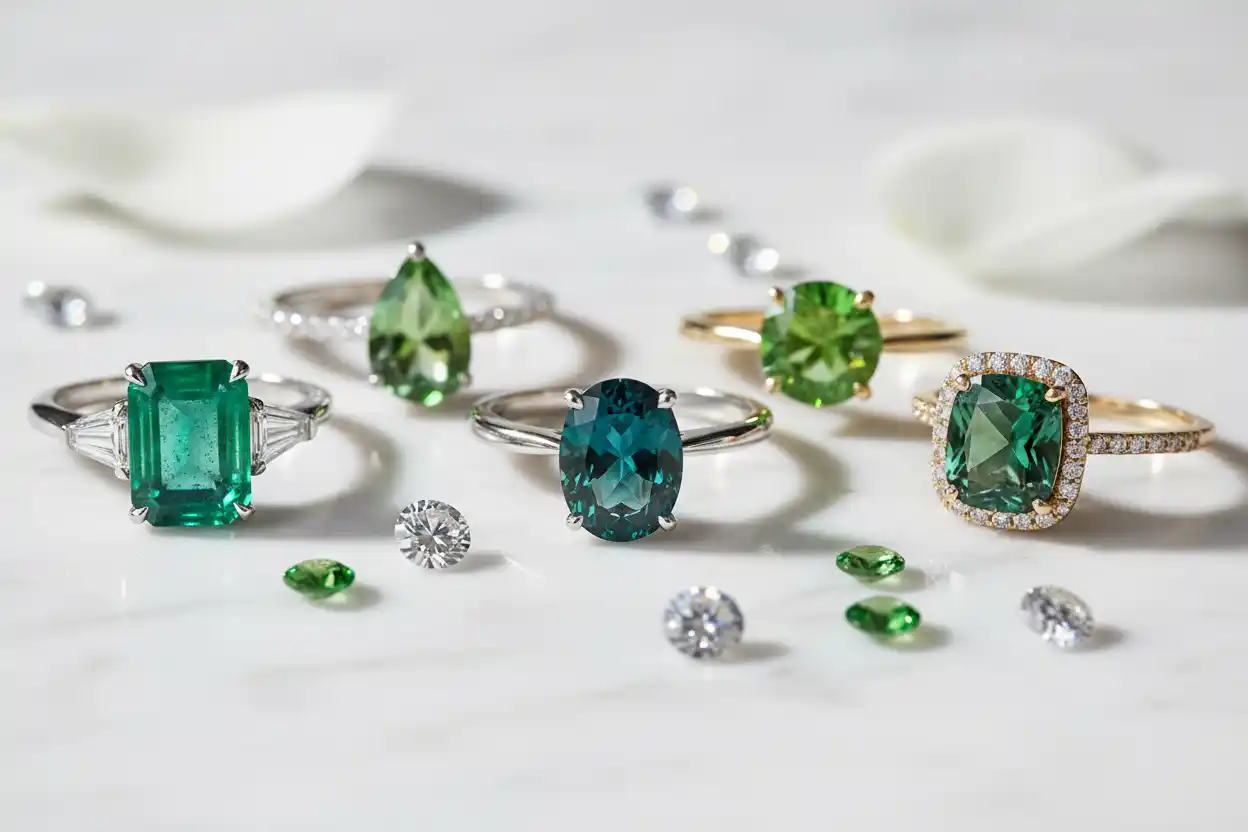
Green Gemstones for Engagement Rings
Green engagement-ring gemstones range from extremely durable green sapphire and spinel to vivid tsavorite, classic emerald and softer options such as peridot and prasiolite. The best choice depends on more than color: an engagement ring is commonly worn for thousands of hours each year, so hardness, toughness, treatment, setting design and willingness to maintain the stone all matter.
For most daily-wear buyers, green sapphire, green spinel and tsavorite garnet provide the strongest balance of green color and durability. Emerald remains the classic luxury option but usually requires more careful wear because natural emerald frequently contains fractures and clarity enhancement.
Best Green Engagement-Ring Stones at a Glance
| Green Gemstone | Mohs Hardness | Toughness / Structural Note | Daily-Wear Suitability |
|---|---|---|---|
| Green Sapphire | 9 | Excellent toughness, no cleavage | Excellent |
| Green Spinel | 8 | Good toughness | Excellent |
| Chrysoberyl | 8.5 | Very durable gem material | Excellent, though strongly green stones are less common |
| Tsavorite Garnet | About 7–7.5 | Garnet has fair-to-good toughness | Very good |
| Emerald | 7.5–8 | Commonly fractured and filled | Good with informed care |
| Green Tourmaline | 7–7.5 | Fair toughness; thermal shock concern | Good with care |
| Jadeite | 6.5–7 | Exceptional toughness | Good, especially in cabochon designs |
| Peridot | 6.5–7 | Fair-to-good toughness | Better for careful wear |
| Prasiolite | 7 | Quartz-family durability | Better with sensible protection |
Hardness is only one part of durability. A stone can resist scratches yet remain vulnerable to impacts, cleavage, fractures or unstable treatments.
The completed Best Gemstones for Engagement Rings provides the wider cross-color durability framework, while this article stays specifically focused on green choices.
1. Green Sapphire — Best Overall for Daily Wear
Green sapphire is one of the strongest natural choices for someone who wants a genuinely green center stone and intends to wear the ring every day.
Sapphire is corundum.
It ranks 9 on the Mohs scale, has excellent toughness and lacks cleavage. GIA describes corundum as a strong choice for rings and mountings exposed to daily wear.
Green sapphire itself ranges considerably in appearance.
Stones may be:
yellow-green, blue-green, olive, forest green or more uniformly saturated green.
GIA notes that strongly and uniformly green sapphires are comparatively uncommon and can attract collector interest.
Why Green Sapphire Works
Its principal advantages are durability and color diversity.
A secure prong or bezel setting can make a green sapphire ring practical for decades of regular wear.
The main buying consideration is treatment.
Sapphire is frequently heat treated, and other treatment categories exist. Treatment is not automatically undesirable, but it should be disclosed because it affects value and sometimes care requirements.
The tracker-approved Sapphire Buying Guide owns detailed quality and treatment evaluation, while Sapphire Rings handles general sapphire-ring design.
2. Green Spinel — Durable and Understated
Spinel ranks 8 on the Mohs scale and has good toughness.
That combination makes it durable enough for all major jewelry categories, including engagement rings.
Green spinel is less familiar than red, pink, blue or gray spinel and may be difficult to find in strongly saturated natural green.
However, stones with greenish, gray-green or cool green appearances can create understated engagement rings.
Why Choose Green Spinel?
Spinel offers good brilliance without the treatment expectations that surround some other gem families.
Its high durability makes it a strong option for someone who wants an unusual gemstone but does not want the care requirements associated with emerald.
A well-cut spinel can also perform visually in solitaire designs because the stone does not require a halo to appear lively.
The completed Spinel Buying Guide provides the broader purchase criteria, while Spinel Rings covers ring construction.
3. Chrysoberyl — A Highly Durable Greenish Option
Chrysoberyl is one of the harder natural colored gemstones at approximately Mohs 8.5.
Its best-known variety is alexandrite, but ordinary chrysoberyl can occur in yellow-green, greenish-yellow and related colors.
Strong pure green is less typical than in emerald or tsavorite.
However, buyers who appreciate subtle olive, yellow-green or celery-green tones can find chrysoberyl extremely practical.
Why Chrysoberyl Deserves More Attention
Its durability makes it particularly suitable for frequent ring wear.
Furthermore, its relative unfamiliarity can appeal to buyers who want a gemstone outside conventional engagement-ring categories.
The completed Chrysoberyl: Meaning, Properties & Symbolism explains the mineral family, including how ordinary chrysoberyl differs from color-changing alexandrite.
4. Tsavorite Garnet — Best Emerald Alternative
Tsavorite is the vivid green variety of grossular garnet.
For many buyers, it is one of the best alternatives to emerald.
Fine stones can display intense green color with strong transparency and brilliance.
GIA specifically highlights tsavorite as a more durable green option than emerald for engagement-ring wear.
Garnets vary between roughly Mohs 6.5 and 7.5, with tsavorite toward the harder side, and they have fair-to-good toughness.
Why Tsavorite Works
Tsavorite is usually not burdened by the extensive fracture filling associated with emerald.
That simplifies care and treatment disclosure.
The tradeoff is availability.
Fine large tsavorite becomes scarce, so a buyer looking for a substantial center stone may face a steep increase in price with size and quality.
For gemstone selection, Tsavorite Buying Guide owns the detailed purchase intent. Ring-specific setting choices are covered in Tsavorite Rings.
5. Emerald — The Classic Green Engagement Stone
Emerald remains the gemstone most people immediately associate with luxury green jewelry.
Its color can be extraordinary.
Fine emerald ranges from green to bluish green and carries thousands of years of jewelry history.
However, hardness alone gives an incomplete picture of durability.
Emerald ranks 7.5–8 Mohs, but natural stones commonly contain fractures.
Furthermore, many fashioned emeralds are clarity enhanced with oils, resins or related fillers.
Is Emerald Suitable for an Engagement Ring?
Yes—but with informed care.
Emerald rings have survived for generations when worn and maintained appropriately.
A protective halo, bezel-like structure or carefully designed prong setting can reduce impact exposure.
Someone who routinely works with tools or knocks their hands against hard surfaces may find sapphire or tsavorite easier to live with.
The dedicated Emerald Engagement Rings guide owns the full emerald-specific buying workflow, while How to Spot Treated or Synthetic Emerald explains disclosure considerations.
6. Green Tourmaline — Wide Color Variety
Green tourmaline provides one of the broadest green palettes available.
Depending on chemistry and orientation, stones may appear:
yellow-green, grassy green, forest green, bluish green or very dark green.
Tourmaline ranks approximately 7–7.5 Mohs.
Its toughness is considered fair.
That makes it suitable for rings, but it requires more care than sapphire or spinel.
The Main Tourmaline Consideration
Thermal shock matters.
High heat and abrupt temperature changes can fracture tourmaline, particularly when liquid inclusions are present.
For everyday ring use, select a sound stone and avoid unnecessarily high settings that expose the gem to repeated blows.
The existing Tourmaline Buying Guide covers gemstone selection, and Tourmaline Rings handles general ring styling.
7. Jadeite — Exceptional Toughness in a Different Style
Jadeite creates a completely different engagement-ring aesthetic.
Instead of conventional transparent brilliance, fine jadeite is valued for color, translucency and smooth texture.
Its Mohs hardness is only about 6.5–7, so scratches are more likely than with sapphire.
However, jadeite has exceptional toughness because its interlocking crystal structure resists chipping and breaking.
Best Jadeite Ring Styles
Cabochons, saddle rings and other smooth low-profile settings make good use of its structural strengths.
Jadeite is therefore particularly suitable for someone who wants a green ring with:
minimal faceting, cultural significance or sculptural design.
Treatment disclosure is crucial.
Bleached, polymer-impregnated and dyed jadeite belongs to different commercial categories from untreated or wax-only material.
The completed Jade Buying Guide and Jade Rings cover those distinctions.
8. Peridot — Bright Green With More Care
Peridot has a distinctive yellow-green to green color that typically does not require treatment to produce its familiar appearance.
Its hardness falls around 6.5–7, with fair-to-good toughness.
GIA considers peridot durable enough for jewelry but recommends care against scratches and hard blows. Its August birthstone guidance is more conservative about constant daily ring wear.
When Peridot Makes Sense
Peridot works best for someone who strongly prefers its particular color and is comfortable removing the ring during rough activity.
A protective bezel or halo can reduce edge exposure.
It is less suitable for a wearer who expects to keep the engagement ring on during nearly every physical task.
The completed Peridot Buying Guide and Peridot Rings preserve the detailed peridot purchase and design intents.
9. Prasiolite — Soft Green Quartz
Prasiolite is transparent pale green quartz.
Its understated color can create elegant engagement rings, particularly in larger sizes.
Like quartz generally, it ranks around Mohs 7.
That is workable for rings but not ideal for someone expecting sapphire-level resistance to surface wear.
Prasiolite Strengths
Large stones can be relatively accessible.
The pale green color coordinates easily with white, yellow or rose metals.
Its main limitation is that a large center stone presents more surface area to impacts and abrasion.
A lower protective setting is therefore preferable for regular use.
For gemstone quality and terminology, the tracker-approved Prasiolite Buying Guide is the relevant companion page.
What About Green Aventurine?
Green aventurine is beautiful, affordable and suitable for many jewelry designs.
However, it is usually translucent to opaque and sits around the quartz hardness range rather than offering the durability and brilliance expected from top engagement-ring center stones.
It can work in:
cabochon rings, symbolic engagement jewelry or designs intended for more careful wear.
For a ring expected to withstand decades of continuous daily use, sapphire, spinel or tsavorite generally provides a stronger practical starting point.
The freshly reconciled Green Aventurine article explains the material itself without turning its symbolism page into engagement-ring advice.
Green Sapphire vs Tsavorite
These are two of the strongest options for a bright transparent green engagement ring.
Green sapphire wins on scratch resistance and overall daily-wear durability.
Tsavorite can deliver brighter, more emerald-like green and strong brilliance but has lower hardness.
A sapphire may therefore suit someone who prioritizes minimal maintenance.
Tsavorite works well for someone who prioritizes vivid natural green and accepts sensible precautions.
Neither is universally better.
Actual color, cut, treatment and budget matter.
Tsavorite vs Emerald
This comparison is particularly important.
Emerald provides unmatched historical prestige and its characteristic beryl green.
Tsavorite often offers greater clarity, brilliance and easier durability.
GIA’s colored engagement-ring guidance specifically suggests tsavorite as a durable alternative when a buyer wants green for everyday wear.
The tracker contains a dedicated Tsavorite vs Emerald comparison for readers deciding directly between those two gemstones.
Hardness Is Not Enough
Engagement-ring buyers frequently rely too heavily on Mohs numbers.
Hardness describes scratch resistance.
Toughness describes resistance to breaking and chipping.
Cleavage describes structural directions along which some minerals can split.
Stability concerns heat, light, chemicals and environmental changes.
A stone can therefore rank high on the Mohs scale yet still require thoughtful care.
The completed Gemstone Toughness vs Hardness page explains why those properties must be evaluated together.
Best Setting for a Green Engagement Stone
The more vulnerable the gemstone, the more important the setting becomes.
Bezel
A bezel surrounds the edge and gives excellent perimeter protection.
It works particularly well for emerald, tourmaline, peridot and prasiolite.
Halo
A halo does not completely protect a center stone, but surrounding diamonds or other gems can create some separation between vulnerable edges and outside objects.
Low Prong Setting
A carefully constructed low prong setting preserves more visual openness while reducing leverage compared with a very high basket.
Cathedral Setting
Cathedral shoulders provide support and elegance but can raise the gemstone substantially depending on design.
Choose based on the actual center stone and lifestyle rather than aesthetics alone.
Watch the Pointed Corners
Pears, marquises and rectangular cuts with exposed corners deserve additional protection.
Corners concentrate impact.
A V-prong or bezel-like element can help protect those areas.
Emerald cuts are particularly relevant because green gemstones are frequently fashioned in that shape.
The name “emerald cut” describes the cutting style; it does not mean only emerald can receive it.
Sapphire, spinel, tourmaline and tsavorite can all be cut into rectangular step-cut forms.
Treatments Matter in Engagement Rings
An engagement ring may be exposed to:
hand soap, lotion, heat during repair, accidental household chemicals and decades of maintenance.
Treatment disclosure therefore has practical importance.
Emerald is frequently fracture filled.
Sapphire may be heated and can receive other treatments.
Jadeite may be bleached, impregnated or dyed.
Tourmaline may be heated or irradiated.
Treatment is not inherently negative.
The key is understanding what was done so the price, care instructions and long-term expectations match the actual gemstone.
The site’s Gemstone Treatments Explained provides the broader treatment framework.
Natural vs Lab-Grown Green Stones
Laboratory-grown emerald and sapphire can provide the same basic mineral identities as their natural counterparts while costing substantially less in many cases.
For engagement rings, this can allow:
larger size, stronger color and better clarity within a fixed budget.
However, origin must be disclosed clearly.
Lab-grown does not mean glass or imitation.
Likewise, a simulant that merely resembles emerald is different from laboratory-grown emerald.
The completed Lab-Grown vs Natural Gemstones explains those categories.
Best Metal for Green Engagement Rings
Green pairs successfully with every major precious-metal color.
Platinum and white gold create crisp contrast and work especially well with blue-green sapphire and tsavorite.
Yellow gold produces a rich traditional appearance with emerald, peridot and darker tourmaline.
Rose gold can make pale green stones such as prasiolite stand out through warm complementary contrast.
For frequently worn rings, construction and alloy performance matter at least as much as color preference.
Certification and Independent Reports
Documentation becomes more useful as gemstone value rises.
A reputable gemological report can address:
material identity, natural or laboratory-grown origin and detectable treatments.
For some gemstones, geographic-origin opinions may also be available under appropriate conditions.
The report does not determine whether you personally like the stone and generally does not provide a retail value.
It reduces uncertainty.
The completed Gemstone Certification Labs Compared explains the role and limitations of laboratory documentation.
Which Green Stone Is Best for You?
If maximum everyday durability is the priority, begin with green sapphire.
If you want unusual durability with rarity, consider greenish spinel or chrysoberyl.
If you want vivid emerald-like green with strong jewelry performance, tsavorite deserves serious consideration.
Choose emerald when its historic identity and particular color matter enough to justify additional care.
Tourmaline offers enormous color variety.
Jadeite works for a distinctive cabochon or sculptural ring.
Peridot and prasiolite can be attractive but are better for people willing to modify wear habits.
Ultimately, the best engagement gemstone is the one whose durability expectations match how the ring will actually be worn.
Frequently Asked Questions
1. What is the best green gemstone for an engagement ring?
Green sapphire is one of the strongest overall choices because it combines Mohs hardness 9, excellent toughness and no cleavage.
2. What is the best alternative to emerald?
Tsavorite garnet is one of the strongest emerald alternatives because it provides vivid transparent green, good jewelry durability and generally fewer treatment concerns.
3. Is emerald durable enough for an engagement ring?
Yes, with informed care. Emerald is hard but commonly fractured and fracture filled, so it requires more caution than sapphire and several other daily-wear stones.
4. Is tsavorite good for everyday engagement-ring wear?
Yes. Tsavorite is toward the harder end of the garnet group and has fair-to-good toughness, making it suitable for frequent wear with sensible care.
5. Is green sapphire natural?
Natural green sapphire exists. GIA notes that uniformly saturated green sapphires are relatively uncommon, although sapphires can also contain mixed greenish-blue or yellow-green appearances.
6. Is spinel durable enough for an engagement ring?
Yes. Spinel ranks Mohs 8 and has good toughness, making it a durable choice for rings.
7. Can peridot be used in an engagement ring?
Yes, but it requires more careful wear. At Mohs 6.5–7 with fair-to-good toughness, it is more vulnerable to scratching and impact than sapphire or spinel.
8. Is jadeite good for engagement rings?
Jadeite can work very well in smooth cabochon or carved designs because it has exceptional toughness, although its lower hardness means it scratches more easily than sapphire.
9. Is tourmaline suitable for an engagement ring?
Yes, provided the wearer uses reasonable care. Tourmaline ranks about Mohs 7–7.5 but has fair toughness and can be damaged by thermal shock.
10. Should I avoid lab-grown green gemstones?
No. Properly disclosed lab-grown emerald or sapphire has the same basic mineral identity as its natural counterpart. The choice depends on budget, rarity preference and personal priorities.
11. Which setting protects a green gemstone best?
A low bezel setting gives excellent perimeter protection. Protective halos and well-designed low prong settings can also reduce exposure.
12. Which green engagement-ring stone requires the least maintenance?
Green sapphire is generally the easiest major natural green option for demanding daily wear because corundum combines excellent hardness, toughness and stability.
Conclusion
Green engagement rings offer more practical choices than emerald alone.
Green sapphire provides the strongest combination of scratch resistance and toughness for daily wear. Spinel and chrysoberyl offer excellent durability for buyers willing to search for less common colors, while tsavorite provides vivid green and stronger everyday practicality than many people expect.
Emerald remains the historic icon, but its fractures and common clarity enhancement make informed care essential.
Tourmaline, jadeite, peridot and prasiolite broaden the palette further, each with a different balance of color, toughness and scratch resistance.
For a ring intended to be worn every day for decades, choose durability before carat weight. A slightly smaller stone in a secure, low-profile setting will usually serve better than a larger vulnerable gemstone chosen only for immediate visual impact.