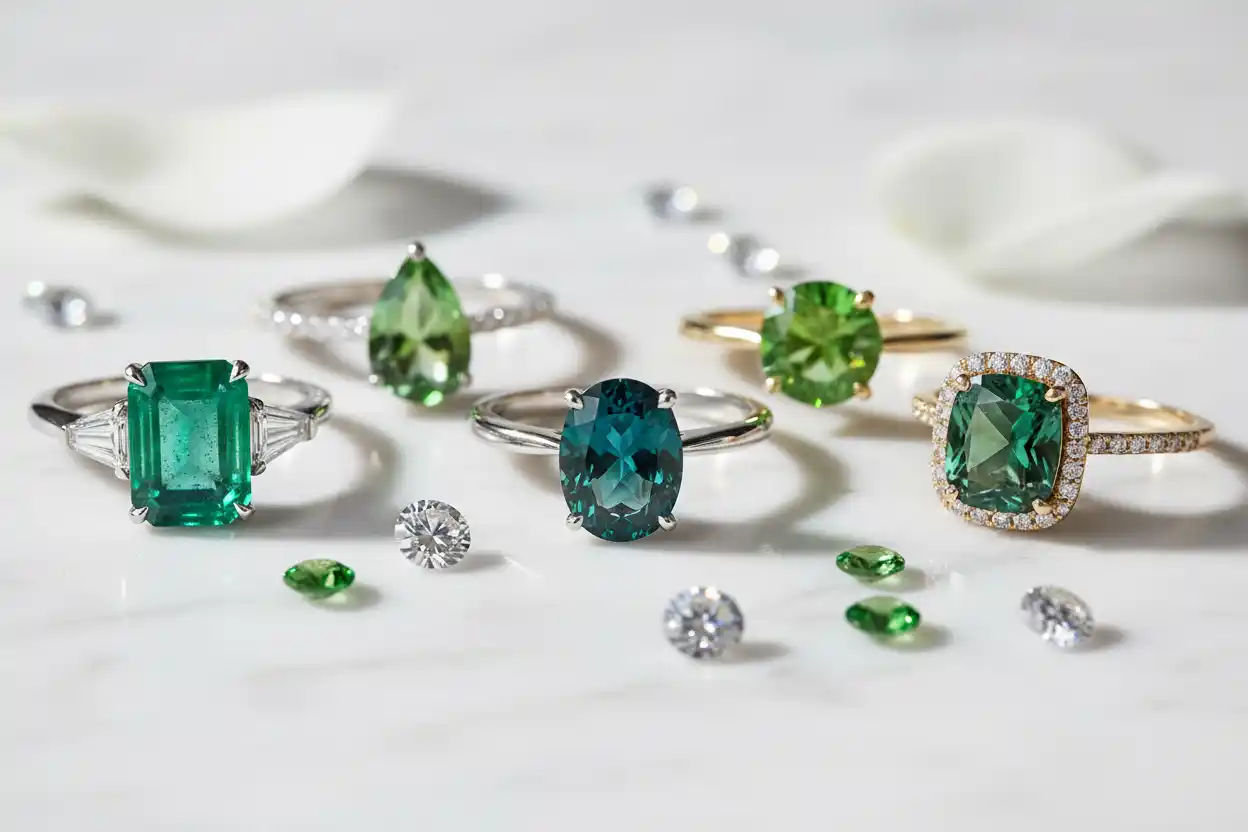
14 Green Engagement Ring Stones for Heart Healing & Abundance
Green engagement ring stones range from prestigious emerald and highly durable green sapphire to vivid tsavorite garnet, green tourmaline, peridot, jadeite, chrysoberyl, and several distinctive alternatives. The best choice for everyday wear depends on much more than color. Sapphire and diamond provide exceptional scratch resistance, chrysoberyl is highly durable, and garnet or tourmaline can perform well with sensible care, while emerald requires extra attention because natural stones commonly contain fractures despite their relatively high hardness.
Green is widely associated with growth, renewal, prosperity, harmony, nature, and love. Contemporary spiritual traditions may also connect green gemstones with the heart, emotional healing, or abundance. These meanings can make a green engagement ring personally significant, but they should remain symbolic. A gemstone does not medically heal the heart, repair emotional trauma, scientifically affect a chakra, or guarantee money, prosperity, fertility, or relationship success.
The green color itself can also have very different origins. Emerald receives its famous color principally from chromium, vanadium, or both. Green sapphire is corundum colored by trace elements and structural interactions, peridot is naturally green because iron is part of its composition, and some green diamonds owe their color to natural radiation-related defects. Understanding these differences helps buyers separate genuine gemology from marketing claims and select a ring that can realistically withstand long-term wear.
14 Green Engagement Ring Stones to Consider
- Emerald
- Green sapphire
- Green diamond
- Tsavorite garnet
- Demantoid garnet
- Green tourmaline
- Peridot
- Green chrysoberyl
- Jadeite jade
- Chrysoprase
- Prasiolite
- Green moissanite
- Malachite
- Green aventurine quartz
These 14 green gemstones occupy very different durability and value categories. Green sapphire, diamond, chrysoberyl, tsavorite, tourmaline, and several well-chosen emeralds can work effectively in regularly worn engagement rings. Softer or more delicate stones such as malachite require significantly more protection and are better suited to careful wear.
Comparing Green Engagement Ring Stones
| Gemstone | Approx. Mohs Hardness | Typical Green Appearance | Daily Ring Suitability |
|---|---|---|---|
| Emerald | 7.5 to 8 | Green to bluish green | Good with careful protection |
| Green sapphire | 9 | Yellow-green to blue-green | Excellent |
| Green diamond | 10 | Pale to vivid green | Excellent |
| Tsavorite garnet | 7 to 7.5 | Bright green | Very good |
| Demantoid garnet | 6.5 to 7 | Yellowish to vivid green | Moderate to good |
| Green tourmaline | 7 to 7.5 | Yellow-green to deep green | Good |
| Peridot | 6.5 to 7 | Yellow-green to olive green | Moderate |
| Green chrysoberyl | 8.5 | Yellow-green to green | Excellent |
| Jadeite jade | About 6.5 to 7 | Pale to vivid green | Very good due to toughness |
| Chrysoprase | About 6.5 to 7 | Apple green | Good with care |
| Prasiolite | 7 | Pale green | Good with sensible care |
| Green moissanite | About 9.25 | Green to blue-green | Excellent |
| Malachite | 3.5 to 4 | Banded medium to deep green | Limited |
| Green aventurine quartz | About 6.5 to 7 | Green with shimmering inclusions | Moderate |
Hardness measures resistance to scratching rather than overall resistance to breakage. Emerald illustrates this difference clearly. Beryl has a respectable hardness of 7.5 to 8, but many emeralds contain fractures that make them less tolerant of impacts. Jadeite is softer but exceptionally tough because of its interlocking microcrystalline structure.
Emerald, Green Sapphire, and Diamond for High-End Green Rings
Emerald is the classic green gemstone and one of the most historically important choices for fine jewelry. It is the green variety of beryl, the same mineral species that includes aquamarine. Chromium, vanadium, or a combination of the two produces the green colors accepted as emerald.
Color usually has the greatest influence on emerald appeal. Fine stones show attractive green to bluish-green hues with enough saturation to appear rich without becoming excessively dark. Perfect clarity is neither expected nor necessary because inclusions are extremely common in natural emerald.
Those inclusions have practical consequences. Surface-reaching fractures may reduce toughness, and many emeralds are treated with oil or resin to make fissures less visible. Fracture filling is common and can be acceptable when properly disclosed, but the amount and type of enhancement affect value and cleaning requirements.
For an engagement ring, emerald works best when the wearer accepts careful handling. Protective settings can shield vulnerable edges, while ultrasonic and steam cleaning are poor default choices because treatments and fractures can react unpredictably.
Green sapphire offers a more forgiving alternative. Sapphire is corundum with a Mohs hardness of 9, no cleavage, and strong everyday durability. Green sapphires can range from yellowish green through olive and forest shades to blue-green, depending on trace-element chemistry and color zoning.
Some buyers overlook green sapphire because blue sapphire dominates the market, but this can make green stones appealing for unconventional engagement rings. Heat treatment may occur, and treatment disclosure remains important, especially for higher-value gems.
Green diamond occupies the rarest end of the category when the color is natural. Diamond reaches Mohs 10, providing exceptional scratch resistance. Natural green color can result from radiation-related structural defects formed during geological history, although determining whether color is natural can be extremely challenging.
Because treatment can also create green diamond coloration, laboratory evaluation becomes especially important for valuable stones. Laboratory-grown green diamonds represent another category and can provide durable color at a different price level.
Tsavorite and Demantoid Garnet: Two Very Different Greens
Tsavorite is the vivid green variety of grossular garnet and can offer saturated color without the clarity enhancement commonly associated with emerald. Chromium and vanadium contribute to its green coloration, and fine stones can display exceptional brilliance.
With hardness around 7 to 7.5 and no cleavage, tsavorite performs well in jewelry. Larger clean gems are much rarer than smaller stones, so prices can rise sharply as size increases without a reduction in color or clarity.
For engagement rings, tsavorite offers an appealing balance between vivid natural green color and practical wearability. It still deserves protection from hard blows, but it is generally a strong choice for someone willing to treat the ring responsibly.
Demantoid is green andradite garnet and is famous for its high dispersion, which can produce colorful flashes when the stone is light enough for them to remain visible. Fine Russian demantoids may contain distinctive radiating fibrous inclusions traditionally called horsetails, although such inclusions are not present in every stone.
Demantoid is somewhat softer than tsavorite, typically around 6.5 to 7, so facet wear can develop more readily in a frequently worn ring. It remains a beautiful choice, especially for someone who values rarity and optical character over maximum hardness.
Green Tourmaline, Peridot, and Chrysoberyl for Natural Green Color
Green tourmaline offers one of the widest green ranges among transparent gemstones. Depending on composition, stones can appear yellow-green, olive, forest green, mint, blue-green, or very dark green. Chromium-bearing green tourmalines can achieve particularly vivid color and may be sold as chrome tourmaline when identification supports the description.
Tourmaline has a hardness around 7 to 7.5 and can work well in engagement rings. Long prismatic crystals also allow cutters to produce elegant emerald cuts, elongated cushions, ovals, and other shapes. Very dark stones should be assessed in normal lighting because some green tourmaline can appear nearly black away from bright jewelry-store illumination.
Peridot is the gem variety of olivine and differs from many colored gemstones because green is an inherent part of its chemistry rather than merely a trace-element effect in an otherwise colorless host mineral. Iron contributes directly to its characteristic yellow-green to olive-green appearance.
Peridot has a hardness of about 6.5 to 7 and requires more care than sapphire or chrysoberyl. It can make an attractive engagement ring for a careful wearer, particularly in protective settings. Fine stones with strong color, good clarity, and minimal brownish tone can be exceptionally lively.
Green chrysoberyl is one of the most practical green gems that receives relatively little attention. Chrysoberyl reaches approximately 8.5 on the Mohs scale and combines high hardness with good jewelry durability. Ordinary transparent chrysoberyl can range from yellow and yellow-green to greenish shades.
It should not be confused with chrysoberyl’s more famous varieties, alexandrite and cat’s-eye chrysoberyl. A well-cut transparent green chrysoberyl can make an excellent engagement stone for someone who values durability and rarity without requiring the prestige attached to emerald.
Jadeite and Chrysoprase for Smooth Green Cabochon Rings
Jadeite jade offers a very different appearance from faceted emerald or sapphire. Fine jadeite may show rich green color, translucency, and exceptional toughness. Its interlocking crystalline structure makes it remarkably resistant to breaking despite a Mohs hardness of only about 6.5 to 7.
Highly saturated translucent green jadeite can be extremely valuable. Treatment is a major buying consideration, however. Jadeite may be dyed, bleached, polymer impregnated, or subjected to combinations of treatment. Untreated fine jadeite and heavily treated commercial jade belong to very different value categories.
A jadeite engagement ring works especially well in cabochon, saddle, or sculptural designs where toughness can be used effectively. Because the gem’s beauty depends on texture, translucency, color distribution, and craftsmanship rather than faceted brilliance, it offers a completely different interpretation of a green engagement ring.
Chrysoprase is another attractive cabochon stone. It is green chalcedony colored principally by nickel-related features and can display a vivid apple-green appearance. Its microcrystalline quartz structure provides useful toughness and a hardness around 6.5 to 7.
Fine chrysoprase can be translucent and richly colored, while lower-quality examples may be paler, uneven, or more opaque. It can be an excellent option for someone who wants natural-looking green color in a smooth, understated ring rather than a highly faceted center stone.
Prasiolite and Green Moissanite as Alternative Choices
Prasiolite is pale green quartz. Natural green quartz of this type is rare, and much prasiolite on the market is produced by heating or irradiating suitable amethyst or other quartz. Treatment can create attractive light green coloration, but buyers should understand that commercial abundance does not indicate naturally common green quartz.
With a Mohs hardness of 7 and no cleavage, prasiolite is reasonably suitable for rings, especially when protected from hard impacts. Its lighter color works well in larger faceted stones because greater size can strengthen visual presence.
Green moissanite offers substantially higher hardness, around 9.25. Gem-quality moissanite used in modern jewelry is laboratory-grown silicon carbide. Green shades can range from soft mint to stronger green or blue-green depending on production and treatment.
For buyers comfortable with laboratory-grown origin, moissanite can provide excellent scratch resistance and lively optical performance. Its appearance differs from diamond because moissanite has stronger dispersion and double refraction, features that some wearers enjoy and others find visually intense.
Malachite and Green Aventurine for Distinctive but Less Conventional Rings
Malachite is an opaque copper carbonate mineral recognized by its vivid green color and characteristic bands. Each polished piece can show unique patterns ranging from curved lines and concentric bands to complex landscape-like structures.
Its hardness of only about 3.5 to 4 makes malachite a poor candidate for an engagement ring that will remain on the hand through every daily activity. It scratches easily and can be damaged by acids, heat, abrasive cleaners, and sharp impacts.
A malachite engagement ring can still be beautiful for someone willing to treat it as careful or occasional-wear jewelry. A protective bezel and substantial metal surround are much more suitable than an exposed setting.
Green aventurine quartz is considerably more durable, usually around 6.5 to 7 on the Mohs scale. It contains platy mineral inclusions, often chromium-bearing mica in green varieties, that can produce a sparkling optical effect known as aventurescence.
The stone is generally translucent to opaque and is most often cut as cabochons, beads, or decorative shapes. It can create an affordable and distinctive engagement ring, although it lacks the hardness and rarity of sapphire or emerald.
Heart Healing and Abundance as Symbolic Green Gemstone Meanings
Green’s connection with plant growth, spring, renewal, and fertile landscapes naturally led many cultures and later spiritual traditions to associate the color with prosperity, hope, vitality, and emotional renewal. Contemporary crystal practices may describe emerald, malachite, jade, aventurine, or other green stones as connected with the heart or abundance.
These meanings can function as personal symbolism but should not be mistaken for medical or financial effects. A gemstone cannot heal cardiovascular disease, treat emotional trauma, regulate the body, guarantee wealth, attract money, or create scientifically established chakra changes.
Within engagement jewelry, “heart healing” can instead represent a couple’s commitment to patience, reconciliation, kindness, or healthier communication. Abundance can symbolize gratitude, shared opportunity, generosity, or building a stable life together rather than a promise of financial gain.
This grounded interpretation keeps the symbolic appeal of green gemstones while respecting what gemology can actually establish about them.
Treatments, Synthetics, and Green Gemstone Imitations
Treatment disclosure matters particularly for emerald, jadeite, diamond, sapphire, prasiolite, and several other green gems. Emerald is frequently clarity enhanced with oils or resins. Jadeite may be impregnated or dyed. Green diamond color may be natural, treated, or associated with laboratory-grown origin. Sapphire may be heated or receive more extensive enhancement.
Synthetic emerald and synthetic sapphire are also available. They possess the essential chemistry and crystal structure of their natural counterparts but were grown by people rather than formed geologically. Their laboratory origin should be clearly disclosed.
Glass can imitate nearly every transparent green gemstone. Dyed chalcedony, assembled stones, coated products, and incorrectly named green minerals add further complexity. Color alone therefore cannot establish gem identity.
For an expensive engagement stone, independent gemological documentation can be worthwhile, especially when price depends heavily on natural origin, lack of treatment, or a claimed geographic source.
Choosing the Best Green Engagement Ring Stone for Everyday Wear
A wearer who wants maximum durability should give strong consideration to green sapphire, green diamond, chrysoberyl, or laboratory-grown green moissanite. These stones provide excellent scratch resistance and can tolerate regular jewelry use more easily than softer alternatives.
Tsavorite garnet and green tourmaline provide another attractive balance of natural green color and useful durability. Emerald remains a classic choice, but individual stone condition matters greatly because fractures and clarity enhancement vary from gem to gem.
Peridot, jadeite, chrysoprase, prasiolite, and aventurine can all work with appropriate settings and sensible habits. Jadeite’s toughness gives it an advantage that its moderate hardness number alone does not reveal.
Malachite requires the greatest caution among these choices. Its softness means a daily ring is likely to develop visible wear unless the wearer is exceptionally careful.
The setting should match the stone. Protective bezels and halos can guard vulnerable edges, while high prong settings expose a gem to more accidental impact. A ring intended for decades of wear should be designed around the physical characteristics of the chosen gemstone rather than appearance alone.
Conclusion
Green engagement ring stones offer options ranging from durable sapphire, diamond, chrysoberyl, tsavorite, and tourmaline to classic emerald and distinctive cabochon gems such as jadeite and chrysoprase. Each stone has different hardness, toughness, treatment, rarity, and maintenance requirements, making practical comparison essential before choosing a center gem.
Green can beautifully symbolize growth, renewal, love, gratitude, and shared prosperity. Ideas of heart healing and abundance are best treated as personal or cultural symbolism rather than medical or financial promises. A lasting engagement ring depends on genuine gem quality, appropriate setting design, truthful disclosure, and care suited to the stone.
FAQs About Green Engagement Ring Stones
What is the best green gemstone for an engagement ring?
Green sapphire is one of the strongest choices for everyday wear because it combines a Mohs hardness of 9, no cleavage, and good toughness. Emerald remains the classic prestige choice, while chrysoberyl, tsavorite garnet, tourmaline, green diamond, and moissanite also offer strong combinations of beauty and durability.
Is emerald durable enough for an engagement ring?
Emerald can be worn successfully in an engagement ring, but natural stones commonly contain fractures and may have clarity enhancement. These features can make them more vulnerable to impact than their hardness of 7.5 to 8 suggests. Protective settings and careful cleaning are particularly important.
Is green sapphire more durable than emerald?
Generally, yes. Sapphire has a Mohs hardness of 9, no cleavage, and usually fewer durability concerns from extensive surface-reaching fractures. Emerald is also relatively hard but is commonly included and fractured, so an individual emerald may require considerably more care.
What is the brightest green alternative to emerald?
Tsavorite garnet can produce intensely saturated green color with excellent brilliance and generally does not require the clarity enhancement commonly seen in emerald. Fine chrome tourmaline can also show vivid green, while green sapphire offers stronger durability but often a different hue and saturation.
Is peridot suitable for an engagement ring?
Peridot can be used in an engagement ring, but its hardness of about 6.5 to 7 means it is more susceptible to scratching than sapphire or chrysoberyl. A protective setting and removal during demanding activities improve its chances of maintaining a polished appearance.
Is jade durable enough for a green engagement ring?
Fine jadeite can be exceptionally tough despite its moderate hardness. This resistance to breaking makes it well suited to cabochon and sculptural ring designs. It can still scratch, and treatment disclosure is important because dyed or polymer-treated jadeite differs substantially from untreated fine jadeite in value.
Does emerald heal the heart?
Emerald has historical and spiritual associations with love, renewal, and the heart, but it does not scientifically heal heart disease, alter circulation, treat emotional trauma, or produce medically established effects. It can serve as a meaningful symbol of love or renewal without being treated as a medical tool.
Do green gemstones attract abundance or money?
There is no scientific evidence that green gemstones cause financial gain, attract money, or guarantee prosperity. Abundance symbolism can instead represent gratitude, opportunity, shared goals, generosity, or the intention to build financial stability through practical decisions.
Are green diamonds naturally green?
Some diamonds develop natural green coloration through radiation-related structural changes during their geological history. Similar colors can also be created through treatment, and laboratory-grown green diamonds are available. Determining natural color origin can require advanced gemological testing.
Is green moissanite natural?
Gem-quality moissanite used in ordinary jewelry is laboratory-grown silicon carbide. Natural moissanite exists but is extraordinarily rare and is not the source of typical commercial engagement stones. Laboratory-grown moissanite can still provide excellent hardness and long-term wearability when represented accurately.
What green engagement stone needs the least maintenance?
Green sapphire, green diamond, chrysoberyl, and moissanite are among the easiest choices for routine wear because of their high hardness and strong overall durability. They still require secure settings and sensible protection from severe impacts, but they generally tolerate daily use better than emerald, peridot, or malachite.
Which green engagement stone needs the most care?
Malachite requires particularly careful wear because its hardness is only about 3.5 to 4 and it can be damaged by abrasion, acids, heat, and impact. Emerald also demands thoughtful maintenance because fractures and clarity enhancement are common, even though emerald itself is much harder.
Can green gemstones symbolize love without spiritual claims?
Yes. Color and gemstones have carried symbolic meaning in jewelry for centuries. A green ring can represent renewal, growth, loyalty, gratitude, or a shared future simply because those ideas matter to the couple. No supernatural or medical claim is required for the symbolism to have personal value.