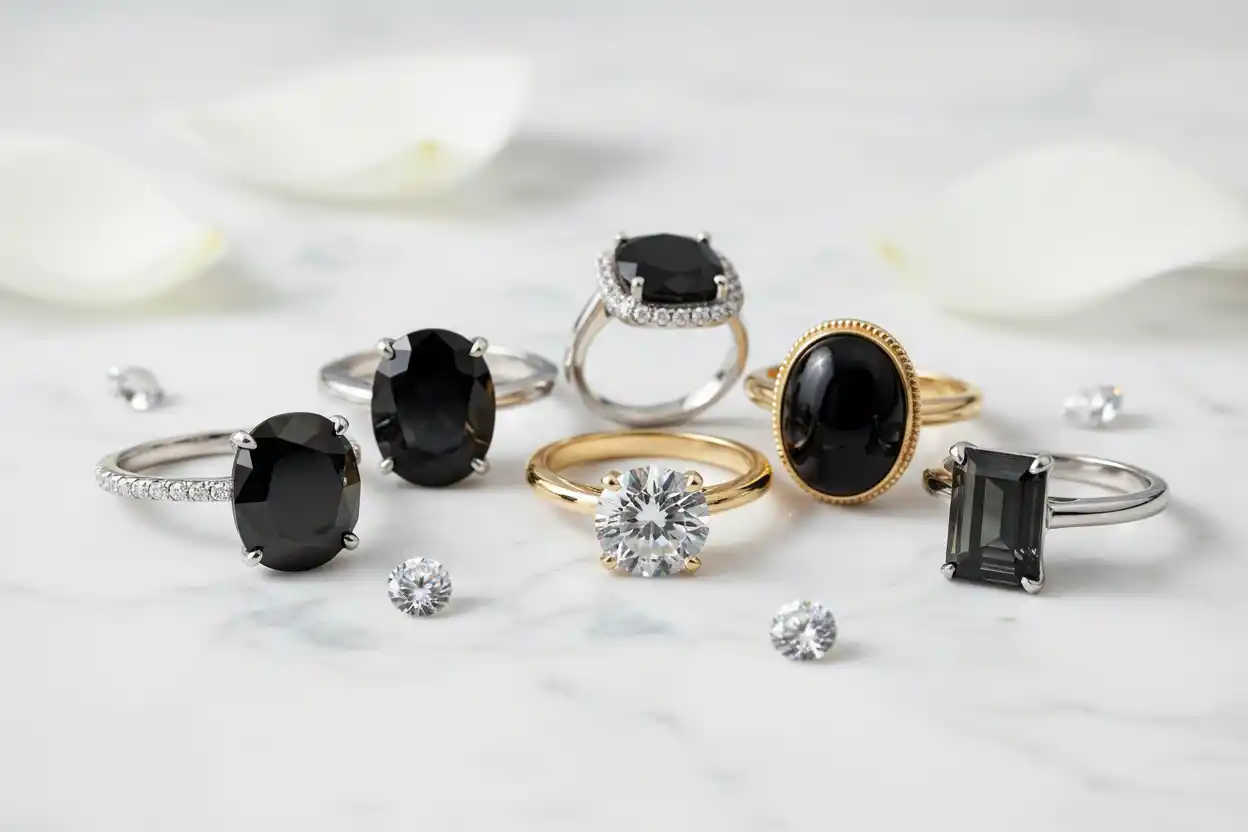
Black Engagement Ring Stones: Value & Buying Guide
Black engagement ring stones can create anything from a restrained minimalist ring to a dramatic high-contrast design, but stones that look similarly black in photographs can behave very differently once they are worn on the hand every day. Black diamond offers exceptional scratch resistance but can contain abundant inclusions and may receive color treatment, black sapphire combines Mohs hardness 9 with excellent toughness, black spinel provides strong durability and a smooth opaque appearance, while onyx, black opal, tourmaline and obsidian require progressively more attention to impact, abrasion, treatment and setting protection.
For a ring intended for frequent wear, black sapphire, black spinel and appropriately selected black diamond are generally the strongest black engagement ring stones, because their physical properties make them substantially more forgiving than softer ornamental materials. Black star sapphire adds asterism to corundum durability, while black opal can deliver spectacular play-of-color for someone willing to accept a much higher-maintenance ring rather than expecting sapphire-like performance.
The best choice therefore depends on more than color. Consider hardness, toughness, cleavage, fractures, treatment, natural versus laboratory-grown origin, transparency, setting height, wedding-band fit, replacement difficulty and the way the stone actually looks under ordinary lighting rather than judging black engagement ring stones as interchangeable dark objects.
Black Engagement Ring Stones at a Glance
| Stone | Mohs hardness | Practical ring durability | Typical appearance | Treatment / disclosure issue | Best setting approach |
|---|---|---|---|---|---|
| Black diamond | 10 | Excellent scratch resistance; individual stones may be fracture-rich | Opaque black to dark gray, adamantine reflections | Natural color, treated color and lab-grown origin must be separated | Secure prongs or bezel; protect corners |
| Black sapphire | 9 | Excellent | Opaque to very dark blue-black; some stones show a star | Heat, diffusion, filling, dye and synthetic origin may matter | Bezel, prongs or substantial signet-style setting |
| Black spinel | 8 | Very good to excellent | Opaque glossy black | Natural vs synthetic identity; treatment is less routine but possible | Bezel or secure prongs |
| Black star sapphire | 9 | Excellent when structurally sound | Black or dark cabochon with moving star | Star quality, diffusion/treatment and fractures | Bezel or strong multi-prong cabochon setting |
| Black onyx | About 6.5–7 | Good with protection | Uniform polished black | Commercial black chalcedony is commonly dyed | Low bezel or recessed signet |
| Black tourmaline | About 7–7.5 | Moderate for exposed daily wear | Opaque black, sometimes striated | Often schorl; fractures and rough crystal structure matter | Protective bezel, preferably cabochon or polished form |
| Black opal | About 5.5–6.5 | Higher-care | Dark body tone with play-of-color | Solid vs doublet/triplet, smoke treatment and dye | Protective bezel |
| Black obsidian | About 5–5.5 | Higher-care | Glossy glassy black | Natural glass vs manufactured imitation | Deep protective bezel; better for occasional wear |
| Hematite | About 5–6.5 | Limited for demanding ring wear | Metallic steel-black | Natural hematite vs magnetic manufactured material | Protected cabochon or signet |
| Dark smoky quartz | 7 | Good with sensible wear | Transparent brown-black to nearly black | Natural vs irradiation-darkened color | Bezel or secure prongs |
For buyers who want the broad gemological comparison rather than an engagement-ring-specific decision, the black gemstones guide separates dark gem materials by species, hardness, treatments and jewelry use.
What Makes a Good Black Engagement Ring Stone?
A good engagement-ring stone needs to survive much more than occasional display. Hands regularly contact desks, handles, countertops, clothing, tools, bags and other jewelry, so a stone that performs beautifully in a pendant may be frustrating in a ring that is expected to remain attractive through frequent wear.
The most useful durability equation is:
everyday ring durability = hardness + toughness + cleavage behavior + inclusions + treatment + setting protection
Hardness measures resistance to scratching, while toughness describes resistance to chipping and breaking, and cleavage identifies crystallographic directions along which some gemstones can split more readily. A black diamond may therefore resist abrasion exceptionally well while still containing fractures or cleavage-related vulnerabilities, whereas black sapphire combines slightly lower hardness with excellent toughness and no easy cleavage.
That is why the strongest black engagement ring stones cannot be selected from a Mohs chart alone.
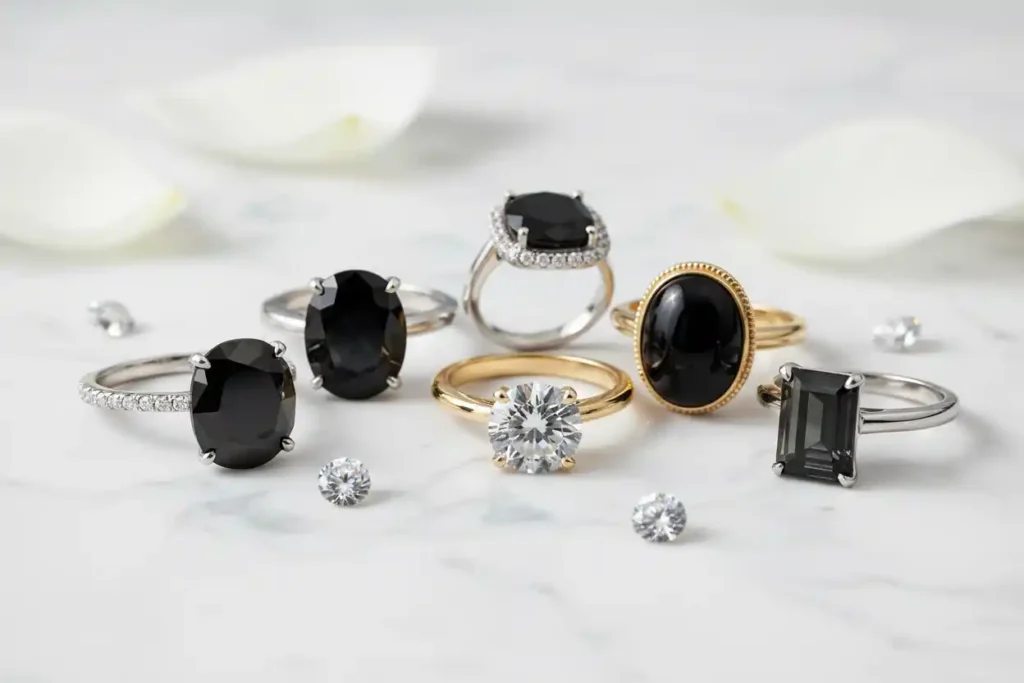
1. Black Sapphire: Best Overall for Frequent Wear
Black sapphire is one of the strongest black engagement ring stones for someone who wants a naturally dark-looking center stone without paying primarily for diamond identity.
Sapphire is corundum, Al₂O₃, and ranks Mohs 9 with excellent toughness and no cleavage. Those properties make sound sapphire highly suitable for rings intended for frequent wear, while the opaque or nearly opaque black appearance can work equally well in contemporary bezels, substantial signets, halos or more conventional prong-set engagement designs.
Many stones described as black sapphire are actually extremely dark blue, greenish blue or gray-blue corundum whose color becomes effectively black under normal viewing conditions. Others contain abundant inclusions that reduce transparency, and some display asterism when oriented inclusions interact with light.
The sapphire color guide places black sapphire within the broader corundum palette and explains why the visual category can include genuinely black-looking material as well as very dark colored stones.
Why Black Sapphire Works So Well
Its principal advantage is the combination of durability and relative simplicity.
A smooth black sapphire can withstand daily abrasion substantially better than onyx, obsidian or black opal, while a secure setting can protect the girdle from direct impact. The dark surface also works across yellow gold, rose gold, white gold and platinum without depending on transparency for its visual effect.
Black sapphire can therefore be especially practical for low-profile engagement rings worn by people who use their hands regularly.
What to Check Before Buying
Ask whether the sapphire is natural or laboratory grown and whether the stone has received treatment.
Heating is common in sapphire generally, while diffusion, fracture filling and dyeing occupy different treatment categories. Black star sapphire deserves particular care because some commercial stones can receive treatment intended to strengthen or create a star effect or alter appearance.
A valuable stone should be described more precisely than simply “genuine black sapphire.”
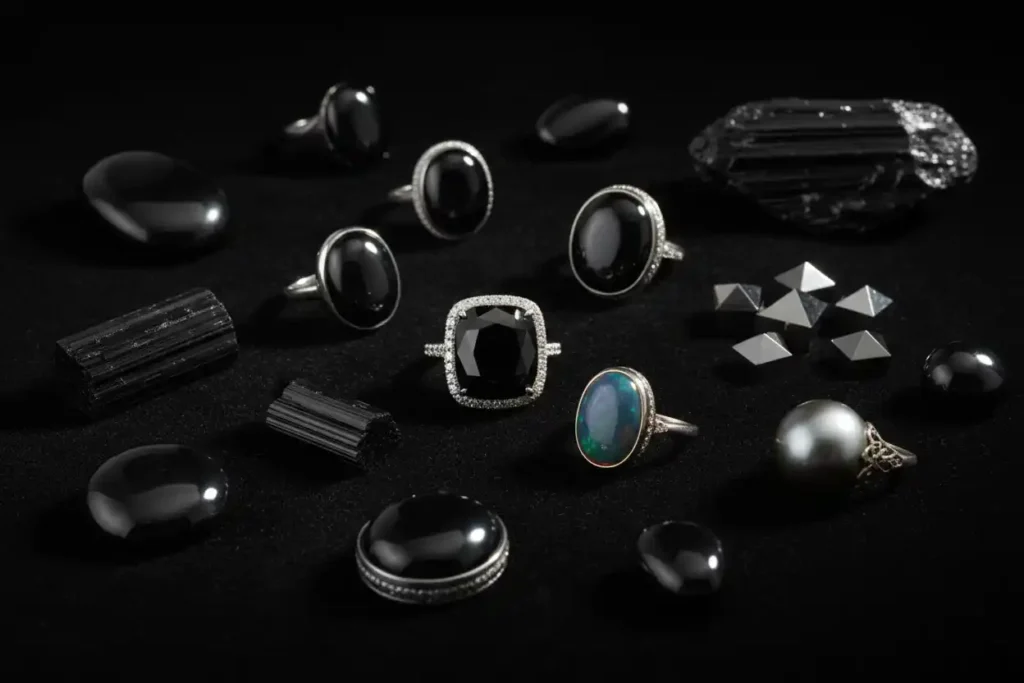
2. Black Diamond: Best for Maximum Scratch Resistance
Black diamond is perhaps the most visually recognizable of the premium black engagement ring stones, combining diamond’s exceptional hardness with an opaque appearance that reverses the traditional expectation of a transparent colorless center stone.
Diamond ranks Mohs 10, giving it the greatest scratch resistance among common jewelry materials.
However, black diamonds need more nuanced buying than the hardness number suggests.
Natural-color black diamonds commonly owe their appearance to numerous dark inclusions, structural defects or graphitic material, and those features can make some individual stones more fracture-rich than conventional transparent diamonds. Diamond also has perfect cleavage directions, so a strong impact at an unfortunate angle can still damage a stone.
The diamond guide covers the broader physical structure, while black stones occupy a specialized part of the colored-diamond market.
Natural Black Diamond vs Treated Black Diamond
This distinction can have a major effect on value.
Natural-color black diamonds are relatively uncommon and can derive their appearance from dense microscopic or larger inclusions and structural features.
Commercial black diamonds are also frequently treated.
Processes involving irradiation, heating or graphitization can transform suitable starting material into a more uniform black stone.
Laboratory-grown black diamond represents another separate category.
All three can produce attractive black engagement ring stones, but they should not be priced or described as though their origins were identical.
For a significant natural-color purchase, independent gemological documentation is particularly valuable because visual inspection alone may not establish color origin reliably.
Cut Matters Differently in Black Diamond
Traditional transparent diamond cutting attempts to control light entering and returning through the stone.
An opaque black diamond cannot display transparency and internal brilliance in the same way.
Its visual quality instead depends heavily on:
surface polish, shape, symmetry, facet reflections, evenness of color and absence of distracting surface-reaching damage.
A poorly polished black diamond can look dull rather than dramatically dark.
3. Black Spinel: Best Underused Alternative
Black spinel is one of the most practical black engagement ring stones for buyers who want a durable natural gemstone without making diamond or sapphire the automatic choice.
Spinel is magnesium aluminum oxide, MgAl₂O₄, with Mohs hardness 8 and no prominent easy cleavage. It generally has good toughness and can take a strong polish, giving opaque black material a smooth, reflective appearance that works particularly well in modern rings.
The spinel guide explains why spinel is a distinct cubic mineral rather than a form of sapphire, despite the historical confusion between transparent spinel and corundum.
Why Choose Black Spinel?
Black spinel provides several advantages:
It is harder than onyx, obsidian and most dark ornamental stones.
It has good practical toughness.
It can be cut into conventional faceted shapes or polished forms.
Its dark color works with both warm and cool metals.
It is generally more accessible than rare natural-color black diamond.
For someone comparing black engagement ring stones primarily on practical wearability, black spinel belongs near the top of the list.
Natural vs Synthetic Spinel
Synthetic spinel has been manufactured for many decades and appears throughout the jewelry market.
A laboratory-grown stone can still be durable and attractive, but natural origin should not be assumed merely because a seller uses the word spinel.
For a higher-value natural piece, independent identification can remove that uncertainty.
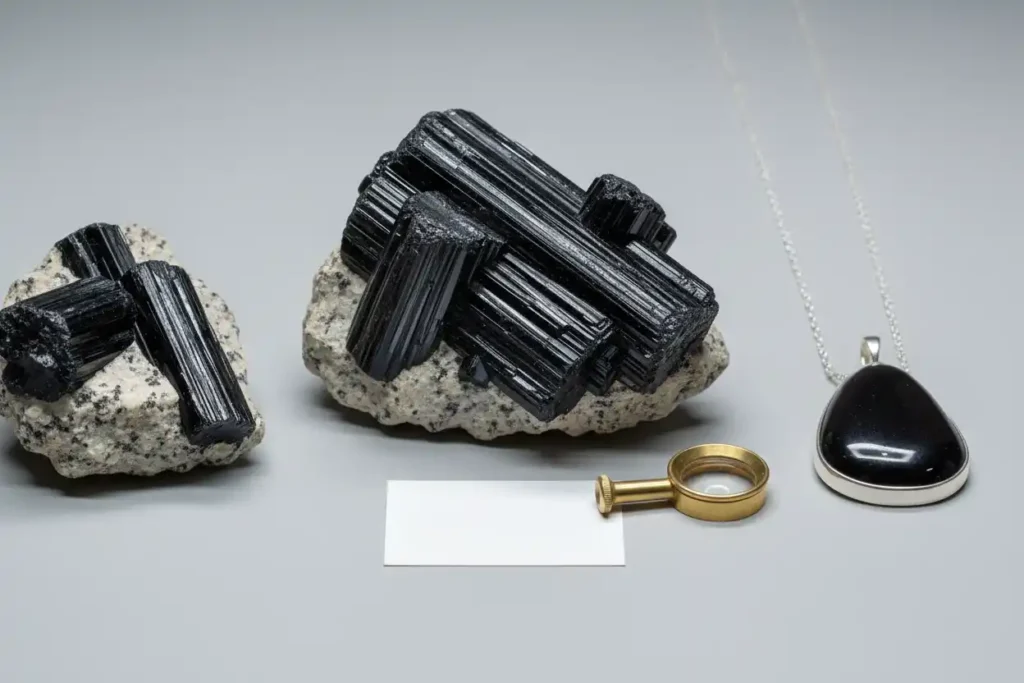
4. Black Star Sapphire: Best for an Optical Effect
Black star sapphire combines corundum’s strong durability with asterism, producing a moving star that becomes visible when a concentrated light source reflects from properly oriented inclusions inside a cabochon.
The effect can create a far more dynamic ring than a uniformly black faceted stone.
Star sapphires commonly display six rays, although other patterns can occur depending on inclusion orientation and crystal structure. The quality of the star depends on sharpness, centering, continuity, movement and how well the bodycolor supports contrast.
A strong star should move across the dome as the stone or light changes position.
Why the Setting Matters
Cabochons sit differently from faceted center stones.
A substantial bezel can protect the perimeter and create a clean design, while a well-built multi-prong setting can expose more of the dome.
The stone should not sit unnecessarily high above the finger.
Black engagement ring stones become more vulnerable when a tall mounting increases leverage and makes accidental impact more likely.
5. Black Onyx: Best for a Classic Smooth Black Look
Black onyx has a long history in signets, mourning jewelry, engraved pieces and geometric designs, and its uniform polished surface can create a highly controlled black engagement ring.
However, it belongs to a different durability tier from sapphire, spinel and diamond.
Onyx is chalcedony, a microcrystalline quartz-family material with hardness around 6.5–7. Traditional onyx contains parallel banding, although uniform commercial black onyx is commonly dyed chalcedony.
The onyx vs obsidian comparison explains why polished black examples can look similar despite fundamentally different structures and durability.
Is Black Onyx Good for an Engagement Ring?
Yes, if the wearer understands the maintenance trade-off.
Onyx can survive regular careful wear, particularly when set low in a bezel or recessed into a substantial ring, but its surface will abrade more readily than sapphire or spinel.
It is therefore better suited to someone willing to remove the ring for manual work rather than someone seeking a center stone that will remain on through nearly every activity.
Treatment Is Normal
Uniform black onyx is commonly dyed.
That fact should not automatically make the stone undesirable, because treated chalcedony can provide attractive, stable and affordable jewelry.
It simply means natural black rarity should not be used to justify an inflated price.
6. Black Tourmaline: Distinctive but Better With Protection
Black tourmaline is normally schorl, an iron-rich member of the tourmaline group, and can provide a more textured or mineral-like look than uniform black spinel or onyx.
Tourmaline generally ranks around Mohs 7–7.5, offering reasonable scratch resistance, although its toughness is only fair and many black crystals contain fractures or natural surface irregularities.
For black engagement ring stones, polished cabochons or carefully fashioned gems are generally more practical than rough crystal points.
Rough terminations can chip, catch clothing and create awkward setting geometry.
Best Setting for Black Tourmaline
A low bezel is particularly sensible.
It protects the perimeter, reduces snagging and keeps the stone closer to the finger.
High exposed prongs around a fractured or unusually shaped black tourmaline create more opportunities for impact.
Someone who wants black tourmaline primarily for its symbolic associations may also find that a pendant provides an easier long-term format than a demanding engagement ring.
7. Black Opal: Best for Dramatic Play-of-Color
Black opal is among the most visually extraordinary black engagement ring stones, but its dark appearance differs fundamentally from opaque black sapphire or onyx.
The term describes opal with a dark body tone, commonly dark gray to nearly black, against which spectral play-of-color can appear exceptionally vivid.
Fine stones may show moving red, orange, green, blue or violet flashes.
The black opal guide explains the relationship between body tone, play-of-color, treatment and assembled stones.
Why Black Opal Requires More Care
Opal generally ranks around Mohs 5.5–6.5 and is brittle.
Some material can also be sensitive to heat, dehydration or changes in environmental conditions, while doublets and triplets introduce adhesive layers that require additional care.
A black opal engagement ring can be successful for a careful wearer who loves the stone enough to accept those limitations.
It is not the best choice for someone expecting unrestricted daily wear.
Solid, Doublet or Triplet?
This distinction matters greatly.
A solid black opal consists of natural opal throughout the relevant gem body, sometimes retaining natural potch or host material on the back.
A doublet uses a thin layer of precious opal attached to a dark backing.
A triplet adds a transparent protective cap over an opal layer and backing.
Doublets and triplets can provide beautiful color at a lower purchase cost, but they should never be priced or represented as equivalent to a comparable fine solid natural black opal.
8. Black Obsidian: Dramatic but Higher Maintenance
Black obsidian offers a glossy dark surface and strong contrast in silver, white gold or architectural yellow-gold rings, yet it is one of the less durable black engagement ring stones for frequent wear.
Obsidian is not a crystalline mineral.
It is natural volcanic glass with hardness commonly around 5–5.5 and brittle conchoidal fracture.
The black obsidian guide explains why a broken edge can become exceptionally sharp, which is an important practical concern in rings.
When Obsidian Makes Sense
Choose obsidian when:
the ring will be worn selectively rather than continuously, the stone sits low in a protective bezel, replacement is relatively easy, and the wearer values its glassy appearance more than maximum durability.
Avoid very thin exposed tablets or tall cabochons with unsupported edges.
A chipped obsidian ring is not merely cosmetically damaged; sharp fracture edges may also become a physical hazard.
9. Hematite: Best for a Metallic Black Appearance
Hematite provides a distinctly metallic steel-gray to black appearance and unusually high density, producing a very different visual result from glassy obsidian or polished onyx.
It is iron oxide, Fe₂O₃, and generally falls around Mohs 5–6.5 depending on form.
The material can be brittle, which limits its suitability for an engagement ring expected to tolerate continual impact.
A smooth protected cabochon or recessed signet can work for deliberate wear.
Beware of “Magnetic Hematite”
Strongly magnetic polished jewelry sold as hematite may actually consist of manufactured ferrite material sometimes marketed under hematite-related names.
Natural hematite is not normally a powerful permanent magnet.
This distinction matters more for material identity and disclosure than for appearance alone.
10. Very Dark Smoky Quartz
Very dark smoky quartz, traditionally called morion when the color becomes nearly black, can provide a transparent or translucent alternative to opaque black engagement ring stones.
Quartz ranks Mohs 7 and has no cleavage, giving it reasonable jewelry durability.
Its main advantage is visual depth.
Under bright light, a stone that appears black from normal viewing distance may reveal dark brown or smoky transparency, creating a softer appearance than black spinel or onyx.
The drawback is abrasion.
Quartz will show facet wear sooner than sapphire, spinel or diamond when used in a heavily exposed ring.
A bezel or low secure prong setting can improve long-term practicality.
Which Black Engagement Ring Stones Are Best for Everyday Wear?
For frequent ring wear, the strongest hierarchy is approximately:
Black sapphire — excellent combination of hardness, toughness and lack of cleavage.
Black diamond — maximum scratch resistance, although inclusions, cleavage and treatment require individual assessment.
Black spinel — excellent practical option with hardness 8 and good toughness.
Black star sapphire — strong corundum durability in cabochon form.
Dark smoky quartz — reasonable with care.
Black onyx — practical in protective settings, but surface wear appears sooner.
Black tourmaline — workable when structurally sound and well protected.
Black opal, obsidian and hematite — better for careful wearers rather than low-maintenance daily use.
The point is not that softer black engagement ring stones cannot be worn.
The point is that they demand different habits.
Black Diamond vs Black Sapphire
Black diamond and black sapphire are two of the strongest choices, but they create different buying decisions.
Choose Black Diamond If:
You want diamond identity.
Maximum scratch resistance matters.
You prefer faceted surface reflections.
You are comfortable verifying whether the color is natural, treated or laboratory grown.
You accept that some black diamonds contain extensive inclusions.
Choose Black Sapphire If:
You want excellent everyday durability without requiring diamond.
You prefer corundum’s toughness and lack of cleavage.
You want the option of a star sapphire.
You prefer a potentially lower-cost natural center stone.
You want a stone that can work equally well in faceted, cabochon or signet-style designs.
Neither is universally superior.
The stronger black engagement ring stones are those whose actual characteristics match the wearer’s priorities.
Black Sapphire vs Black Spinel
Black sapphire is harder at Mohs 9, while spinel ranks Mohs 8.
Both can perform extremely well in rings.
Sapphire generally provides greater abrasion resistance, whereas spinel remains a highly durable alternative with its own cubic mineral identity and polished appearance.
Price should not be judged by species name alone.
A large ordinary opaque sapphire may be inexpensive, while an unusually attractive natural spinel or documented specialty stone can command more.
Natural versus synthetic origin also matters in both markets.
Black Onyx vs Black Spinel
These stones can look deceptively similar when polished into simple opaque black shapes.
Spinel is substantially harder.
Onyx is microcrystalline quartz-family material and commercial black color is frequently created through dye treatment.
Spinel therefore makes more sense for an exposed daily ring.
Onyx makes more sense when the buyer wants a classic broad cabochon or signet appearance and accepts more surface maintenance.
Because black engagement ring stones are often purchased partly for design rather than rarity, either can be correct when represented accurately.
Black Stone Color Is More Complicated Than “Jet Black”
A dark gemstone does not have to be perfectly neutral black.
Black sapphire may reveal blue or green undertones.
Dark spinel can lean gray or brown.
Smoky quartz can reveal brown transparency.
Black diamond may appear charcoal, graphite-black or unevenly opaque.
Black opal contains flashes of spectral color by definition when it is precious opal.
These subtleties become more visible under daylight and strong directional lighting.
When purchasing black engagement ring stones online, ask for video under at least ordinary neutral light rather than judging only high-contrast studio photographs.
A stone photographed against a black background can also appear darker than it will against skin.
Faceted vs Cabochon Black Engagement Ring Stones
Faceting works best when reflective planes contribute to the design.
Black diamond, black spinel and some black sapphire can show attractive facet reflections even when the material is opaque.
Cabochons create smoother, broader areas of color.
Black star sapphire needs a properly oriented cabochon to display its star.
Onyx traditionally works extremely well as a cabochon or tablet.
Black opal is normally shaped to preserve play-of-color rather than force conventional brilliant-cut geometry.
The right cut therefore depends on what makes the individual material attractive.
A faceted onyx does not become more valuable simply because it resembles a diamond shape.
Setting Choice Matters as Much as the Gemstone
Bezel Settings
A bezel surrounds much or all of the gemstone’s perimeter with metal, making it one of the most useful choices for black engagement ring stones such as onyx, opal, tourmaline and obsidian.
It also creates a clean contemporary look around black sapphire or spinel.
A bezel cannot make a fragile stone indestructible, but it reduces direct edge exposure.
Prong Settings
Prongs allow more of the gemstone to remain visible and work particularly well with diamond, sapphire and spinel.
Pointed shapes require protection at their most vulnerable areas.
Pear and marquise tips benefit from V-prongs, while square cuts require adequate corner support.
Recessed and Signet Settings
Opaque black engagement ring stones work exceptionally well in rings where the gemstone sits almost flush with surrounding metal.
This arrangement reduces snagging and can make onyx, sapphire or spinel considerably more practical.
Halo Settings
A halo can increase visual width and create contrast between a black center and colorless accent stones.
However, many small prongs introduce additional maintenance.
A halo protects the center’s visual perimeter somewhat but should not be treated as a substitute for appropriate structural setting.
Low-Profile Designs Are Better for Active Wear
Setting height changes impact risk.
A high-set center stone sits farther from the finger and has greater opportunity to catch clothing or strike external surfaces.
A low basket or bezel keeps the gemstone closer to the hand.
This is especially valuable for large black engagement ring stones because visual size increases the target area for accidental contact.
Someone who works frequently with their hands should prioritize a low center, substantial metal and rounded or protected stone outlines.
Which Shapes Are Most Practical?
Round and oval shapes eliminate pointed tips and are generally forgiving.
Cushion cuts combine softer corners with a broad visual footprint.
Emerald-style rectangles can work well in strong stones when corners are protected.
Pear, marquise, kite and shield shapes create more vulnerable points.
A black diamond or sapphire can tolerate these shapes better than obsidian or opal, but even hard gemstones need secure tip protection.
For softer black engagement ring stones, the safest design often becomes a rounded cabochon surrounded by metal.
Carat Weight Does Not Equal Visible Size
Carat measures weight rather than diameter.
Black engagement ring stones have different densities, so two stones weighing one carat can have noticeably different dimensions.
Diamond has a density around 3.5.
Spinel is in a similar general range.
Sapphire is denser, so the same carat weight may face up somewhat smaller depending on cut.
Quartz is less dense and can appear larger at the same weight.
Instead of comparing only carats, use:
length × width × depth + carat weight
For opaque black gemstones, face-up millimeter dimensions often tell you more about the visual impact of the ring than weight alone.
Metal Color Changes the Entire Design
Black stones are unusually responsive to metal contrast.
Yellow Gold
Yellow gold creates strong warm contrast and can make an opaque black center look more graphic.
It works particularly well with onyx, sapphire and spinel in signet-inspired or vintage designs.
Rose Gold
Rose gold creates a softer contrast and can make black engagement ring stones feel less severe, particularly when small white accent stones are included.
White Gold
White gold provides a cool, sharp frame around black gemstones.
Remember that rhodium plating can wear and may require maintenance.
Platinum
Platinum creates a naturally white high-value setting with substantial density and is especially useful when long-term structural durability is prioritized.
The correct metal depends on design, budget, alloy tolerance and long-term maintenance rather than the gemstone alone.
Black Stone With White Diamond Accents
Black centers paired with colorless diamond accents create one of the highest-contrast engagement-ring styles.
A black sapphire or spinel center surrounded by a colorless halo can produce a visually substantial ring without depending on a large black diamond.
A black diamond center with colorless side stones creates a more entirely diamond-based construction.
Another option reverses the arrangement by placing small black stones around a colorless center.
When combining gemstones, remember that diamond is harder than nearly every alternative.
Direct contact between diamond girdles and softer stones can gradually abrade the softer material if the setting allows them to rub.
Treatment Disclosure Is Essential
Several black engagement ring stones commonly receive treatment, and the specific treatment can influence price, durability or future repair.
Black diamond: natural color, treated color and laboratory-grown origin should be distinguished.
Black sapphire: heating, diffusion, filling or dye may occur.
Black onyx: uniform black commercial material is commonly dyed.
Black opal: smoke treatment, dye, impregnation and assembled constructions can occur.
Smoky quartz: dark color can be natural or irradiation-produced.
Treatment does not automatically make a stone bad.
Undisclosed treatment is the problem.
The seller should provide enough information for the buyer, jeweler and future appraiser to understand what is actually in the ring.
Natural vs Lab-Grown Black Stones
Laboratory-grown gemstones can make excellent engagement rings when represented accurately.
Laboratory-grown diamond has diamond’s fundamental structure and hardness.
Laboratory-grown sapphire is corundum.
Synthetic spinel has a manufactured origin but can share important physical properties with natural spinel.
The market value and rarity story differ substantially from natural material.
A buyer interested mainly in appearance and durability may reasonably choose laboratory-grown material, while someone paying a premium for geological rarity should require documentation proportionate to the purchase.
Do Black Engagement Ring Stones Need a Laboratory Report?
Not every ring requires one.
An inexpensive dyed onyx center may cost less than obtaining a major laboratory report, making formal documentation economically unnecessary.
A high-value stone deserves more scrutiny when price depends on facts that cannot be established reliably by sight.
A report can be especially useful for:
natural-color black diamond, expensive natural sapphire, unusual star sapphire, valuable spinel, fine black opal or any stone whose treatment or origin materially changes value.
A laboratory report describes gemological characteristics.
It does not automatically prove that the retail price is fair.
Value: What Are You Actually Paying For?
Black engagement ring stones do not follow one universal price hierarchy because each material has a different supply chain and valuation structure.
Black Diamond
Value depends strongly on natural versus treated color, natural versus laboratory-grown origin, size, shape, polish, condition and documentation.
Natural-color black material belongs to a different collector category from ordinary treated commercial black diamonds.
Black Sapphire
Commercial opaque black sapphire can be relatively accessible.
Star quality, natural origin, size, polish and treatment can create additional value.
Black Spinel
Opaque black spinel can provide excellent visual size and durability without the premium associated with some diamond categories.
Natural origin should still be represented accurately.
Onyx
Material cost is usually modest compared with precious metals and fine-setting labor.
In an expensive onyx ring, much of the value may come from metal weight, craftsmanship, designer attribution or historical provenance rather than the stone itself.
Black Opal
Fine solid black opal can become highly valuable when body tone, brightness, pattern, color range, size and condition are exceptional.
Doublets, triplets and treated stones belong to different price categories.
The phrase “black gemstone” therefore says almost nothing about fair value by itself.
Wedding-Band Fit Should Be Checked Before Buying
A dramatic black center often encourages large bezels, halos or low baskets, all of which can affect whether a straight wedding band sits flush beside the engagement ring.
Look at the ring from the side.
Check whether the basket protrudes below the center stone.
Determine whether a straight band can slide underneath the setting or whether a curved contour will be required.
This design issue should be resolved while comparing black engagement ring stones and settings, rather than discovered after the engagement ring has already been purchased.
Consider Resizing Before Choosing a Complex Ring
Simple solitaire and signet-style rings are generally easier to resize than full eternity bands, elaborate pavé designs or rings containing gemstones around nearly the entire circumference.
A large resizing can change:
prong alignment, halo geometry, band roundness and the spacing between small stones.
If the ring size is uncertain, choose architecture that leaves some plain metal in the shank.
The center gemstone can be perfect while the ring remains impractical if its size cannot be adjusted safely.
Cleaning Black Engagement Ring Stones
The safest cleaning method depends on the most sensitive component in the ring.
Sound sapphire, spinel and diamond can generally tolerate ordinary gentle cleaning well, although treatment and fractures still matter.
Onyx is better cleaned with mild soap, lukewarm water and a soft cloth or brush.
Black opal needs conservative treatment, particularly when it is a doublet or triplet.
Obsidian should be protected from abrasion and thermal shock.
Tourmaline should not be subjected casually to strong heat, especially when fractured.
When treatment is uncertain, avoid making steam or ultrasonic cleaning the default.
A jeweler should know the gemstone identity and treatment before using aggressive cleaning or repair methods.
Inspect the Setting, Not Just the Stone
A durable gemstone can still be lost from a poorly maintained ring.
Check prongs periodically for thinning, bending and gaps.
Watch for movement in the center stone.
Inspect bezel edges for deformation.
Look beneath the ring for worn gallery components.
Pavé accent stones deserve particular attention because tiny beads and prongs can wear more quickly than a substantial center setting.
For black engagement ring stones intended as lifelong jewelry, maintenance of the metal is as important as the durability of the gemstone.
Which Black Engagement Ring Stone Should You Choose?
Choose black sapphire if you want the strongest overall combination of natural colored-gem durability, black appearance and straightforward frequent wear.
Choose black diamond if diamond identity, maximum scratch resistance and high-contrast faceting matter most, while accepting the need to understand color origin and inclusions.
Choose black spinel if you want a durable, underused natural gemstone with a smooth black appearance and strong value relative to many premium stones.
Choose black star sapphire if you want an optical phenomenon rather than uniform black.
Choose black onyx if you prefer a broad classic cabochon or signet look and are comfortable with more surface wear.
Choose black tourmaline if its mineral character matters more than achieving the lowest-maintenance daily ring.
Choose black opal if vivid play-of-color is worth substantially greater care.
Choose obsidian only when its volcanic-glass appearance matters enough to accept a more fragile ring.
The strongest black engagement ring stones are ultimately those whose material properties support the way the ring will genuinely be worn.
Frequently Asked Questions
What are the best black engagement ring stones?
Black sapphire, black diamond and black spinel are among the best black engagement ring stones for frequent wear because they combine dark appearance with strong scratch resistance and practical durability. Black star sapphire is another excellent option when asterism is desired.
What is the most durable black engagement ring stone?
Diamond provides the greatest scratch resistance at Mohs 10, while sapphire combines Mohs hardness 9 with excellent toughness and no cleavage. The condition of the individual stone and setting still affect overall durability.
Is black sapphire good for an engagement ring?
Yes. Black sapphire is one of the strongest black engagement ring stones because corundum ranks Mohs 9, has excellent toughness and lacks easy cleavage, making it highly suitable for frequent wear.
Is black spinel suitable for an engagement ring?
Yes. Spinel ranks Mohs 8 and generally has good toughness without easy cleavage, giving black spinel excellent practical durability for engagement rings.
Is black diamond naturally black?
Some diamonds have natural black color caused primarily by abundant inclusions, defects and related structures, while many commercial black diamonds receive treatment to create a darker and more uniform appearance. Laboratory-grown black diamond is another separate category.
Are treated black diamonds real diamonds?
A treated natural black diamond can still be diamond, but the black appearance has been altered after formation. Treatment status should be disclosed because treated and natural-color stones occupy different market categories.
Does a black diamond need a laboratory report?
A report is particularly valuable when a significant premium depends on natural color, natural origin or another characteristic that cannot be confirmed reliably from appearance alone.
Is black onyx durable enough for an engagement ring?
Black onyx can work well in a protective low bezel or recessed setting, but its hardness around 6.5–7 means it will show surface wear sooner than sapphire, spinel or diamond.
Is black onyx naturally black?
Uniform black onyx in commercial jewelry is commonly dyed chalcedony. Treated material can make attractive jewelry, but its black color should be disclosed rather than marketed as exceptionally rare natural color.
Is black tourmaline good for an engagement ring?
Black tourmaline can be used, particularly as a polished cabochon in a protective setting, but its fair toughness and frequent fractures make it less forgiving than black sapphire or spinel for demanding daily wear.
Can black opal be used in an engagement ring?
Yes, but black opal is a higher-maintenance choice because it is softer and more vulnerable to scratching and impact. A protective bezel and careful wear are strongly preferable.
Is black obsidian suitable for an engagement ring?
Obsidian can be used for occasional or carefully worn rings, but its hardness around 5–5.5 and brittle glassy fracture make it substantially less durable than sapphire, spinel or diamond.
What is the difference between black sapphire and black spinel?
Black sapphire is corundum with Mohs hardness 9, while black spinel is magnesium aluminum oxide with Mohs hardness 8. Both can perform well in rings, although sapphire provides greater abrasion resistance.
Which black engagement ring stones are naturally opaque?
Black spinel, many black sapphires, onyx, hematite and black tourmaline can appear opaque, while black diamond is often opaque because of abundant inclusions and structural features. Black opal is valued instead for a dark body tone supporting play-of-color.
What is the best black gemstone for an active wearer?
Black sapphire is one of the strongest choices because of its hardness, excellent toughness and lack of cleavage. Black diamond and spinel are also excellent candidates when the individual stone and setting are sound.
What setting is best for black engagement ring stones?
A bezel is particularly useful for onyx, tourmaline, opal and obsidian because it protects the perimeter, while diamond, sapphire and spinel can perform well in either secure prongs or bezels. Lower settings generally reduce impact exposure.
Does a black gemstone look bigger than a colorless stone?
Dark stones can create a strong visual silhouette, but apparent size depends more directly on millimeter dimensions, shape, setting and contrast with the metal. Carat weight alone does not determine face-up size.
Should I buy black engagement ring stones by carat weight?
Use carat weight together with exact length, width and depth measurements. Different gemstone densities and cutting styles mean stones with the same weight can look noticeably different from above.
Which metal looks best with black engagement ring stones?
Yellow gold creates strong warm contrast, white gold and platinum produce a cool graphic look, while rose gold softens the contrast. The best combination depends on personal design preference rather than a fixed gemstone rule.
Are laboratory-grown black engagement ring stones a good choice?
They can be. Laboratory-grown diamond, sapphire and spinel can provide strong physical durability and attractive appearance when their manufactured origin is disclosed clearly and the price reflects the correct market category.
Are black engagement rings more difficult to maintain?
Not necessarily. A black sapphire or spinel ring can be relatively straightforward to maintain, while black opal, obsidian and onyx require more care. Maintenance depends on material and setting rather than color alone.
Can a black engagement ring be resized?
Often, but resizing depends primarily on the ring architecture and metal rather than the black gemstone. Full eternity designs, continuous pavé and certain complex settings can limit how much resizing is practical.
What should I check before buying black engagement ring stones online?
Confirm the exact gemstone species, natural or laboratory-grown origin, treatment, millimeter dimensions, condition, setting height, metal, ring size, return policy and any laboratory documentation appropriate to the price. Request video under ordinary lighting so undertones, surface reflections and optical effects are visible.
Which black engagement ring stone offers the best value?
Black spinel and commercial black sapphire can provide excellent combinations of durability, size and cost, while dyed onyx can offer a large classic black appearance at a lower material cost. Value depends on accurate identification, treatment disclosure, craftsmanship and how the ring will be worn.
What matters most when choosing black engagement ring stones?
Prioritize durability and setting compatibility first, then evaluate color, surface quality, treatment, natural or laboratory-grown origin, visible size, wedding-band fit, maintenance and price. A black stone should be chosen because its complete material profile suits the wearer, not merely because it appears dark in a photograph.