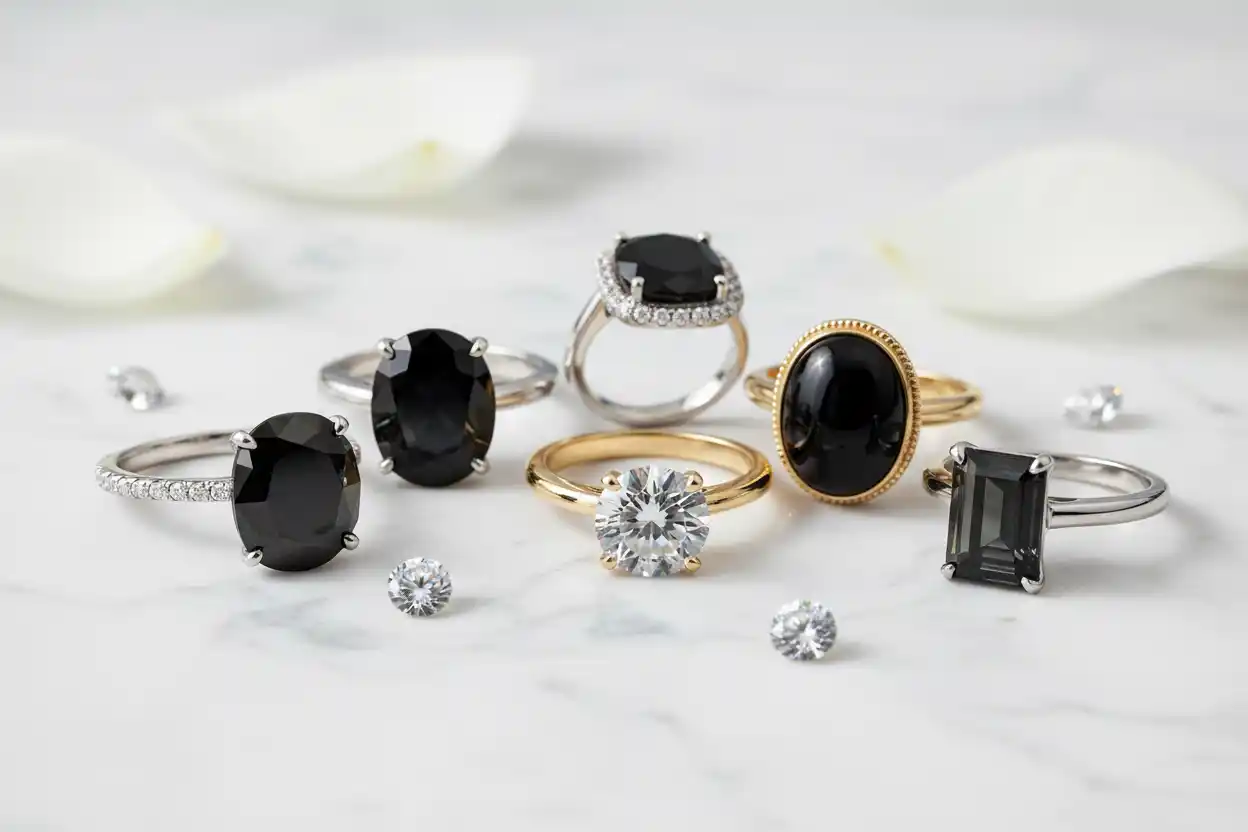
12 Black Engagement Ring Stones for Protection, Elegance & Deep Love
Black engagement ring stones offer a distinctive alternative to traditional colorless diamonds, combining dramatic appearance with a wide range of durability, rarity, price, and gemological characteristics. The most practical options for frequent wear include black diamond, black sapphire, black spinel, and black moissanite, while stones such as onyx, black tourmaline, black jade, obsidian, and black opal require more consideration because their hardness, toughness, porosity, or fracture behavior can make them less forgiving in an everyday ring.
The word black also describes several different optical appearances. Some stones are genuinely opaque and absorb most visible light, while others are extremely dark varieties that reveal color around thin edges or under strong transmitted illumination. Black diamonds often owe their opaque appearance to dense inclusions or treatment, black sapphire may be very dark blue or green rather than perfectly black, and very dark smoky quartz can look black in normal jewelry conditions while remaining brown in transmitted light.
Black gemstones have also accumulated symbolic associations with commitment, strength, protection, privacy, resilience, and enduring love. These ideas can give an engagement ring personal significance, but they are cultural or spiritual interpretations rather than measurable gemstone powers. A black stone does not physically block negative energy or guarantee a stronger relationship. For a ring intended to last decades, durability, treatment disclosure, setting design, and accurate identification matter far more than symbolic claims.
12 Black Engagement Ring Stones to Consider
- Black diamond
- Black sapphire
- Black spinel
- Black moissanite
- Black onyx
- Black tourmaline
- Black garnet
- Black jade
- Black opal
- Black obsidian
- Hematite
- Very dark smoky quartz
These 12 stones do not offer equal performance in an engagement ring. Black diamond, sapphire, spinel, and moissanite are generally the strongest candidates for frequent wear, while softer or more brittle stones demand protective settings and greater care. Choosing by appearance alone can therefore lead to a ring that looks beautiful initially but becomes difficult to maintain over years of daily use.
Comparing Black Engagement Ring Stones for Everyday Wear
| Stone | Approx. Mohs Hardness | Typical Appearance | Everyday Ring Suitability |
|---|---|---|---|
| Black diamond | 10 | Opaque black, sometimes metallic | Excellent with quality evaluation |
| Black sapphire | 9 | Black to extremely dark blue or green | Excellent |
| Black spinel | 8 | Opaque to nearly opaque black | Very good |
| Black moissanite | About 9.25 | Dark black with high surface luster | Excellent |
| Black onyx | 6.5 to 7 | Uniform opaque black | Moderate |
| Black tourmaline | 7 to 7.5 | Black, commonly opaque | Good with protection |
| Black garnet | About 6.5 to 7.5 | Black to very dark brown or red | Moderate to good |
| Black jade | About 6 to 7 | Opaque black to very dark green | Good when tough |
| Black opal | About 5.5 to 6.5 | Dark body tone, often play-of-color | Requires careful wear |
| Black obsidian | About 5 to 5.5 | Glassy black | Limited for daily rings |
| Hematite | About 5 to 6.5 | Metallic gray-black | Limited |
| Very dark smoky quartz | 7 | Near-black brown | Good with sensible care |
Hardness is only one part of durability. A gemstone can resist scratching but still break under impact, while a slightly softer stone may possess excellent toughness. Internal fractures, cutting style, stone thickness, treatments, mounting design, and the wearer’s routine all affect how well an engagement ring performs.
A ring worn daily encounters countertops, metal handles, tools, gym equipment, luggage, furniture, cleaning products, and repeated contact with other jewelry. Engagement stones therefore need to be chosen for real-world wear rather than simply for how dark they appear in a photograph.
1. Black Diamond: The Strongest Traditional Choice
Black diamond is one of the most recognizable choices for a dark engagement ring. Diamond reaches 10 on the Mohs scale and offers exceptional resistance to scratching, making it attractive for jewelry intended for decades of frequent wear. Black diamonds can produce a bold opaque appearance that contrasts strongly with platinum, white gold, yellow gold, or rose gold.
Natural black diamonds often contain abundant dark inclusions, fractures, and graphitic or other mineral features that make the stone appear opaque. Some commercial black diamonds begin as lower-color or heavily included diamonds and receive treatment to create a more uniform black appearance. Irradiation and high-temperature processes may be used depending on the stone.
This makes treatment disclosure important. A naturally colored black diamond and a treated black diamond may look similar to a casual observer but can occupy very different value categories. Dense inclusions can also affect toughness, so a black diamond should not be assumed structurally perfect merely because diamond is the hardest natural mineral.
Symbolically, black diamond is often associated with permanence, strength, individuality, and enduring commitment. These meanings suit engagement jewelry naturally, but the practical attraction remains its distinctive appearance and outstanding scratch resistance.
2. Black Sapphire: Excellent Durability With Understated Color
Black sapphire is another strong choice for an engagement ring because corundum reaches 9 on the Mohs scale and has no cleavage. Many stones sold as black sapphire are actually very dark blue, green, or another deep color that appears black under normal lighting.
This subtle hidden color can make black sapphire visually interesting. Under bright illumination, thin edges or reflective facets may reveal dark blue or green undertones rather than complete opacity. The effect varies according to trace chemistry, crystal structure, inclusions, and cutting.
Black sapphire usually offers excellent resistance to daily abrasion and is generally more affordable than fine transparent blue sapphire. Some stones may be heat treated, and other enhancements are possible, so treatment disclosure remains relevant.
For someone who wants a black-looking center stone with strong everyday durability but does not specifically need diamond, sapphire is one of the most practical alternatives.
3. Black Spinel: Naturally Dark and Highly Wearable
Black spinel is valued for its opaque black appearance, good polish, vitreous luster, and Mohs hardness of about 8. It lacks cleavage and generally performs well in rings when properly cut and set.
Unlike several dark stones that may owe their appearance mainly to treatment, naturally black spinel is readily available. Its dark color can result from iron and other elements within the crystal structure, producing a rich black appearance without the layered structure of onyx or the volcanic glass composition of obsidian.
Black spinel is particularly attractive in faceted cuts because polished facets can produce crisp flashes of reflected light even though the stone itself is opaque. It works well in solitaire, halo, three-stone, and geometric engagement designs.
Its combination of durability, availability, and natural dark color makes black spinel one of the strongest choices for buyers who want an elegant black engagement stone without paying for black diamond.
4. Black Moissanite: High Hardness and Strong Surface Brilliance
Moissanite used in modern jewelry is laboratory-grown silicon carbide. Gem-quality natural moissanite is extraordinarily rare and is not the source of ordinary commercial moissanite jewelry.
With a hardness of about 9.25, moissanite provides exceptional scratch resistance. Black moissanite can therefore offer excellent practical durability for an engagement ring, especially for buyers who prefer a laboratory-grown stone.
Because dark moissanite absorbs much of the light entering the stone, its appearance differs from colorless moissanite. Instead of bright internal rainbow dispersion dominating the view, the polished surface and facets create much of the visual character.
Black moissanite should be accurately represented as laboratory-grown. It can be a highly practical choice, but it should not be marketed as a rare natural black gemstone.
5. Black Onyx: Classic, Smooth, and Elegant
Black onyx is typically a form of chalcedony with a hardness around 6.5 to 7. Much of the uniformly black onyx used in jewelry has been treated, often through traditional dyeing processes that create the deep, even appearance buyers expect.
Onyx can look exceptionally elegant in signet-style rings, bezel settings, Art Deco-inspired designs, and rings that emphasize smooth surfaces rather than brilliance. It usually appears opaque and is commonly polished as a cabochon, flat tablet, or carved form.
Its main limitation is durability compared with sapphire, diamond, spinel, or moissanite. It can scratch more readily during daily wear, particularly when exposed to harder objects. A protective bezel is therefore preferable for someone determined to use black onyx as an everyday engagement stone.
Treatment is not automatically a problem, but sellers should represent dyed or otherwise enhanced onyx accurately.
6. Black Tourmaline: Natural Character With Care Requirements
Black tourmaline is commonly schorl, an iron-rich member of the tourmaline group. It usually appears opaque black and may show vertical striations on crystal surfaces when left in natural form.
With a hardness around 7 to 7.5, black tourmaline can work in jewelry, although it is less resistant to wear than sapphire or spinel. Tourmaline also has somewhat variable toughness, and stones containing fractures or inclusions can chip if struck.
Black tourmaline has become strongly associated with protection in contemporary spiritual practice. Within an engagement ring, that meaning can symbolize boundaries, commitment, or the intention to protect a relationship, but there is no scientific evidence that the mineral physically absorbs negative energy.
A low setting and rounded shape can make black tourmaline more practical for frequent wear.
7. Black Garnet: Dark Color With Hidden Warm Tones
Certain garnets can appear black or nearly black. Melanite, a dark titanium-bearing variety of andradite garnet, is particularly well known for its black appearance. Some other garnets can also become extremely dark because of their chemistry and tone.
Garnet hardness varies by species, generally falling around 6.5 to 7.5. Andradite has no cleavage, which is useful for jewelry, but hardness remains lower than sapphire or spinel.
A black garnet can be especially appealing to someone who wants a less common engagement stone with natural darkness and strong luster. Under intense lighting or around thin edges, subtle brown, reddish, or other undertones may sometimes become visible.
Because garnet names and species matter, buyers considering an expensive black garnet should seek accurate identification rather than relying on a generic black-stone description.
8. Black Jade: Toughness Can Compensate for Moderate Hardness
The term jade refers principally to jadeite and nephrite, two different gem substances with different structures. Both can occur in extremely dark green to black-looking varieties.
Jade does not have exceptionally high hardness compared with sapphire or diamond, but high-quality jade can possess impressive toughness. Nephrite in particular has an interlocking fibrous structure that gives it excellent resistance to breaking.
This distinction between hardness and toughness is important in ring design. A black jade cabochon may resist impact surprisingly well even though it can develop scratches more readily than sapphire.
Treatment and accurate identity deserve attention because jade can be dyed, impregnated, bleached, or imitated by other dark stones. A valuable piece should be represented clearly as jadeite or nephrite rather than simply “black jade” without further information.
9. Black Opal: Dramatic Beauty With Higher Maintenance
Black opal is not necessarily a completely black gemstone. The term typically refers to precious opal with a dark body tone that makes flashes of spectral play-of-color appear particularly vivid. Fine examples can show blue, green, orange, red, or multiple colors moving across a dark background.
Opal generally reaches only about 5.5 to 6.5 on the Mohs scale and contains water within its structure. It is much less resistant to scratching than sapphire, diamond, or spinel and can be vulnerable to cracking from severe dehydration, thermal shock, or impact.
A black opal engagement ring can be extraordinary, but it requires a wearer who accepts higher maintenance. Protective bezel settings are preferable, and the ring should be removed for heavy work, cleaning, sport, and other activities likely to expose it to impact or chemicals.
Its symbolic associations with creativity, emotional depth, and individuality may appeal to couples seeking something distinctive, but its practical limitations should be understood before choosing it for daily wear.
10. Black Obsidian: Beautiful Volcanic Glass With Limited Ring Durability
Obsidian is natural volcanic glass formed by rapid cooling of silica-rich lava. Black obsidian produces a deep glassy appearance and takes an excellent polish, making it visually attractive in cabochons and carved jewelry.
Its Mohs hardness is only about 5 to 5.5, and its glassy structure is brittle. Obsidian can develop scratches and chips much faster than the strongest engagement-ring stones. It also fractures conchoidally, producing curved, sharp surfaces when broken.
For these reasons, black obsidian is better suited to occasional-wear engagement rings than to a ring expected to remain on the hand through every daily activity. A low bezel setting offers considerably more protection than exposed prongs.
Obsidian’s popular association with shielding and protection is symbolic. Its actual geological appeal comes from its volcanic origin, glassy structure, and distinctive appearance.
11. Hematite: Metallic Black With Important Limitations
Hematite is an iron oxide mineral known for metallic gray to black polished surfaces and a characteristic reddish-brown streak when tested appropriately. Jewelry-grade pieces can display a dense, reflective appearance unlike the glassy black of obsidian or the faceted luster of spinel.
Its hardness is commonly around 5 to 6.5, and hematite can be brittle. This makes it a less practical choice for an engagement ring that will receive constant wear. It can chip or break under impact and may lose polish from abrasion over time.
Some jewelry sold as magnetic hematite is not natural hematite at all. Manufactured magnetic products have historically been marketed under hematite-related names, so accurate identification matters.
For a carefully worn symbolic ring or unusual design, genuine hematite can be visually compelling. For decades of uninterrupted daily wear, stronger options are usually preferable.
12. Very Dark Smoky Quartz: Near-Black Color at an Accessible Price
Smoky quartz ranges from pale smoky brown to extremely dark brown that can appear nearly black. Historically, exceptionally dark smoky quartz has sometimes been called morion. Even when a stone looks black face-up, transmitted light may reveal its brown coloration.
Quartz has a Mohs hardness of 7 and no cleavage, giving smoky quartz reasonable durability for jewelry. It will scratch more readily than sapphire, spinel, moissanite, or diamond but can still perform well in a sensibly designed ring.
Natural smoky coloration develops through interactions involving trace aluminum and natural irradiation within quartz. Commercial quartz may also receive irradiation to deepen color, so very dark appearance should not automatically be interpreted as rare.
Its affordability allows large center stones and unusual custom cuts without the price associated with black diamond. For buyers who like an almost-black appearance with subtle transparency, dark smoky quartz can be particularly attractive.
What Makes a Black Stone Suitable for an Engagement Ring?
An engagement ring is not merely a decorative object worn occasionally. It may be exposed to thousands of small contacts each year, making hardness, toughness, fracture behavior, treatment stability, and setting design crucial.
For the strongest everyday choices, black diamond, black sapphire, black spinel, and black moissanite stand out. Their high hardness gives them much better resistance to scratches than onyx, obsidian, opal, or hematite.
Black tourmaline, garnet, jade, and smoky quartz occupy a middle range. They can work well if the wearer removes the ring during strenuous activities and chooses a protective design.
Black opal, obsidian, and hematite require the greatest care. Their beauty can justify the maintenance for some buyers, but they should be selected with realistic expectations rather than treated as equally durable alternatives to diamond or sapphire.
Natural Black, Treated Black, and Laboratory-Grown Stones
The word natural can refer either to geological origin or to untreated color, and these ideas should not be confused. A black diamond may have formed naturally in the Earth but received treatment to create or deepen its black color. It remains a natural diamond with treated color.
Black moissanite in ordinary jewelry is laboratory-grown, which is a different origin category. It is genuine silicon carbide but was created under controlled manufacturing conditions rather than formed as a gem crystal in nature.
Black onyx is commonly treated to produce its familiar uniform appearance, while dark smoky quartz may be naturally dark or treated. Sapphire can also receive heat or other enhancement.
A treatment does not automatically make a stone unsuitable. The important issue is accurate disclosure, stability, and whether the price reflects what the buyer is actually receiving.
Choosing the Right Setting for Black Engagement Ring Stones
Setting design can substantially change the durability of a black engagement ring. A bezel surrounds much of the stone’s edge with metal and is one of the most protective choices for softer or brittle gems. Partial bezels and substantial halos can also reduce exposure.
Traditional prongs expose more of the gemstone and may maximize visible surface area, but they leave edges vulnerable. Strong stones such as sapphire, diamond, spinel, and moissanite are better suited to exposed settings than obsidian or opal.
Stone shape also matters. Round and oval forms avoid pointed corners, while princess, marquise, pear, and other angular cuts contain areas that may chip more readily after impact. Protective prongs are particularly important around sharp points.
For a ring intended for daily wear over many years, practical setting design is part of gemstone selection rather than an afterthought.
Black Engagement Ring Symbolism: Protection, Elegance, and Love
Black gemstones have long been used to represent authority, restraint, mystery, strength, mourning, individuality, and protection in different cultures and periods. In an engagement ring, black can also symbolize commitment that does not follow conventional expectations.
Protection should be understood as a symbolic idea rather than a scientific gemstone property. A couple may choose black tourmaline or obsidian to represent the promise of supporting one another through difficult periods, but the stones do not create a measurable protective field.
Deep love can be represented in the same way. Black diamond may symbolize durability, black sapphire may represent loyalty, and black spinel may represent resilience. Those meanings become significant because the couple chooses them, not because mineral chemistry guarantees a particular relationship outcome.
This distinction allows symbolism to remain meaningful while keeping the buying decision grounded in actual durability, quality, treatment, and craftsmanship.
Conclusion
Black engagement ring stones range from exceptionally durable options such as black diamond, sapphire, spinel, and moissanite to more delicate choices including black opal, obsidian, and hematite. The strongest stone is not automatically the best choice for every person, but daily wear should always be considered alongside color, symbolism, budget, treatment history, and setting design.
Black gemstones can represent protection, elegance, commitment, resilience, or deep love without those meanings being treated as physical powers. For a ring expected to last for decades, accurate identification, honest treatment disclosure, sound craftsmanship, and realistic care requirements matter most.
FAQs About Black Engagement Ring Stones
What is the best black gemstone for an engagement ring?
Black diamond, black sapphire, black spinel, and black moissanite are among the strongest choices for frequent wear. Diamond offers the greatest scratch resistance, sapphire combines hardness with excellent durability, spinel is naturally attractive and robust, and laboratory-grown moissanite provides very high hardness at a different price point.
What is the most durable black engagement ring stone?
Diamond is the hardest at Mohs 10, but durability involves more than hardness. Sapphire and moissanite also perform exceptionally well, while black spinel is another strong option. Individual fractures, inclusions, treatment, cut, and setting can affect the durability of any particular stone.
Are black diamonds naturally black?
Some black diamonds have natural dark coloration caused by dense inclusions and structural features, while many commercial black diamonds are treated to produce a more uniform black appearance. Both can be genuine natural diamonds, but treatment status should be disclosed because it influences rarity and value.
Is black sapphire really black?
Some black sapphires are extremely dark rather than perfectly black. Strong blue, green, or other undertones may become visible under bright light or around thinner areas. The stone can still appear black in ordinary jewelry wear and remains corundum with a Mohs hardness of 9.
Is black onyx good for an everyday engagement ring?
Black onyx can be used in an engagement ring, but it requires more care than diamond, sapphire, spinel, or moissanite. Its hardness is around 6.5 to 7, so scratches and surface wear are more likely over time. A protective bezel can make it more practical.
Is black obsidian suitable for an engagement ring?
Obsidian is visually striking but comparatively soft and brittle, with a hardness around 5 to 5.5. It is better for a carefully worn or occasional-wear ring than for someone who expects to keep the ring on through demanding daily activities.
What is the best affordable black engagement ring stone?
Black spinel often provides an excellent balance of natural dark color, hardness, durability, and affordability. Black onyx and very dark smoky quartz may cost less, but they generally require more careful wear. Laboratory-grown black moissanite is another durable option when natural geological origin is not essential.
Do black gemstones symbolize protection?
Many black stones are traditionally or spiritually associated with protection, strength, boundaries, or resilience. These meanings are symbolic rather than scientifically measurable. A black engagement stone can represent the couple’s intention to support and protect one another without being expected to physically block harmful forces.
Can a black gemstone engagement ring last a lifetime?
Yes, particularly when the stone, setting, and wear habits are suitable. Black diamond, sapphire, spinel, and moissanite can perform very well over long periods. Softer stones may also survive for decades but are more likely to require repolishing, repair, replacement, or stricter protection.
Should I choose a bezel setting for a black engagement stone?
A bezel is particularly useful for softer, brittle, included, or frequently worn stones because surrounding metal protects much of the edge. It is an excellent choice for onyx, tourmaline, opal, obsidian, and smoky quartz, though durable stones such as sapphire and diamond can also benefit from bezel protection.
Are laboratory-grown black stones suitable for engagement rings?
Yes, provided their origin is disclosed accurately. Laboratory-grown moissanite and synthetic corundum can offer excellent durability. A laboratory-grown stone is different from an imitation because it may have the chemistry and structure of the named gem species, but its origin is artificial rather than geological.
Which black engagement stone needs the most care?
Black opal, obsidian, and hematite generally need more care than diamond, sapphire, spinel, or moissanite. Opal is relatively soft and sensitive to severe environmental changes, obsidian is soft and brittle volcanic glass, and hematite can also be brittle. These stones are better suited to protective settings and careful wear.