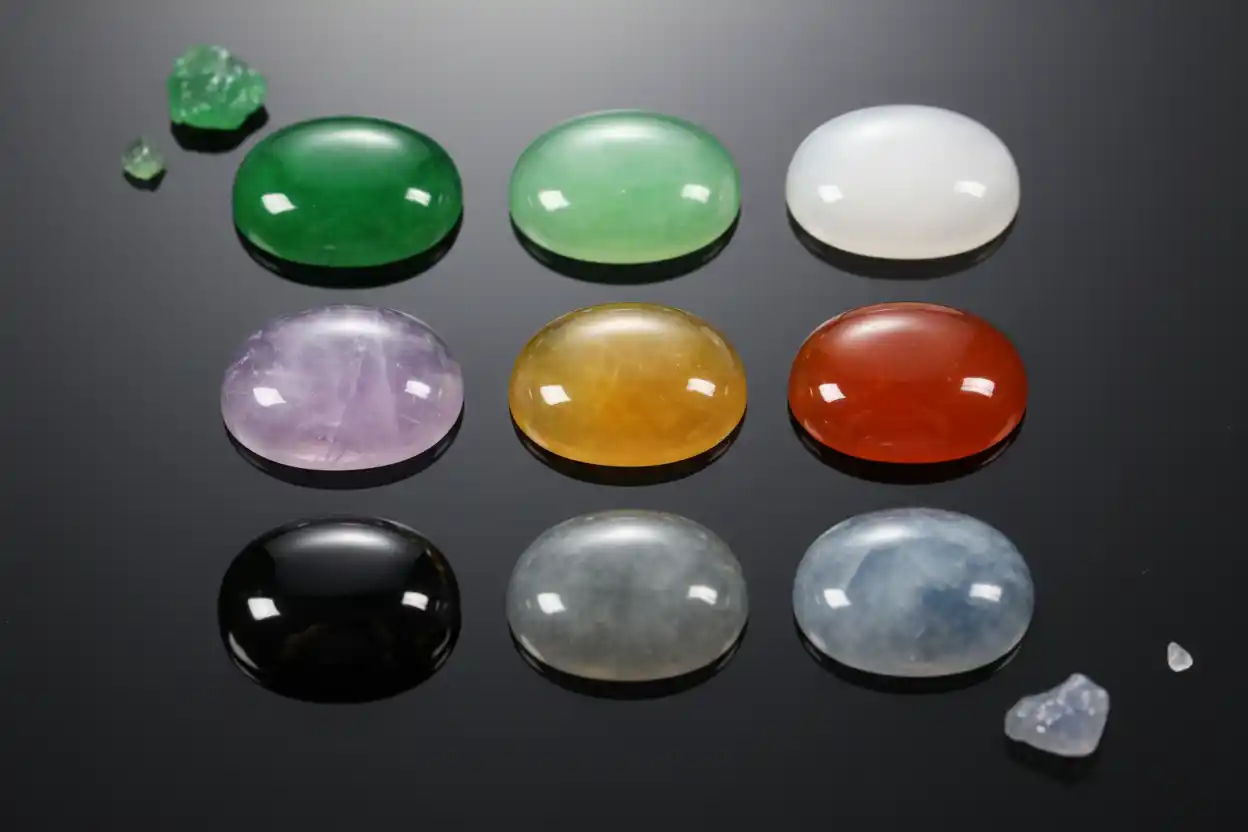
Jade Color Meaning and Symbolism: Green, White, Lavender & More
Jade is famous for green, but genuine jade occurs in a much broader palette. Depending on the material, jade can be white, lavender, yellow, orange, reddish, brown, gray, black and even blue-toned, while different trace elements, mineral inclusions and geological processes create those colors.
Color also carries a second layer of meaning. Modern crystal traditions commonly associate green jade with growth and prosperity, white with clarity, lavender with reflection, yellow with optimism and black with grounding. Those symbolic interpretations are not scientific properties, and they should be kept separate from the mineralogical reasons jade develops each color.
Jade Colors at a Glance
| Jade Color | Common Material | Mineralogical Context | Common Modern Symbolism |
|---|---|---|---|
| Imperial green | Primarily jadeite | Vivid green commonly associated with chromium; chemistry may be complex | Prosperity, renewal, opportunity |
| Apple/yellow-green | Jadeite | Lighter or more yellowish green composition | Growth, optimism, fresh starts |
| Dark green | Jadeite, nephrite, some omphacite | Iron and other compositional factors may deepen green | Stability, endurance, grounded growth |
| White | Jadeite or nephrite | Low concentration of strong chromophores; some white jadeite approaches nearly pure composition | Clarity, simplicity, balance |
| Lavender | Primarily jadeite | Manganese is important in classic lavender jadeite; other trace-element combinations may contribute by locality | Reflection, calm, individuality |
| Yellow | Jadeite or nephrite | Color origin varies; iron-related processes may contribute in some material | Optimism, confidence, warmth |
| Orange/red | Mainly jadeite | Some reddish material involves iron-bearing surface coloration and oxidation | Vitality, courage, motivation |
| Black | Jadeite or nephrite | Can involve graphite, iron-rich compositions or other dark inclusions depending on material | Grounding, boundaries, resilience |
| Gray | Jadeite or nephrite | Mineral chemistry and inclusions create neutral gray tones | Discernment, neutrality, composure |
| Blue/violet-blue | Uncommon jadeite | Ti-Fe and other trace-element effects are documented in some localities | Communication, perspective, calm |
| Brown | Jadeite or nephrite | Iron-bearing minerals, weathering and other geological factors may contribute | Stability, practicality, connection to earth |
Jade Is More Than One Mineral Material
Before interpreting jade colors, it helps to clarify what the word jade means.
Modern gemology traditionally recognizes two principal jade materials:
jadeite and nephrite.
Under current gemological usage, certain green omphacite material can also fall within the jade definition.
Jadeite is a sodium-aluminum pyroxene-rich material. It produces the broadest and often most vivid palette, including:
green, white, lavender, yellow, orange, reddish orange, brown, gray and black.
Nephrite consists mainly of tightly intergrown tremolite-actinolite amphiboles. Its colors tend to be more muted and include:
white, cream, light green, dark green, gray, yellowish, brown and black.
The detailed Jadeite vs Nephrite comparison owns the mineral-identification differences, while this page focuses specifically on what the colors represent.
Why Does Jade Have Different Colors?
Pure mineral chemistry does not explain jade’s appearance by itself.
Trace elements, substitutions within mineral structures, microscopic inclusions and weathering can all influence color.
That means two pieces that look similarly green may not owe their color to exactly the same chemical mechanism.
Likewise, one explanation should not be applied automatically to every lavender, black or yellow jade specimen.
Color origin can also vary by locality.
For example, research on classic lavender jadeite has demonstrated an important manganese contribution, while studies of Japanese violet jadeite show that titanium, iron and manganese can interact to produce violet coloration.
The same caution applies to green.
Chromium is particularly important in the vivid green associated with fine jadeite, but iron can contribute to other green shades.
Therefore, jade color should be described precisely rather than reduced to one universal “coloring element.”
Green Jade Meaning
Green is the color most strongly associated with jade.
It ranges from:
nearly white green through apple green, moss green, spinach green, bluish green and exceptionally vivid emerald-like green.
Gemologically, green jade can refer to jadeite, nephrite or, under particular circumstances, green omphacite.
Symbolically, modern traditions most often connect green jade with:
growth, prosperity, renewal, harmony and opportunity.
These associations make intuitive sense within color symbolism. Green is widely linked with vegetation, spring growth and abundance.
However, owning green jade does not scientifically increase wealth or guarantee good fortune.
A more grounded use is to make the stone represent a specific kind of growth.
Ask:
What am I trying to build steadily rather than obtain instantly?
That could refer to:
a skill, business, relationship, savings habit or personal routine.
The broader Jade: Meaning, Healing Properties & Uses page keeps the general jade symbolism separate from this color-specific guide.
Imperial Green Jade
The most famous jadeite color is Imperial green.
Fine Imperial jadeite is vivid, highly saturated green with attractive translucency and fine texture.
The ideal color is commonly described as a penetrating emerald-like green that remains strong without looking gray or excessively dark.
Importantly, “Imperial” is not a name that should be applied casually to every green jade object.
The term represents an exceptional quality category.
Fine green jadeite can become extraordinarily valuable, but color alone still does not determine price.
Transparency, texture, treatment, craftsmanship and overall quality matter as well.
The Jade Price Guide addresses those valuation factors separately.
Imperial Green Jade Symbolism
Modern symbolism tends to intensify the broader green-jade themes.
Imperial green is commonly associated with:
ambition, abundance, confidence and major growth.
A useful reflective interpretation is:
What opportunity deserves serious commitment rather than casual interest?
The stone can symbolize the decision to invest sustained effort.
Apple Green Jade Meaning
Apple green describes a brighter yellowish or fresh green appearance.
It is less intense than the finest Imperial green but can still be highly attractive.
The color often feels lighter and more energetic than deep forest or spinach green.
Modern symbolism commonly associates apple green jade with:
fresh starts, curiosity, adaptability and optimism.
Instead of treating it as a stone that automatically creates new opportunities, use it as a reminder to recognize situations where change is already possible.
A practical prompt is:
Which small beginning could produce a meaningful result if I continue it?
Dark Green Jade Meaning
Dark green occurs in both jadeite and nephrite.
Nephrite in particular can show muted:
spinach green, olive green or nearly black-green colors.
These stones tend to have a more restrained visual character than bright Imperial jadeite.
Dark green jade is commonly given symbolic themes of:
endurance, stability, patience and grounded growth.
Those meanings fit the visual character of the material.
Rather than representing dramatic transformation, dark green can symbolize consistency.
Ask:
What would improve if I simply kept doing the useful thing for another six months?
White Jade Meaning
White jade can be jadeite or nephrite.
High-quality white jadeite may contain very low concentrations of strong color-causing impurities and can approach the composition of nearly pure jadeite.
White nephrite has its own mineralogical texture and history.
Therefore, the term “white jade” describes color rather than one unique mineral composition.
Modern traditions commonly associate white jade with:
clarity, simplicity, balance and deliberate decision-making.
Because a dedicated White Jade: Meaning, Properties & Symbolism page owns the detailed white-jade intent, the important point here is how white fits within the larger jade palette.
White represents the visual absence of strong bodycolor.
Symbolically, that makes it useful as a reminder to remove unnecessary complexity.
A good question is:
What would this decision look like if I removed everything that is not essential?
“Ice Jade” and Colorless Jadeite
Highly translucent near-colorless jadeite is sometimes called ice jade in the trade.
The finest material combines:
high transparency, very fine texture and minimal visible bodycolor.
It should not be confused automatically with white opaque jade.
A translucent colorless jadeite can interact with light very differently from chalky or creamy material.
Ice-jade terminology also describes appearance rather than creating a new mineral species.
It remains jadeite.
Because high transparency can strongly affect value, imitation and treatment concerns should be evaluated independently from color terminology.
Lavender Jade Meaning
Lavender is one of jadeite’s most distinctive non-green colors.
It ranges from:
pale lilac and grayish violet to stronger purple-violet tones.
GIA research has demonstrated an important role for manganese in classic lavender jadeite, although color mechanisms can differ in material from different geological environments.
For example, violet Japanese jadeite can include contributions from titanium-iron interactions along with manganese.
Therefore, it is safer to say:
lavender jadeite can owe its color to manganese and other locality-dependent trace-element effects
rather than claiming all purple jade has one identical chemical cause.
Lavender Jade Symbolism
Modern symbolism links lavender jade with:
reflection, calm, emotional perspective and individuality.
The color feels less connected with material prosperity than green jade and more connected with introspection.
A practical lavender-jade prompt is:
Which part of this situation needs understanding rather than an immediate reaction?
That keeps the meaning reflective without presenting the gemstone as a psychological treatment.
Purple vs Lavender Jade
Most natural jadeite in this range is described as lavender, lilac, violet or grayish purple rather than saturated royal purple.
Trade photographs may intensify color.
Lighting also affects how the stone appears.
A weak lavender piece photographed under highly favorable lighting can look substantially more saturated online.
Therefore, strong purple color should not automatically be treated as proof of superior quality.
When an expensive stone has unusually intense color, laboratory testing can help determine:
material identity and treatment status.
Yellow Jade Meaning
Yellow jade occurs in both jadeite and nephrite.
Colors can range from:
cream-yellow and pale lemon to golden or brownish yellow.
The exact origin varies with material and geological history, so it is unwise to claim that every yellow jade receives its color from exactly one element.
Iron-bearing processes can contribute to yellow and brownish coloration in some material.
Yellow Jade Symbolism
Modern traditions commonly associate yellow jade with:
optimism, confidence, warmth and constructive ambition.
The visual connection comes partly from sunlight and gold-like color symbolism.
A practical interpretation is:
What would I attempt if I approached this situation with realistic confidence rather than expecting failure?
This makes yellow jade a reminder of mindset rather than a source of guaranteed success.
Golden Jade Meaning
“Golden jade” can be used informally for rich yellow-to-golden jade material, but buyers should pay attention to what mineral is actually being sold.
Many unrelated materials carry trade names containing the word jade.
Color should never override identification.
When the material is genuine jade, a rich golden tone may be aesthetically desirable.
Symbolically, modern practitioners often connect golden jade with:
achievement, confidence, generosity and purposeful use of resources.
These associations should be treated as personal symbolism, not evidence that the stone attracts money.
Orange Jade Meaning
Jadeite can occur in orange and reddish-orange colors.
Some orange-to-red jadeite develops near the weathered outer portions of jadeite boulders.
Iron-bearing minerals and oxidation can contribute to these warm colors.
Because the coloration may occur only in relatively thin areas, strongly colored red-orange material can be less abundant than ordinary green or white jade.
Orange Jade Symbolism
Orange jade commonly receives modern associations involving:
creativity, enthusiasm, sociability and forward motion.
A grounded use is to make the stone represent action.
Ask:
What idea have I thought about long enough and now need to test?
That turns “creative energy” into a practical behavior.
Red Jade Meaning
Red jade generally sits at the stronger end of the orange-to-reddish jadeite range.
Natural red material can be uncommon, and treatment complicates the market.
GIA has documented reddish jadeite whose color can be intensified through heating in air, which promotes oxidation in iron-bearing material.
Therefore, a vivid red color should not automatically be assumed untreated.
Red Jade Symbolism
Modern symbolism commonly connects red jade with:
vitality, courage, determination and commitment.
Instead of interpreting that as a physical energy boost, use it as a reminder of deliberate action.
A useful question is:
Which difficult action have I already decided is necessary?
The stone can represent follow-through rather than supply courage itself.
Black Jade Meaning
Black jade can refer to either jadeite or nephrite.
The mechanism behind the darkness depends on the material.
Research on Japanese black jadeite has documented graphite-bearing material.
In contrast, some black nephrite contains high concentrations of iron-rich amphibole, producing material that appears black in ordinary lighting but can reveal greenish or brownish tones when extremely thin.
Therefore, “black jade” does not have one universal chemical explanation.
Black Jade Symbolism
Modern crystal traditions commonly associate black jade with:
grounding, boundaries, resilience and self-discipline.
These themes fit broader black-color symbolism.
A practical interpretation is:
Which boundary would make this situation simpler and more sustainable?
The meaning comes from using the object as a reminder to enforce that boundary.
Is Black Jade Really Black?
Sometimes the material is visually black in normal thickness but reveals another color in strong transmitted light.
Certain black nephrites, for example, can show greenish or yellow-brown tones when cut extremely thin.
Similarly, black jadeite may contain dark inclusions responsible for the appearance.
That does not make the material “fake black.”
Gemstone color depends partly on:
thickness, lighting and microscopic composition.
Gray Jade Meaning
Gray jade occurs in both jadeite and nephrite.
It can range from:
pale silvery gray to medium charcoal.
Some pieces combine gray with:
green, white, lavender or black areas.
Gray is less celebrated commercially than vivid green or lavender jadeite, but subtle gray material can be attractive in minimalist jewelry and carving.
Gray Jade Symbolism
Modern symbolism commonly connects gray jade with:
neutrality, discernment, patience and emotional distance from immediate reactions.
A useful question is:
What changes if I evaluate this situation without deciding immediately whether it is good or bad?
Gray jade therefore works well as a symbol of observation before judgment.
Blue Jade Meaning
Blue jade is much less common than green or white material.
Some jadeite can show:
blue, violet-blue or blue-gray tones.
Scientific research on certain Japanese blue jadeite has linked the coloration partly with titanium-iron charge-transfer effects.
That does not mean every stone marketed as “blue jade” shares this chemistry.
Numerous non-jade minerals also carry jade trade names.
Consequently, unusually vivid blue material deserves careful identification.
Blue Jade Symbolism
Modern practitioners commonly associate blue jade with:
communication, calm, perspective and thoughtful expression.
A practical prompt is:
What needs to be said clearly without being said aggressively?
This gives the color meaning without claiming that jade changes the nervous system or communication ability.
Brown Jade Meaning
Brown occurs naturally in both jadeite and nephrite.
The color can range from:
light beige-brown to deep earthy brown.
Iron-bearing minerals, weathering and other geological processes can influence warm brown coloration depending on the material.
Brown zones may also occur together with:
green, yellow or reddish areas.
Brown Jade Symbolism
Brown jade is commonly associated in modern color symbolism with:
stability, practicality, patience and connection with everyday responsibilities.
A grounded reflection is:
Which practical task would reduce the most stress if I simply finished it?
This gives the earthy color a useful symbolic role without turning it into a supernatural claim.
Multicolor Jade
Jade frequently displays more than one color in the same piece.
Jadeite boulders can contain:
white backgrounds, green patches, lavender zones and warm weathered skins.
Carvers often use these natural transitions deliberately.
For example, a white section may become a figure’s clothing while a green patch becomes foliage.
This relationship between color zoning and carving is one reason jade artistry cannot be evaluated using faceted-gem standards alone.
The stone’s uneven color may actually increase artistic possibilities.
Moss-in-Snow Jade
“Moss-in-snow” is a descriptive trade term for translucent white jadeite containing:
bright green spots, veins or patches.
The contrast can be highly attractive.
It demonstrates an important principle:
even color distribution is not always the only desirable pattern.
A deliberate natural pattern can have significant aesthetic appeal.
Modern symbolism often combines the themes of its two dominant colors:
white for clarity and green for growth.
Again, this is interpretive rather than a mineralogical property.
Does Jade Color Affect Value?
Yes, especially in jadeite, but the relationship is not as simple as “green is expensive.”
Color is a major value factor.
Fine vivid Imperial green jadeite occupies the highest level of the market.
Strong lavender can also be highly desirable.
However, buyers additionally evaluate:
transparency, texture, evenness of color, craftsmanship, fractures and treatment.
A mediocre opaque green stone is not automatically more valuable than every fine lavender or colorless jadeite.
Likewise, attractive black, red-orange and multicolor carvings can have substantial value depending on quality.
Color must always be evaluated together with the whole object.
Natural Color vs Dyed Jade
Color is one of the easiest jade properties to alter commercially.
Jadeite may be:
dyed, bleached and polymer impregnated, waxed or subjected to combinations of treatment.
Heating may also modify some warm colors.
This means unusually vivid color is not evidence of authenticity.
A stone can be genuine jadeite while having treated color.
It can also be a completely different material dyed to resemble jade.
These are separate questions.
The How to Spot Treated or Synthetic Jade page owns treatment analysis, while Real vs Fake Jade handles the broader authenticity workflow.
Does Color Tell You Whether Jade Is Jadeite or Nephrite?
Sometimes it gives a clue, but not a reliable conclusion.
Vivid Imperial green and strong lavender are most strongly associated with jadeite.
Muted spinach green, creamy white and dark green are common in nephrite.
However, their ranges overlap.
Both can be:
white, green, gray, yellowish, brown or black.
Therefore, a color name alone cannot determine jade type.
The dedicated Jade vs Jadeite identification page keeps that terminology problem separate from this symbolism article.
Which Jade Color Is Best?
There is no objectively best jade color.
For gem-market rarity and traditional value, exceptional Imperial green jadeite occupies a special position.
For personal preference, the answer may be completely different.
Someone may prefer:
lavender for its softness, white for minimalism, black for dramatic contrast or orange for warmth.
If you are choosing jade jewelry to wear rather than treating it as an investment, examine how the actual piece looks against your skin and in ordinary lighting.
A color you enjoy regularly is more useful than choosing solely from a hierarchy.
Choosing Jade by Symbolism
If symbolism matters to you, choose a color that represents an intention you can define clearly.
Green can represent something you want to grow.
White can represent simplification.
Lavender can represent reflection.
Yellow can represent confidence.
Orange can represent action.
Black can represent boundaries.
Blue can represent communication.
Brown can represent stability.
Then connect the symbol to an observable behavior.
For example, instead of saying:
“Green jade brings prosperity,”
use:
“This green jade reminds me to make the financial decision that supports long-term growth.”
The second approach preserves the symbolic tradition without treating the gemstone as a guarantee of an external result.
Frequently Asked Questions
1. What colors does real jade come in?
Genuine jade occurs in green, white, lavender, yellow, orange, reddish, brown, gray and black, while uncommon jadeite can also show blue or violet-blue tones. Jadeite generally has a broader and more vivid color range than nephrite.
2. What is the most valuable jade color?
Exceptional vivid, translucent Imperial green jadeite generally occupies the highest-value color category. However, transparency, texture, treatment and workmanship also have major effects on value.
3. What does green jade symbolize?
Modern traditions commonly associate green jade with growth, prosperity, renewal and opportunity. These are symbolic interpretations rather than scientifically demonstrated effects.
4. What does white jade symbolize?
White jade is commonly associated with clarity, simplicity, balance and deliberate decision-making in modern crystal symbolism.
5. What does lavender jade symbolize?
Lavender jade is commonly linked with calm, reflection, perspective and individuality. Classic lavender jadeite coloration is associated importantly with manganese, though color mechanisms vary by locality.
6. What does yellow jade symbolize?
Modern symbolism commonly connects yellow jade with optimism, confidence, warmth and constructive ambition.
7. What does black jade symbolize?
Black jade is often associated with grounding, resilience, boundaries and self-discipline in contemporary crystal traditions.
8. Is black jade naturally black?
Yes, genuine black jade exists. Its color mechanism varies: some jadeite contains graphite, while certain black nephrites derive their dark appearance largely from iron-rich amphibole compositions.
9. Is purple jade the same as lavender jade?
Purple, violet and lavender are overlapping trade descriptions. Most natural material in this color family is commonly described as lavender jadeite, although intensity and hue vary considerably.
10. Can real jade be orange or red?
Yes. Jadeite can occur naturally in orange and reddish tones, often near weathered portions of jadeite material. Some reddish jadeite on the market may also have its color intensified by heat treatment.
11. Does jade color tell you if it is jadeite or nephrite?
Not reliably. Jadeite has the broader vivid palette, but jadeite and nephrite overlap in green, white, gray, brown, yellowish and black colors. Gemological testing is more reliable than color.
12. Can jade be dyed to another color?
Yes. Jadeite can be dyed or otherwise treated to change its appearance. A vivid color does not prove natural color, so valuable material should be evaluated for both identity and treatment.
Conclusion
Jade’s color range is far richer than its familiar green image suggests.
Jadeite can display vivid green, lavender, white, yellow, orange, reddish, gray, brown and black, while nephrite commonly appears in more muted green, white, yellowish, brown, gray and black shades. Under current gemological usage, certain green omphacite material can also fall under the jade name.
Those colors arise from different combinations of trace chemistry, inclusions and geological processes. Chromium is important in vivid green jadeite, manganese contributes significantly to classic lavender material, some black jadeite contains graphite, and high iron can help create black nephrite. Yet locality matters, so no single color mechanism should be applied automatically to every specimen.
Symbolically, the palette provides a useful framework: green for growth, white for clarity, lavender for reflection, yellow for confidence, orange-red for action, black for boundaries and blue for communication.
Those meanings become most useful when they represent a concrete intention rather than a promise that jade itself will produce an external result.
Disclaimer: Jade color symbolism, prosperity, grounding, communication and related metaphysical associations are cultural, spiritual or personal interpretations rather than scientifically established medical, psychological or financial effects. Jade color alone cannot confirm species, natural origin, treatment status or value.