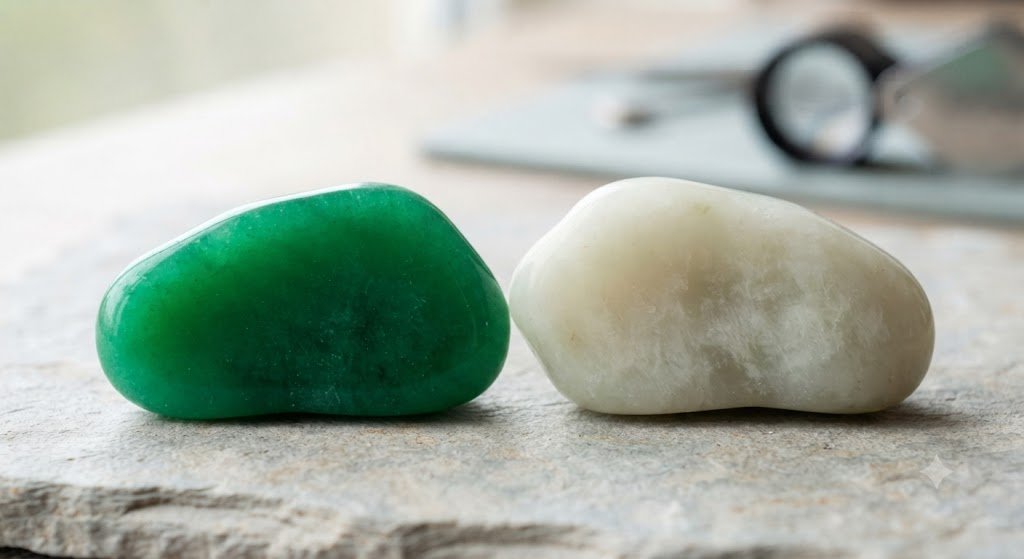
Jadeite vs Nephrite: Key Differences & How to Choose
Jadeite and nephrite are both legitimately called jade, but they are not the same mineralogical material. Jadeite belongs to the pyroxene group and has the ideal formula NaAlSi₂O₆. Nephrite is a compact, exceptionally tough aggregate composed principally of tremolite-actinolite amphibole, commonly represented by the approximate composition Ca₂(Mg,Fe)₅Si₈O₂₂(OH)₂. Modern gemology therefore treats jadeite and nephrite as two distinct jade materials whose similar appearance and extraordinary toughness historically allowed them to share one traditional name. GIA also recognizes certain green omphacite under jade terminology, but that does not erase the jadeite-nephrite distinction.
The practical differences are measurable. GIA lists jadeite jade with a refractive index around 1.666–1.680, specific gravity near 3.34, and Mohs hardness around 6.5–7. Nephrite normally falls around RI 1.606–1.632, specific gravity near 2.95, and Mohs hardness around 6–6.5. Their microstructures are also different: polished or thin-section jadeite generally shows interlocking granular pyroxene crystals, while nephrite has a densely interwoven fibrous or felted amphibole structure. That fibrous architecture is a major reason nephrite is renowned for exceptional fracture toughness.
Those differences matter for identification, wear, treatment assessment, valuation, and buying decisions. Yet neither material is universally superior. Fine jadeite can achieve vivid color and high translucency that place it among the world’s most valuable gem materials, while fine nephrite offers remarkable toughness, distinctive texture, important carving traditions, and its own premium collector markets. The correct jadeite vs nephrite choice starts with what the material actually is and what you expect it to do, rather than with the assumption that one name automatically represents higher quality.
For other evidence-led mineral comparisons, the Identification category groups pages where appearance is tested against measurable material properties.
Jadeite vs Nephrite at a Glance
| Property | Jadeite jade | Nephrite jade |
|---|---|---|
| Mineral family | Pyroxene | Amphibole |
| Principal material | Jadeite-rich interlocking aggregate | Tremolite-actinolite fibrous aggregate |
| Ideal/representative chemistry | NaAlSi₂O₆ | Ca₂(Mg,Fe)₅Si₈O₂₂(OH)₂ |
| Typical structure | Interlocking granular crystals | Densely interwoven fibers |
| Refractive index | Approx. 1.666–1.680 | Approx. 1.606–1.632 |
| Specific gravity | Approx. 3.34 | Approx. 2.95 |
| Mohs hardness | Approx. 6.5–7 | Approx. 6–6.5 |
| Toughness | Exceptional | Exceptional; particularly renowned |
| Typical transparency | Opaque to semitransparent | Opaque to translucent |
| Typical colors | Green, white, lavender, yellow, orange, brown, gray, black | White, cream, yellow, brown, gray, black, pale to dark green |
| Typical visual character | Can show brighter color and greater translucency | Often more muted with waxy/greasy appearance |
| Important treatment terminology | A, B and C jade classifications commonly applied | Treatments can occur, but A/B/C terminology is principally associated with jadeite |
| Highest-end market | Fine translucent green jadeite can reach extraordinary prices | Fine white and exceptional green nephrite can also be valuable |
| Best identification tools | RI, SG, microscopy and laboratory analysis | RI, SG, microscopy and laboratory analysis |
| Reliable from color alone? | No | No |
GIA’s published ranges show enough separation in refractive index and specific gravity that properly obtained measurements can often distinguish jadeite from nephrite far more reliably than visual impressions. Both remain aggregate materials, however, so mounted construction, surface curvature, treatments, mixed mineralogy and test technique can affect what is practical.
Identity: Two Real Jades, Two Different Mineral Systems
Jadeite is a sodium-aluminum pyroxene. Gem jadeite usually occurs as a rock-like aggregate of interlocking microscopic crystals rather than as a single conventional transparent crystal. Natural jadeite jade can include varying quantities of related pyroxenes and accessory minerals, which is one reason laboratory terminology can be more nuanced than simply declaring every green aggregate chemically pure jadeite.
Nephrite belongs to an entirely different mineral system. It consists principally of densely interwoven tremolite-actinolite amphibole fibers. In thin section, the structural contrast can be dramatic: GIA’s classic comparative work describes jadeite as an aggregate in which individual interlocking grains remain recognizable, while nephrite presents a rope-like, fibrous network that appears tightly woven together.
This distinction is fundamental rather than cosmetic. Jadeite and nephrite do not become different merely because gemologists assign them different trade categories; their chemistry, crystal families, density, refractive behavior and microstructure are genuinely different. The terminology-focused jade vs jadeite guide addresses why jadeite is jade while the word jade itself is broader.
Side-by-Side Identity Table
| Evidence question | Jadeite | Nephrite | Diagnostic weight |
|---|---|---|---|
| Pyroxene-based? | Yes | No | Strong |
| Amphibole-based? | No | Yes | Strong |
| Granular interlocking microstructure typical? | Yes | Less characteristic | Strong under appropriate magnification |
| Fine felted/fibrous structure typical? | No | Yes | Strong |
| RI near 1.67? | Consistent | Inconsistent with normal nephrite | Strong |
| RI near 1.61–1.62? | Inconsistent with normal jadeite | Consistent | Strong |
| SG around 3.3+? | Typical | Too high for normal nephrite | Strong |
| SG around 2.9–3.0? | Too low for normal jadeite | Typical | Strong |
| Vivid translucent green possible? | Yes | Yes, although less characteristic | Weak alone |
| Waxy or greasy luster possible? | Yes | Commonly pronounced | Weak alone |
| Green color proves identity? | No | No | None |
| Seller calling it “jade” proves which type? | No | No | None |
The last two rows are especially important. Jade identification fails when a visual description is allowed to become a mineralogical conclusion. Both materials occur in green, both can polish beautifully, both can be highly tough, and both have simulants.
Visual Clues: What the Eye Can Suggest
Jadeite often offers more vivid color and stronger translucency than typical nephrite. GIA describes jadeite in greens ranging from muted to extremely vivid, along with white, lavender, yellow, reddish orange, gray, black and brown. Nephrite also spans white, gray, yellow, brown, black and several greens, but its colors generally tend to be more subdued.
Surface appearance can provide another clue. A well-polished jadeite may look somewhat brighter or more vitreous, while nephrite frequently shows a softer waxy or greasy character. Classic GIA comparison work notes that many jadeites look more granular and can appear brighter or clearer, whereas nephrite’s texture can appear denser and more fibrous. These are tendencies, not rules: fine nephrite can be highly polished and attractive, while low-quality jadeite may be opaque, coarse, dull or grayish.
Translucency is similarly useful but not decisive. Fine semitransparent jadeite is central to the high-end jadeite market, yet nephrite can also be translucent. Thickness greatly changes apparent translucency, so comparing a 2 mm jadeite cabochon edge with a 10 mm nephrite bangle wall under a flashlight is not a controlled identification test.
Color, luster and translucency therefore belong near the beginning of an examination, not at the end of it.
Original Same-Light Visual Comparison Protocol
A fair visual jadeite vs nephrite comparison should remove as many photographic variables as possible. The following worksheet creates repeatable observations without pretending that photography can replace gemological testing.
| Control | Method | Record |
|---|---|---|
| Light source | Use one diffuse daylight-balanced source | Exact light used |
| Background | Use neutral matte gray | Background description |
| Scale | Place both objects beside the same millimeter reference | Dimensions |
| Thickness | Compare similar thickness where possible | Thickness at observed area |
| Camera | Same camera, focal length, exposure and white balance | Camera settings |
| Face-up view | Photograph both perpendicular to the main polished surface | Hue, tone, saturation |
| Transmitted-light view | Apply the same backlight strength | Degree of translucency |
| Oblique light | Tilt both equally | Surface texture and luster |
| Magnification | Use the same magnification | Granular versus fibrous clues |
| Color editing | Do not selectively alter hue or saturation | Any global correction disclosed |
| Treatment status | Record separately from appearance | Lab-confirmed, seller-stated or unknown |
| Final conclusion | Separate observation from identification | Suggested, supported or laboratory-confirmed |
This protocol creates original comparison data a reader can reproduce. If the photographs still look too similar to distinguish confidently, that result is itself useful evidence: visual examination has reached its limit.
The same principle applies beyond jade. Kunzite vs Morganite and Kyanite vs Sapphire also require mineral properties to outrank superficial color resemblance.
Optical Data: The Strongest Routine Separation
Refractive index provides one of the clearest routine differences. GIA gives jadeite jade a typical RI of approximately 1.666–1.680 and nephrite approximately 1.606–1.632. Those normal ranges are substantially separated. On a suitable polished surface, a correctly obtained spot reading around 1.67 strongly supports jadeite over nephrite, while a reading close to 1.61–1.62 strongly supports nephrite.
Specific gravity provides another useful separation. Jadeite is typically around 3.34, while nephrite is around 2.95. A jadeite object of equal volume will therefore generally be heavier than a comparable nephrite object. Hydrostatic testing can turn that difference into measurable evidence, although metal settings, cavities, attached components, repairs and mixed materials can invalidate a simple density calculation.
Neither property should be treated as an excuse for careless home testing. Refractometers require correct contact and suitable surfaces, and specific-gravity measurements require accurate weight and volume procedures. A poor measurement that happens to resemble a textbook number is weaker evidence than multiple correctly acquired observations that agree.
This evidence-first approach also explains why the lab diamond vs moissanite comparison relies on measurable optical behavior rather than sparkle alone.
Microscopic Texture: Granular Jadeite Versus Fibrous Nephrite
Microstructure is one of the most informative conceptual differences between the two jades. GIA’s thin-section comparison shows jadeite as many interlocking granular crystals, whereas nephrite consists of intensely interwoven fibrous crystals. That structural architecture is not merely academic; it influences toughness, surface appearance, carving behavior and sometimes the clues visible under magnification.
In polished jadeite, grain boundaries can sometimes create a granular or slightly dimpled appearance, especially under oblique light. Nephrite can show felted, fibrous, directional or rope-like internal textures, although grain size may be far too fine for a simple loupe to resolve cleanly. GIA studies of nephrite deposits repeatedly document densely intergrown tremolite fibers as a defining microstructural feature.
Microscopic appearance should still be interpreted as part of a larger identification. Polishing effects, weathering, treatment, mineral mixtures and similar-looking simulants can complicate observation. A surface that “looks fibrous” is not automatically nephrite.
Color: Jadeite Usually Has the Broader High-Saturation Range
Fine jadeite can reach vivid emerald-like green with significant translucency, a combination at the heart of the exceptional Imperial jade market. GIA identifies color as jadeite’s most important value factor, followed by transparency and texture, and notes that its finest green material can rank among the world’s most expensive gemstones.
Nephrite’s colors are commonly creamier or more muted, although the material can range from white through yellowish, gray, brown and black to multiple shades of green. Bright green nephrite does exist, and GIA has documented Siberian material whose color can resemble green jadeite, so “bright green equals jadeite” is not a defensible rule.
White nephrite also occupies an important high-end cultural market of its own, particularly when the material has very fine texture, attractive translucency and desirable provenance. The jadeite-vs-nephrite decision therefore should not be framed as vivid green versus inexpensive dull green. Each material has multiple quality tiers and collecting traditions.
Treatments: The A, B and C Terms Need Correct Interpretation
Treatment terminology creates one of the most important commercial differences. GIA explains that, in the widely used Chinese classification, A jade refers to jadeite that is natural or has received traditional wax polishing; B jade refers to jadeite bleached with acid and then impregnated with polymer resin; C jade refers to dyed material.
Those letters do not describe visual quality. A pale, coarse, opaque jadeite can still qualify as A jade if its treatment status fits the definition. Conversely, a brilliantly colored B or C jade object can be visually attractive while having a treatment history that materially changes its commercial interpretation.
Nephrite is not immune to treatment or artificial color. GIA states broadly that jade can be dyed, bleached, heated, waxed and impregnated, so any high-stakes purchase should treat a treatment statement as an evidence question rather than an assumption. However, the A/B/C shorthand discussed in GIA’s buyer guidance specifically defines jadeite treatment categories.
Suspiciously concentrated color along fractures or porous zones can justify further investigation, but appearance alone cannot prove dye. The how to spot dyed crystals guide provides a broader visual framework for distinguishing warning signs from conclusions.
Durability: Hardness and Toughness Tell Different Stories
Jadeite is slightly harder than nephrite. GIA gives jadeite approximately 6.5–7 on the Mohs scale and nephrite approximately 6–6.5. That means jadeite normally has a modest advantage in resistance to scratching. Yet both materials are famous primarily for toughness rather than extreme hardness.
Nephrite’s interwoven fibrous structure gives it particularly exceptional resistance to breaking, while jadeite’s compact interlocking granular structure is also extraordinarily tough by gem standards. This is why jade materials could historically be shaped into axes, tools, ritual objects, bangles and carvings that might be impractical in more brittle stones of similar hardness. GIA specifically emphasizes that both jadeite and nephrite resist breaking and chipping unusually well.
The practical result is that the hardness numbers alone do not identify the better jewelry material. A thick sound jadeite bangle may be extremely durable; so may a nephrite bangle. A thin jadeite carving with a pre-existing fissure can be more vulnerable than a substantial nephrite piece. Object geometry, damage, drill holes, treatment and setting design can outweigh the small difference on the Mohs scale.
Do Not Use a Scratch Test to Separate Them
A destructive scratch test is particularly poor for jadeite vs nephrite because their hardness ranges sit too close together. GIA’s classic jade identification work explicitly notes that hardness testing cannot reliably separate jadeite from nephrite for this reason.
Scratching a polished surface can therefore damage genuine jade without answering the question. Heating, burning, striking, acid exposure or deliberately breaking an edge are similarly inappropriate shortcuts. Non-destructive refractive-index, density, microscopic and spectroscopic examination provide better evidence.
The general caution is the same one that applies when evaluating uncertain material in is my moldavite real and how to spot fake crystals: suspicion should lead to better evidence, not more destructive testing.
Care: Both Benefit From Conservative Cleaning
For ordinary ownership, GIA recommends warm, soapy water as a safe cleaning choice for jade. Untreated jade can tolerate ultrasonic and steam cleaning under controlled circumstances, but treatment uncertainty makes aggressive cleaning a poor universal recommendation. Dye, polymer impregnation, coatings and other enhancements can change how a piece reacts to heat, chemicals and cleaning equipment.
Heat from jewelry repair can also harm jade, and warm acids can affect it. A repaired, dyed, impregnated or antique object should therefore be treated according to its actual construction and treatment history rather than simply being labeled “tough jade.”
This is a useful contrast with other gem comparisons such as Iolite vs Tanzanite and Labradorite vs Moonstone, where the safer cleaning decision likewise depends on more than visual appearance.
Value: Jadeite Usually Has the Higher Ceiling
At the upper end of the international gem market, fine jadeite generally has the higher price ceiling. GIA describes vivid, almost transparent Imperial green jadeite as one of the world’s most expensive gems and identifies color, transparency and texture as its three dominant value factors. Slight size differences can also have a large effect when top-quality jadeite is being compared.
Nephrite usually operates within a different market structure. Larger size does not normally increase nephrite value as dramatically as it can for top jadeite, but that does not make nephrite commercially insignificant. Fine white nephrite, exceptional green material, important carvings and pieces with strong cultural or historical provenance can carry substantial value. GIA research on green nephrite shows that color, texture and clarity are important market factors and that source reputation can influence demand.
A buyer should therefore avoid the simplistic rule “jadeite expensive, nephrite cheap.” Commercial jadeite can be inexpensive. Fine nephrite can be expensive. The meaningful comparison is fine jadeite versus fine nephrite of similar object type and documented quality, not merely one mineral name versus another.
For a broader example of why similar-looking stones can occupy very different value structures, Lapis Lazuli vs Sodalite separates appearance from material and market identity.
Original Jadeite vs Nephrite Decision Matrix
| Buyer priority | Better starting point | Reason | Main caveat |
|---|---|---|---|
| Vivid translucent emerald-green appearance | Jadeite | Fine jadeite can combine intense green with substantial translucency | Color and translucency must be verified; treatments occur |
| Creamy white traditional jade | Nephrite | Fine white nephrite has an important historical and collector market | “White jade” trade names can be misleading |
| Highest scratch resistance of the two | Jadeite | Slightly higher Mohs hardness | Hardness is not the same as toughness |
| Exceptional resistance to fracture | Nephrite has an edge conceptually | Felted fibrous structure gives extraordinary toughness | Jadeite is also exceptionally tough |
| High-end international gem-jewelry market | Jadeite | Finest jadeite occupies an exceptionally high market tier | Most jadeite is not Imperial quality |
| Traditional carving material | Either | Both have major carving traditions | Cultural context differs by place and period |
| Bright green on a modest budget | Compare individual pieces | Commercial jadeite and green nephrite span wide price ranges | Mineral name alone cannot establish value |
| Strong treatment sensitivity | Either, with testing | Both require honest disclosure; jadeite has especially important A/B/C treatment terminology | Seller claims are weaker than laboratory evidence |
| Everyday bangle | Either | Both can be remarkably tough | Existing fractures, thickness and treatment matter |
| Online purchase from photographs only | Neither without stronger evidence | Color and luster can overlap | Ask for material identification and treatment evidence |
| Laboratory-identifiable material | Either | RI, SG and microscopy usually give clear separation | Mixed pyroxene jade can require advanced testing |
| Guaranteed financial return | Neither | Gemstone resale performance cannot be guaranteed | Buy for documented quality and personal purpose, not promises |
The decision matrix deliberately avoids assigning an overall winner. It turns mineral properties into practical tradeoffs and keeps subjective preferences separate from measurable differences.
Decision Case 1: You Want the Most Vivid Translucent Green
Fine jadeite is the stronger starting point. Its highest-value material combines vivid penetrating green with semitransparency and fine texture. GIA notes that color has the greatest influence on jadeite value and that superior transparency gives fine material an internal luminosity that is difficult to reproduce in ordinary opaque jade.
That does not mean every intense green object is jadeite or naturally colored. Green nephrite can be bright, and jadeite can be dyed. The stronger the price premium attached to color, the more important treatment documentation becomes.
Decision Case 2: You Want Exceptional Toughness for a Carved Object
Nephrite deserves serious consideration. Its densely interwoven tremolite fibers create one of the most fracture-resistant mineral aggregates used ornamentally. Historic use for tools and carving reflects a real material advantage rather than folklore.
Jadeite remains extremely tough, so this is not a case in which nephrite is durable and jadeite fragile. The choice should also consider color, texture, object thickness, workmanship and existing fissures.
Decision Case 3: The Seller Says “Grade A Jade”
Ask what the phrase means. If the seller means A jade in the established treatment terminology, it generally refers to jadeite that is natural or only traditionally wax polished. If the seller simply means “top grade,” the phrase may be an informal quality claim with no standardized laboratory definition.
Then ask whether the object is jadeite or nephrite. An A-jade classification does not turn nephrite into jadeite, nor does it guarantee exceptional color, texture or value.
Decision Case 4: Two Green Bangles Look Almost Identical
Begin with matched observation rather than visual guessing. Photograph both under the same daylight-balanced source, record dimensions and wall thickness, and compare transparency only through equivalent sections. Examine surface texture under the same magnification.
Then move to measurable properties. A density near jadeite’s normal range versus nephrite’s lower range can be strongly informative when the construction allows accurate hydrostatic testing. Refractive index can also separate typical material cleanly. If the pieces are valuable, laboratory confirmation is preferable to escalating home tests.
The same reasoning applies in Lab Diamond vs Moissanite: similar appearance does not invalidate measurable physical differences.
Decision Case 5: You Care More About Cultural Tradition Than Maximum Market Price
The answer depends on which tradition matters. Nephrite dominated ancient Chinese jade culture for millennia and has major histories in other regions, including important Māori pounamu traditions in New Zealand. Jadeite has deep pre-Columbian importance in Mesoamerica and later achieved extraordinary prestige within Chinese jade culture.
The material should therefore follow the cultural object being sought rather than the assumption that more expensive jade is historically “more authentic.” A nephrite object can be exactly the correct material for one tradition while jadeite is correct for another.
Decision Case 6: You Want the Best Value
“Best value” requires defining what you value. If vivid translucent color is the priority, paying more for fine jadeite may be rational. If toughness, carving character, creamy-white color or a particular nephrite tradition is the priority, nephrite may offer greater satisfaction without imitating jadeite.
Do not compare only price per gram. Finished jade objects incorporate color distribution, usable rough, carving, matching, polish, treatment, condition and provenance. A smaller object can be more valuable than a larger one because its material quality is much higher.
When Visual Comparison Is Insufficient
Visual examination becomes insufficient when identity materially affects the price, when a seller charges a premium for untreated jadeite, when photographs and measurements disagree, when color looks unusually vivid or uniform, when an item carries a prestigious origin claim, or when the piece may involve related pyroxenes such as omphacite.
GIA notes that some green omphacite can have color and conventional gemological properties similar to jadeite, and Raman spectroscopy may be necessary for separation. Although that issue is beyond a simple nephrite comparison, it demonstrates why even apparently decisive “jadeite-looking” material can require more advanced analysis.
A responsible conclusion can therefore be “consistent with jadeite,” “consistent with nephrite,” or “requires laboratory confirmation” rather than forcing certainty from incomplete evidence.
What a Gemological Laboratory Can Establish
A qualified laboratory can identify whether a submitted object is jadeite jade, nephrite jade or another material and investigate detectable treatments using appropriate analytical methods. Standard refractive-index, density and microscopic evidence may resolve straightforward cases, while spectroscopy can address treatment or mineral-composition questions that routine visual examination cannot.
Laboratory evidence is especially useful when a seller’s value proposition depends on untreated jadeite. Acid bleaching followed by polymer impregnation can improve apparent jadeite clarity or color while changing the treatment classification, and GIA notes that detecting the impregnation may require advanced analytical techniques.
Testing should therefore answer a defined question. “What material is this?” and “Is polymer impregnation detected?” are laboratory questions. “Do I personally prefer this green?” is not.
Laboratory Limits
A laboratory report cannot determine which jade you should personally prefer. It cannot convert subjective beauty into one universal quality score, decide how much cultural significance an object has to its owner, guarantee that a retail price is fair, or promise future resale value.
It also cannot make weak provenance evidence stronger than the documentation supporting it. Mineral identity, treatment, geographic origin, age of an object and archaeological provenance are separate claims that may require different expertise and evidence.
Likewise, a report proving jadeite does not establish that the stone is Imperial jade. The highest jadeite quality depends on exceptional color, transparency, texture, workmanship and other factors, not simply the species name.
Common Jadeite vs Nephrite Mistakes
The first mistake is saying nephrite is “fake jade.” It is genuine jade and has been used as jade for thousands of years. The second is assuming jadeite is always bright emerald green; jadeite exists in white, lavender, yellow, orange, gray, black and many less-saturated greens. The third is identifying nephrite from a waxy surface alone, because polish and surface treatment can influence luster.
The fourth mistake is assuming A jade means the best grade. It is treatment terminology, not an overall quality ranking. The fifth is relying on a scratch test even though jadeite and nephrite are too close in hardness for that destructive method to separate them reliably. The sixth is equating a high asking price with proven identity.
These are variations on the same identification error addressed in How to Spot Fake Crystals: commercial confidence should rise with evidence, not with marketing intensity.
Safe Ownership and Testing
Ordinary handling of intact jadeite and nephrite jewelry is generally straightforward. Their exceptional toughness makes both suitable for many jewelry and carving formats, but neither is indestructible. Keep them away from hard impacts when an object is thin, fissured or elaborately carved, and do not assume a treatment is absent simply because the object looks robust.
Warm soapy water and a soft cloth provide a conservative cleaning method for both. Avoid improvised acid, heat, burning or scratch tests. Cutting, drilling, grinding and sanding are fundamentally different from ordinary ownership because they generate mineral dust and require appropriate professional workshop controls.
Neither jadeite nor nephrite should be ground into powders for consumption, placed in drinking water to make supposed elixirs, or treated as a nutritional source. Mineral composition does not establish medical bioavailability or a safe dose.
A Practical Evidence Hierarchy
A product title reading “natural jade” provides the least specificity. Controlled photographs and accurate dimensions improve the record but still do not establish mineral identity. Refractive index, density and microscopic texture provide stronger objective evidence when collected correctly. Spectroscopic or other laboratory analysis provides higher-confidence evidence when routine testing is insufficient.
The same evidence hierarchy is useful in the Iolite vs Tanzanite comparison, where similar color can conceal major mineralogical differences.
Gems Lore’s general evidence scope is described on About, while the educational and specimen-specific limits of comparison content are stated in the Disclaimer. If a reader chooses to send general questions or existing report details through Contact, the site’s Privacy Policy explains how submitted information is handled.
Which Should You Choose?
Choose jadeite when the goal is the possibility of highly saturated color, significant translucency, the distinctive granular jadeite appearance, or participation in the high-end jadeite jewelry market. Its slightly higher hardness can also provide modestly greater resistance to scratching, although that should not be mistaken for an overwhelming durability advantage.
Choose nephrite when its dense fibrous texture, exceptional toughness, creamy white or characteristic green colors, carving traditions, cultural context or tactile appearance better match the purpose of the object. Nephrite should never be dismissed as a substitute merely because fine jadeite can command higher prices.
When the purpose is simply to own authentic jade, either can be the correct choice. The more important requirement is accurate material identification, honest treatment disclosure, appropriate quality assessment and a design suitable for how the piece will actually be used.
Frequently Asked Questions
Is jadeite better than nephrite?
Not universally. Jadeite can achieve more vivid color, greater translucency and much higher top-end gem prices, while nephrite is renowned for exceptional toughness, distinctive fibrous texture and major historical carving traditions. The better choice depends on the desired material qualities.
Are jadeite and nephrite both real jade?
Yes. Both are genuine jade materials recognized by gemologists. They are mineralogically different even though they share the traditional jade name.
What is the main mineral difference between jadeite and nephrite?
Jadeite is a sodium-aluminum pyroxene, while nephrite is principally a densely interwoven aggregate of tremolite-actinolite amphibole. Their chemistry and microstructure are therefore fundamentally different.
Which is harder, jadeite or nephrite?
Jadeite is slightly harder, at approximately Mohs 6.5–7 compared with nephrite at about 6–6.5. The difference concerns scratch resistance; both materials have exceptional toughness.
Which is tougher?
Both are extremely tough, but nephrite is especially renowned for fracture toughness because of its tightly interwoven fibrous microstructure. Jadeite’s interlocking granular structure also makes it highly resistant to breaking.
Is jadeite heavier than nephrite?
For comparable volume, generally yes. GIA gives jadeite a typical specific gravity of approximately 3.34 and nephrite about 2.95. Proper density measurement can therefore be highly useful in identification.
Can I tell jadeite from nephrite by color?
Not reliably. Jadeite often reaches brighter colors and greater translucency, while nephrite frequently has more muted or waxy-looking appearances, but their color ranges overlap. Bright green nephrite can resemble jadeite.
What refractive index separates jadeite from nephrite?
GIA lists jadeite around 1.666–1.680 and nephrite around 1.606–1.632. These ranges normally provide useful separation when readings are obtained correctly from suitable surfaces.
Is A jade the same as high-grade jadeite?
No. A jade is primarily treatment terminology for jadeite considered natural or traditionally wax polished. It does not guarantee superior color, transparency, texture, condition or value.
Can nephrite be treated?
Yes, jade materials can be altered through processes including dyeing, waxing and other treatments. Treatment disclosure should therefore be considered for nephrite as well as jadeite, although the familiar A/B/C classification is particularly associated with jadeite.
Why can jadeite be much more expensive?
The finest jadeite combines exceptionally desirable color, translucency, fine texture and scarcity. GIA identifies color, transparency and texture as the dominant jadeite value factors and notes that top Imperial jadeite can command extraordinary prices.
Is nephrite always inexpensive?
No. Fine white nephrite, high-quality green material, important carvings and pieces with desirable provenance can be valuable. Its market structure differs from the most expensive jadeite market, but mineral identity alone does not determine an object’s price.
Can a flashlight identify jadeite or nephrite?
A light can help evaluate translucency, internal texture and color distribution, but it cannot establish identity by itself. Thickness, light intensity and color treatment can strongly affect the result.
Should I scratch jade to determine which type it is?
No. Jadeite and nephrite have hardness ranges that are too close for scratch testing to separate them reliably, and scratching can permanently damage the object.
When should I obtain laboratory testing?
Laboratory testing becomes worthwhile when identity or treatment materially affects price, when a high-value jade purchase is being considered, when ordinary measurements conflict, when color appears suspicious, or when the seller’s claims require more certainty than photographs can provide.
Which jade is best for everyday jewelry?
Both can work well because both are exceptionally tough. Jadeite has slightly better scratch resistance, while nephrite is particularly resistant to fracture. The actual design, thickness, fractures, drill holes, treatment status and intended wear matter more than choosing solely by mineral name.