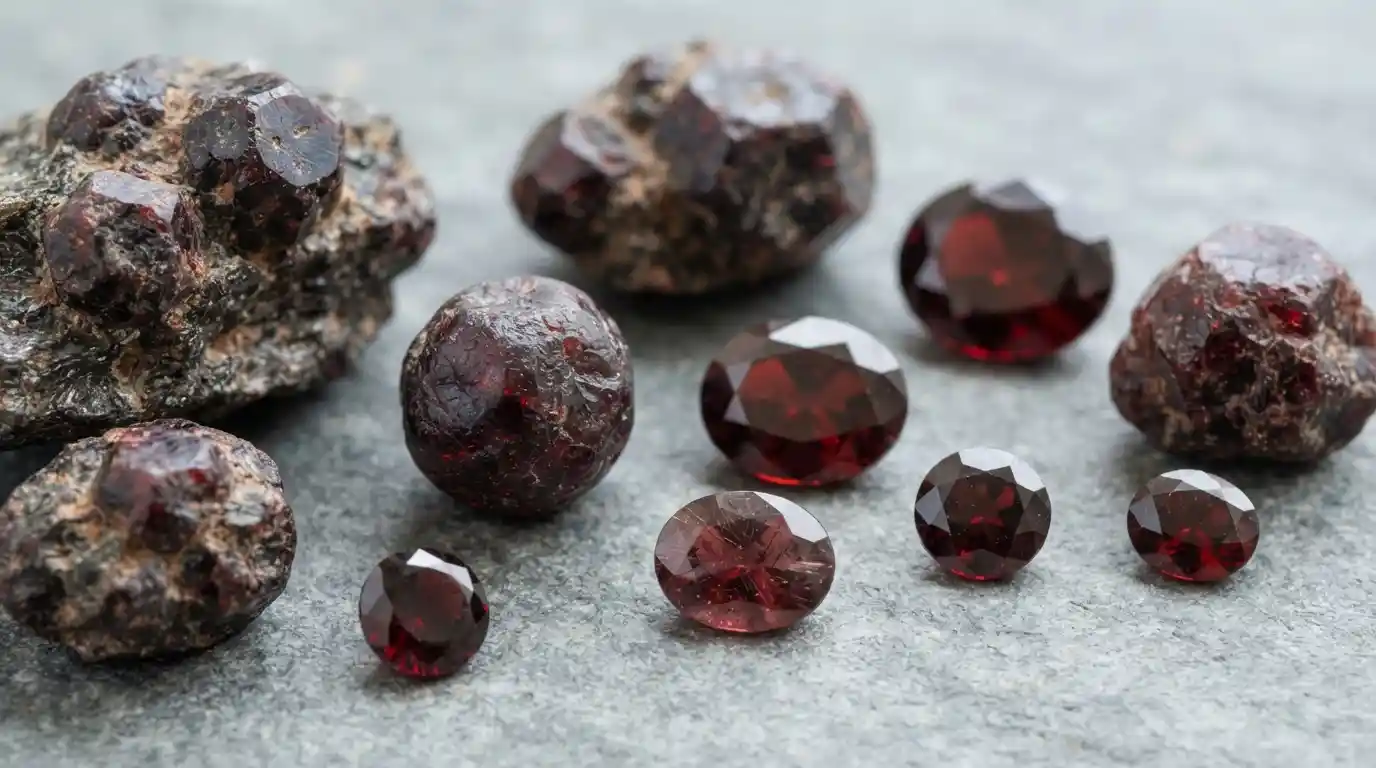
Garnet Spiritual Meaning: Benefits, Uses & Guide
Garnet spiritual meaning belongs to the realm of symbolism, personal interpretation, and modern crystal practice, but garnet itself is first a real mineral group with measurable physical and chemical properties. The name covers several closely related silicate minerals rather than one chemically identical gemstone, and gem-quality garnets occur in red, orange, green, purple, and other colors. Mineralogical references commonly recognize almandine, pyrope, spessartine, grossular, andradite, and uvarovite among the traditional garnet species, with compositions varying according to which elements occupy positions in the garnet crystal structure.
That material identity matters because claims about garnet spiritual meaning should not replace observations about what a specimen actually is. Color, transparency, inclusions, crystal habit, density, optical properties, and composition belong to mineralogy and gemology; ideas such as courage, grounding, passion, protection, or motivation belong to cultural or contemporary symbolic interpretation. Readers looking for the broader mineral overview can use the garnet meaning guide, while this page concentrates specifically on how spiritual associations can be understood without presenting them as scientific effects.
Within Gems Lore, related belief-centered material is organized in the Healing Crystal category. The useful boundary is simple: a garnet can be physically examined and scientifically tested, while its spiritual meaning is interpreted rather than measured.
Garnet Spiritual Meaning at a Glance
| Aspect | Evidence-based position |
|---|---|
| Material identity | Garnet is a mineral group composed of related silicate species |
| Common colors | Red is widespread, but garnets also occur in green, orange, purple, yellow, and other colors |
| Crystal system | Garnets used as gems are generally associated with the isometric crystal system |
| Mohs hardness | Approximately 6.5–7.5 across common gem garnets |
| Spiritual meaning | Modern interpretations often associate garnet with vitality, commitment, courage, grounding, or focused action |
| Scientific status | These symbolic associations are not established medical or physiological effects |
| Historical use | Garnet has documented use in jewelry, seals, adornment, and treasured objects across multiple cultures |
| Safe use | Ordinary handling of intact specimens is different from cutting, grinding, drilling, heating, or generating mineral dust |
| Best interpretive approach | Keep physical facts, documented history, and personal symbolism clearly separated |
GIA describes garnets as closely related minerals occurring in almost every color and reports refractive indices spanning roughly 1.714–1.888, specific gravity around 3.47–4.15, and Mohs hardness around 6.5–7.5 across the group. These ranges show why “garnet” is not one perfectly uniform material.
What Garnet Actually Is
A useful discussion of garnet spiritual meaning begins with mineral identity because visual resemblance alone cannot establish a specimen’s exact species or composition. The garnet group has a general silicate structural formula commonly represented as X₃Z₂(SiO₄)₃, with different elements occupying those structural positions. Iron, magnesium, manganese, calcium, aluminum, chromium, and other elements contribute to the chemistry of different garnet members. This compositional variability helps explain why garnets occur in such a broad range of colors and geological environments.
In gemology, garnets are generally singly refractive because of their isometric structure, although real specimens may show anomalous optical effects under some conditions. Their measurable properties can help separate garnet from look-alike materials, but precise identification may require more than color and a handheld inspection. Refractive index, specific gravity, spectroscopy, microscopy, and in some cases chemical analysis can become important when the exact garnet species or variety matters.
The workbook-specific technical discussion of internal features belongs on the garnet spiritual microscope inclusion notebook, while detailed optical behavior belongs on the garnet spiritual optical properties and color behavior guide. Those subjects are linked here rather than reproduced in full.
How Garnet Forms
Garnet forms in several geological settings, particularly where suitable temperature, pressure, and chemical conditions allow garnet-structured minerals to crystallize. Many garnets occur in metamorphic rocks, where changes in pressure and temperature transform earlier minerals into new mineral assemblages. Garnets can also occur in igneous environments and other specialized geological settings. The exact species that forms depends heavily on the available chemistry.
This geological history has no demonstrated connection to supernatural power. High pressure, metamorphism, trace elements, and crystal growth are geological processes, not evidence that a mineral stores emotions, intentions, or healing energy. Someone may choose to use formation as a metaphor for endurance or transformation, but that is a human interpretation placed on the specimen after the geological event.
Readers who want the petrological detail should use the garnet spiritual formation and deposit geology guide, which owns the deeper formation and locality discussion.
What Causes Garnet Color?
Garnet color is produced by mineral chemistry and the way particular elements interact with visible light. Iron and manganese contribute strongly to many red, orange, and brown garnets, while chromium and vanadium can be important in certain green varieties. Different species and mixtures can therefore look dramatically different even though they share the garnet structural family.
This point is important when interpreting garnet spiritual meaning by color. A modern practitioner might associate red garnet with drive, green garnet with renewal, or orange garnet with creativity, but those associations do not explain why the colors physically occur. Chemistry explains the observed color; symbolism explains what a person or tradition chooses to associate with that color.
Color alone can also mislead identification. A red gemstone is not automatically garnet, and a green garnet cannot be identified to a precise variety solely from a photograph. Technical confirmation may require appropriate gemological testing.
Diagnostic Traits of Garnet
For an intact specimen, initial observations may include color, transparency, luster, crystal shape, inclusions, apparent heft, and surface condition. Faceted garnets commonly display a vitreous luster, and many gem-quality stones are transparent to translucent. Garnets may form characteristic equant crystals in rough material, although broken, weathered, polished, or faceted examples can lose obvious external crystal form.
Hardness is useful but should not be treated as a casual home identification test. Deliberately scratching gemstones can damage either the test specimen or the object being tested. The same caution applies to destructive chemical, heat, or grinding tests. When identification matters financially, historically, or scientifically, non-destructive professional gemological examination is preferable.
The physical appearance of garnet can overlap with glass, spinel, ruby, tourmaline, zircon, and other red or differently colored materials. No discussion of garnet spiritual meaning can establish authenticity; symbolism cannot substitute for identification.
Documented Garnet History
Garnet has a genuine archaeological and jewelry history that does not need modern spiritual claims added to make it interesting. GIA records garnet use in ancient Egyptian adornment and notes its later use in Roman signet rings. Red garnets continued to appear in jewelry through later European periods, and Bohemian deposits became particularly important to a regional garnet jewelry tradition.
Historical terminology requires caution. Older words for red gems were not always mineralogically precise by modern standards. The term “carbuncle,” for example, was historically used for glowing or deep-red stones and was not restricted with modern gemological precision to one species. This means a historical text mentioning a red stone cannot always be translated directly into a confirmed modern garnet identification without supporting evidence.
Modern garnet spiritual meaning should therefore not be projected backward onto every ancient garnet object. Archaeological evidence may show that a stone was worn, valued, traded, buried, carved, or used decoratively; it does not automatically prove that the owner believed the exact contemporary metaphysical meanings now found in crystal literature.
Modern Garnet Spiritual Meaning
In contemporary crystal practice, garnet spiritual meaning is commonly framed around vitality, commitment, courage, grounding, passion, persistence, or renewed motivation. These themes can work as reflective metaphors. Someone might keep a garnet on a desk as a reminder to finish a project, wear it as a symbol of commitment, or use its deep red color as a personal cue for determination.
Those uses are interpretive rather than medical. There is no established scientific basis for claiming that holding or wearing garnet can treat depression, anxiety, cardiovascular disease, hormonal disorders, infertility, pain, immune problems, neurological conditions, or other health conditions. Garnet is not a medicine, and the presence of iron, manganese, magnesium, calcium, or other elements in a mineral does not mean the body can absorb or use those elements therapeutically through the skin.
A separate page discusses commonly reported garnet healing properties within the appropriate belief boundary. Such descriptions should be read as traditional or contemporary metaphysical interpretation, not as substitutes for medical evidence, diagnosis, or treatment.
Garnet, Grounding, and Stability
Grounding is one of the most frequent themes attached to garnet spiritual meaning. In practical terms, the idea can be reframed without making supernatural claims: a person may use a tangible object as a focus cue during journaling, planning, meditation, or reflection. The psychological usefulness, when present, comes from the person’s attention, habits, associations, and chosen ritual rather than a demonstrated measurable field emitted by the stone.
This distinction preserves the meaningful part of symbolic practice while avoiding unsupported mechanisms. A garnet can remind someone to return attention to a task. It cannot be assumed to regulate the nervous system, correct a biochemical imbalance, or produce a guaranteed emotional state.
A symbol is most defensible when it helps organize reflection without being mistaken for treatment.
Garnet and Motivation
Another common interpretation links garnet spiritual meaning with motivation, drive, and persistence. Its saturated red tones can culturally evoke heat, movement, blood, urgency, or intensity, which helps explain why modern symbolic systems may connect it with action and vitality. Color symbolism, however, differs among cultures and individuals.
A person might use garnet as a prompt to define one achievable goal, revisit an unfinished commitment, or identify a practical next action. That kind of use makes the stone a reminder rather than the cause of the outcome.
Garnet cannot guarantee productivity, financial gain, career success, manifestation, or another person’s cooperation.
Garnet and Relationships
Garnet is also frequently associated with commitment, affection, loyalty, or passion. Those themes may be meaningful in jewelry or personal rituals, especially when a garnet marks an anniversary, gift, family connection, or shared experience. The symbolism comes from the relationship and the meaning assigned to the object.
A gemstone cannot create consent, repair incompatibility, compel reconciliation, guarantee fidelity, or change someone else’s feelings. Relationship decisions should remain grounded in communication, boundaries, mutual respect, and personal safety.
Using garnet spiritual meaning as a private reminder of one’s own values is substantially different from treating a stone as a method for controlling another person.
Original Information Gain: Garnet Specimen and Photo Claim Checklist
The following checklist separates observations that can reasonably be made from a specimen or photograph from claims that require stronger evidence.
| Claim or observation | Can a normal photo support it? | What stronger evidence may be needed? | Common mistake |
|---|---|---|---|
| General visible color | Usually | Neutral lighting and color-calibrated photography for precision | Treating edited color as exact |
| Transparent vs. opaque appearance | Often | Direct inspection for borderline cases | Assuming clarity from one angle |
| Obvious surface damage | Often | Magnification for fine fractures or abrasion | Confusing reflections with chips |
| Rough crystal habit | Sometimes | Mineralogical context or specimen examination | Assuming every equant red crystal is garnet |
| Exact garnet species | Usually no | Refractive index, spectroscopy, chemistry, or other gemological tests | Identifying species by color alone |
| Geographic origin | No | Provenance records and sometimes advanced laboratory analysis | Inferring locality from appearance |
| Natural vs. imitation | Not reliably | Gemological testing | Trusting a listing photograph alone |
| Treatment status | Usually no | Appropriate laboratory examination | Assuming “natural-looking” means untreated |
| Historical provenance | No | Chain-of-custody records, archival documents, collection labels | Treating seller narrative as documentation |
| Spiritual energy | No scientific test established | Personal interpretation only | Presenting subjective experience as measured fact |
| Healing effect | No | Controlled medical evidence would be required | Treating testimonials as clinical proof |
This framework is particularly useful for online listings and social-media photographs. A visually attractive garnet can support observations about shape or apparent color, but it cannot independently prove a mine source, treatment history, exact mineral species, ancient ownership, or metaphysical effect.
For provenance-focused evaluation, use the garnet spiritual provenance disclosure checklist rather than relying on appearance alone.
Disputed and Unsupported Garnet Claims
Some garnet spiritual meaning statements become problematic when a symbolic idea is presented as an objective property. “Garnet represents commitment in my practice” is clearly interpretive. “Garnet emits a frequency that permanently changes hormones” is a biological claim requiring scientific evidence. The wording matters because one statement describes meaning, while the other asserts a measurable medical mechanism.
The same principle applies to historical claims. A modern crystal seller may attribute a current chakra interpretation to an ancient civilization without documenting a period source. Garnet certainly has ancient use, but ancient possession does not establish every later metaphysical system.
A careful reader should ask three questions: Is this a physical claim, a historical claim, or a modern symbolic interpretation? What kind of evidence would be appropriate for that category? Does the source actually provide it?
Color-Based Spiritual Interpretations
Modern practitioners sometimes vary garnet spiritual meaning according to color. Deep red stones may be associated with determination or commitment, orange garnets with creativity or enthusiasm, and green varieties with growth or renewal. These associations can be used as personal symbolic systems, but they are not standardized mineralogical properties.
Color categories can also be commercially confusing. Garnet encompasses many species and varieties, and some stones sit between simple color labels. A grayish, brownish, purplish, or mixed-tone specimen may not fit neatly into a metaphysical color chart. Readers comparing muted-colored minerals can browse gray crystals or the broader gray gemstones guide without assuming that color alone determines identity or meaning.
A symbolic color scheme can be personally coherent even when it is not scientifically testable.
Safe Ownership and Handling
Ordinary handling of a sound, intact garnet specimen or finished gemstone is very different from lapidary work. The main additional concern begins when a mineral is cut, drilled, ground, sanded, crushed, or otherwise processed in a way that generates fine particulate matter. Dust control, eye protection, suitable respiratory precautions, equipment safety, and professional lapidary practices become relevant during those activities.
Heating an unknown specimen is also inappropriate as a casual test. Heat may damage a gemstone, affect inclusions, alter some treatments or settings, or create additional hazards depending on associated materials. Destructive testing should not be used as a substitute for proper identification.
Detailed workmanship considerations belong in the garnet spiritual cutting, orientation, and polish guide.
Wearing Garnet Safely
Garnet’s hardness makes many varieties suitable for jewelry, but hardness measures resistance to scratching rather than complete resistance to breakage, impact, abrasion, or setting damage. A mounted stone can still suffer from knocks, worn prongs, poor setting geometry, or existing fractures.
Jewelry design matters because rings generally receive more impact than earrings or pendants. Protective settings, sound workmanship, periodic inspection, and sensible wear habits can reduce avoidable risk. The engineering side is covered separately in the garnet spiritual setting and wear engineering guide.
Spiritual significance does not make a stone physically indestructible.
Storing and Documenting a Garnet Specimen
Collectors should keep specimen identity, locality claims, invoices, labels, laboratory reports, acquisition records, and important photographs together whenever those records exist. Provenance can easily become separated from a mineral over time, particularly when handwritten labels or older collection tags are discarded.
Physical conservation also matters. Specimens should be stored so they are not repeatedly striking harder materials, rubbing against faceted surfaces, or losing associated labels. The dedicated garnet spiritual specimen conservation record covers structured documentation and conservation without turning a meaning page into a collection-management manual.
Good records preserve knowledge that symbolism alone cannot reconstruct.
Responsible Personal Use
Someone who values garnet spiritual meaning can use the stone in ways that remain grounded. It can serve as a visual prompt during reflection, accompany a journaling practice, mark a personal commitment, represent a goal, or simply be appreciated as a mineral with a long human history.
What should be avoided is converting symbolism into unsupported medical or behavioral claims. Garnet should not be powdered, ingested, dissolved into drinking water, or placed in a homemade crystal elixir for supposed mineral supplementation. Elements contained in a crystal lattice are not automatically safe or bioavailable nutrients.
The site’s broader evidence and safety boundaries are explained in the Gems Lore disclaimer.
Evidence, Limits, and Corrections
This article synthesizes established mineralogical and gemological information with clearly labeled historical and modern symbolic interpretation. It does not claim first-hand mine visits, laboratory analysis of the reader’s specimen, unpublished testing, personal authentication, or specialist examination of a particular garnet.
Where an exact species, origin, treatment status, unusual inclusion, archaeological attribution, or other technical conclusion materially matters, an appropriate gemological, mineralogical, geological, archaeological, or laboratory specialist may need to examine the actual object. The general editorial approach and scope of Gems Lore are described on the About page.
Readers who identify a factual issue, disputed attribution, or evidence that materially improves a claim can use the contact page so the record can be reviewed and corrected.
Frequently Asked Questions About Garnet Spiritual Meaning
What is garnet spiritual meaning?
Garnet spiritual meaning commonly refers to modern symbolic associations with grounding, vitality, courage, commitment, passion, and persistence. These are cultural or personal interpretations, not scientifically demonstrated properties of the mineral.
Is garnet a single mineral?
No. Garnet is a group of related silicate minerals with a shared structural pattern but differing chemistry. Common gem garnets include members associated with almandine, pyrope, spessartine, grossular, and andradite compositions.
Is garnet spiritual meaning historically ancient?
Garnet itself has ancient documented use, but that does not mean every modern metaphysical interpretation is ancient. Historical evidence supports garnet in jewelry, adornment, seals, and treasured objects; specific contemporary spiritual claims require their own historical evidence.
Does garnet have healing powers?
There is no established scientific evidence that garnet treats disease or produces specific physiological healing effects. Healing language in crystal practice should be understood as spiritual or symbolic unless supported by appropriate medical evidence.
Can garnet help with motivation?
A garnet can function as a personal reminder or focus object if someone chooses to associate it with motivation. The stone itself is not proven to cause motivation, productivity, financial success, or behavioral change.
Does red garnet have a different spiritual meaning from green garnet?
Modern symbolic systems often assign different themes to colors, such as determination for red or renewal for green. These interpretations vary between practitioners and are not mineralogical properties.
Can I identify garnet from a photograph?
A photograph may support observations about apparent color, transparency, crystal shape, or visible damage, but it usually cannot establish exact species, origin, treatment status, or authenticity with technical certainty.
Is garnet safe to touch?
Ordinary handling of an intact garnet specimen is generally distinct from cutting or processing it. Grinding, drilling, crushing, or sanding can generate dust and should be approached with appropriate lapidary safety controls.
Should garnet be put in drinking water?
No crystal should be treated as a nutritional or medical ingredient merely because it contains particular elements. Garnet should not be powdered, ingested, or used to prepare drinking-water elixirs.
What is the most evidence-aware way to use garnet spiritually?
Treat garnet spiritual meaning as a symbolic framework: use the stone as a reminder, journaling cue, meditation object, or representation of a chosen value while keeping medical, historical, mineralogical, and behavioral claims subject to appropriate evidence.
Final Perspective
Garnet spiritual meaning becomes more useful when the stone’s physical reality and its symbolic interpretation are allowed to coexist without being confused. Garnet is a diverse mineral group with measurable chemistry, optical properties, hardness, density, geological origins, and a substantial history of human use. Its associations with courage, grounding, passion, vitality, or commitment belong to modern and personal systems of meaning rather than laboratory measurement.
That distinction does not make symbolism meaningless. It makes the boundaries clearer. A garnet can carry personal significance, mark an event, represent an intention, or connect someone with a long tradition of appreciating gemstones while remaining a physical mineral rather than a medical treatment or guaranteed mechanism for changing circumstances.
The strongest approach is therefore evidence-aware: identify the material carefully, document historical claims, label modern interpretations as interpretations, preserve the specimen responsibly, and let personal meaning remain personal rather than turning it into unsupported scientific certainty.