7 Best Gray Crystals: Powerful Meanings & Positive Everyday Uses
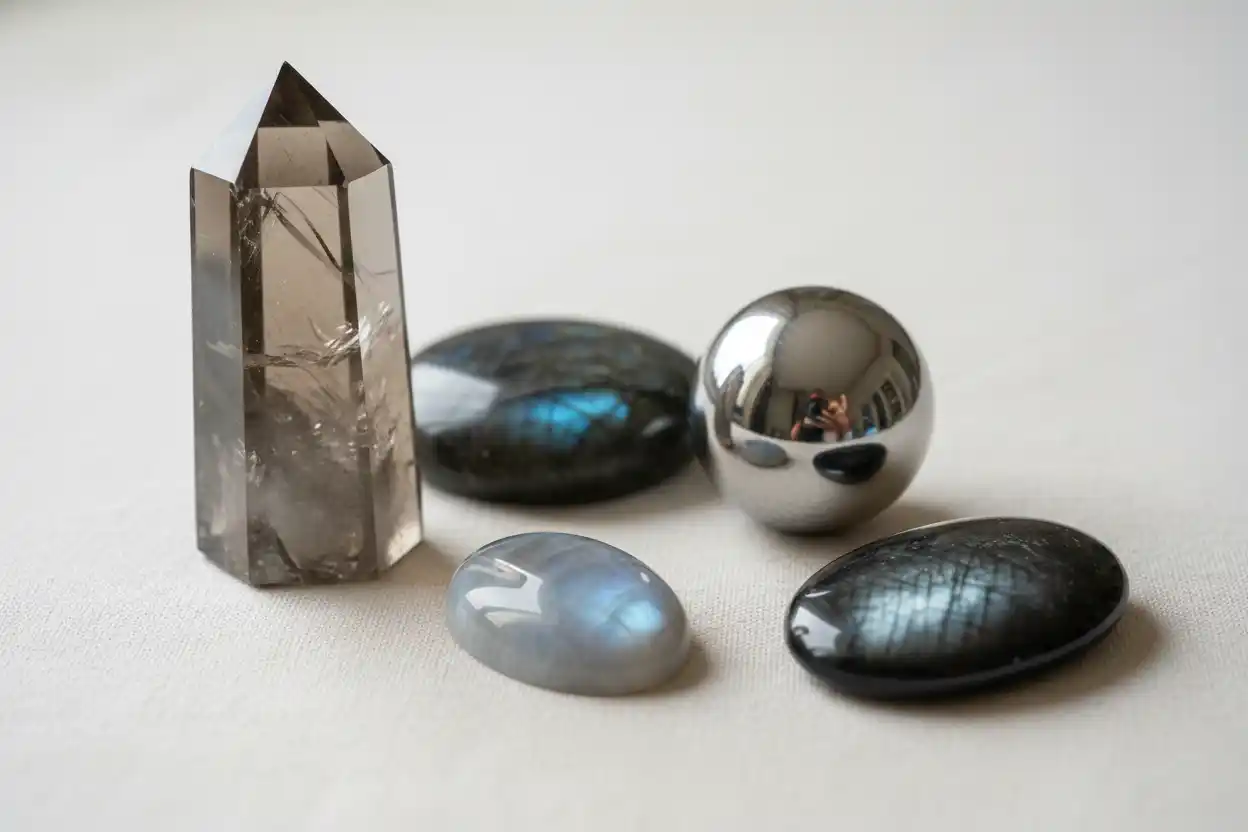
Gray crystals are commonly associated with balance, composure, reflection, patience, adaptability, and finding a steady position between extremes. Their colors can range from pale silver-gray and cloudy white-gray to charcoal, metallic steel, and deep smoky tones. Some remain understated until light reveals a flash, band, metallic sheen, or internal pattern, which helps explain why gray stones are often used symbolically for perspective and thoughtful decision-making.
Labradorite, larvikite, hematite, smoky quartz, gray moonstone, Botswana agate, and howlite all fit comfortably within a gray collection, but they are geologically very different. Some tolerate frequent jewelry wear, while others need more protection from scratching, impact, heat, or chemicals. Traditional meanings can provide a useful personal framework, but choosing the right stone should also account for hardness, structure, finish, and the way you actually plan to use it.
Labradorite and Larvikite for Perspective, Change, and Reflective Thinking
Labradorite can look gray, charcoal, or nearly black until light strikes the stone at the right angle and reveals flashes of blue, green, gold, orange, or mixed colors. This optical effect, called labradorescence, develops from interference within its feldspar structure rather than from a surface coating. A plain-looking gray stone can therefore become dramatically colorful when rotated.
That changing appearance has encouraged symbolism around transformation, perspective, imagination, and recognizing possibilities that are not immediately obvious. The traditions surrounding labradorite healing properties often use the stone as a reminder to approach change with curiosity instead of assuming the first impression tells the whole story.
For everyday use, a polished labradorite palm stone works well beside a notebook or creative workspace. Pendants and earrings are also practical because they expose the stone to less impact than rings. Feldspar is not as hard as quartz or sapphire, so exposed jewelry should be protected from repeated knocks.
Larvikite is frequently confused with labradorite because it can also show blue or silver flashes against a dark gray background. It is an igneous rock containing feldspar crystals rather than a single mineral species, and its reflective appearance is often called schiller.
Traditional larvikite healing properties are associated with grounded reflection, patience, adaptability, and practical insight. Its darker and more subdued appearance makes it a natural choice for people who prefer gray stones with occasional flashes rather than constant bright color.
Hematite and Smoky Quartz for Stability, Focus, and Practical Routines
Hematite provides a metallic interpretation of gray. It is an iron oxide and can appear steel-gray, silver-gray, blackish, or reddish when powdered. Polished hematite is especially distinctive because its metallic surface reflects light strongly and its relatively high density gives even a small piece a substantial feel.
The themes linked with hematite healing properties often emphasize grounding, discipline, concentration, and returning attention to practical concerns. It can function well as a symbolic desk stone for routines built around organization, study, or finishing tasks before moving to something new.
Natural hematite is not usually strongly magnetic. Highly magnetic jewelry sold under the hematite name may contain manufactured components or other substances, so buyers interested in genuine mineral specimens should not use magnetism as proof of authenticity.
Smoky quartz occupies the warmer side of gray. Some crystals look distinctly brown, while others appear gray, gray-brown, or almost black depending on depth of color and lighting. Because quartz ranks 7 on the Mohs scale, it offers useful durability for polished stones and jewelry.
Traditional smoky quartz healing properties often center on steadiness, perspective, letting go of distractions, and making practical decisions. Its transparent to translucent appearance can also provide a visual contrast with opaque hematite while supporting similar symbolic themes.
A smoky quartz point beside a planner, for example, can represent simplifying priorities. The benefit comes from the habit and meaning assigned to the object rather than from a demonstrated therapeutic force.
Gray Moonstone and Botswana Agate for Emotional Perspective and Patience
Gray moonstone combines subdued body color with a floating glow that can appear silver, white, or occasionally bluish. Moonstone belongs to the feldspar family, and its characteristic adularescence comes from light interacting with fine internal layers.
The traditions associated with moonstone healing properties commonly connect the stone with cycles, reflection, intuition, and recognizing that moods and circumstances change over time. Gray moonstone suits this symbolism especially well because its appearance can shift subtly as the stone moves.
It works best in pendants, earrings, or protected settings. Moonstone is softer than quartz and has cleavage, so rings require more care. A polished palm stone should also be stored away from harder gems that could scratch its surface.
Botswana agate presents gray in bands rather than flashes. Typical stones combine gray, taupe, brown, white, cream, pink, or muted orange in fine curved layers. As a chalcedony variety, it has useful quartz-family durability and takes a smooth polish.
The traditions surrounding Botswana agate healing properties commonly emphasize patience, reassurance, reflection, and working gradually through difficult changes. The slow layered appearance supports that symbolism naturally because the stone records repeated bands of mineral growth.
A Botswana agate palm stone can fit easily into journaling or quiet reflection. Its patterned surface provides enough visual detail to hold attention without the strong sparkle of faceted gems.
Howlite for Simplicity, Pause, and Deliberate Response
Howlite is usually white to pale gray with darker gray or black veining. It is softer than quartz and is frequently carved into beads, skulls, palm stones, and decorative shapes because it accepts polish and dye readily.
Its natural veining creates a calm marble-like appearance, but buyers should know that howlite is often dyed blue and sold as an imitation of turquoise. Natural white-gray howlite has its own identity and does not need added color to be useful or attractive.
Traditional howlite healing properties often focus on patience, calm responses, slowing down impulsive reactions, and making room for reflection. That symbolism translates well into practical routines. A small howlite stone beside a phone could become a reminder to reread a message before sending it, while a desk piece might symbolize taking a deliberate pause before making a decision.
Because howlite is relatively soft, it is better suited to pendants, beads, palm stones, or protected jewelry than exposed rings. It can also be scratched by harder stones when stored together.
Why Gray Crystals Are Linked With Balance and Neutral Perspective
Gray sits visually between black and white, which helps explain its strong symbolic association with neutrality, compromise, ambiguity, and seeing more than one side of a situation. Gray crystals are therefore often chosen when the desired theme is not dramatic action but measured judgment.
Labradorite and larvikite add another dimension because their quiet gray surfaces can suddenly display vivid flashes. This makes them particularly fitting symbols for hidden possibilities and changing perspective. Hematite emphasizes steadiness, while smoky quartz introduces transparency and depth. Botswana agate and howlite contribute pattern, and gray moonstone brings a softer shifting glow.
The traditions around crystals for clarity work well when used this way. A stone can act as a cue to write down facts, separate assumptions from evidence, or consider several possible responses before choosing one.
No special arrangement is required. The personal usefulness comes from repeatedly connecting the object with a behavior you want to practice.
Gray Crystal Jewelry: Hardness, Cleavage, and Surface Wear Matter
Gray stones vary greatly in durability despite their similar colors. Smoky quartz and Botswana agate are among the easiest choices for regular jewelry because quartz and chalcedony both rank around 7 on the Mohs scale.
Labradorite, larvikite, and moonstone are feldspar-rich and require more protection from scratching and impact. Their polished faces can lose crispness if repeatedly rubbed against harder stones.
Hematite is dense and attractive but can chip or fracture, while howlite is significantly softer and scratches more readily. The crystal hardness chart is useful when deciding whether a stone belongs in a ring, bracelet, pendant, or protected collection.
Storage matters as much as wear. Keeping softer gray stones in separate pouches or compartments prevents harder jewelry from scratching them.
Warm water, mild soap, and gentle wiping suit many sound stones, but avoid aggressive cleaning when a specimen contains fractures, coatings, glued components, or uncertain treatments.
Simple Ways to Use Gray Crystals in Daily Life
Gray crystals fit naturally into work and study environments because their colors are visually quiet. Labradorite beside a creative notebook can represent changing perspective, while hematite can mark a focused work period. Howlite can accompany a routine built around pausing before reacting.
Meditation can remain equally straightforward. Hold a smooth stone, notice its weight and texture, and return attention to breathing whenever the mind wanders. The stone becomes an anchor for the routine rather than a medical device.
Journaling is another useful option. Botswana agate can represent patience, gray moonstone changing emotional states, and smoky quartz separating practical concerns from mental noise.
A single stone connected with one clear habit often has more personal meaning than a large collection used without a specific purpose.
Conclusion
Gray crystals offer a restrained palette with rich differences in texture, optical effects, and symbolism. Labradorite, larvikite, hematite, smoky quartz, gray moonstone, Botswana agate, and howlite are traditionally linked with balance, patience, reflection, focus, and adaptable thinking. Choosing among them becomes easier when symbolism is considered alongside durability, polish, structure, and the way the stone will actually be handled or worn.
FAQs
What do gray crystals traditionally symbolize?
Gray crystals are commonly associated with balance, neutrality, reflection, composure, patience, adaptability, and practical judgment.
Which gray crystal is commonly linked with transformation?
Labradorite is frequently associated with transformation and changing perspective because its subdued surface can reveal vivid flashes when viewed from different angles.
Is larvikite the same as labradorite?
No. They can look similar because both may show blue or silver flashes, but larvikite is an igneous rock with feldspar crystals, while labradorite refers to a feldspar mineral variety.
Is hematite naturally magnetic?
Natural hematite is generally not strongly magnetic. Highly magnetic products sold as hematite may contain other substances or manufactured components.
Is smoky quartz gray or brown?
It can appear gray, brown, gray-brown, or almost black depending on color depth and lighting.
Is gray moonstone durable enough for rings?
It can be worn in rings, but feldspar is softer than quartz and has cleavage. Protective settings and sensible wear reduce the risk of damage.
Is howlite naturally gray?
Howlite is usually white to pale gray with gray or black veining. It is frequently dyed other colors, especially blue.
Which gray crystals are easiest to wear regularly?
Smoky quartz and Botswana agate offer useful quartz-family hardness. Labradorite, moonstone, hematite, larvikite, and howlite require somewhat more protection.
Can gray crystals improve concentration or emotional balance?
They can act as personal symbols or tactile prompts in focus and reflection routines, but there is no established evidence that crystals directly treat cognitive or emotional conditions.
Crystal meanings and wellness associations are traditional or personal practices, not established medical treatments.