Blue Calcite Healing Properties: 12 Powerful Claims, Hopeful Traditions & Safe Limits
Blue calcite healing properties are traditionally associated with calm communication, emotional reflection, inner peace, patience, sleep routines, creativity, self-expression, mental clarity, confidence, dream reflection, adaptability, and releasing tension. These meanings come from modern crystal traditions rather than established medical evidence. Blue calcite does not treat anxiety, depression, insomnia, throat problems, blood pressure, inflammation, pain, hormonal conditions, or nervous-system disorders through ordinary handling. Its most responsible use is symbolic, especially when its soft blue appearance becomes part of a deliberate routine for quieter reflection, careful communication, or winding down at the end of the day.
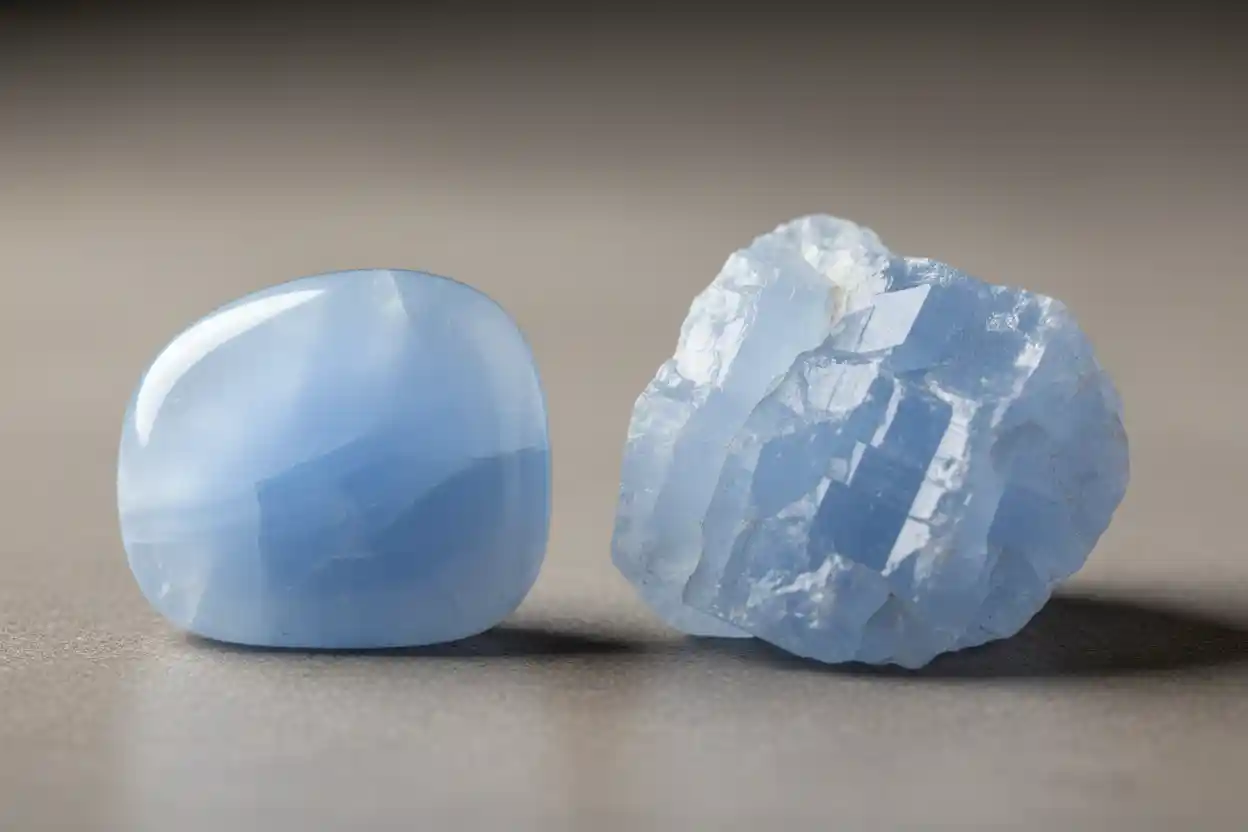
Blue calcite is a blue variety of calcite, a calcium carbonate mineral with the formula CaCO3. Calcite defines hardness 3 on the Mohs scale, has perfect cleavage in three directions, and reacts with dilute acids. These properties make blue calcite much softer and more fragile than quartz-family stones. Its pale blue color can range from nearly white blue to stronger cloudy blue, often with translucent areas, internal cleavage, and a waxy to glassy surface appearance. The mineral’s calcium content, color, and optical behavior are real, but none establishes therapeutic effects on the body.
Blue Calcite Calm and Inner-Peace Claims Work Best as Low-Stimulation Routine Cues
Calm is probably the most common theme attached to blue calcite. Its pale blue color and soft visual texture naturally encourage associations with quiet spaces, slower breathing, rest, and emotional gentleness. There is no established evidence that the mineral lowers stress hormones or regulates the nervous system, but it can become a consistent cue for creating a quieter environment when stimulation has become excessive.
A blue calcite stone beside a journal can represent ending work for the day, silencing unnecessary notifications, or spending a few minutes identifying what still needs attention tomorrow so it no longer has to be mentally rehearsed tonight. The crystals for inner peace tradition becomes more useful when calm is supported by practical conditions rather than attributed to an invisible force coming from the stone.
Inner peace should also not be confused with avoiding necessary action. If stress comes from an unsafe relationship, unrealistic workload, unresolved medical concern, or financial crisis, becoming calmer does not solve the underlying problem. Blue calcite symbolism is strongest when it supports enough calm to identify what actually needs to change.
Blue Calcite Communication Claims Encourage Gentler Language Without Altering Speech Ability
Blue calcite is frequently associated with communication because blue stones are commonly linked with speaking and self-expression in crystal culture. The stone is sometimes described as helping people find their voice or communicate difficult emotions more easily. These effects are not established physiological properties, but the symbolism can support preparation.
Someone may use blue calcite before a difficult conversation to write down the issue in one clear sentence, identify the specific example that matters, and decide what response would help. The crystals for communication tradition works best when the focus includes listening, asking questions, and avoiding unnecessary escalation.
Gentle communication does not mean surrendering a boundary. It can include declining a request, correcting inaccurate information, or stating that a conversation needs to stop if it becomes disrespectful. Blue calcite symbolism is useful when calm speech and clear boundaries remain compatible.
Blue Calcite Emotional-Reflection Claims Should Support Naming Feelings Rather Than Treating Mood Disorders
Blue calcite is often described as emotionally soothing or supportive during stress, sadness, or conflict. These themes can be personally meaningful, but the mineral does not treat depression, anxiety, trauma, panic, or another mental health condition.
A more responsible routine is to use the stone during journaling and ask what the emotional reaction is responding to. Sadness may reflect loss, anger may point toward a crossed boundary, and anxiety may highlight uncertainty. Naming that connection can make the next step easier to identify.
Traditional blue calcite benefits are therefore most useful when emotional support means creating space to reflect. Persistent or severe distress still deserves appropriate professional evaluation rather than increasingly complex crystal practices.
Blue Calcite Sleep Claims Can Support Bedtime Habits but Do Not Treat Insomnia
Blue calcite is frequently placed in bedrooms because its color and calm symbolism fit evening routines. Some crystal descriptions claim that it promotes deep sleep, prevents waking, or corrects insomnia. There is no established evidence that blue calcite directly changes melatonin, sleep architecture, or nervous-system activity.
A bedside stone can still act as a useful routine marker. It might represent putting away work, reducing stimulating screen use, dimming the environment, preparing tomorrow’s essentials, and ending the day at a consistent time. These behaviors are more relevant to a sleep routine than any presumed energy from the stone.
Sleep problems can have many causes. Persistent insomnia, breathing interruptions, repeated nightmares, or severe daytime sleepiness deserve appropriate assessment rather than reliance on a crystal beside the bed.
Blue Calcite Dream Traditions Support Dream Journaling Without Controlling Dream Content
Dream symbolism often accompanies blue calcite’s sleep reputation. The stone is sometimes said to increase dream recall, encourage vivid dreams, or support intuitive messages during sleep. These claims are not established effects of calcium carbonate.
The crystals for dreams tradition becomes safer when a crystal simply serves as a reminder to keep a notebook nearby and record dreams soon after waking. Regular attention to dreams can make recall feel easier because the person is intentionally preserving the memory.
Dreams should also not be treated automatically as predictions or factual messages. They can be personally interesting and emotionally revealing without providing reliable information about future events or another person’s intentions.
Blue Calcite Creativity and Self-Expression Claims Reflect Environment and Habit Rather Than Enhanced Brain Function
Blue calcite is often associated with creativity because its color is linked with communication, imagination, and relaxed expression. There is no established evidence that it increases creative brain activity, but the stone can become part of a workspace designed to support less pressured idea generation.
A writer or artist might use blue calcite to signal a brainstorming period where several possibilities are produced before any are evaluated. The goal is to reduce premature judgment and create room for experimentation. Creativity then develops through observation, practice, revision, and exposure to ideas.
Self-expression can be treated similarly. A stone can represent the decision to write honestly, make a sketch, practice a presentation, or communicate something that has been difficult to articulate. The expression comes from the person, while the crystal remains a visual cue.
Blue Calcite Mental-Clarity Claims Should Be Framed as Slower Thinking, Not Cognitive Enhancement
Blue calcite is sometimes marketed as a stone for clarity and mental organization. There is no established evidence that it improves memory, intelligence, concentration, or executive function. Its calm symbolism can nevertheless support a useful approach to complex decisions: slow the process down enough to separate facts from assumptions.
Someone may use the stone beside a notebook and write what is known, what remains uncertain, and which information would change the decision. This simple structure is more reliable than treating a strong impression as an answer.
Blue calcite may therefore symbolize mental spaciousness rather than enhanced cognition. The goal is not to think faster but to reduce unnecessary mental noise long enough to identify the actual question.
Blue Calcite Confidence and Adaptability Claims Fit Quiet, Prepared Action
Confidence traditions around blue calcite tend to emphasize calm self-expression rather than bold risk-taking. A person may still feel nervous before speaking in public or entering a new situation, but preparation can make the action more manageable.
Blue calcite can represent practicing the first sentence of a difficult conversation, reviewing the main point of a presentation, or identifying the next step during a transition. Confidence develops through experience and preparation, while the stone helps maintain continuity in the routine.
Adaptability follows the same principle. A plan that worked previously may need revision when responsibilities, health, work, or relationships change. Blue calcite symbolism is more useful when it represents adjusting thoughtfully rather than interpreting every change as failure.
Blue Calcite Is Calcium Carbonate With Perfect Cleavage and Mohs Hardness 3
Blue calcite’s actual mineral properties are central to its safe use. Calcite is calcium carbonate and defines hardness 3 on the Mohs scale, making it much softer than quartz, topaz, sapphire, or many common jewelry gems. It also has perfect cleavage in three directions, so a specimen can split or chip along smooth internal planes.
The general calcite healing properties tradition includes many colors of calcite, each assigned different symbolic meanings by crystal culture. Blue calcite is usually connected with calm and communication, while green, orange, and honey-colored varieties receive different interpretations. These distinctions are symbolic rather than scientifically demonstrated therapeutic differences.
The mineral’s softness explains why polished pieces can develop scratches relatively easily. It also makes collector specimens vulnerable to damage from drops, pressure, or contact with harder stones.
Blue Calcite Reacts With Acids and Should Never Be Cleaned With Vinegar or Acidic Solutions
Calcite reacts readily with acids, making acidic household cleaners a poor choice for blue calcite. Vinegar, citrus-based cleaners, and stronger acidic products can etch or damage the surface. This chemical behavior is one of the classic identification features of calcite and one of the most important practical care facts for owners.
Cleaning should therefore stay gentle. A soft dry cloth or brush is often enough for lightly dusty specimens, while brief contact with clean water can be used cautiously when necessary. Long soaking, steam, ultrasonic cleaning, abrasive powders, and aggressive scrubbing are unnecessary for a soft carbonate stone.
Crystal-cleansing rituals involving vinegar, saltwater, or harsh chemical solutions should be avoided. Personal symbolism does not require damaging the stone.
Blue Calcite Calcium Content Does Not Strengthen Bones, Teeth, or Correct Calcium Deficiency
Because calcite consists of calcium carbonate, wellness descriptions sometimes claim that blue calcite strengthens bones, improves teeth, supports calcium metabolism, or corrects deficiency. This reasoning is misleading. Calcium contained within a solid mineral is not delivered into the body through ordinary skin contact.
Holding a blue calcite stone is not equivalent to eating calcium-containing food or taking an appropriate supplement. The mineral does not release a controlled therapeutic dose simply because it contains calcium.
Anyone concerned about bone density, dental health, or calcium deficiency should rely on appropriate nutritional and medical guidance rather than crystal chemistry. The composition of a mineral describes what the stone is made of, not which conditions it treats.
Blue Calcite Jewelry and Display Need Extra Protection Because the Stone Scratches Easily
Blue calcite is much better suited to display, carvings, polished palm stones, and occasional low-impact jewelry than demanding everyday rings. A hardness of 3 means many everyday objects can scratch it, while cleavage increases the chance of chipping under impact.
If worn, pendants and earrings generally expose the stone to fewer knocks than rings or bracelets. Separate storage from quartz and other harder gems helps preserve polished surfaces. Collector pieces should also be placed on stable shelves where they are unlikely to fall.
The stone does not need to be placed in drinking water, powdered, or consumed for symbolic use. External display and careful handling provide all of the personal meaning without creating unnecessary risks.
Blue Calcite Healing Claims Cannot Treat Throat Problems, Blood Pressure, Pain, or Mental Health Conditions
Some blue calcite descriptions claim benefits for the throat, lungs, blood pressure, inflammation, pain, sleep, anxiety, or neurological health. These claims are not established therapeutic effects of calcium carbonate crystal.
Blue color symbolism does not create a medical connection with the throat or respiratory system, and calcium content does not make the stone a treatment for bone or muscle concerns. Physical symptoms require assessment based on their actual cause.
Blue calcite can remain meaningful as a calming object, decorative stone, or part of a reflective routine. Its value does not depend on assigning it medical powers.
Conclusion: Blue Calcite Healing Properties Stay Symbolic While Calcium Carbonate Chemistry Explains Its Real Behavior
Blue calcite healing properties are best understood as traditional themes of calm communication, emotional reflection, inner peace, patience, sleep routines, creativity, self-expression, clarity, confidence, dream reflection, adaptability, and releasing tension. Blue calcite itself is a soft calcium carbonate mineral with perfect cleavage, Mohs hardness 3, and sensitivity to acids. It can support meaningful personal routines, but it does not treat insomnia, anxiety, pain, blood pressure, respiratory problems, calcium deficiency, or other health conditions.
FAQs About Blue Calcite Healing Properties, Acid Sensitivity, and Safe Use
What are the main traditional blue calcite healing properties?
Blue calcite is commonly associated with calm, communication, emotional reflection, inner peace, sleep routines, creativity, clarity, patience, and self-expression.
Is blue calcite scientifically proven to heal?
No. There is no established evidence that blue calcite treats physical or mental health conditions through ordinary handling.
What is blue calcite made of?
Blue calcite is calcium carbonate with the chemical formula CaCO3.
How hard is blue calcite?
Calcite defines hardness 3 on the Mohs scale, so blue calcite scratches relatively easily.
Can blue calcite help with sleep?
It can be used as a bedtime routine cue, but it does not treat insomnia or directly alter sleep physiology.
Can blue calcite improve communication?
It can serve as a symbolic reminder to communicate calmly and clearly, but it does not directly change speech ability.
Does blue calcite provide calcium to the body?
No. Holding or wearing the mineral does not provide a therapeutic calcium dose.
Can blue calcite be cleaned with vinegar?
No. Acidic cleaners such as vinegar can damage calcite because calcium carbonate reacts with acids.
Is blue calcite good for everyday rings?
Its softness and cleavage make lower-impact use or display more practical than heavily worn rings.
Can blue calcite go in drinking water?
There is no need to put blue calcite in drinking water for wellness purposes. External symbolic use is simpler and safer.
Is blue calcite the same as other calcite colors?
They share the same basic calcite mineral identity, while color and inclusions can differ. Traditional meanings vary by color, but those metaphysical differences are not established therapeutic effects.
Can blue calcite reduce anxiety?
It may feel personally calming, but it is not an established treatment for anxiety disorders.
Blue calcite healing meanings are traditional or personal practices, not established treatments for physical or mental health conditions.