Botswana Agate Healing Properties: 11 Important Claims, Gentle Traditions & Safe Limits
Botswana agate healing properties are commonly described in modern crystal practice through ideas of calm, emotional steadiness, grounding, confidence, focus, comfort during change, and spiritual reflection. These are traditional or personal interpretations rather than established medical effects. Botswana agate has not been shown to treat illness, alter brain function, remove anxiety or grief, or produce a measurable healing force in the body. Its real identity is geological: a finely banded form of agate and chalcedony composed primarily of silicon dioxide, while the Botswana agate meaning used in crystal practice comes from symbolism people assign to its layered colors, origin, and appearance.
Botswana Agate Healing Properties: 11 Traditional Claims
The eleven recurring claim themes can be separated clearly rather than treating “healing” as one vague promise:
- Calm during tense moments
- Emotional balance
- Comfort during grief or transition
- Support for a consistent sleep routine
- Grounding and stability
- Courage and confidence
- Focus and patience
- Clearer communication
- Creativity and fresh perspective
- Protective symbolism and personal boundaries
- Chakra and spiritual reflection
Each theme can still have personal value when it is treated as a deliberate ritual or symbolic reminder. None requires the stone itself to cause a biological change.
A Fine-Banded Form of Quartz
Botswana agate is not a separate mineral species. It is a locality-associated variety of agate, which belongs to the chalcedony family of microcrystalline quartz. Its ideal chemical formula is SiO₂, the same basic composition as quartz. Quartz has a trigonal crystal system, although Botswana agate normally develops as dense microscopic intergrowths rather than large visible crystal points.
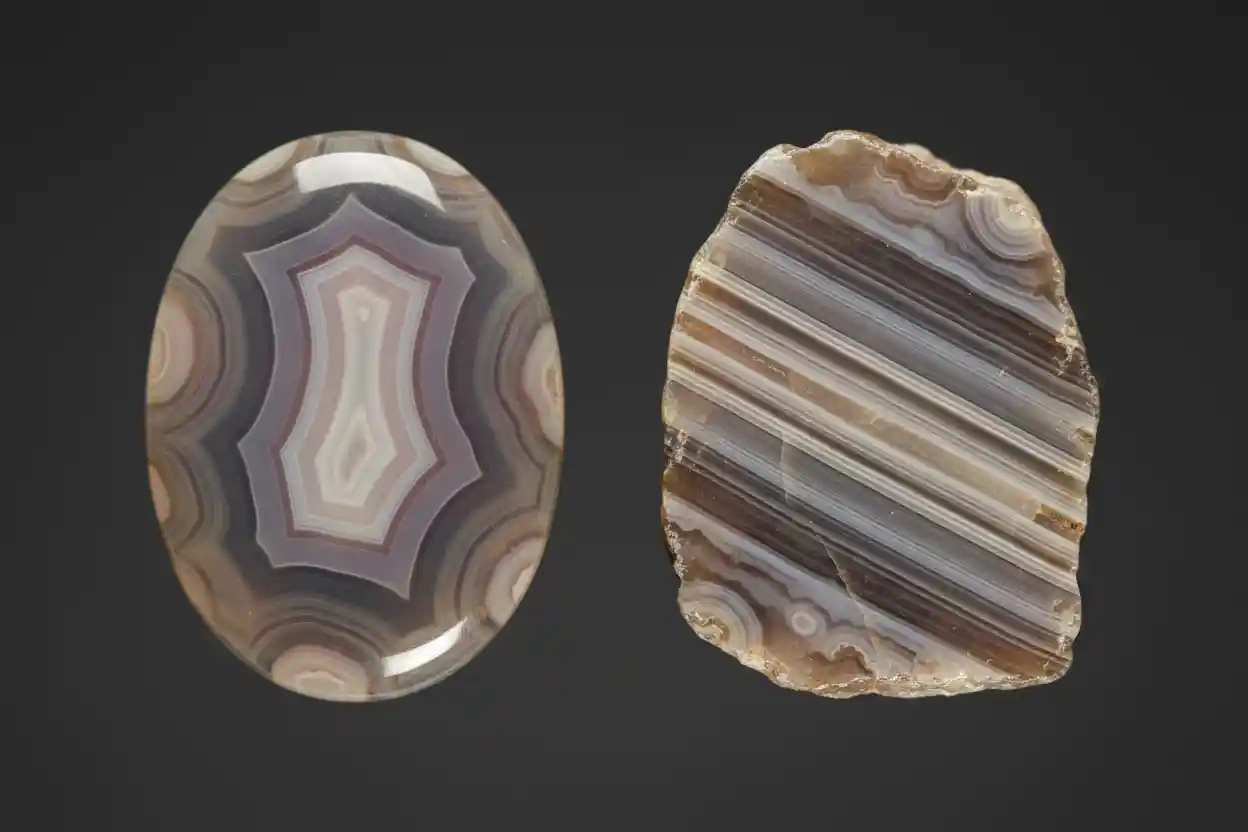
The stone is especially recognizable for fine parallel, curved, or concentric bands. Gray, white, smoky brown, pink, salmon, apricot, reddish, and muted purplish tones can occur, often with gradual transitions rather than sharply separated colors. Those patterns distinguish many specimens from more chaotic lace agates, strongly striped sardonyx, plain chalcedony, and brightly dyed commercial agates. Symbolic interpretations of these shades are discussed through Botswana agate color meaning, but color itself comes from the stone’s structure, impurities, and geological history rather than a healing property.
Natural chalcedony surfaces commonly show a waxy or dull luster, while a good polish can produce a brighter, glassier appearance. Botswana agate usually measures about 6.5 to 7 on the Mohs scale. It has no significant cleavage, but it remains brittle and can fracture conchoidally when struck. That combination makes polished stones and jewelry reasonably durable while still requiring protection from hard impacts and harder gems.
Chalcedony can contain small amounts of molecular water and hydroxyl-related groups within its microscopic structure, but Botswana agate is not classified as a hydrated mineral by its ideal chemical formula. That distinction matters when discussing water exposure: ordinary brief cleaning is very different from assuming the stone needs prolonged soaking for a ritual.
Fine Bands From Botswana’s Volcanic Rocks
The name Botswana agate reflects its association with Botswana in southern Africa. Bobonong Subdistrict in the Central District is one of the best-documented sources, with agates also reported from areas around the Motloutse River and Serowe. The stone occurs in association with volcanic rocks, where silica entered cavities, vesicles, and fractures and accumulated in repeated microscopic layers.
Those repeated deposits created the narrow bands that make the gem visually distinctive. Some nodules weather free from their original host rock and can later occur in surface deposits or drainage areas, while other agates remain embedded in the rock. The geology behind where Botswana agate is found therefore explains both its geographic name and the layered appearance that later became important to collectors and crystal practitioners.
Because Botswana agate is a variety rather than an independently recognized mineral species, it does not have a separate formal species type locality in the same sense as a newly described mineral. Its identity rests on the characteristic agate and chalcedony structure combined with its Botswana origin.
Calm, Emotional Balance, Grief, and Sleep
1. Calm During Tense Moments
Calm is one of the most familiar Botswana agate healing claims. A practical version of the idea is simple: hold or look at the stone while slowing your breathing, identifying the immediate problem, and deciding what needs attention first.
There is no demonstrated mechanism by which the silica bands in Botswana agate lower nervous-system arousal. The useful part is the pause you intentionally create. A familiar object can become a cue to stop reacting automatically and begin a breathing, journaling, or reflection routine.
2. Emotional Balance
People who describe Botswana agate benefits often include emotional steadiness, particularly when feelings seem scattered or intense. The stone can be used as a visual reminder to name an emotion before acting on it, separate a feeling from a decision, or write down what triggered a strong reaction.
The stone does not regulate mood. The routine built around it might encourage a more deliberate response because the person has chosen a consistent moment for reflection.
3. Comfort During Grief or Transition
Botswana agate is also associated with bereavement, endings, uncertainty, and major personal transitions in contemporary crystal practice. A polished stone kept beside a photograph, journal, or meaningful object may function as a physical reminder of a person, memory, commitment, or stage of life.
That part is belief, not biology. Botswana agate cannot remove grief or shorten a natural grieving process. A personally significant object can still have symbolic value when someone uses it to remember, reflect, or mark gradual change.
4. Support for a Sleep Routine
Some practitioners keep Botswana agate near the bed and associate it with quieter evenings or restful sleep. A safer interpretation is behavioral: placing the stone beside a journal can become the cue for putting away a phone, dimming lights, recording unfinished thoughts, and beginning the same bedtime sequence each night.
Botswana agate does not sedate the brain or treat insomnia. Consistent nighttime habits are the active part of that routine, not a force emitted by the stone.
Grounding, Confidence, Focus, and Communication
5. Grounding and Stability
Grounding language usually describes feeling present, steady, and less mentally scattered. With Botswana agate, someone might pair the stone with a simple sensory exercise by noticing its weight, temperature, bands, and texture while identifying what they can see, hear, and physically feel around them.
This is best treated as a metaphor rather than a mechanism. The stone does not physically anchor a person’s energy. Attention to immediate sensory information is the intentional behavior.
6. Courage and Confidence
Confidence claims can be turned into something concrete by carrying Botswana agate before a difficult meeting, presentation, conversation, or personal decision. Touching the stone can serve as a reminder to straighten posture, review prepared points, or take the first planned action despite discomfort.
No mineral property creates courage or changes self-esteem directly. Confidence develops through preparation, experience, choices, and repeated action. The stone can only act as a chosen prompt within that process.
7. Focus and Patience
The fine repetitive banding makes Botswana agate an appealing visual focus during study, planning, or quiet work. One approach is to place it beside a notebook and use it as a reset signal whenever attention starts drifting.
There is no evidence that Botswana agate increases concentration or cognitive performance. A visual cue can still remind someone to return to a task, silence distractions, or work for another planned interval.
8. Clearer Communication
Communication is another popular symbolic association. A person might hold the stone before a difficult discussion and use that pause to decide what they actually want to say, what tone would be useful, and what question they need answered.
The mineral does not alter speech centers, language processing, or another person’s reaction. The controllable part is preparation. Some people combine the ritual with short Botswana agate affirmations that focus on listening carefully, speaking accurately, or avoiding an impulsive reply.
Creativity and Protective Symbolism
9. Creativity and Fresh Perspective
Botswana agate’s intricate bands can make it useful as a visual prompt during drawing, writing, design, or brainstorming. Rather than waiting for the stone to create an idea, look closely at one pattern and use it as the starting point for free writing, sketching, color selection, or a five-minute idea exercise.
There is no established pathway by which Botswana agate increases creativity. What can help is creating a repeatable starting ritual that reduces the friction involved in beginning creative work. A structured Botswana agate practice can therefore focus on behavior instead of promising an invisible effect.
10. Protection and Personal Boundaries
Protective symbolism is often expressed as the idea that Botswana agate shields its owner from unwanted energy or emotional influence. A practical interpretation is to let the stone represent a boundary you have already chosen, such as declining an unreasonable request, leaving an unhealthy conversation, limiting repeated interruptions, or taking time before agreeing to something.
The stone is not a physical or energetic shield against harm. What changes a situation are the boundary, the decision, and the action taken to enforce it.
Chakra and Spiritual Reflection
11. Chakra and Spiritual Awareness
In contemporary chakra practice, Botswana agate’s gray and brown tones are often connected with root-chakra themes such as stability and grounding, while warmer pink, salmon, or apricot bands may be used in sacral-focused practices involving emotion and creativity. Pale bands are sometimes incorporated into more contemplative spiritual work. The exact correspondences vary between traditions.
Chakras are a spiritual framework, not anatomical structures demonstrated by modern medicine. A Botswana agate chakra practice therefore works best as meditation, symbolism, or personal reflection rather than as a claim about organs, nerves, or measurable energy centers.
The Botswana agate spiritual meaning is similarly personal. Someone may use its repeating bands to reflect on patience, gradual change, continuity, or the idea that difficult periods develop in layers rather than resolving all at once. The symbolism can be meaningful without needing the mineral to cause a supernatural event.
Safe Physical Care
Botswana agate’s Mohs hardness of roughly 6.5 to 7 makes it suitable for beads, pendants, cabochons, earrings, and many rings, but hardness does not make it indestructible. Its brittle tenacity means a hard impact can chip an edge or fracture a stone. Store it separately from harder gems such as sapphire, ruby, and diamond, and avoid tossing polished pieces together where repeated contact can scratch surfaces.
For home cleaning, a soft cloth and mild soapy water are usually sufficient. Avoid harsh household chemicals, abrasive powders, prolonged heat, steam cleaning, and unnecessary ultrasonic cleaning, particularly when a piece may be dyed, fractured, repaired, or mounted in jewelry. Sudden temperature changes are also unnecessary risks for quartz-family gems.
Brief contact with clean water during ordinary washing is generally reasonable for intact Botswana agate. Prolonged soaking is not needed, especially for jewelry, treated stones, or specimens with fractures and attached components. The specific considerations around Botswana agate water safety are therefore mostly about sensible care rather than the stone dissolving in normal water.
Cleansing Without Abrasion
Ritual cleansing is different from physical cleaning. If cleansing has spiritual meaning for you, there is no need to soak Botswana agate, scrub it, expose it to chemicals, or subject it to extreme heat. Sound from a bell or singing bowl, quiet reflection, placing the stone in a dry dedicated space, or simply pausing to restate the intention connected with it can serve the same symbolic purpose.
These methods protect the stone while keeping the ritual clearly personal. Sound, reflection, and dry placement are common approaches to cleansing Botswana agate without confusing symbolic practice with physical decontamination or medical treatment.
Conclusion
Botswana agate is a durable, finely banded chalcedony and quartz gem whose real properties come from silica chemistry, microscopic structure, and volcanic geology. Its eleven popular healing themes can still carry personal meaning when they are understood as symbols, habits, and intentional routines rather than proven therapeutic effects. Used with those limits in mind, the stone can become a thoughtful visual cue for reflection without asking geology to do the work of medicine, psychology, or personal action.
Frequently Asked Questions
What are Botswana agate healing properties?
They are traditional and contemporary crystal-practice claims involving calm, emotional balance, grief support, grounding, confidence, focus, communication, creativity, protection, sleep routines, and spiritual reflection. These effects have not been established as medical properties of the stone.
What is Botswana agate made of?
Botswana agate is a banded variety of agate and chalcedony composed primarily of silicon dioxide, SiO₂. It belongs to the quartz family.
How hard is Botswana agate?
Botswana agate is typically about 6.5 to 7 on the Mohs hardness scale. It resists ordinary scratching fairly well but can still chip or fracture after a strong impact.
Why does Botswana agate have bands?
Its bands developed as silica accumulated in repeated microscopic layers within cavities and fractures in volcanic rock. Changes during deposition produced the fine variations in color and pattern.
Can Botswana agate reduce stress or anxiety?
Botswana agate has not been shown to directly reduce anxiety through a mineral or biological mechanism. Using it as a cue for breathing, reflection, or another calming routine may still be personally useful.
Can Botswana agate help with grief?
The stone cannot remove grief or medically treat emotional distress. Some people use it as a memorial object or reflection cue during bereavement and major life changes.
Is Botswana agate suitable for jewelry?
Yes. Its hardness makes it practical for many jewelry styles, although its brittle nature means it should still be protected from strong impacts and harder gemstones.
What chakra is Botswana agate associated with?
Contemporary practice commonly connects darker gray and brown tones with the root chakra and warmer pink or orange tones with sacral symbolism. Chakra associations are spiritual interpretations rather than anatomical facts.
Is Botswana agate safe in water?
Brief washing with clean or mildly soapy water is generally reasonable for intact Botswana agate. Avoid prolonged soaking when a stone is dyed, fractured, repaired, or mounted with components that may react to moisture.
How should Botswana agate be cleansed?
For ritual cleansing, sound, quiet reflection, intention-setting, or placement in a clean dry space avoids unnecessary water, chemicals, heat, and abrasion. Physical dirt should instead be removed gently with a soft cloth and mild cleaning.
Crystal healing claims are traditional or personal beliefs and should not replace qualified medical or mental health care.