Botswana Agate Meaning: Facts, Formation & Symbolism
Botswana agate meaning is commonly associated with steadiness, transition, patience, emotional composure, and finding structure during uncertain periods. Those ideas belong to modern symbolism. Materially, Botswana agate is a locality-associated variety of banded agate from Botswana, composed principally of chalcedony and quartz rather than a separate mineral species with its own chemical formula.
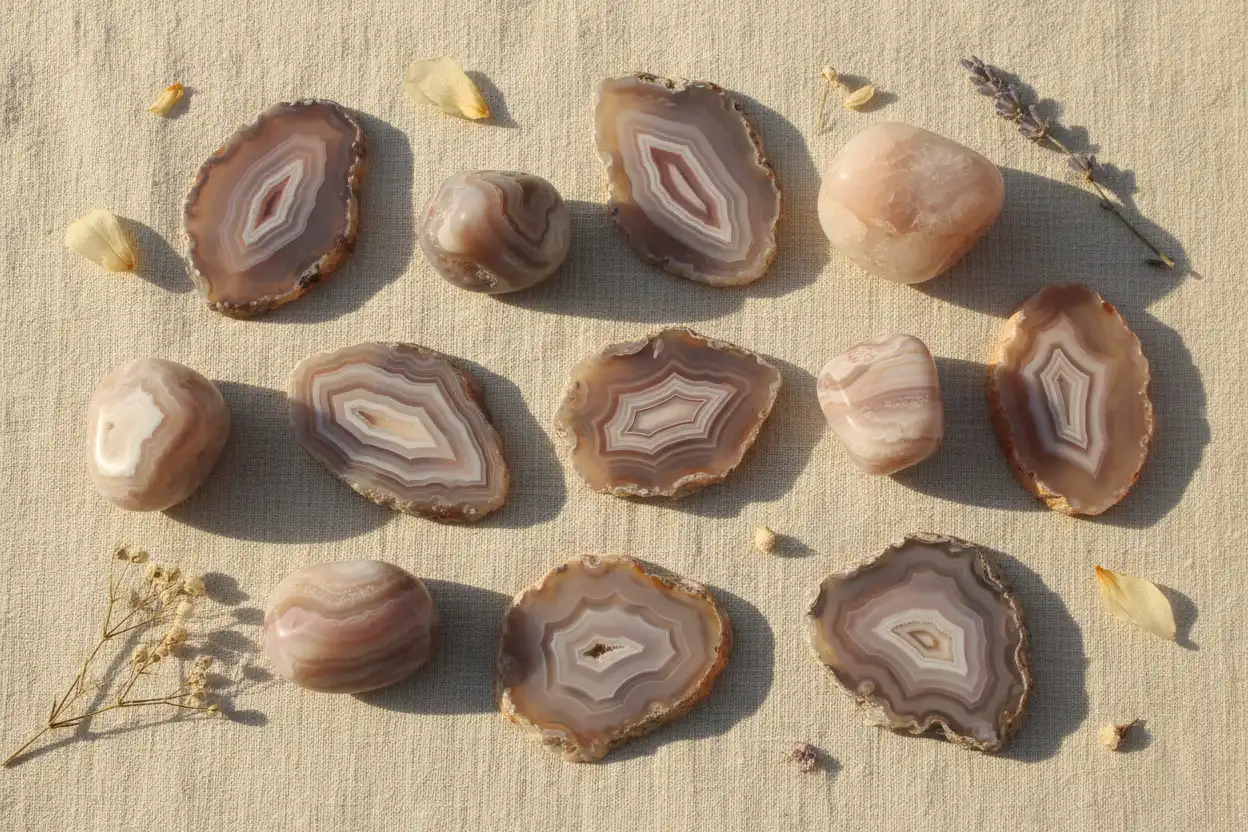
Its visual identity comes from repeated bands that can combine gray, white, brown, muted pink, cream, lavender-gray, and occasionally warmer orange or reddish tones. Some pieces show tight parallel lines, while others develop curved, concentric, or fortification-like patterns around former cavities. Those bands are geological records of repeated silica deposition and changing growth conditions, not evidence that the stone accumulated layers of emotional or spiritual energy.
For broader material-first references, the Gemstone Guides organize stones by geological and gemological identity before cultural interpretation.
What Is Botswana Agate?
Botswana agate is a variety of agate, and agate is a patterned form of chalcedony within the quartz family. Its principal chemistry is silica, SiO₂. At microscopic scale, chalcedony consists of extremely fine intergrowths of quartz and related silica structures rather than one large transparent crystal.
The word “Botswana” describes geographic association and commercial identity, while “agate” describes the banded silica material. It does not create a new mineral species.
| Property | Typical Botswana agate characteristics |
|---|---|
| Material type | Banded agate / chalcedony |
| Mineral family | Quartz |
| Principal chemistry | SiO₂ |
| Structure | Microcrystalline to cryptocrystalline silica aggregate |
| Typical colors | Gray, white, brown, pink, cream, lavender-gray and locally orange-brown |
| Pattern | Fine parallel, curved, concentric or fortification-style bands |
| Mohs hardness | Approximately 6.5–7 |
| Cleavage | None |
| Fracture | Commonly conchoidal to uneven |
| Luster | Waxy to vitreous when polished |
| Transparency | Translucent through individual bands to locally opaque |
| Common forms | Nodules, slabs, cabochons, beads, carvings and polished specimens |
| Separate mineral species? | No |
The ranges above describe chalcedony-rich Botswana agate generally. Natural pieces vary because individual bands can contain different proportions of microscopic inclusions, iron-bearing phases, porosity, quartz textures, and secondary minerals.
What Makes Botswana Agate Distinctive?
Fine banding is the most recognizable characteristic. Many specimens contain numerous narrow layers rather than a few broad color zones, creating a detailed pattern that becomes especially visible after cutting and polishing.
Color is equally variable. A piece does not need to display every commonly marketed shade to qualify as Botswana agate, and one specimen may be almost entirely gray and white while another combines pinkish, brown, cream, and smoky layers.
The strongest identification therefore comes from several observations working together: chalcedony-like physical properties, authentic agate banding, appropriate texture, natural variation, and reliable provenance. Pattern alone cannot prove Botswana origin.
How Botswana Agate Forms
Agate forms when silica-bearing fluids enter cavities, fractures, or other open spaces in rock and deposit silica in successive stages. Rather than filling the entire space at once, mineralization can proceed episodically. Each stage may differ slightly in chemistry, silica concentration, included particles, oxidation state, or growth texture, producing bands with different colors and translucency.
As deposition continues, layers commonly follow the walls of the original cavity. This produces curved or concentric banding. Where growth advances from several surfaces or responds to irregular cavity geometry, more angular fortification patterns can develop.
Some cavities eventually become completely filled with chalcedony. Others retain central openings that may later acquire crystalline quartz. Weathering can then free resistant agate nodules from softer host rock, allowing them to survive transport and collect in sediment.
The detailed deposit-scale processes, host rocks, silica movement, and geological interpretation are covered in Botswana agate formation and deposit geology.
Why Botswana Agate Has Gray, Pink, Brown, and White Bands
The different colors are not separate minerals stacked like manufactured laminate. Most of the body remains silica-rich chalcedony, while microscopic inclusions, iron-bearing compounds, oxidation states, scattering, porosity, and structural differences among bands influence visible color.
Iron-bearing material can contribute yellow, orange, reddish, brown, or muted pink tones in appropriate conditions. Gray and smoky areas may reflect extremely fine inclusions, structural effects, or combinations of several microscopic constituents, while pale and white bands may contain comparatively little strongly colored material.
A specific coloring mineral should not be assigned simply by looking at a polished cabochon. Statements such as “every pink band is hematite” or “all gray Botswana agate is colored by manganese” go beyond what ordinary visual inspection can demonstrate.
For a deeper examination of band translucency, reflected and transmitted light, microstructure, and why colors shift with illumination, see Botswana agate optical properties and color behavior.
Botswana Agate Is a Variety Name, Not a Laboratory Identification
A seller can correctly use the term Botswana agate as a trade and locality-associated description, but the label itself is not analytical evidence.
Gemological testing can establish that an object is chalcedony or agate. Provenance evidence is needed to support the geographic part of the name.
This distinction becomes important when visually similar banded agates are sold without traceable source information. Fine gray, pink, white, or brown banding may be compatible with Botswana material while still being insufficient to prove origin.
Original Botswana Agate Specimen and Photo Checklist
The following checklist is designed to help evaluate an unfamiliar specimen or listing without pretending that photographs can prove everything.
Confirm an agate-like host
Look for compact chalcedony rather than coarse visible grains or obvious cleavage. A polished surface should generally have the dense, smooth character expected from quartz-family material.
Examine the band structure
Natural bands should appear integrated through the material. Fine parallel lines, curved contours, concentric zones, and fortification patterns are all plausible.
Look beyond the most colorful area
Inspect the whole stone. Authentic material can contain subdued gray or cream areas beside stronger pink, brown, or orange bands.
Compare rough and polished surfaces
Weathered rough can be dull and unimpressive. A cut face may reveal banding that was almost invisible through the exterior rind.
Check for natural irregularity
Band thickness, curvature, color, and translucency should not be expected to remain perfectly uniform. Small interruptions, fractures, cloudy areas, and textural variations are normal geological features.
Inspect fractures for concentrated color
Strong dye can accumulate along cracks, drill holes, porous areas, or surface-reaching boundaries. Such concentration can justify treatment investigation, although it does not by itself prove artificial coloration.
Backlight thinner areas
Some bands may transmit more light than others. Variation in translucency can help reveal internal structure and distinguish superficial pattern from material extending through the stone.
Look for silica-style fracture
Where rough breakage remains visible, conchoidal or irregular fracture is more compatible with chalcedony than the strong planar cleavage seen in minerals such as calcite.
Use magnification
A loupe can reveal band boundaries, tiny fractures, fillings, coatings, polish, inclusions, and color concentrations that are difficult to evaluate with the unaided eye.
Do not identify Botswana origin from colors alone
Gray-and-pink banding can support a visual comparison, but it cannot establish a country, mine, or deposit.
Be cautious with identical product batches
Natural agate pieces vary. Numerous beads or cabochons with unnaturally identical band placement and coloration deserve closer inspection.
Do not reject subtle material
Botswana agate is often attractive precisely because of restrained, finely layered colors rather than extreme saturation.
Preserve provenance information
Original labels, supplier records, parcel documentation, and acquisition history may be more important to locality attribution than the visual appearance.
Avoid destructive testing on important material
Do not scratch, chip, acid-test, or grind an attractive collector specimen simply to verify properties that can be investigated by less damaging methods.
Treat metaphysical wording separately
Terms such as grounding, transition stone, comfort crystal, or energy stabilizer provide no evidence for material identity or geographic origin.
The Botswana agate microscope inclusion notebook examines magnified band boundaries, inclusions, fractures, treatment clues, and the limits of microscopy in more depth.
Botswana Agate Claims: What the Evidence Can Support
Botswana agate meaning is easier to interpret when geological claims, provenance claims, and modern symbolism are not mixed together.
| Claim | Evidence status | More accurate interpretation |
|---|---|---|
| Botswana agate is a separate mineral species | Incorrect | It is a locality-associated variety of banded chalcedony |
| Its principal chemistry is silica | Supported | Chalcedony is predominantly SiO₂ |
| Fine banding records repeated mineral growth | Supported | Agate bands reflect successive stages of silica deposition and structural development |
| Every Botswana agate has the same colors | Incorrect | Natural color and band proportions vary considerably |
| Every pink band has one universal coloring mineral | Too absolute | Exact color causes can require specimen-specific analysis |
| Gray, pink, white and brown bands prove Botswana origin | Unsupported | Pattern and color alone cannot establish provenance |
| All intensely colored material is dyed | Too absolute | Unusual saturation deserves examination, not automatic rejection |
| Botswana agate has an ancient Botswana crystal-healing tradition | Unsupported without documentation | Modern trade identity should not be projected backward without historical evidence |
| Botswana agate symbolizes stability | Modern symbolism | Reasonable as a personal or cultural interpretation |
| Botswana agate physically absorbs emotional distress | Unsupported metaphysical claim | No standard gemological measurement establishes this effect |
| Botswana agate treats anxiety or depression | Unsupported medical claim | A chalcedony specimen should not replace healthcare |
| Botswana agate guarantees protection or luck | Unsupported supernatural claim | Such ideas belong to belief rather than mineral science |
The value of this table is not merely to label claims true or false. It shows which questions can be resolved through mineral testing, which require historical or provenance documentation, and which remain matters of personal interpretation.
How Hard Is Botswana Agate?
Botswana agate has approximately the same hardness expected for chalcedony, around 6.5–7 on the Mohs scale. That makes it much more scratch-resistant than materials such as calcite, gypsum, fluorite, or many softer ornamental stones.
Hardness is useful diagnostically but is not unique to Botswana agate. Other agates, jaspers, quartz varieties, and several unrelated minerals can fall within comparable ranges.
A scratch test therefore cannot establish geographic origin, and deliberate scratching of a polished piece is unnecessary when other evidence is available.
Botswana Agate Has No Prominent Cleavage
Chalcedony lacks the perfect cleavage displayed by minerals such as calcite. Broken agate typically produces conchoidal to irregular fracture, reflecting its dense silica structure.
This distinction can be useful when a blue-gray or brownish object has been given a vague commercial name. A stone that repeatedly separates along smooth rhombohedral planes would be inconsistent with normal agate behavior.
Polished beads and cabochons may conceal natural fracture surfaces, so laboratory or gemological testing becomes more important once rough diagnostic features have been removed.
What a Microscope Can and Cannot Prove
Magnification is particularly useful with fine-banded agate because individual layers may differ in translucency, porosity, inclusions, microfracturing, and polish response.
A microscope can help reveal whether color follows natural growth zones or appears concentrated along cracks. It can also reveal resin, coatings, foreign particles, polishing defects, cavities, or later mineral growth.
What microscopy usually cannot do alone is prove that the stone came from Botswana. Locality attribution may require geological context, trace-element comparison, supply documentation, or a documented chain of custody.
Likewise, seeing an iron-colored particle does not automatically justify naming its exact mineral species without additional testing.
Natural Color, Dye, and Other Treatments
Agate and chalcedony can accept artificial coloring under suitable conditions, so treatment is a reasonable consideration whenever a specimen shows unusual color behavior.
Dye may penetrate porous layers preferentially, collect along fractures, or create colors uncommon in untreated material. Treatments can also exploit natural differences among agate bands, making some layers respond more strongly than others.
However, a treated stone can still be genuine natural agate. The accurate description would distinguish the natural chalcedony host from its modified color rather than simply calling the entire object fake.
Strong evidence of treatment matters most when a seller represents the color as natural or charges a premium specifically for untreated material.
Botswana Agate Versus Other Banded Agates
Botswana agate belongs to a much larger agate family. Numerous deposits produce gray, brown, pink, white, red, blue, or multicolored banded chalcedony, sometimes with patterns that overlap visually.
This makes origin-by-pattern identification unreliable. A collector can learn to recognize appearances associated with particular deposits, but resemblance is not equivalent to provenance.
For comparison, boulder opal meaning describes an entirely different silica-rich gem material in which precious or common opal remains naturally attached to ironstone or another host. Both materials can show striking layers, yet their structure, water content, optical behavior, formation, and durability differ substantially.
Similarly, bornite meaning concerns a metallic copper-iron sulfide rather than silica. These contrasts illustrate why pattern or color should never replace material identification.
Documented History Versus Invented Ancient Lore
Agate has a long archaeological and lapidary history. Humans have fashioned banded chalcedony into beads, seals, carvings, cameos, amulets, and decorative objects across many cultures.
That broad history does not prove that the specific modern trade category Botswana agate carried today’s meanings in antiquity.
A claim that an ancient culture used “Botswana agate” for anxiety, smoking cessation, childbirth, protection, or chakra work would need evidence identifying the actual stone, archaeological context, cultural interpretation, and historical source. General statements about ancient agate use are not enough.
A careful account therefore separates the well-established history of agate from the much more recent symbolic vocabulary attached to Botswana agate in contemporary crystal markets.
Botswana Agate Meaning in Modern Symbolism
Modern Botswana agate meaning commonly emphasizes stability, patience, gradual change, composure, resilience, and adapting to transitions.
Its physical appearance makes those metaphors intuitive. The stone is built visually from many layers, each distinct but joined into one coherent body. A person can interpret those bands as a reminder that progress can occur incrementally rather than through one dramatic event.
Someone might keep a polished stone near a journal while working through a complicated decision, use its banding as a visual cue to separate a large problem into smaller steps, or carry it during a period of change as a reminder to maintain routines that remain under personal control.
In these examples, the object has symbolic value because the user assigns it a practical meaning. No invisible mineral mechanism is required.
Transition as a Layered Metaphor
“Transition stone” is one of the more fitting modern descriptions when treated metaphorically rather than literally. An agate band does not erase the layer before it; a new layer develops alongside what already exists.
That visual structure can represent the idea that change often accumulates rather than replacing a person’s entire life at once.
Someone beginning a new job, moving home, ending a project, or adjusting to a changed routine might use Botswana agate as an object associated with maintaining continuity while adapting.
The stone does not cause the transition or guarantee a favorable outcome. It serves as the chosen reminder.
Botswana Agate and Grounding
Grounding can mean different things depending on context. In electrical systems it has a precise technical definition. In psychological coping exercises, grounding can refer to bringing attention back to immediate sensory experience. In crystal practice, it is often described as an energetic effect.
Botswana agate can be used safely within the second and third frameworks if the distinction remains clear. Holding a smooth, cool object and deliberately noticing its weight, texture, banding, and temperature can provide a tangible focus during a reflective exercise.
That does not establish that chalcedony drains negative energy into the earth or changes a measurable human energy field.
Does Botswana Agate Reduce Anxiety?
Botswana agate is frequently marketed as a calming stone, and some modern sources make more specific claims involving anxiety, panic, grief, depression, or emotional trauma.
Those statements should not be converted into medical promises.
A person may find a familiar object soothing or may use it as part of breathing, journaling, or sensory grounding. Such a practice can coexist with appropriate mental-health care. It does not demonstrate that SiO₂ itself treats an anxiety disorder or alters brain chemistry through ordinary touch.
Persistent or severe symptoms deserve qualified medical or mental-health support rather than gemstone substitution.
Does Botswana Agate Have Healing Properties?
No established gemological property demonstrates that Botswana agate medically heals the body.
Its measurable characteristics include silica composition, microcrystalline structure, hardness, density, refractive behavior, fracture, banding, inclusions, and geological origin. These can be tested and documented.
Claims that the stone detoxifies organs, improves fertility, treats smoking dependence, cures depression, balances hormones, improves circulation, or removes disease belong outside established mineral science unless supported by appropriate clinical evidence.
Symbolic or spiritual use should not interfere with diagnosis, medication, therapy, or other necessary healthcare.
Chakra Associations
Modern crystal practices sometimes associate Botswana agate with the root chakra, sacral chakra, or other energy centers depending on the dominant color of a particular piece.
These assignments are spiritual interpretations rather than gemological classifications. A gray-and-pink band cannot be measured for chakra activity using standard mineralogical instruments.
Someone who uses chakra symbolism can still choose the stone as a meditation focus. The appropriate description is that the mineral is being used within a spiritual framework, not that its banding proves an anatomical effect.
Cutting Reveals the Geological Pattern
Rough Botswana agate can conceal much of its beauty beneath a dull rind. Sawing through a nodule reveals the internal geometry of the bands and lets a cutter choose which surface will show the strongest pattern.
Orientation matters. One cutting plane may expose dozens of tight parallel lines, while another crosses the same structure at an angle and creates broader curved bands. Central cavities, fractures, weak areas, color distribution, and translucency further affect the decision.
Polishing then increases contrast and allows light to penetrate translucent bands more effectively.
The detailed relationship among rough orientation, pattern exposure, fracture management, shape, and polish belongs in Botswana agate cutting, orientation and polish.
Jewelry Durability
Botswana agate’s quartz-family hardness makes sound material useful for many jewelry forms, including cabochons, beads, pendants, earrings, bracelets, rings, and carvings.
Hardness does not make a stone indestructible. Thin edges, drilled holes, natural fractures, sharp carving details, or internal cavities can still chip under impact. Rings also encounter more repeated knocks and abrasion than pendants.
Protective setting design, stone thickness, fracture location, and intended wear therefore matter. Those mechanical decisions are covered in Botswana agate setting and wear engineering.
Where Botswana Origin Actually Matters
Botswana origin matters because the locality-associated name is part of the material’s commercial identity. If a seller specifically claims Botswana provenance, the evidentiary question becomes different from simply asking whether the object is agate.
Useful provenance can include supplier documentation, old parcel records, collection labels, photographs associated with acquisition, mine or regional information, and a traceable chain of custody.
The Botswana agate provenance disclosure checklist provides a structured way to evaluate what a locality claim actually rests on.
Pattern recognition can support a preliminary opinion, but it should be reported proportionately: “consistent with commonly marketed Botswana agate” is not the same statement as “proven to originate in Botswana.”
Buying Context Without Turning Meaning Into a Shopping Guide
Material identity should be established before metaphysical promises influence a purchase. Useful seller information includes representative photographs, dimensions, weight, condition, treatment disclosure, whether the material is natural agate, and what evidence supports a Botswana-origin claim.
Marketing terms such as “healing grade,” “high vibration,” “guaranteed calming,” or “rare spiritual quality” do not establish authenticity.
When the actual question is seller selection, pricing, disclosure, returns, or comparing offers, use the dedicated guide on where to buy Botswana agate rather than treating symbolic meaning as a purchasing test.
Safe Ownership and Handling
Normal handling of an intact Botswana agate cabochon, bead, carving, or specimen does not require unusual precautions. The relevant safety distinction is between solid chalcedony and fine respirable dust produced during lapidary work.
Agate is silica-rich. Sawing, drilling, grinding, and polishing can generate respirable crystalline-silica dust, so lapidary work should use suitable wet methods, local extraction, eye protection, and appropriate respiratory controls rather than uncontrolled dry grinding.
The fact that a polished stone can be worn safely does not make its dust safe to inhale.
Botswana agate should not be ground into powder for ingestion or placed in drinking water as a crystal elixir. Symbolic practice does not require consuming mineral material.
Important specimens can benefit from baseline photographs documenting fractures, rind, banding, labels, polish, and storage condition. The Botswana agate specimen conservation record provides a structured way to track those changes.
A Practical Evidence Ladder for Botswana Agate Claims
Different questions about Botswana agate require different kinds of evidence.
Direct observation can document banding, color, translucency, fracture, surface texture, dimensions, rind, and visible condition.
Basic gemological testing can determine whether hardness, specific gravity, refractive behavior, and fracture are consistent with chalcedony.
Microscopy can examine band boundaries, inclusions, dye concentrations, fracture fillings, polishing features, and surface coatings.
Spectroscopy and structural methods can provide stronger confirmation of silica phases or unusual associated minerals when ordinary testing is insufficient.
Chemical analysis can investigate trace elements or inclusions when a specific color-causing claim requires evidence.
Geological context can explain how agate formed and whether associated textures are consistent with a particular deposit environment.
Provenance documentation is required to move from “this looks like Botswana agate” to a defensible geographic claim.
Historical evidence is necessary before attributing a specific use or belief to an earlier culture.
Symbolic interpretation includes stability, transition, comfort, grounding, patience, and chakra associations. These are human meanings rather than intrinsic mineral properties.
What Botswana Agate Meaning Can Reliably Include
Botswana agate meaning is clearest when material identity, documented history, and symbolism remain separate.
Materially, it is banded chalcedony associated with Botswana, composed principally of silica and characterized by fine layers that can combine gray, white, brown, muted pink, cream, lavender-gray, and warmer tones. Its bands record repeated geological growth and variations within silica-rich mineralization rather than accumulated emotional energy.
Historically, agate has been carved and collected for a very long time, but that broad record should not be transformed into an invented ancient Botswana-agate healing tradition. Specific cultural claims require evidence tied to the correct material and context.
Symbolically, the layered structure lends itself naturally to ideas of gradual change, stability, patience, and maintaining perspective during transitions. A person can use the stone as a reminder of those intentions without claiming that it medically treats anxiety, controls luck, absorbs negative energy, or produces a scientifically established grounding force.
Gems Lore explains its material-first approach on the About page. Health, spiritual, and informational limitations are set out in the Disclaimer, factual corrections or supporting evidence can be submitted through Contact, and site data practices are described in the Privacy Policy.
Botswana agate needs little embellishment to be distinctive. A small polished slice can preserve numerous mineral-growth episodes in bands only fractions of the stone’s total thickness, while cutting orientation can transform a dull rough nodule into an intricate geological pattern. Botswana agate meaning becomes most useful when that real material story comes first and its modern symbolism remains what it is: a human interpretation inspired by a naturally layered stone.