10 Popular Chrysocolla Healing Claims: Hopeful Traditions, Verified Facts & Safe Use
Chrysocolla healing properties are commonly described through themes of calm, emotional balance, communication, confidence, creativity, focus, compassion, resilience, personal boundaries, and spiritual reflection. Some of these ideas draw on the stone’s blue-green color and its long name history, while others belong mainly to contemporary crystal practice. None establishes a medical effect. Chrysocolla has not been shown to treat anxiety or depression, alter brain function, remove emotional distress, or transmit a measurable healing force through the body. Its verified identity is mineralogical: chrysocolla is a soft, hydrated copper-bearing silicate that commonly develops in the oxidized zones of copper deposits, while the chrysocolla meaning used in crystal practice comes from symbolic interpretations of its color, appearance, history, and association with copper minerals.
Chrysocolla Healing Properties: 10 Popular Claims
The ten recurring themes can be kept genuinely distinct without stretching one general idea into several nearly identical benefits:
- Calm during stressful moments
- Emotional balance
- Clear communication
- Confidence in self-expression
- Creativity and fresh ideas
- Focus and mental organization
- Compassion and relationship reflection
- Resilience during change
- Protective symbolism and personal boundaries
- Chakra and spiritual reflection
These claims can still have personal value when chrysocolla is used as a cue for journaling, pausing, preparing for a conversation, organizing a problem, or beginning a reflective practice. The meaningful action comes from the person, not from a demonstrated biological effect of the mineral.
A Hydrated Blue-Green Copper Silicate
Chrysocolla is a valid mineral species, although its structure and composition are more complex and variable than those of familiar minerals such as quartz or calcite. A modern formula is commonly written approximately as Cu₂₋ₓAlₓ(H₂₋ₓSi₂O₅)(OH)₄·nH₂O, with x less than 1. In simpler terms, it is a hydrated copper-aluminum silicate whose chemistry can vary naturally between specimens. Mineralogical references generally place it in the orthorhombic system, although chrysocolla is often extremely fine-grained, poorly crystalline, cryptocrystalline, or gel-like in appearance rather than occurring as obvious textbook crystals.
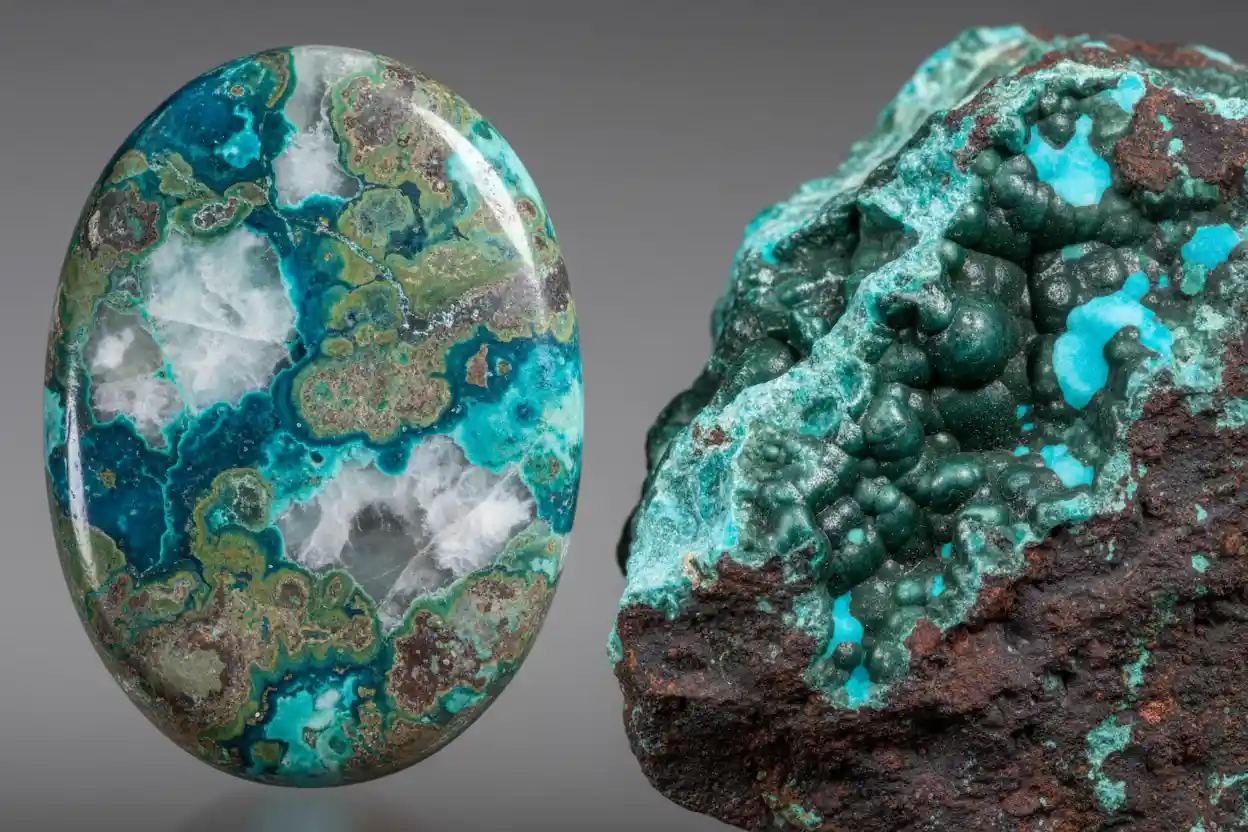
Most specimens form botryoidal masses, rounded coatings, crusts, vein fillings, earthy deposits, or smooth enamel-like surfaces. True well-formed chrysocolla crystals are unusual, and needle-like forms sold or labeled as crystalline chrysocolla can represent pseudomorphs where chrysocolla replaced an earlier mineral. Its luster ranges from vitreous to waxy and earthy depending on structure, purity, and surface texture.
Color is one of chrysocolla’s strongest identifying features. It commonly appears turquoise blue, blue-green, green, deep blue, or darker when mixed with impurities. Brown and rarely yellow tones can also occur. Copper is central to the blue-green appearance, although associated minerals may change the final look of a specimen. The symbolism attached to these shades is explored through chrysocolla color meaning, but color remains a result of mineral chemistry and structure rather than evidence of a healing effect.
Pure chrysocolla is soft, usually around 2.5 to 3.5 on the Mohs scale. It is generally brittle to somewhat sectile and commonly shows conchoidal or irregular fracture rather than useful gem-quality cleavage. That softness matters because many polished stones marketed as chrysocolla are not composed of soft chrysocolla alone. Silica can impregnate or surround chrysocolla, producing much harder chrysocolla-in-chalcedony material that accepts a stronger polish and is far more practical for jewelry.
This difference explains why two pieces sold under the same general name can behave very differently. A soft porous blue-green mass may scratch easily with ordinary objects, while a quartz-rich chrysocolla cabochon can approach the durability of chalcedony. Appearance alone is not enough to determine how a particular piece should be handled.
An Ancient Name With a Complicated History
The word chrysocolla has genuine antiquity, but that fact needs careful interpretation. Theophrastus used the term around 315 BCE. It comes from Greek words meaning “gold” and “glue,” referring to substances used in processes associated with soldering gold. The historical term did not necessarily describe the exact modern mineral species every time it appeared, because ancient mineral names often covered groups of visually similar substances rather than chemically defined species.
The modern mineral name was revived in European mineralogical literature in the early nineteenth century. That means chrysocolla has a real historical name connection, but it would be inaccurate to claim that today’s detailed set of emotional, chakra, communication, and wellness beliefs has been documented continuously since classical antiquity. Modern crystal practice combines older color symbolism and gemstone traditions with much newer interpretations.
Chrysocolla forms as a secondary mineral in the weathered and oxidized portions of copper deposits. Water and oxygen alter primary copper minerals near the surface, allowing new copper-bearing minerals to develop in fractures, cavities, veins, and porous rock. Chrysocolla commonly occurs alongside malachite, azurite, cuprite, tenorite, quartz, opal, and other secondary minerals.
Important occurrences are known across major copper-producing regions. Arizona contains classic chrysocolla localities at Morenci, Globe-Miami, Ray, and other copper districts. New Mexico, Utah, Nevada, and Michigan also have documented occurrences in the United States. Outside the country, notable material has come from Chile, Mexico, Peru, the Democratic Republic of the Congo, Zambia, Israel, Russia, and Australia. The geology behind where chrysocolla is found is therefore tied closely to oxidation zones in copper-rich deposits rather than one isolated gemstone locality.
Because the name predates modern mineral-species conventions and has a complex historical usage, assigning chrysocolla one simple formal discovery site would be misleading.
Calm and Emotional Balance
1. Calm During Stress
Chrysocolla is often described as soothing or calming, partly because blue-green colors are widely associated with quiet water, open skies, and natural landscapes. A practical use is to make the stone the cue for a short pause during tense moments. Seeing or holding it can signal that it is time to slow breathing, stop typing an immediate reply, or decide whether a situation actually requires an instant response.
There is no demonstrated mechanism by which hydrated copper silicate directly lowers nervous-system arousal. The useful element is the routine. Repeatedly pairing one object with a deliberate pause can make the habit easier to remember.
2. Emotional Balance
Emotional balance is a related but separate claim. Instead of focusing on immediate calm, it concerns how someone interprets and responds to strong feelings over time. Chrysocolla can be placed beside a journal and used as the cue to separate what happened from what was felt, what was assumed, and what still needs to be clarified.
The stone does not regulate mood or remove emotional distress. The chrysocolla benefits described in crystal practice become more practical when they point toward reflection, communication, rest, or appropriate support rather than promising automatic emotional change.
Communication, Confidence, and Creativity
3. Clear Communication
Blue and turquoise stones are frequently associated with communication in contemporary spiritual systems, and chrysocolla is often placed prominently in that group. A grounded way to use the idea is to treat the stone as preparation for an important conversation. Identify the main point, decide what information is actually relevant, and choose one question that needs a clear answer.
Chrysocolla does not change speech centers, improve language processing, or control another person’s reaction. Communication improves when someone prepares carefully, speaks accurately, and listens before responding.
4. Confidence in Self-Expression
Someone can know exactly what needs to be said and still hesitate to say it. Confidence in expression is therefore different from communication skill itself. Chrysocolla can serve as a reminder before a presentation, boundary-setting conversation, interview, meeting, or creative critique that preparation has already been done and the next step is to speak.
That part is behavior, not mineral biology. Confidence grows through practice, experience, skill, and repeated action. Short chrysocolla affirmations can support the ritual when they focus on realistic intentions such as speaking calmly, asking directly, or saying no without unnecessary explanation.
5. Creativity and Fresh Ideas
The shifting mixtures of blue, green, turquoise, brown, and matrix minerals make chrysocolla visually distinctive, so it can work well as a creative prompt. A writer, artist, designer, or maker might keep a polished piece nearby and use it as the starting cue for ten minutes of unrestricted brainstorming, sketching, color exploration, or free writing.
There is no established mechanism through which chrysocolla activates creativity. The routine can still help because beginning a creative task often matters more than waiting to feel inspired. The stone marks the beginning rather than causing the idea.
Focus, Relationships, and Change
6. Focus and Mental Organization
Chrysocolla is sometimes associated with clarity or thoughtful decision-making. Instead of assuming the stone makes the mind sharper, it can be assigned a simple role: when the stone comes out, the problem goes onto paper. List the facts, uncertainties, options, possible consequences, and information still needed.
This is best treated as a metaphor rather than a mechanism. Chrysocolla does not improve attention span or executive function through contact. Organizing information can nevertheless make a complicated problem easier to understand.
The ways to use chrysocolla are most useful when they accompany a concrete practice rather than an expectation that the stone will make a decision automatically.
7. Compassion and Relationship Reflection
Chrysocolla is frequently associated with empathy, understanding, and gentler relationships. Those ideas can be translated into behavior by using the stone as a reminder to check whether an assumption about another person’s motive has actually been verified, or whether a conversation would benefit from a genuine question instead of a conclusion.
The mineral cannot create compassion in one person or make another person behave differently. Relationships improve through communication, mutual respect, boundaries, accountability, and sometimes distance when a relationship is unhealthy.
8. Resilience During Change
Hope and renewal are recurring modern chrysocolla themes. During relocation, career change, relationship transition, recovery from disappointment, or another period of uncertainty, someone can use the stone while separating the situation into what has already changed, what remains controllable, and what action needs attention next.
Chrysocolla does not make difficult transitions painless or guarantee a positive outcome. The ritual may still be useful because it turns an undefined sense of disruption into smaller questions that can be addressed one at a time.
Boundaries and Spiritual Reflection
9. Protective Symbolism and Personal Boundaries
Some crystal traditions describe chrysocolla as protecting emotional energy or keeping unwanted influences away. There is no verified mineral mechanism that creates this kind of invisible protection.
The idea becomes more useful when protection is translated into a real boundary. The stone might represent a decision not to answer work messages after a certain time, to leave an aggressive conversation, to refuse pressure for an immediate decision, or to limit contact when someone repeatedly ignores stated limits.
The stone does not enforce the boundary. The person does. Chrysocolla can simply represent the commitment to maintain it.
10. Chakra and Spiritual Reflection
Modern crystal practice most often associates chrysocolla with the throat chakra because of its blue and turquoise coloring and its strong communication symbolism. Green-blue specimens may also be connected with the heart chakra through themes of compassion, relationships, and emotional openness. Individual systems differ in the exact correspondence.
Chakras are a spiritual framework, not anatomical structures established by medical science. A chrysocolla chakra practice therefore belongs to meditation, symbolism, religion, or personal spirituality rather than treatment of the throat, heart, thyroid, nervous system, or other physical structures.
The chrysocolla spiritual meaning often centers on expression, patience, compassion, hope, and thoughtful change. Its vivid copper-derived colors make those associations understandable from a symbolic perspective. They remain interpretations rather than measurable forces produced by the mineral.
Safe Care for Soft Chrysocolla
Chrysocolla requires more careful handling than many popular quartz-family stones because pure material is soft. With a typical Mohs hardness of about 2.5 to 3.5, it can be scratched by many common objects and by almost every familiar jewelry gemstone. Abrasive dust, stiff brushes, rough fabric, and harder stones can damage a soft surface.
Jewelry durability depends heavily on composition. Chrysocolla that has been naturally silicified or mixed with chalcedony can be much harder and more practical for cabochons, pendants, earrings, and carefully worn rings. Soft porous chrysocolla is better suited to protected jewelry, carvings, or collector specimens. Stabilized material may also behave differently from untreated stone because resin has been introduced to improve strength.
For cleaning, begin with the least aggressive method. A soft dry cloth is often enough for lightly handled pieces. A slightly damp cloth can be used cautiously on stable polished material, but prolonged washing and soaking are unnecessary. Avoid ultrasonic cleaning, steam, harsh detergents, bleach, acids, abrasive powders, stiff brushes, and sudden temperature changes.
Chrysocolla is a hydrated mineral, so water is part of its mineral chemistry. That does not mean ordinary moisture instantly destroys the stone, but it does reinforce the need to distinguish brief careful cleaning from prolonged immersion. Porous material, matrix specimens, stabilized stones, glued jewelry, fractures, and mixed-mineral pieces can all respond differently to water.
The safest answer to whether chrysocolla is safe in water is therefore cautious: brief surface contact may be acceptable for some stable pieces, while soaking should not be the default.
Chrysocolla also contains copper and can occur with other copper minerals. Natural specimens should never be soaked in drinking water to make crystal elixirs, and mineral dust or residue should not be intentionally ingested. Decorative mineral specimens are not prepared or tested as food-contact products.
Dry Cleansing for Chrysocolla
Ritual cleansing does not require physical soaking. Chrysocolla’s softness, hydration, variable porosity, and frequent association with other copper minerals make dry symbolic methods especially sensible. Sound, quiet reflection, intention-setting, or keeping the stone in a clean dedicated space can all serve as personal cleansing practices.
A bell, singing bowl, meditation period, or spoken intention can mark the transition between one use and another without exposing the surface to salt, chemicals, or prolonged moisture. These methods do not remove a scientifically established harmful energy from chrysocolla. Their purpose is symbolic.
The gentlest ways to cleanse chrysocolla avoid salt burial, water baths, abrasive rubbing, intense heat, and repeated handling of fragile botryoidal surfaces. A spiritual practice should not create unnecessary mineral damage.
Conclusion
Chrysocolla is a soft hydrated copper silicate whose real character comes from variable chemistry, blue-green coloration, secondary formation in copper deposits, and often delicate physical properties. Its ten popular healing themes can provide meaningful prompts for calm, communication, creativity, relationships, resilience, boundaries, and reflection, but they remain traditional or personal interpretations rather than proven therapeutic effects. Used carefully, chrysocolla can serve as a powerful visual symbol while the practical change remains in the decisions and behaviors built around it.
Frequently Asked Questions
What are the main chrysocolla healing properties?
Popular claims include calm, emotional balance, communication, confidence, creativity, focus, compassion, resilience, personal boundaries, and spiritual reflection. These are traditional or personal beliefs rather than established medical effects.
What is chrysocolla made of?
Chrysocolla is a hydrated copper-bearing silicate with variable aluminum content and structural water. Its chemistry is more complex and variable than a simple mineral such as quartz.
Is chrysocolla an ancient healing stone?
The name chrysocolla dates back to ancient Greek writing, but the historical term referred to substances used in processes involving gold and did not necessarily match the exact modern mineral species. Today’s detailed healing claims should not automatically be presented as ancient traditions.
How hard is chrysocolla?
Pure chrysocolla is usually about 2.5 to 3.5 on the Mohs scale. Quartz-rich or chalcedony-infused chrysocolla can be considerably harder, which is why some polished jewelry pieces are much more durable than soft natural masses.
Can chrysocolla reduce anxiety or stress?
Chrysocolla has not been shown to directly treat anxiety or change the biological stress response. It can be used as a reminder to pause, breathe slowly, journal, or begin another chosen calming routine.
Does chrysocolla improve communication?
There is no evidence that chrysocolla changes speech or language function. Someone can use it as a symbolic cue to prepare carefully, speak clearly, listen fully, and pause before responding.
What chakra is chrysocolla associated with?
Modern crystal practice most commonly links chrysocolla with the throat chakra and sometimes the heart chakra. These associations belong to spiritual frameworks rather than human anatomy.
Is chrysocolla suitable for jewelry?
It can be, but durability depends on the specimen. Soft pure chrysocolla needs substantial protection, while chrysocolla mixed with chalcedony or stabilized material can be much more practical for jewelry.
Can chrysocolla go in water?
Routine soaking is best avoided. Chrysocolla is hydrated, often soft and porous, and may occur with other copper minerals, fractures, matrix, stabilizers, or adhesives that make prolonged water exposure undesirable.
How should chrysocolla be cleansed?
For ritual cleansing, sound, meditation, intention-setting, or dry placement are gentle choices. Physical dirt should be handled separately with minimal moisture and methods appropriate to the specific specimen.
Crystal healing claims are traditional or personal beliefs and should not replace qualified medical or mental health care.