Kambaba Jasper Healing Properties: 12 Important Claims, Modern Traditions & Safe Limits
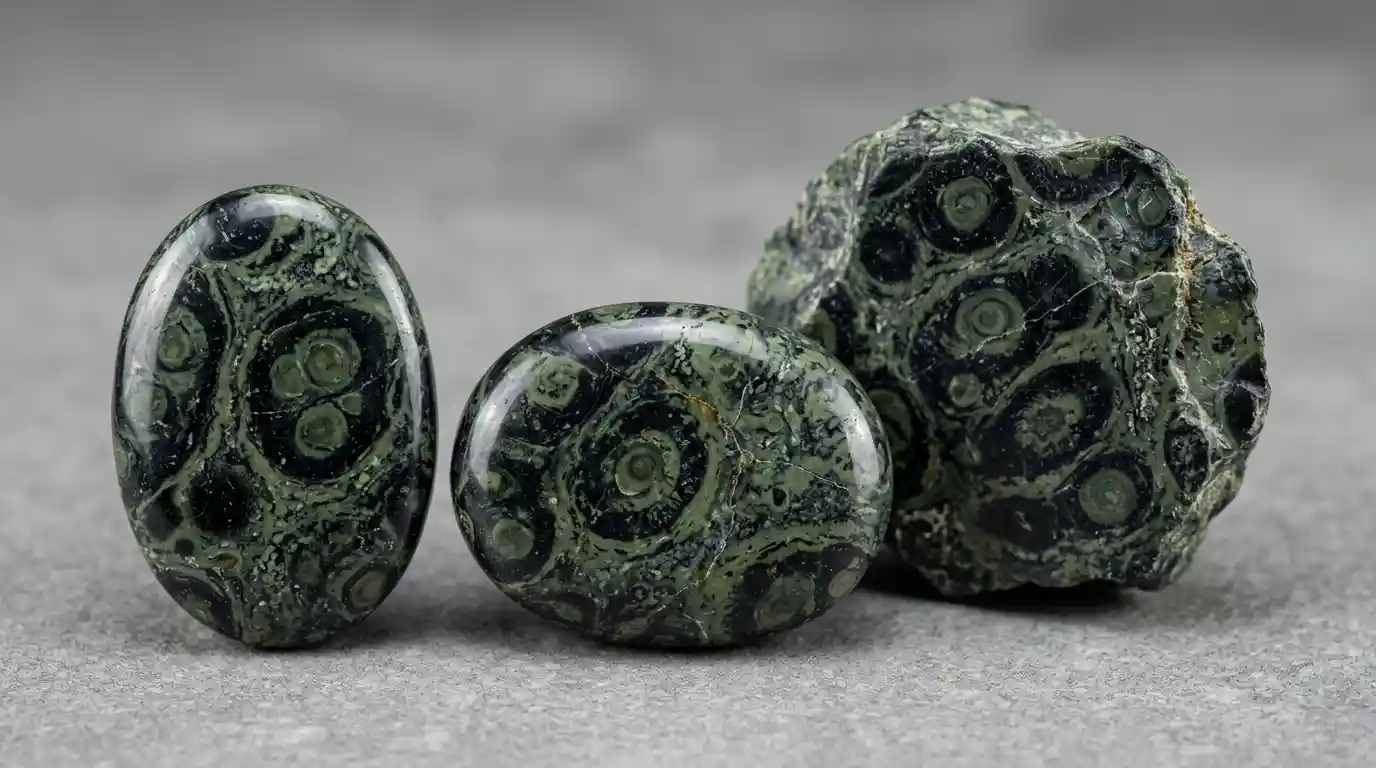
Kambaba jasper healing properties are commonly associated with grounding, calm, emotional stability, patience, resilience, connection with nature, confidence, boundaries, concentration, personal growth, meditation, and spiritual renewal. Its deep green background and dark circular patterns can resemble moss, pond life, ancient microbial structures, or reptilian eyes, which has encouraged a large amount of mythology around the stone. The most important factual correction is that Kambaba Jasper is not considered true jasper in a strict geological sense and analyzed examples are not fossil stromatolites. Research on the Madagascan rock identifies it as a rhyolitic volcanic stone containing quartz, feldspars, aegirine pyroxene, and dark radial amphibole-rich aggregates. It has not been demonstrated to treat anxiety, depression, blood pressure, pain, inflammation, immune problems, sleep disorders, or any other medical condition, and the circular patterns do not preserve healing energy from ancient algae. Its real appeal lies in unusual volcanic textures, complex mineral composition, and dramatic green-black appearance.
Why 12 Kambaba Jasper Healing Claims Grew Around Its Green Orbs and Earthy Look
- Grounding and present-moment awareness
- Calm during stressful situations
- Emotional steadiness and perspective
- Patience with gradual change
- Resilience after setbacks
- Connection with nature
- Confidence during uncertainty
- Stronger personal boundaries
- Concentration and practical focus
- Personal growth and habit change
- Meditation and sustained observation
- Spiritual renewal during transitions
These twelve themes can support different reflective practices without becoming twelve scientifically verified healing effects. The Kambaba Jasper benefits commonly discussed in crystal culture are more useful when translated into behaviors such as slowing down, observing the present environment, reviewing a setback, defining a boundary, or creating a consistent reflective routine.
Kambaba Jasper Is a Volcanic Rhyolite, Not Fossil Stromatolite
The name “Kambaba Jasper” is a commercial label rather than a precise mineral species name. Analytical work on representative specimens from Madagascar has identified the stone as a rhyolitic volcanic rock. This matters because true jasper is generally an opaque silica-rich variety of chalcedony, whereas Kambaba contains a more complex volcanic assemblage.
The green groundmass includes quartz, aegirine pyroxene, albite, and potassium feldspar. The characteristic dark round or orbicular zones contain fine amphibole needles, including compositions reported between riebeckite and pargasite. These mineral associations are consistent with igneous formation rather than with layered microbial growth.
Kambaba has often been sold as fossilized stromatolite or ancient cyanobacteria. That identification became popular because the dark rounded patterns resemble certain polished stromatolite fossils. Visual resemblance is not enough to establish fossil origin. Microscopic and X-ray diffraction work instead supports volcanic crystallization.
Because Kambaba Jasper is a rock made from several minerals, assigning it one chemical formula or one crystal system is inaccurate. Quartz, feldspars, pyroxenes, and amphiboles each have their own structures and physical properties. The finished rock therefore behaves as a composite volcanic stone rather than as a single crystal species.
Hardness also varies across different components and specimens. Quartz-rich areas may approach Mohs 7, while some constituent minerals are softer. In practical use, polished Kambaba is reasonably durable for spheres, carvings, cabochons, pendants, and beads but can still scratch, chip, or fracture after impact.
Its green-black coloration and rounded patterns are natural geological features. They do not come from preserved green algae, and the color of a fossil would not necessarily reproduce the living organism’s original color anyway.
Madagascar Origin, Volcanic Formation, and the Ancient-Stromatolite Myth
Commercial Kambaba Jasper is principally associated with the Bongolava region of west-central Madagascar, particularly around the Tsiroanomandidy district. The exact geology of individual quarry areas can be complex, but investigations of the trade stone point toward volcanic rhyolitic rock associated with igneous bodies rather than sedimentary fossil reefs.
Rhyolite forms from silica-rich magma or lava. As volcanic rock cools and undergoes later alteration or recrystallization, different minerals can develop distinctive textures. In Kambaba, quartz and feldspar-rich regions combine with aegirine and dark amphibole aggregates to create the rounded green-black appearance that made the stone commercially distinctive.
The name “crocodile jasper” is also used because some people see reptilian-eye patterns in the dark orbs. Kambaba, Kambamba, Kabamba, and similar spellings occur in trade listings. None of these names defines a formal mineral species.
The idea that Kambaba represents fossil stromatolites billions of years old has been repeated widely in crystal marketing, often followed by claims that it carries the wisdom of Earth’s earliest life. Those claims confuse visual resemblance with geological evidence. Genuine stromatolites are sedimentary structures produced through microbial activity, while analyzed Kambaba specimens have volcanic mineralogy.
This correction also affects historical claims. A commercial name applied to a Madagascan volcanic ornamental stone cannot reasonably be assigned an ancient metaphysical tradition without evidence of identifiable archaeological use. The Kambaba Jasper meaning used today is therefore modern symbolism inspired by color and pattern rather than a documented ancient healing system.
Grounding, Calm, and Emotional Stability Claims
1. Grounding Through Visual and Tactile Attention
Kambaba Jasper is frequently described as grounding because its dark green colors and rounded patterns resemble forests, ponds, moss, and stone landscapes. It does not electrically ground the body or change nervous-system function through an invisible field. A practical ritual is to hold the polished stone and notice its weight, temperature, circular markings, surface texture, breathing rhythm, and surrounding sounds. The useful mechanism is redirected attention.
2. Calm During Stressful Situations
The stone’s muted green palette often encourages calming symbolism. Kambaba has not been shown to reduce anxiety or alter stress hormones biologically. It can instead become a cue to reduce stimulation, slow the breathing, step away from unnecessary notifications, and identify the one problem that actually needs attention now.
3. Emotional Steadiness and Perspective
Some practitioners say Kambaba stabilizes turbulent emotions. The volcanic rock does not regulate mood chemistry. A more grounded approach is to use its complex orbicular patterns as a reminder that one event can contain several layers. Write down what happened, what you felt, what you assumed, and what remains under your control. Perspective comes from reflection rather than from the rock absorbing emotion.
Patience, Resilience, and Connection With Nature Claims
4. Patience With Gradual Change
The geological processes that form igneous rocks make patience an intuitive symbolic theme. Kambaba itself cannot increase impulse control. A practical ritual is to review a long-term goal on a weekly or monthly schedule rather than repeatedly judging progress from one difficult day. Slow progress becomes easier to recognize when it is measured over an appropriate interval.
5. Resilience After Setbacks
Kambaba is often associated with perseverance and recovery. It cannot biologically strengthen psychological resilience. After a setback, use the stone as a cue to separate what is irreversible from what can still be changed, identify one lesson, and define the next attempt. Resilience grows through adaptation.
6. Connection With Nature
Because Kambaba resembles moss, forests, ponds, or lichen-covered stone, modern crystal traditions frequently associate it with the natural world. The rock cannot replace actual time outdoors. It can serve as a prompt to walk, observe local vegetation, notice seasonal change, learn about geology, or spend uninterrupted time away from screens. The connection comes through experience.
Confidence, Boundaries, and Concentration Claims
7. Confidence During Uncertainty
Dark, substantial stones are often given symbolism involving steadiness and confidence. Kambaba does not biologically increase self-belief. Before a difficult action, use it as a reminder to identify what has already been prepared, what remains uncertain, and which first step is reasonable despite incomplete information.
8. Stronger Personal Boundaries
Kambaba is also marketed as protective. There is no evidence that it blocks emotional or spiritual attacks through an energetic shield. A useful interpretation is to connect protection with boundaries: decide which behavior you will accept, which requests you will decline, and what action you will take if a limit is repeatedly ignored.
9. Concentration and Practical Focus
The dark circular patterns can make Kambaba an absorbing visual object, but the stone does not increase attention span. A practical focus ritual is to place it near one active task, silence unrelated alerts, and work for a set period without switching activities. The environment and routine support concentration.
Growth, Meditation, and Spiritual Renewal Claims
10. Personal Growth and Habit Change
Green stones frequently acquire symbolism involving growth. Kambaba cannot produce psychological development, but it can represent one behavior the user wants to strengthen. Associate the stone with a specific action, such as writing, studying, exercising appropriately, organizing finances, or practicing a skill. Repetition creates the progress.
11. Meditation and Sustained Observation
Kambaba’s complex rounded structures make it useful as a visual meditation object. A practitioner can focus on one orb, notice when attention wanders, and return to the pattern or the breath. This is a legitimate attention exercise without proving that the rock changes consciousness through mineral energy.
12. Spiritual Renewal During Transitions
Modern crystal practice often uses Kambaba during endings, new routines, or changes in identity. A reflective ritual can involve writing down what has ended, what is worth carrying forward, and what new action should define the next stage. The gemstone marks the transition while the person’s choices create it.
Kambaba Jasper Chakra Associations and Nature-Based Symbolism
Modern crystal systems commonly associate Kambaba Jasper with the heart chakra because of its green coloration and sometimes with the root chakra because of its dark patterns and grounding reputation. Themes typically include compassion, emotional steadiness, security, connection with nature, and personal growth.
Chakras are a spiritual framework rather than anatomical structures. Kambaba has not been demonstrated to affect the physical heart, spine, circulation, nervous system, endocrine glands, or another physiological system through chakra placement.
The stone’s green-black appearance can still be used symbolically in meditation without linking those colors to medical effects or invented ancient traditions.
Kambaba Jasper Physical Care: Mixed Mineral Hardness, Water, Chemicals, Heat, and Surface Damage
Kambaba is reasonably durable for decorative use, but its mixed mineral composition means no single hardness value perfectly describes every area. Quartz-rich portions are relatively hard, while amphibole, feldspar, and pyroxene components can behave differently. Polished surfaces should therefore be protected from harder gemstones and abrasive grit.
Brief contact with plain water is generally suitable for sound untreated Kambaba pieces. The constituent minerals are not normally harmed by a quick rinse under ordinary household conditions. Long soaking is unnecessary, especially for carvings with fractures, fillers, coatings, adhesives, or uncertain treatments.
Warm water, mild soap, and a soft cloth are generally sufficient for physical cleaning. Avoid aggressive acids, bleach, abrasive powders, and industrial cleaners. Hydrofluoric acid is especially dangerous and attacks silica-bearing rocks.
Steam and ultrasonic cleaning are not useful defaults. Differences between mineral grains, fractures, repairs, and internal weaknesses can make aggressive cleaning less predictable than gentle hand washing.
Polished spheres and carvings should also be protected from hard impacts. A rock can be reasonably scratch resistant while still breaking along fractures or grain boundaries.
Lapidary cutting and grinding generate mixed mineral dust, including silica-bearing particles. Wet cutting, extraction, eye protection, and suitable respiratory controls are important.
Ritual Cleansing Kambaba Jasper Without Repeating the Fossil Myth
Ritual cleansing can remain entirely symbolic. There is no scientific evidence that Kambaba stores negative energy, ancient microbial memory, or harmful spiritual residue.
Sound, intention-setting, quiet reflection, or dry placement on a clean surface are gentle choices. A nature-centered ritual can involve sitting outdoors with the stone, observing plants or landscape, and choosing one action that reflects the value the stone represents.
Avoid prolonged saltwater soaking, aggressive chemicals, flame, abrasive powders, and unnecessary heat. Simple practices preserve the polish while keeping spirituality separate from unsupported geological claims.
Conclusion
Kambaba Jasper becomes more interesting when its fossil myth is removed. It is a distinctive green-black volcanic rock from Madagascar with quartz, feldspars, aegirine, and amphibole-rich structures that create unusual orbicular patterns. Its twelve healing themes can still support grounding, patience, reflection, boundaries, meditation, and habit change, but neither ancient stromatolite history nor medical healing is required to appreciate the stone.
Frequently Asked Questions About Kambaba Jasper Healing Properties
What are the main Kambaba Jasper healing properties people claim?
Common claims include grounding, calm, emotional stability, patience, resilience, nature connection, confidence, boundaries, concentration, growth, meditation, and spiritual renewal. These are modern wellness or spiritual beliefs rather than proven therapeutic effects.
Is Kambaba Jasper actually jasper?
Not in the strict geological sense. Analytical work identifies representative Kambaba as a green rhyolitic volcanic rock containing quartz, feldspars, aegirine, and amphibole-rich aggregates.
Is Kambaba Jasper a fossil stromatolite?
Analyzed Kambaba specimens are not stromatolites. Their rounded patterns are volcanic mineral structures rather than fossilized microbial mats.
Does Kambaba Jasper contain ancient algae?
The popular claim that its dark orbs are fossilized algae is not supported by mineralogical examination. The dark rounded regions contain amphibole-rich crystalline aggregates.
Where does Kambaba Jasper come from?
Commercial Kambaba is associated mainly with the Bongolava region of west-central Madagascar, particularly around the Tsiroanomandidy district.
Does Kambaba Jasper have genuine ancient healing traditions?
No specific ancient Kambaba healing tradition is documented. The commercial trade identity is modern, and claims based on supposed ancient stromatolite origins rely on an incorrect geological interpretation.
Which chakras are associated with Kambaba Jasper?
Modern crystal practice commonly associates it with the heart chakra and sometimes the root chakra. These are spiritual correspondences rather than anatomical effects.
Can Kambaba Jasper go in water?
Brief contact with clean water is generally acceptable for sound untreated pieces. Long soaking is unnecessary, particularly when the stone contains fractures, fillers, coatings, adhesives, or uncertain treatments.
How should Kambaba Jasper be physically cleaned?
Use lukewarm water, mild soap, and a soft cloth when needed. Avoid harsh chemicals, strong acids, abrasive powders, steam, and aggressive ultrasonic cleaning.
What makes Kambaba Jasper’s dark circles?
The dark rounded structures are associated with fine amphibole-rich aggregates within the volcanic rock rather than fossil colonies. Their pattern is one of the stone’s most distinctive verified geological features.
Crystal healing claims are traditional or personal beliefs and should not replace qualified medical or mental health care.