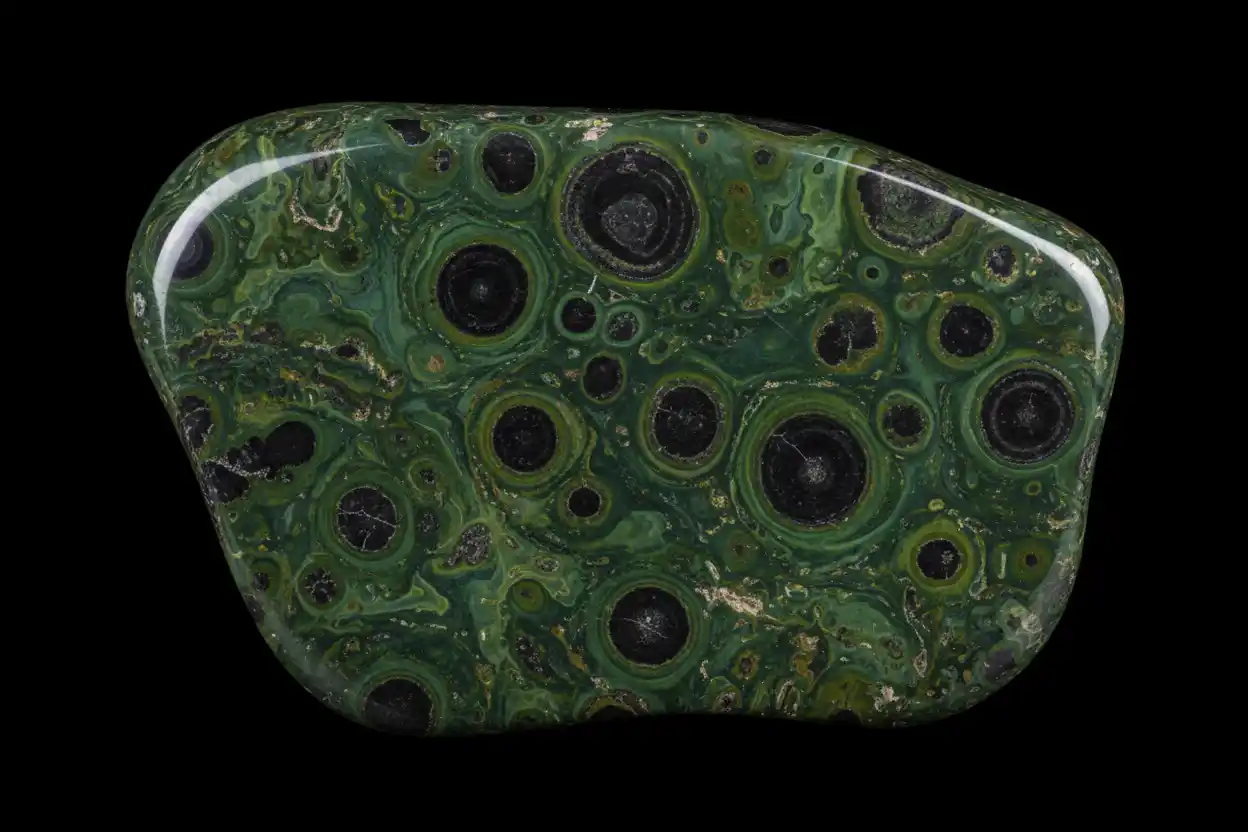
Kambaba Jasper Meaning: Properties, Uses & Symbolism
Kambaba jasper meaning is best understood by correcting two of the material’s most repeated labels. Kambaba Jasper is a trade name for a green-and-black volcanic rock from Madagascar, but mineralogical analysis does not support classifying the studied material as conventional jasper or as fossil stromatolite. Thin-section, microprobe, and diffraction-related work reported by Germany’s EPI gem-testing institute identifies the rock as rhyolite containing quartz, alkali feldspars such as albite and sanidine or related phases, green amphibole aggregates, and aegirine pyroxene. The characteristic dark rounded structures are mineral-growth features, not fossilized colonies of cyanobacteria.
This distinction matters because Kambaba Jasper has accumulated an unusually persistent origin story. Its dark circular patterns superficially resemble some polished stromatolites, so the material has often been described as fossilized algae or ancient microbial reefs. Analytical evidence points elsewhere: EPI found a volcanic mineral assemblage and microscopic flow structures indicating crystallization from viscous magma, with radial amphibole aggregates and aegirine occurring within a quartz-and-feldspar-rich rock. Those features are incompatible with interpreting the analyzed Madagascar material as a sedimentary stromatolite.
The correction does not make the stone less interesting. It replaces a fossil story with a volcanic one involving mineral crystallization, flow textures, recrystallization, and distinctive orbicular-looking aggregates. Modern crystal communities may still associate Kambaba Jasper with stability, perspective, grounding, renewal, or patience, but those meanings belong to personal symbolism rather than measurable mineral effects. This page keeps those categories separate within the broader Gemstone Guides.
Kambaba Jasper at a Glance
| Feature | Evidence-based description |
|---|---|
| Common trade name | Kambaba Jasper |
| More precise material description | Green orbicular rhyolitic volcanic rock |
| Other trade names | Kambaba Stone, Kabamba Stone, Crocodile Jasper |
| True jasper? | Not in the strict mineralogical sense for the analyzed material |
| Fossil stromatolite? | No evidence supports that interpretation for the studied Madagascar material |
| Major minerals | Quartz, alkali feldspars, aegirine, amphiboles |
| Dark rounded structures | Fine radial amphibole-rich aggregates with associated aegirine |
| Green appearance | Produced by the mineral assemblage, especially green amphibole and pyroxene phases |
| Rock type | Rhyolite / volcanic rock |
| Crystal system | None for the rock as a whole; each constituent mineral has its own structure |
| Typical appearance | Dark olive-to-forest-green matrix with irregular blackish circles, swirls, and orbicular features |
| Main source | Madagascar; trade material is associated with the Bongolava/Tsiroanomandidy region |
| Common uses | Cabochons, beads, spheres, carvings, freeforms, decorative objects |
| Major identification issue | Stromatolite and jasper mislabeling |
| Proven healing properties | None established |
| Safe handling | Intact ownership differs from cutting or grinding silica-bearing rock |
What Kambaba Jasper Actually Is
Kambaba Jasper is not a mineral species. It is a multi-mineral rock, so it has no single chemical formula, crystal system, refractive index, or universal microscopic structure of the kind that can be assigned to a mineral such as quartz or calcite. EPI’s investigation of material from the original Madagascar source found quartz and alkali feldspars in the green matrix, together with radially arranged green amphibole aggregates and fine aegirine. The institute ultimately classified the analyzed rock as a volcanic rock, more precisely rhyolite.
Mindat likewise lists Crocodile Jasper, Kambaba Jasper, and Kabamba Jasper as trade names for green volcanic rhyolite from Madagascar and summarizes the mineral assemblage as quartz, aegirine, albite, potassium feldspar, and amphibole-rich rounded aggregates. Its record explicitly states that the material is commonly but incorrectly sold as jasper or stromatolitic rock.
That makes the word “jasper” commercially useful but mineralogically imprecise. True jasper is generally a dense, opaque silica-rich material dominated by microcrystalline quartz. In the Kambaba material analyzed by EPI, the rock instead contains an identifiable volcanic assemblage of feldspars, pyroxene, amphiboles, and quartz, with no conventional jasper phase detected in the examined specimens.
This is similar to the naming problem addressed in K2 Stone meaning, where a familiar commercial name does not provide the most precise geological classification. Trade terminology can remain useful for identifying a product category while still requiring mineralogical correction.
Kambaba Jasper Identity Table
| Question | Evidence-based answer | What should not be assumed |
|---|---|---|
| Is it a mineral? | No, it is a rock | One formula or crystal system |
| Is it jasper? | Not according to analytical work on studied material | That “jasper” in the trade name is a petrographic classification |
| Is it rhyolite? | Yes, analyzed material has been classified as rhyolite | That every visually similar green rock has identical chemistry |
| Is it stromatolite? | Not for the analyzed Madagascar material | Fossil microbial origin from appearance alone |
| What makes the dark orbs? | Fine radial amphibole-rich aggregates with aegirine | Fossil algae colonies |
| What minerals dominate? | Quartz, alkali feldspars, aegirine, amphiboles | Pure chalcedony |
| Is the green color biological? | No evidence supports fossil algae as the color source | Preserved original color of ancient organisms |
| Does it have one hardness? | No exact single value for the heterogeneous rock | Every grain responds identically |
| Is every specimen from one verified quarry? | Trade material is associated with Madagascar, but provenance can vary in documentation quality | Exact locality from trade name alone |
| Does the pattern prove authenticity? | No | That similar-looking dyed or reconstructed products cannot exist |
| Does age prove metaphysical potency? | No | Geological antiquity is not evidence of therapeutic energy |
Why “Kambaba Jasper” Is Not Strictly Jasper
The commercial gemstone world uses “jasper” broadly, often attaching the word to opaque patterned rocks that polish well. Mineralogy uses more restrictive criteria. This difference explains why the Kambaba Jasper name can be recognizable and useful in retail while still being inaccurate as a rock classification.
EPI’s thin-section and microprobe work did not identify the studied material as microcrystalline jasper. Instead, the green groundmass contained quartz and alkali feldspars, while the dark rounded zones consisted of extremely fine amphibole needles associated with aegirine. The mineral textures were interpreted as volcanic, and the rock was classified as rhyolite.
The distinction is important because an inaccurate category can lead to further inaccurate claims. If the material is assumed to be jasper, writers may assign it quartz-only properties. If it is assumed to be stromatolitic jasper, they may add an unsupported fossil age, biological origin, or microbial symbolism. Correcting the first classification prevents those later claims from appearing factual.
The broader Jasper meaning reference explains why the jasper category itself can be complicated. Kambaba Stone sits even farther outside the strict definition because its analyzed volcanic mineral assemblage is structurally different from conventional microcrystalline jasper.
Why Kambaba Jasper Is Not a Stromatolite
Stromatolites are layered sedimentary structures produced through interactions between microbial communities and sediment or mineral precipitation. Their identification depends on geological context, lamination, microscopic structures, and sedimentary evidence—not on the presence of circles in a polished slab.
Kambaba Jasper was repeatedly marketed as fossil stromatolite because its blackish rounded structures can resemble biological domes or concentric microbial patterns. EPI specifically investigated that claim and found the rock was not sedimentary. The green amphibole occurs as minute needles, some showing flow structure, while quartz and feldspar show recrystallization. The observed texture was interpreted as volcanic, with the small crystals potentially developing through devitrification of an earlier melt.
The result directly contradicts the common claim that the dark circles are fossilized algae. FossilEra’s review of the controversy reaches the same conclusion, citing the EPI work and noting that specialists familiar with stromatolites do not regard the structures as consistent with microbial stromatolite architecture.
This does not mean every circular pattern in geology must be volcanic. It means the analyzed Kambaba material has mineralogical evidence for a volcanic origin that outweighs a superficial resemblance to stromatolite fossils.
Formation: A Volcanic Rock With Complex Mineral Growth
The broad formation sequence begins with silica-rich magma. Rhyolite forms from evolved, silica-rich volcanic magma, and Kambaba Stone preserves a mineral assemblage consistent with alkaline volcanic crystallization. Quartz and alkali feldspars form much of the host, while aegirine and amphibole phases contribute strongly to the green and dark textural domains.
EPI observed microscopic flow structure in the fine amphibole needles, suggesting crystallization within viscous magma. The laboratory also documented recrystallized quartz and feldspar and proposed that the tightly intergrown fine minerals may have developed through devitrification of an earlier melt. Importantly, EPI also cautioned that hand-specimen observations alone are insufficient to reconstruct the complete petrogenetic sequence.
That caution should be preserved. “Volcanic rhyolite” is supported; a detailed story assigning every ring to a specific cooling pulse, gas bubble, eruption event, or exact crystallization sequence would need stronger locality-specific petrographic evidence.
The dedicated Kambaba Jasper formation and deposit geology page owns the detailed geological model rather than repeating it here.
What Creates the Green-and-Black Pattern
The pattern is mineralogical rather than biological. EPI reports that the rounded dark structures are built from tiny radially arranged amphibole needles, described as pargasite, riebeckite, or related phases, and are mantled or associated with fine-grained aegirine. These aggregates occur within a matrix rich in quartz and alkali feldspars.
The green background therefore does not represent the preserved color of algae. Fossil coloration rarely preserves an organism’s original living color in the simplistic way suggested by some commercial descriptions, and the analyzed material does not support a biological origin in the first place. The observed green is a product of its present mineral assemblage and texture.
The black or near-black “eyes” also vary substantially. Some are rounded, some elongated, some irregular, and others merge into swirling or wispy domains. A polished sphere can exaggerate their apparent circularity because cutting intersects three-dimensional mineral aggregates at different angles.
The more technical relationship among mineral phases, reflected light, grain size, polishing, and pattern appearance belongs in Kambaba Jasper optical properties and color behavior.
Original Source-Comparison Framework: Testing the Most Repeated Claims
| Common statement | Trade repetition | Analytical evidence | Responsible conclusion |
|---|---|---|---|
| “Kambaba Jasper is jasper.” | Very common | EPI found rhyolitic mineral assemblage rather than conventional jasper | Use Kambaba Jasper as a trade name, not strict mineral classification |
| “It is fossil stromatolite.” | Very common | Thin-section and mineral analyses show volcanic texture | Unsupported for analyzed Madagascar material |
| “The circles are fossil algae colonies.” | Frequently repeated | Rounded zones are amphibole-rich mineral aggregates with aegirine | Mineral-growth structures, not demonstrated fossils |
| “The green is fossil algae color.” | Repeated in metaphysical retail content | Green minerals occur in the volcanic assemblage | Biological color explanation is unsupported |
| “It is billions of years old.” | Often attached to the stromatolite story | Specific age is not established simply by the trade name | Do not assign an age without locality-specific geology |
| “It is pure quartz/chalcedony.” | Derived from calling it jasper | Feldspars, pyroxene, and amphiboles are significant constituents | Multi-mineral rhyolitic rock |
| “Every black orb is the same mineral.” | Sometimes implied | Aggregates are mineralogically complex | Treat individual zones as composite until analyzed |
| “Crocodile Jasper is a separate mineral.” | Trade wording | It is another trade name for the same material | Not a mineral species |
| “Eldarite and Kambaba are completely unrelated.” | Commercial distinction exists | EPI found mineralogical similarities with certain Mexican material | Similar mineral systems can occur under different trade names |
| “Ancient cultures used Kambaba Jasper spiritually.” | Frequently claimed without documentation | The recognizable trade material has a modern documented commercial history | Ancient-specific claims require independent evidence |
| “It heals because it contains minerals.” | Metaphysical claim | Mineral composition does not prove therapeutic action | Unsupported medical inference |
This framework is useful because Kambaba Jasper illustrates how repetition can gradually substitute for evidence. A claim may appear on hundreds of pages and still originate from one mistaken visual interpretation.
The Relationship With Nebula Stone and Eldarite
EPI also compared Kambaba material with Mexican rock marketed as Nebula Stone or Eldarite. The Mexican material was likewise described as an alkali-rich volcanic rock containing quartz, alkali feldspar, riebeckite-type amphibole, and aegirine. EPI concluded that the mineral assemblages are closely comparable even though their visual distribution differs.
The visual rule summarized by EPI is that Kambaba Stone generally shows darker rounded structures on a greener background, whereas the Mexican material commonly reverses the distribution, with greener rounded structures against a darker background. That distinction is useful for trade recognition, but it is not a substitute for provenance or petrography.
This relationship is another reason to avoid treating the pattern itself as proof of locality. Similar mineralogical systems can create closely related decorative rocks in different regions.
Diagnostic Traits
A typical polished Kambaba specimen shows a dark green to olive-green base containing blackish or very dark green circular, oval, wispy, or swirling structures. The material is commonly opaque and takes a strong polish. Rough surfaces may look less dramatically patterned than polished ones because contrast increases when grain boundaries and mineral aggregates become optically smoother.
Magnification is especially useful. EPI’s thin sections show that the dark areas resolve into fine amphibole needles associated with aegirine rather than sedimentary laminations. The mineral grains are tightly intergrown, and some flow texture can be visible microscopically.
A loupe cannot reproduce a petrographic thin section, but it can still identify warning signs. Perfect printed circles, surface-only color, dye collecting in scratches, resin-filled cavities, repeating manufactured patterns, or a uniform glassy matrix deserve further investigation.
The dedicated Kambaba Jasper microscope inclusion notebook covers those observations in greater detail.
Original Specimen and Photo Checklist
| Observation | What to document | Why it matters |
|---|---|---|
| Base color | Olive green, forest green, gray-green, black-green | Creates a neutral color record |
| Dark pattern | Circular, oval, irregular, wispy, merged, radial | Natural material should show variation |
| Pattern size | Measure representative “eyes” | Prevents scale distortion in photographs |
| Pattern boundaries | Sharp, diffuse, mineral-grained, swirling | Helps distinguish natural aggregate texture from surface decoration |
| Surface type | Rough, polished, waxed, resin-coated | Finish can strongly change appearance |
| Grain visibility | Fine crystalline, feldspar-rich, quartz-rich, amphibole-rich | Supports rock rather than fossil interpretation |
| Radial texture | Visible, subtle, absent | May correspond to amphibole-rich aggregates |
| Fractures | Cross-cutting, filled, weathered, open | Useful for condition and treatment assessment |
| Color in fractures | Same as matrix, concentrated, suspiciously bright | Can flag possible dye |
| Matrix continuity | Pattern passes through body or only surface | Important for authenticity screening |
| Locality statement | Madagascar, Bongolava, seller-stated, documented, unknown | Keeps provenance levels separate |
| Trade name | Kambaba Jasper, Crocodile Jasper, Kambaba Stone | Preserves seller wording without treating it as taxonomy |
| Photo lighting | Neutral daylight, flash, backlight, edited | Green stones are easily oversaturated |
| Magnification | Record magnification level | Makes texture comparisons reproducible |
| Analytical evidence | Thin section, Raman, XRD, microprobe, petrography | Stronger than pattern recognition |
This checklist deliberately avoids assigning a numerical authenticity score. A natural rock is not authenticated by accumulating weak clues until a percentage appears convincing. The strongest identification comes from compatible texture, provenance, and analytical evidence.
Documented History of the Name and the Stromatolite Dispute
Kambaba Jasper’s documented modern history is intertwined with trade-name confusion. The Madagascar rock was circulated under names including Kambaba Jasper, Kabamba Stone, Crocodile Jasper, and Eldarite, while visually related Mexican material appeared under names such as Nebula Stone. At one stage, commercial descriptions attempted to distinguish Kambaba by claiming it was a fossil stromatolite rather than volcanic rock.
That disagreement led to formal examination by EPI. A substantial hand specimen from the Madagascar source was studied through thin-section and microprobe methods. The result showed a volcanic mineral assemblage and led EPI to reject both the stromatolite interpretation and the use of “jasper” as a strict mineralogical label for the analyzed material.
This is a better documented history than claims of an ancient Kambaba Jasper healing tradition. The material may have existed geologically for a very long time, but geological age does not establish that ancient communities identified, named, or used this specific trade material in the ways claimed by modern crystal marketing.
The distinction resembles Kimberlite meaning, where the geological history of a rock can be extremely deep without implying a long human metaphysical tradition.
Kambaba Jasper Meaning in Modern Symbolism
Modern symbolism commonly associates Kambaba Jasper with steadiness, resilience, patience, connection with nature, emotional balance, perspective, and gradual change. Its dark circular structures and green groundmass naturally invite visual associations with forests, ponds, cells, eyes, or repeated natural cycles.
Those associations can be personally meaningful. Someone may use a polished Kambaba Stone as a reminder to slow down before reacting, maintain consistency through a long project, or distinguish an appealing story from evidence. The last interpretation is especially appropriate given the material’s own history of misclassification.
Personal symbolism is different from claiming that the rock emits a measurable grounding frequency or changes the nervous system. The mineral assemblage contains quartz, feldspar, amphiboles, and pyroxene, but none of those facts establishes a mechanism by which holding the rock treats anxiety, depression, trauma, cardiovascular conditions, immune disorders, hormonal problems, neurological disease, or sleep disorders.
The contrast with Kammererite meaning is useful. Kammererite is a defined chromium-bearing chlorite mineral, while Kambaba Stone is a volcanic rock containing several minerals. If both are described with the same metaphysical terms, the repetition reflects modern symbolic language rather than shared mineral chemistry.
The Symbolism Boundary
A mineralogical statement can describe quartz, feldspar, aegirine, amphiboles, flow texture, volcanic origin, or radial mineral aggregates. Those claims can be examined analytically.
A historical statement can document the emergence of the Kambaba trade name, the stromatolite controversy, and laboratory investigation of the material.
A modern symbolic statement can say that some people associate the stone with patience, stability, or connection with nature.
Problems begin when these evidence categories are merged. Green minerals do not scientifically produce emotional healing because they are green. Amphibole-rich circles do not represent biological memory simply because they resemble cells or eyes. Volcanic origin does not make the rock capable of transferring “earth energy” into the body.
The site’s general boundaries around metaphysical and health information are explained in the Disclaimer.
Uses of Kambaba Jasper
The material is used principally as an ornamental lapidary rock. Its dark green color and highly variable rounded patterns make it suitable for cabochons, beads, spheres, palm stones, carvings, polished slabs, bowls, freeforms, and display specimens. The strongest visual pieces tend to be those where cutting exposes several contrasting orbicular structures across a polished surface.
Cut orientation matters because a three-dimensional mineral aggregate can look completely different depending on where the saw intersects it. One slice may reveal obvious circular “eyes,” while a nearby cut through the same mass can produce elongated streaks or irregular swirls. Preserving the most attractive pattern can therefore matter more than maximizing weight.
Those practical decisions belong in Kambaba Jasper cutting, orientation, and polish rather than being interpreted as ways to “activate” the stone.
Durability and Wear
Because Kambaba Stone is a heterogeneous rock, assigning one precise Mohs hardness to every part is less rigorous than it would be for a single mineral. Quartz is relatively hard, feldspars are moderately hard, and the amphibole and aegirine components have their own mechanical behavior. Natural fractures and differences in grain boundaries can also affect polish and edge strength.
In practice, competent lapidary material can produce durable cabochons and beads, but it should not be treated as indestructible. Thin carving projections can chip. Drill holes can become failure points. Repeated contact with harder materials can scratch polished surfaces, while strong impacts can exploit existing fractures.
Mounting design, edge exposure, drilling, ring wear, and protective settings are discussed in Kambaba Jasper setting and wear engineering.
Safe Ownership: Intact Rock Versus Lapidary Dust
Ordinary handling of an intact, polished Kambaba Stone is fundamentally different from mechanically processing it. Simply holding a stone does not create the same exposure conditions as sawing, grinding, drilling, crushing, or dry sanding rock.
Kambaba material contains quartz. OSHA explains that cutting, grinding, drilling, and crushing stone containing crystalline silica can generate respirable crystalline silica particles small enough to reach deep into the lungs. Professional exposure control relies on methods such as wet processing, local exhaust, and appropriate workplace protection.
This does not mean a polished Kambaba cabochon should be treated as hazardous to touch. The safety boundary is between intact ownership and dust-generating processing.
The rock should not be powdered for consumption, deliberately dissolved, or placed in drinking water for supposed healing purposes. A multi-mineral volcanic rock is not a supplement, and its constituent elements do not become therapeutically bioavailable simply because they occur naturally.
Buying Kambaba Jasper Without Buying the Myth
A buyer does not need a complex laboratory report for every inexpensive bead, but the seller’s description should still distinguish observation from folklore. The strongest basic listing identifies the material as a Madagascar trade stone, shows several neutral-light photographs, discloses treatments if any are known, and avoids presenting the stromatolite claim as fact.
A seller who calls the material Kambaba Jasper for recognizability is not necessarily making a deceptive statement; the term is entrenched in the lapidary market. The more important question is whether the description goes on to falsely identify the stone as fossil algae, ancient cyanobacteria colonies, or a scientifically proven healing material.
For purchase-specific checks involving pattern quality, surface coatings, return terms, seller claims, and documentation, use where to buy Kambaba Jasper rather than treating symbolic meaning as evidence of quality.
Comparison With Other Trade-Named and Geological Materials
Kambaba Stone demonstrates why rocks need to be classified from texture and mineral assemblage rather than commercial appearance. K2 Stone meaning deals with another ornamental rock whose familiar trade name does not fully describe its mineralogical identity, but its granodioritic host and azurite mineralization are entirely different from Kambaba rhyolite.
Kimberlite meaning concerns a volatile-rich ultramafic igneous rock famous for transporting mantle material and sometimes diamonds toward Earth’s surface. Both kimberlite and Kambaba Stone are igneous rocks, yet their chemistry, textures, geological settings, and economic importance are profoundly different.
Jet meaning presents the opposite case again: jet is an organic-origin mineraloid derived from altered woody material rather than a volcanic rock. Applying identical symbolic explanations to all of these materials would erase the geological distinctions that make them interesting.
Specimen Conservation
A good Kambaba specimen record should preserve more than the polished face. Keep the locality supplied with the piece, seller terminology, acquisition documentation, photographs of rough surfaces, treatment information, and any analytical results. If the stone has been cut from a larger slab, record that relationship where possible.
Avoid aggressive chemical cleaning, deliberate heating, acid testing, or unnecessary scratch tests. These methods can damage polish, alter coatings, attack particular mineral phases, or erase useful evidence without proving authenticity.
Long-term storage, label preservation, repair records, coatings, fracture monitoring, and specimen documentation belong in the Kambaba Jasper specimen conservation record.
Evidence Limits
This reference relies on published mineralogical and gem-testing evidence and does not claim a first-hand mine visit, private laboratory analysis of an individual Kambaba specimen, or unpublished specialist authentication. EPI’s published analytical work is particularly important because it directly tested the two claims most often repeated about the material: that it is jasper and that it is stromatolite.
Where an individual specimen has meaningful scientific or commercial value, petrographic examination, X-ray diffraction, Raman spectroscopy, electron-microprobe work, or other appropriate mineralogical testing may be more reliable than a visual judgment.
The site’s publication approach is summarized on About, while Contact is available for general site communication.
Common Kambaba Jasper Misunderstandings
The first misconception is that Kambaba Jasper is a fossil stromatolite. Analytical evidence on studied Madagascar material supports a volcanic rhyolite instead. The second is that the dark circles represent algae colonies. They are mineral aggregates dominated by fine amphibole needles with associated aegirine.
The third misconception is that “jasper” establishes a pure or nearly pure quartz composition. The analyzed rock contains significant feldspar, pyroxene, and amphibole. The fourth is that the green coloration comes from fossilized organisms. The color belongs to the present mineral assemblage, not a preserved biological pigment.
A fifth misconception assigns a specific ancient age merely because the stone is incorrectly called stromatolite. A commercial trade name cannot establish geological age. A sixth claims an ancient spiritual tradition specific to Kambaba Jasper without documented archaeological evidence.
A seventh is that one photo can prove authenticity. Similar patterns can occur in other rocks, and treatments or manufactured look-alikes can complicate the market. An eighth assumes the material has one exact hardness and one formula despite being a heterogeneous rock.
A Practical Evidence Hierarchy
The weakest evidence is a seller title such as “ancient fossil Kambaba jasper.” A neutral photograph adds useful pattern evidence but still cannot establish biology or mineral composition.
A documented Madagascar provenance and rough-rock context strengthen the material attribution. Magnification can show whether the dark structures behave like mineral aggregates rather than surface color. Petrographic thin sections can expose mineral textures and flow structures. Diffraction, microprobe analysis, Raman spectroscopy, and other mineralogical methods provide stronger constituent identification.
The EPI investigation sits near the top of that hierarchy because it analyzed the rock directly rather than inferring origin from a polished pattern. Its conclusion—that Kambaba Stone is volcanic rhyolite rather than sedimentary stromatolite—should therefore outweigh repeated retail descriptions unsupported by equivalent evidence.
Frequently Asked Questions
What is Kambaba Jasper?
Kambaba Jasper is the trade name for a green-and-black volcanic rock from Madagascar. Analytical work identifies studied material as rhyolite containing quartz, alkali feldspars, aegirine, and amphibole-rich aggregates.
Is Kambaba Jasper actually jasper?
Not in the strict mineralogical sense for the analyzed Madagascar material. EPI did not identify conventional jasper in its samples and classified the rock as rhyolite. “Kambaba Jasper” remains a widely recognized trade name.
Is Kambaba Jasper a stromatolite?
No evidence from the principal analytical work supports that interpretation. Thin-section and mineralogical examination shows volcanic mineral textures rather than sedimentary microbial structures.
What are the black circles in Kambaba Jasper?
EPI found that the characteristic rounded dark structures contain extremely fine radially arranged amphibole needles, with pargasite-, riebeckite-, or related compositions, associated with fine aegirine.
What makes Kambaba Jasper green?
Its green appearance is associated with the rock’s mineral assemblage, including green amphiboles and aegirine within a quartz-and-feldspar-rich volcanic matrix. It is not evidence of preserved green algae.
Is Crocodile Jasper the same as Kambaba Jasper?
Yes, Crocodile Jasper is another commercial name used for Kambaba or Kabamba Stone. The name refers to the eye-like dark pattern rather than a separate mineral species.
Is Kambaba Stone rhyolite?
The material examined by EPI was classified as volcanic rhyolite based on its mineralogy and microscopic texture. Mindat likewise records the Madagascar occurrence as rhyolite.
Where does Kambaba Jasper come from?
Commercial material is associated with Madagascar, particularly the west-central Bongolava/Tsiroanomandidy area in mineral-locality records. Exact provenance should still be documented specimen by specimen because a trade name alone does not prove a quarry location.
Is Kambaba Jasper millions or billions of years old?
A specific age should not be assigned from the trade name alone. Many exaggerated age claims originate from the unsupported stromatolite story. Reliable age requires locality-specific geological evidence.
Does Kambaba Jasper contain fossil algae?
The analyzed Madagascar material does not support that claim. Its circular patterns are mineral-growth structures in volcanic rock, not confirmed fossil algae colonies.
What does Kambaba Jasper symbolize?
Modern symbolism commonly associates it with patience, stability, resilience, nature, perspective, or gradual change. These are contemporary personal or metaphysical interpretations rather than measurable physical properties.
Does Kambaba Jasper have healing properties?
There is no established scientific evidence that wearing or holding Kambaba Jasper treats physical or psychological conditions.
Can Kambaba Jasper go in drinking water?
It should not be intentionally used for gemstone elixirs or drinking-water preparations. It is a multi-mineral rock, and mineral composition does not establish safe ingestion or therapeutic benefit.
Is Kambaba Jasper safe to handle?
Ordinary handling of an intact polished stone is different from cutting or grinding it. Because the rock contains quartz, powered processing can generate respirable crystalline silica dust and should use appropriate professional controls.
How can I tell whether Kambaba Jasper is real?
Look for natural variation in the green matrix and dark rounded structures, examine whether patterns are part of the rock rather than surface paint, preserve provenance, and compare the material with documented rhyolitic texture. For important specimens, petrography or laboratory mineral analysis provides stronger evidence than appearance alone.
Why was Kambaba Jasper confused with stromatolite?
Its dark circular and swirling structures resemble some polished microbial sedimentary patterns. Repetition of that visual comparison eventually became a fossil-origin claim, but direct mineralogical analysis demonstrated volcanic rather than sedimentary texture.