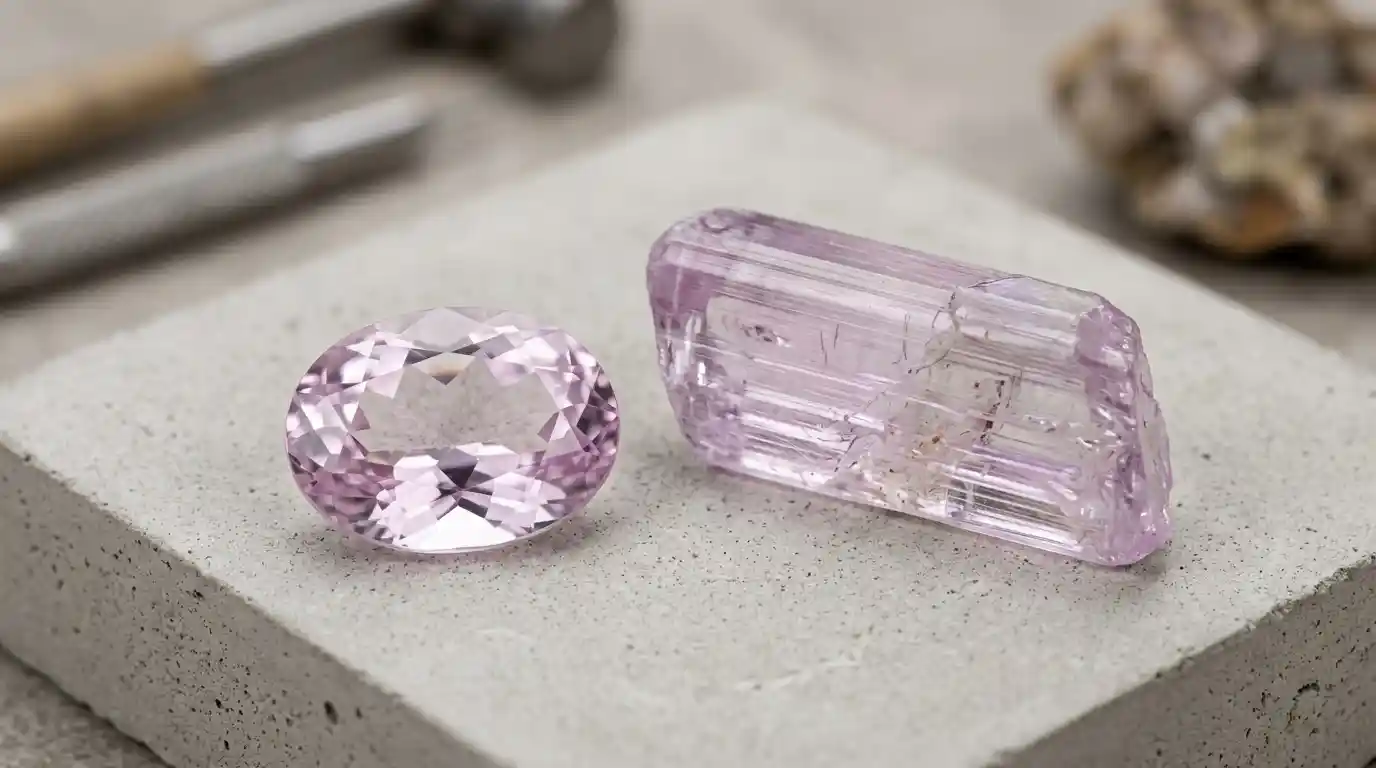
Kunzite Healing Properties: 12 Modern Claims, Gentle Traditions & Safe Limits
Kunzite healing properties are commonly associated with compassion, emotional openness, calm, self-acceptance, forgiveness, relationship communication, confidence, resilience, optimism, meditation, boundaries, and spiritual reflection. Its delicate pink to violet color naturally encourages symbolism around tenderness and emotional expression, but color does not establish a therapeutic mechanism. Kunzite has not been demonstrated to treat anxiety, depression, trauma, heart disease, hormonal conditions, infertility, sleep disorders, pain, or neurological illness, and its lithium content does not give the gemstone the pharmacological effects of prescribed lithium compounds. Mineralogically, kunzite is the pink to violet variety of spodumene, a lithium aluminum silicate with the formula LiAlSi₂O₆. It crystallizes in the monoclinic system, has Mohs hardness around 6.5 to 7, possesses perfect cleavage in two directions, shows strong pleochroism, and can lose color after prolonged exposure to intense light or heat. These verified physical properties matter far more to safe ownership than unsupported medical claims.
12 Kunzite Healing Claims Linked to Pink Color, Tenderness, and Self-Expression
- Compassion toward oneself and others
- Emotional openness and honest expression
- Calm during emotionally intense moments
- Self-acceptance and reduced self-criticism
- Forgiveness and release of resentment
- Relationship communication and empathy
- Confidence in vulnerable situations
- Resilience after emotional setbacks
- Optimism during personal change
- Meditation and reflective attention
- Healthier emotional boundaries
- Spiritual reflection on love and values
These twelve themes can support different personal practices without becoming twelve proven therapeutic effects. Many kunzite benefits become more useful when the gemstone is treated as a reminder to communicate honestly, pause before reacting, set a boundary, write down an emotion, or choose a behavior consistent with personal values.
Kunzite Mineral Science: Pink Spodumene, Lithium Chemistry, Pleochroism, and Perfect Cleavage
Kunzite is a gem variety of spodumene rather than a separate mineral species. Spodumene is a lithium aluminum silicate with the chemical formula LiAlSi₂O₆ and belongs to the pyroxene group. Lithium is an essential element in its crystal structure, but that does not mean wearing kunzite supplies medicinal lithium through the skin.
The mineral crystallizes in the monoclinic system and commonly forms elongated prismatic crystals. Pegmatite environments can produce exceptionally large spodumene crystals because late-stage magmatic fluids concentrate lithium and allow large crystals to develop.
Kunzite ranges from pale pink through lilac, violet-pink, and violetish purple. Manganese is responsible for its characteristic color. Natural gems are often relatively clean to the eye, which allows large faceted stones to retain considerable transparency.
Pleochroism is one of kunzite’s most important optical features. The stone can display stronger and weaker pink or violet colors depending on viewing direction. Cutters therefore orient rough carefully to show the most attractive color, often looking down the long direction of the crystal for the strongest hue.
Kunzite rates approximately 6.5 to 7 on the Mohs scale. This provides reasonable scratch resistance, but toughness is poor because spodumene has perfect cleavage in two directions. A gemstone can therefore split after a sharp blow, excessive pressure, or sudden thermal stress despite having respectable hardness.
Luster is typically vitreous, and transparent faceted kunzite can be exceptionally bright. It can resemble morganite, pink tourmaline, pink sapphire, rose quartz, or synthetic pink gems depending on saturation and cut, although each has different optical and physical properties.
Kunzite is not a hydrated mineral. Water is not an essential component of the LiAlSi₂O₆ formula.
Kunzite Discovery in California and Why Its Traditions Are Modern
Kunzite is a comparatively recent gemstone identity. Pink spodumene crystals were discovered in San Diego County, California, around 1902 and sent for identification to George Frederick Kunz, the prominent gemologist associated with Tiffany & Co. He recognized the crystals as an unusual pink variety of spodumene.
Charles Baskerville subsequently named the variety kunzite in Kunz’s honor in 1903. This well-documented chronology makes kunzite very different from gemstones such as jade, garnet, lapis lazuli, or opal that have archaeological histories extending thousands of years.
The discovery areas in Southern California are associated with lithium-rich granitic pegmatites, particularly in the Pala district. These pegmatites also contain tourmaline, beryl, quartz, feldspar, lepidolite, and other minerals typical of highly evolved granitic systems.
Important modern kunzite sources include Afghanistan, Brazil, Madagascar, Pakistan, and California. Large transparent crystals are one reason kunzite can produce substantial faceted gems without the prices associated with equally large fine sapphire or spinel.
Because the gemstone identity is modern, claims that ancient civilizations specifically used kunzite for heart healing, chakra work, emotional trauma, or romantic energy are historically implausible. The kunzite meaning found today is largely a modern symbolic system inspired by its pink-violet color and transparent appearance.
Compassion, Emotional Openness, and Calm Claims
1. Compassion Through Perspective-Taking
Kunzite is frequently described as a stone of compassion. The gemstone does not biologically increase empathy. A more practical use is to treat it as a reminder to ask what another person may be experiencing, what information is missing, and how to respond kindly without abandoning personal boundaries. Compassion becomes a behavior rather than a property emitted by spodumene.
2. Emotional Openness and Honest Expression
Pink kunzite is often linked with emotional openness and the willingness to express feelings. It cannot force emotional disclosure or make vulnerability safe in every situation. Before an important conversation, use the stone as a cue to decide what you actually want to communicate, what level of disclosure is appropriate, and what response you need from the other person.
3. Calm During Emotionally Intense Moments
Some practitioners use kunzite as a calming stone. There is no evidence that lithium locked inside its crystal structure produces a sedative or mood-stabilizing effect through touch. A practical ritual is to hold the gemstone while slowing the breathing, delaying an immediate response, and identifying what needs to happen next.
Self-Acceptance, Forgiveness, and Relationship Communication Claims
4. Self-Acceptance and Reduced Self-Criticism
Kunzite’s soft pink appearance has made it popular in self-love practices. A gemstone cannot biologically change self-esteem. It can instead serve as a prompt to notice excessively harsh internal language and replace vague criticism with a specific, fair assessment of what happened and what can be improved.
5. Forgiveness Without Ignoring Harm
Modern crystal traditions often connect kunzite with forgiveness. The stone cannot remove resentment or restore trust automatically. A healthier ritual distinguishes forgiveness from reconciliation. Someone may decide to stop repeatedly reliving an event while still maintaining boundaries and acknowledging that harmful behavior occurred.
6. Relationship Communication and Empathy
Kunzite is often recommended for relationships because of its association with tenderness. It cannot make another person honest, loyal, affectionate, or emotionally available. A practical use is to prepare for conversation: state the issue clearly, listen to the response, ask direct questions, and judge the relationship by repeated behavior rather than by symbolic expectations.
Confidence, Resilience, and Optimism Claims
7. Confidence in Vulnerable Situations
Emotional openness often requires confidence. Kunzite does not biologically increase courage or self-belief. Before a difficult conversation, use it as a reminder to identify what needs to be said, what outcome is realistic, and which boundary should remain intact even if the conversation becomes uncomfortable.
8. Resilience After Emotional Setbacks
Kunzite is sometimes associated with recovery after heartbreak, disappointment, or conflict. It cannot heal grief or trauma through mineral energy. A reflective practice can separate the event from personal identity, identify what was outside your control, and decide what support or next action would be constructive.
9. Optimism During Personal Change
Pink and violet gems are frequently associated with hope and renewal. Kunzite cannot guarantee a better future. A more grounded optimism ritual is to identify one difficulty, one reason change remains possible, and one action that would make a favorable outcome more likely.
Meditation, Boundaries, and Spiritual Reflection Claims
10. Meditation and Reflective Attention
Kunzite’s transparency and soft color can make it a visually appealing meditation object. A practitioner might focus on the gem, notice when attention wanders, and return to the breath or an intention. This is a real attention practice without demonstrating that kunzite changes consciousness through a mineral frequency.
11. Healthier Emotional Boundaries
Because kunzite is strongly associated with compassion, it is sometimes presented as encouraging unconditional openness. Healthy compassion does not require accepting harmful behavior. The gemstone can instead symbolize a balanced rule: remain kind where possible, communicate clearly, and protect personal limits when necessary.
12. Spiritual Reflection on Love and Values
Kunzite is widely used in modern spiritual practice for contemplation around love, gratitude, relationships, and personal values. Someone may find these rituals meaningful, but there is no evidence that the stone activates supernatural love energy or changes the physical heart through a measurable mechanism.
Kunzite Chakra Associations: Heart Symbolism and Crown-Centered Reflection
Modern crystal systems most commonly associate pink kunzite with the heart chakra because of themes involving compassion, love, emotional openness, forgiveness, and relationships. Violet-toned stones may also be linked with the crown chakra, where symbolism shifts toward spiritual reflection and awareness.
Chakras are a spiritual framework rather than anatomical structures. Kunzite has not been demonstrated to affect the physical heart, brain, endocrine glands, nervous system, circulation, or another physiological system through chakra placement.
Its lithium content should also not be confused with psychiatric medication. Medicinal lithium involves specific compounds, controlled doses, medical supervision, and blood-level monitoring. Lithium locked inside a spodumene crystal is not equivalent.
Kunzite Physical Care: Perfect Cleavage, Light Fading, Heat, Water, Steam, and Ultrasonic Risk
Kunzite requires more care than its Mohs hardness might suggest. At approximately 6.5 to 7, it can resist many ordinary scratches, but perfect cleavage in two directions gives it poor toughness. A sharp blow can split the gem even if it looks clean and solid.
Pendants, earrings, and occasional-wear pieces are generally safer than exposed rings or bracelets. If kunzite is used in a ring, protective settings and careful wear reduce impact risk. Remove it before sports, housework, gardening, or activities involving tools and hard surfaces.
Brief contact with plain water is generally safe for untreated kunzite. Warm or lukewarm water with mild soap is the preferred cleaning method. Prolonged soaking is unnecessary, especially when jewelry contains adhesives or uncertain treatments.
Steam cleaning should be avoided because heat and sudden temperature changes can cause breakage. Ultrasonic cleaning is also unsuitable. Vibration may exploit cleavage planes or internal fractures.
Light exposure is especially important. Both natural and treated kunzite can fade after prolonged exposure to strong light or heat. This has led to the informal nickname “evening stone,” reflecting the practical idea that kunzite is better protected from intense daylight than many other gems.
Store kunzite in a closed jewelry box or drawer when it is not being worn. Avoid prolonged display in bright windows, direct sunlight, or high-heat environments.
Kunzite can be irradiated and then heat treated to improve color. Treatment disclosure matters because enhanced and natural color can both fade. The workbook-verified buy kunzite topic addresses quality, treatment, and buying considerations.
Cutting and grinding spodumene produce fine lithium-aluminum-silicate dust. Ordinary wearing is not a concern, but lapidary work should use wet methods, effective extraction, eye protection, and suitable respiratory precautions.
Gentle Ritual Cleansing Kunzite Without Sunlight, Heat, or Cleavage Stress
Ritual cleansing should avoid the very conditions that can damage kunzite. There is no scientific evidence that the gemstone accumulates negative energy requiring physical removal.
Sound, quiet reflection, intention-setting, or dry placement on a clean cloth are safer options. A practitioner can simply hold the stone briefly, identify what emotional pattern or value it represented previously, and decide what it will symbolize next.
Avoid prolonged sunlight, steam, flame, hot water, ultrasonic devices, abrasive salt, chemical sprays, and unnecessary soaking. Kunzite’s perfect cleavage and light-sensitive color make gentle dry practices especially appropriate.
Conclusion
Kunzite’s appeal lies in verified features that are already unusual: pink-violet manganese color, strong pleochroism, large transparent crystals, perfect cleavage, and a well-documented California discovery history. Its twelve modern healing themes can support compassion, communication, boundaries, resilience, and reflective routines, but its lithium content, color, and crystal structure do not provide medical treatment.
Frequently Asked Questions About Kunzite Healing Properties
What are the main kunzite healing properties people claim?
Common claims include compassion, emotional openness, calm, self-acceptance, forgiveness, relationship communication, confidence, resilience, optimism, meditation, emotional boundaries, and spiritual reflection. These are contemporary beliefs rather than scientifically proven therapeutic effects.
What is kunzite made of?
Kunzite is the pink to violet variety of spodumene, a lithium aluminum silicate with the chemical formula LiAlSi₂O₆.
How hard is kunzite?
Kunzite is approximately Mohs 6.5 to 7. Despite that moderate hardness, it has poor toughness because spodumene has perfect cleavage in two directions.
Does kunzite’s lithium content act like lithium medication?
No. Lithium is locked inside the spodumene crystal structure and is not delivered as a therapeutic dose by touching or wearing kunzite.
When was kunzite discovered?
Kunzite was recognized as a distinctive pink spodumene variety after crystals were found in San Diego County, California, around 1902. It was named for gemologist George Frederick Kunz shortly afterward.
Can kunzite fade in sunlight?
Yes. Kunzite can lose color after prolonged exposure to intense light or heat. Both naturally colored and treated stones may fade, so storage away from strong light is sensible.
Which chakras are associated with kunzite?
Modern crystal systems commonly link pink kunzite with the heart chakra and violet-toned stones with the crown chakra. These are spiritual correspondences rather than anatomical effects.
Can kunzite go in water?
Brief cleaning with lukewarm water and mild soap is generally safe for untreated kunzite. Avoid unnecessary soaking and sudden temperature changes.
Can kunzite be cleaned ultrasonically or with steam?
No. Both methods should be avoided because kunzite has perfect cleavage and can break from vibration, heat, or thermal shock.
Is kunzite suitable for everyday jewelry?
It is better suited to pendants, earrings, pins, or protected occasional-wear rings than jewelry exposed to frequent impacts. Its cleavage and light-sensitive color require more care than its hardness number alone suggests.
Crystal healing claims are traditional or personal beliefs and should not replace qualified medical or mental health care.