12 Genuine Lepidolite Healing Properties: Traditional Claims, Evidence & Safe Limits
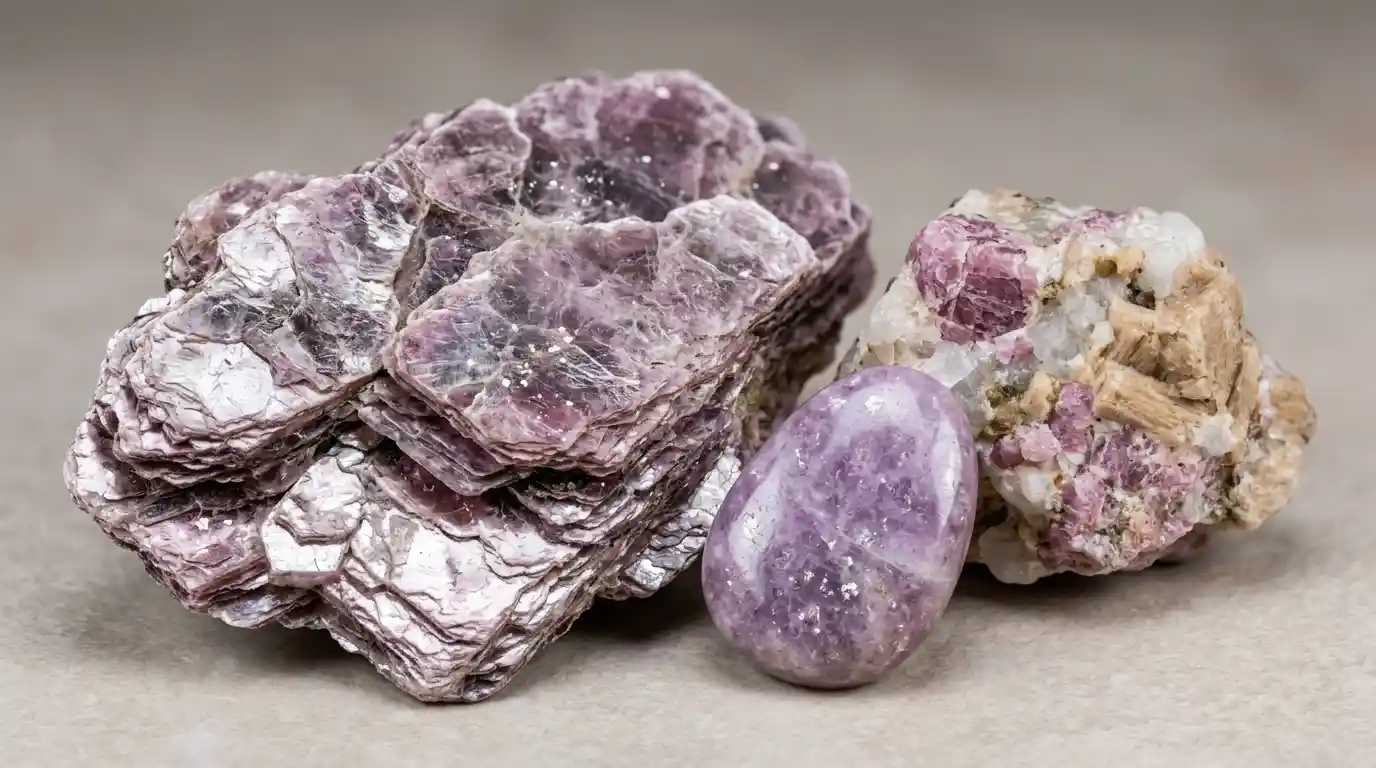
Lepidolite healing properties are commonly associated with calm, emotional balance, patience, self-awareness, adaptability, resilience, sleep routines, confidence, boundaries, concentration, personal growth, and spiritual reflection. Its lilac to pink coloration and soft layered mica texture have helped make it one of the most familiar stones in modern crystal practices centered on stress and emotional change. Those associations do not establish a medical mechanism. Lepidolite has not been demonstrated to treat anxiety, depression, bipolar disorder, insomnia, neurological disease, hormonal conditions, pain, inflammation, or another health condition, and its natural lithium content does not make touching or wearing it equivalent to taking prescribed lithium medication. Mineralogically, lepidolite is not a single modern mineral species with one universal formula. The name is used for lithium-rich trioctahedral micas close to the polylithionite-trilithionite series and related compositions. These micas are soft, perfectly cleavable, commonly pink to violet, and most often found in lithium-rich granitic pegmatites.
12 Lepidolite Claims Inspired by Lilac Mica, Layered Structure, and Transition Symbolism
- Calm during stressful periods
- Emotional balance and perspective
- Patience before reacting
- Self-awareness through reflection
- Adaptability during life changes
- Resilience after setbacks
- Better preparation for sleep
- Confidence during uncertain situations
- Stronger emotional boundaries
- Concentration and reduced distraction
- Personal growth and habit change
- Spiritual reflection and acceptance
These twelve themes can support different personal practices without becoming twelve proven biological effects. Many lepidolite benefits become more useful when translated into actions such as slowing the breath, postponing an impulsive reply, writing down a worry, reviewing a setback, changing a routine, or preparing the environment for sleep.
Lepidolite Mineral Science: Lithium-Rich Mica, Flexible Sheets, Perfect Cleavage, and Softness
The name lepidolite is commonly used for a group of lithium-rich micas rather than one perfectly defined mineral species. Modern mica nomenclature places much classic lepidolite close to the polylithionite-trilithionite compositional series. Polylithionite has the ideal formula KLi₂Al(Si₄O₁₀)(F,OH)₂, while trilithionite is represented by K(Li₁.₅Al₁.₅)(AlSi₃O₁₀)(F,OH)₂. Natural specimens can fall between end members or include related lithium-rich mica compositions.
This matters because assigning every piece sold as lepidolite one precise formula is misleading. The trade name remains useful for identifying the familiar lilac, pink, violet, gray, or pale green lithium-rich mica seen in collections and lapidary pieces, but detailed laboratory analysis may be required to determine the exact mica species.
Lepidolite typically shows pearly, sub-vitreous, greasy, or resinous luster and commonly forms scaly, platy, foliated, granular, or massive aggregates. Its layered mica structure allows it to split easily along one perfect basal cleavage direction.
Hardness is low, commonly around Mohs 2.5 to 4 depending on composition and aggregate texture. This means quartz dust, glass, steel, feldspar, and most familiar jewelry gemstones can scratch it readily. Some mica plates can bend slightly before breaking, yet polished aggregates remain vulnerable to abrasion, chipping, flaking, and separation along cleavage.
The pink to violet color common in lepidolite is often associated with manganese-related coloration. Lithium itself is not what automatically produces the purple color, and not every lithium-bearing mica looks violet.
Lepidolite Naming History, Pegmatite Formation, and Important Lithium-Mica Localities
The name lepidolite was introduced in 1792 by Martin Heinrich Klaproth. It comes from Greek roots meaning “scale” and “stone,” a reference to the scaly mica texture. The original material came from the Rožná pegmatite area in present-day Czech Republic.
Lepidolite forms mainly in highly evolved granitic pegmatites where late-stage melts and fluids become enriched in lithium, fluorine, cesium, rubidium, and other elements that do not fit easily into the early-forming minerals of ordinary granite. Those concentrated chemical conditions allow lithium-rich micas to crystallize alongside quartz, feldspar, spodumene, tourmaline, beryl, amblygonite-group phosphates, and other pegmatite minerals.
Important occurrences are known from Brazil, the Czech Republic, Afghanistan, Pakistan, Madagascar, the United States, Canada, Zimbabwe, Mozambique, and several other pegmatite regions. Individual deposits can produce everything from fine mica books and sprays to massive lapidary-grade purple rock.
Lepidolite has genuine importance as a lithium-bearing geological substance, but that industrial and chemical fact should not be confused with medical lithium therapy. Lithium locked inside a mica crystal lattice is not administered to the body simply because the stone touches the skin.
Calm, Emotional Balance, and Patience Claims
1. Calm Through a Deliberate Reduction in Stimulation
Lepidolite is frequently marketed as a calming stone. Its lithium content often gets cited as an explanation, but there is no evidence that pharmaceutical quantities of lithium enter the body from holding or wearing the mica. A practical ritual is to use the stone as a signal to reduce stimulation, put the phone aside, slow the breathing, and focus on one immediate problem rather than several competing concerns.
2. Emotional Balance Through Structured Reflection
Another common claim says lepidolite balances emotions. It has not been shown to regulate neurotransmitters or mood chemistry through skin contact. A more grounded approach is to write down what happened, what emotion is present, what interpretation is making it more intense, and what action remains available. The structure can help create perspective.
3. Patience Before Reacting
The layered mica appearance often encourages symbolism around slowing down and working through change gradually. Lepidolite cannot biologically increase impulse control. It can instead become a reminder to delay a reactive message, argument, or decision long enough to ask whether the same response will still make sense after the emotional peak has passed.
Self-Awareness, Adaptability, and Resilience Claims
4. Self-Awareness Through Journaling
Lepidolite is sometimes described as revealing emotional patterns. The stone cannot retrieve hidden psychological information. A useful ritual is to keep it near a journal and track repeated triggers, automatic reactions, consequences, and alternative responses. Pattern recognition comes from observation over time.
5. Adaptability During Life Changes
Modern crystal practice strongly associates lepidolite with transition. The stone cannot make change painless or automatically improve psychological flexibility. During a major shift, use it as a cue to separate what has ended, what remains important, and which new routine needs to replace the old one. Adaptability becomes active reorganization.
6. Resilience After Setbacks
Lepidolite is also linked with recovery after disappointment. It does not biologically create resilience. A grounded practice is to identify what cannot be changed, what lesson is worth retaining, what support is available, and what next action remains possible. The stone can mark the review while behavior creates recovery.
Sleep Routines, Confidence, and Emotional Boundaries Claims
7. Better Preparation for Sleep
Lepidolite is one of the stones most often promoted for sleep because sellers connect its lithium content with calm. There is no evidence that placing the mica under a pillow alters melatonin, sleep architecture, or insomnia through a mineral-specific effect. It can instead become part of a consistent wind-down routine involving dimmer light, reduced screen use, a regular bedtime, and writing unresolved tasks down before bed.
8. Confidence During Uncertain Situations
Some users associate lepidolite with quiet confidence rather than assertive energy. The stone does not increase self-esteem biologically. Before entering an uncertain situation, use it as a reminder to identify what has already been prepared, what remains unknown, and what first action is still under your control.
9. Stronger Emotional Boundaries
Lepidolite is sometimes described as protecting emotional energy. No evidence shows that mica creates an invisible shield. A practical interpretation is to define what conversations you will participate in, what requests you will decline, and how much time or emotional labor you are willing to provide. Boundaries become explicit behavior.
Concentration, Personal Growth, and Spiritual Reflection Claims
10. Concentration and Reduced Distraction
Lepidolite is occasionally recommended for focus during study or work. It has not been demonstrated to improve attention or memory through mineral contact. It can still become a consistent work cue: place it beside one task, silence unrelated notifications, and work for a predetermined interval before switching activities.
11. Personal Growth and Habit Change
Transition symbolism also leads to claims around personal growth. Lepidolite cannot cause behavioral change, but it can represent one chosen habit. Place the stone where that habit begins and connect seeing it with a specific action such as writing, studying, preparing for exercise, organizing finances, or maintaining a boundary.
12. Spiritual Reflection and Acceptance
Lilac lepidolite is commonly used in meditation around surrender, acceptance, and perspective. A person may find the stone helpful as a visual focus while reflecting on what can be changed and what cannot. That can be spiritually meaningful without suggesting that the mica changes consciousness through a therapeutic frequency.
Lepidolite Chakra Associations and the Mistake of Treating Lithium as Medicine
Modern crystal systems commonly associate lepidolite with the crown and third-eye chakras because of its violet to lilac color. Some practitioners also link pinker specimens with heart-centered themes involving compassion, acceptance, and relationships.
Chakras are a spiritual framework rather than anatomical structures. Lepidolite has not been demonstrated to affect the brain, pineal gland, nervous system, endocrine function, heart, or another physiological system through chakra placement.
The lithium point deserves special emphasis. Prescription lithium medicines use specific lithium compounds in carefully controlled doses and require medical supervision because blood concentrations matter. Lithium inside a mica crystal lattice is not equivalent to medication, and wearing lepidolite does not provide a therapeutic lithium dose.
Lepidolite Physical Care: Mohs 2.5 to 4, Perfect Cleavage, Water, Heat, and Abrasion
Lepidolite requires gentle handling because it is soft and perfectly cleavable. Rough wiping, abrasive cloths, quartz dust, and contact with harder stones can scratch or dull the surface. Store it separately in a padded compartment or soft pouch.
The layered mica structure can split along basal cleavage planes. Thin flakes, exposed crystal books, and coarse scaly specimens are especially vulnerable to pressure and impact. Even polished pieces should not be treated like quartz or jade.
Brief contact with clean water does not instantly dissolve ordinary lepidolite, and the mineral is not simply a source of freely soluble lithium when washed. The more practical concern is physical fragility. Prolonged soaking, vigorous brushing, and repeated wetting are unnecessary for soft, flaky aggregates and may affect resin, glue, fracture fill, matrix minerals, or assembled jewelry.
A soft dry cloth is the safest routine choice. If a sturdier polished piece needs additional cleaning, use a barely damp cloth and dry it carefully rather than scrubbing or soaking.
Steam and ultrasonic cleaning should be avoided because heat, vibration, cleavage, and layered texture create needless risk. Strong acids, alkaline cleaners, bleach, abrasives, and solvent-heavy jewelry products are also unnecessary.
Lepidolite should never be ground into powder for ingestion or added directly to drinking water for wellness purposes. Lapidary work should control dust with wet methods, extraction, eye protection, and appropriate respiratory precautions.
Ritual Cleansing Lepidolite Without Soaking or Damaging Its Mica Layers
Ritual cleansing does not require putting lepidolite through aggressive physical treatment. There is no scientifically demonstrated negative energy that must be washed, salted, heated, or smoked out of the mica.
Sound, quiet reflection, intentional breathing, or dry placement on a clean surface are simple low-risk choices. A transition-themed ritual can involve writing one behavior that is ending and one new routine that will replace it.
Avoid prolonged water immersion, saltwater, abrasive salt contact, steam, flame, chemical sprays, and vigorous brushing. Gentle practices fit both the symbolic intention and the mineral’s physical fragility.
Conclusion
Lepidolite is more interesting when its lithium chemistry is explained accurately. It is a field name for lithium-rich micas, not a psychiatric medicine in crystal form, and its soft layered structure requires much more care than quartz-based stones. Its twelve healing themes can still support calm routines, journaling, boundaries, sleep preparation, resilience, and personal change when those practices remain behavioral or spiritual rather than medical.
Frequently Asked Questions About Lepidolite Healing Properties
What are the main lepidolite healing properties people claim?
Common claims include calm, emotional balance, patience, self-awareness, adaptability, resilience, sleep support, confidence, boundaries, concentration, personal growth, and spiritual reflection. These are contemporary wellness or spiritual beliefs rather than proven therapeutic effects.
Is lepidolite one mineral species?
Not in modern strict mineral nomenclature. Lepidolite is used as a field name for lithium-rich micas close to the polylithionite-trilithionite series and related compositions.
Does lepidolite contain lithium?
Yes. Lithium is an essential part of the chemistry of the lithium-rich micas called lepidolite, although the exact amount and formula vary with the specific mica composition.
Does lepidolite work like lithium medication?
No. Prescription lithium involves specific pharmaceutical compounds, controlled doses, blood monitoring, and medical supervision. Lithium locked inside a mica crystal does not provide the same exposure by being worn or held.
How hard is lepidolite?
Common lepidolite is soft, generally around Mohs 2.5 to 4 depending on composition and aggregate structure. It can be scratched easily by most common gemstones.
Why does lepidolite split into flakes?
It is a mica with perfect basal cleavage. Its layered crystal structure allows it to separate readily into thin sheets or plates.
Which chakras are associated with lepidolite?
Modern crystal practice commonly links violet lepidolite with the crown and third-eye chakras and sometimes pink specimens with the heart chakra. These are spiritual correspondences rather than anatomical effects.
Can lepidolite go in water?
Brief damp cleaning can be acceptable for a sound polished piece, but soaking is unnecessary. Its softness, cleavage, flaky aggregates, matrix minerals, and possible treatments make dry or minimally damp cleaning preferable.
Can lepidolite be cleaned with steam or ultrasonics?
No. Heat and vibration add unnecessary risk to a soft, cleavable mica. Gentle dry cleaning or careful wiping is safer.
Is lepidolite suitable for everyday jewelry?
It is much better suited to protected pendants, earrings, beads, or occasional wear than exposed rings. Its softness and cleavage make scratching and flaking significant concerns.
Crystal healing claims are traditional or personal beliefs and should not replace qualified medical or mental health care.