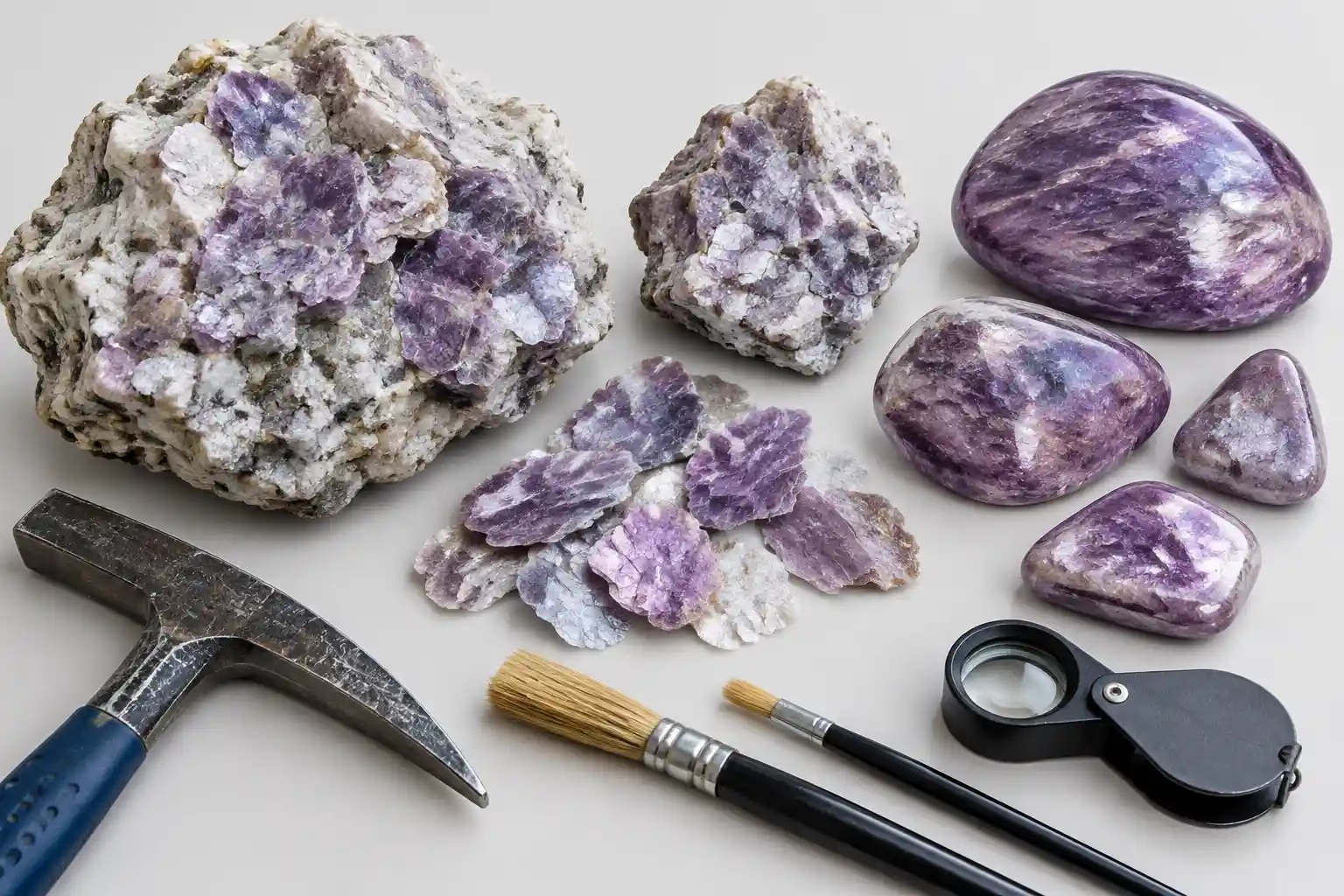
Lepidolite Benefits: 11 Real Uses, Deep Symbolism & Verified Facts, Safe Limits
Lepidolite benefits are more interesting when this purple mineral is understood accurately rather than described only through modern crystal-healing claims. The name lepidolite is traditionally used for lithium-rich mica and is now best treated as a field name covering related lithium-bearing mica species, particularly compositions within or near the polylithionite-trilithionite series. This distinction matters because lepidolite does not have one simple chemical formula that accurately represents every specimen sold under the name.
Its lilac, pink, purple, grayish, or occasionally pale-colored appearance, pearly to vitreous luster, platy mica structure, and association with lithium-rich granitic pegmatites give lepidolite real value for mineral collecting, geology, decorative objects, and selected lapidary work. It commonly occurs alongside minerals associated with evolved pegmatites, including quartz, feldspar, tourmaline, spodumene, and other lithium-bearing species.
Many modern discussions of lepidolite benefits focus on calmness, emotional balance, sleep, anxiety, or lithium itself. Those ideas require careful limits. Lithium-bearing mica does not work like prescription lithium medication simply because a person holds or wears it, and there is no established evidence that therapeutic lithium enters the body through ordinary skin contact with a polished stone. Lepidolite can still be meaningful as a specimen, educational mineral, visual object, or symbolic focus without being presented as medicine.
11 Lepidolite Benefits at a Glance
- Lilac and purple colors give lepidolite distinctive decorative and collector appeal.
- Lithium-rich mica chemistry provides genuine mineralogical and geological interest.
- Pegmatite associations make specimens useful for studying highly evolved granitic systems.
- Platy crystal habit helps demonstrate the layered structure and perfect cleavage characteristic of mica.
- Collector specimens can show attractive crystals, books, aggregates, or associations with other pegmatite minerals.
- Massive and aggregate lepidolite can sometimes be polished or carved into decorative pieces.
- Educational value comes from distinguishing a field name from individual formally defined mica species.
- Modern symbolism can connect the stone with transition, reflection, patience, and intentional routines.
- Meditation or journaling use can provide a visual and tactile focus without requiring medical claims.
- Care awareness teaches why soft mica-rich stones need protection from abrasion, impact, and harsh cleaning.
- Responsible interpretation separates naturally occurring lithium in minerals from pharmaceutical lithium treatment.
Purple Color Gives Lepidolite Strong Visual and Collector Appeal
Color is one of the easiest lepidolite benefits to appreciate. Specimens commonly appear lilac, lavender, pinkish purple, violet, pale rose, grayish, or sometimes nearly colorless. The purple and pink shades traditionally associated with lepidolite have been linked largely with manganese-related coloration, although exact chemistry varies among specimens.
Mica structure contributes just as much to its appearance as color. Flat surfaces can show a pearly or reflective sheen, and thin plates may catch light differently as the specimen moves. Coarse aggregates can produce a sparkling appearance because many small cleavage surfaces reflect light independently.
The visual effect differs from transparent purple gemstones such as amethyst. Lepidolite is often appreciated for texture, layered mica structure, silvery reflections, and soft blended color rather than high brilliance from faceting. Some specimens are almost entirely lilac mica, while others occur mixed with white quartz, feldspar, tourmaline, or additional pegmatite minerals.
This variability makes lepidolite interesting in mineral cabinets and decorative collections. A compact polished piece, an open mica book, and a pegmatite specimen containing several mineral species can each reveal a different aspect of the stone.
Lithium-Rich Mica Chemistry Is a Real Lepidolite Benefit
The lithium association behind lepidolite is genuine mineralogy, although it is frequently misunderstood in wellness marketing. Lepidolite is a traditional field term for lithium-rich members of the mica group rather than one chemically uniform mineral species. Modern mineral classification recognizes individual mica species with defined compositions, while the familiar lepidolite name remains useful in geological, collecting, and commercial contexts.
Lithium can become concentrated during advanced stages of granitic magma evolution. In highly fractionated pegmatites, unusual elements may accumulate sufficiently for lithium-bearing minerals to crystallize. This is why lepidolite can occur with spodumene, elbaite tourmaline, petalite, amblygonite-group minerals, quartz, and feldspars.
That geological association gives the stone genuine scientific importance. A specimen may provide evidence that the host pegmatite reached an advanced stage of chemical differentiation. Geologists studying lithium-bearing pegmatites can examine mineral assemblages, textures, zonation, and chemistry to understand how the body crystallized.
The presence of lithium does not make a polished lepidolite stone pharmacologically active when handled. Mineral-bound lithium and prescribed lithium compounds used medically are entirely different contexts. Confusing the two turns an interesting mineralogical fact into an unsupported health claim.
Lepidolite Helps Explain Mica Structure and Perfect Cleavage
Mica minerals have a sheet-like crystal structure that allows them to split readily into thin layers. Lepidolite displays this characteristic strongly, making its physical behavior useful for teaching basic mineralogy.
Individual crystals or mica books may separate along perfect basal cleavage into very thin plates. These sheets can appear flexible in some specimens, but the stone should not be treated as mechanically durable simply because a thin flake bends. Large crystals and aggregates can chip, split, or crumble along cleavage surfaces when handled roughly.
This structure is one reason assigning a single simple durability description to every lepidolite object can be misleading. Individual lithium-mica species are relatively soft, commonly around the low end of the Mohs scale, and aggregate pieces may contain harder companion minerals such as quartz. A mixed pegmatite specimen can therefore behave differently from a pure mica crystal.
For students, this creates an immediate lesson in the difference between hardness, cleavage, toughness, and rock or mineral aggregation. Lepidolite benefits mineral education precisely because its physical structure is so visible.
Pegmatite Geology Makes Lepidolite Valuable for Study
Lepidolite is closely associated with granitic pegmatites, which are famous for exceptionally coarse crystals and unusual concentrations of elements. These geological environments can produce spectacular combinations of quartz, feldspar, mica, tourmaline, spodumene, beryl, and other minerals.
Late-stage pegmatite fluids and melts can become enriched in lithium, fluorine, rubidium, cesium, and other elements as crystallization progresses. Lithium-rich mica may form under these specialized conditions, sometimes creating large plates or extensive purple aggregates.
This makes lepidolite benefits particularly significant for anyone interested in economic geology. Lithium has major industrial importance, and mineralized pegmatites are among the geological sources studied for lithium resources. Lepidolite itself has historically been considered among lithium-bearing minerals, although modern extraction economics depend on deposit size, mineralogy, processing methods, market conditions, and competing lithium sources.
Collectors do not need to view every specimen as ore. A well-formed purple mica crystal on pale feldspar can simply be an attractive geological object. Its chemistry nevertheless connects a hand specimen with larger questions about magma evolution, mineral resources, and geochemical concentration.
Collector Specimens Can Show Exceptional Mineral Associations
Collecting is one of the most tangible lepidolite benefits because attractive specimens occur in several forms. Crystals can develop as platy books, tabular masses, sparkling granular aggregates, or intergrowths with other pegmatite minerals.
Association specimens may be particularly attractive. Purple lepidolite beside clear or smoky quartz creates strong color contrast, while combinations with pink or green tourmaline can produce highly decorative pegmatite pieces. Feldspar provides a pale background that often emphasizes the mica’s lilac coloration.
Collectors may consider crystal size, color intensity, luster, association, locality, damage, alteration, and specimen aesthetics. A bright, undamaged mica book can be desirable for a different reason than a large polished aggregate. Locality documentation can also add scientific value because pegmatites from different regions have distinct mineral histories.
The soft, cleavable nature of mica requires careful specimen handling. Thin plates can break, edges can flake, and friable aggregates may shed small particles. Proper storage and gentle handling preserve features that may have taken geological processes a very long time to produce.
Massive Lepidolite Can Have Lapidary and Decorative Uses
Single lepidolite crystals are generally not ideal for conventional faceting because mica cleavage is extremely pronounced. Massive or fine-grained aggregates, however, may sometimes be shaped into cabochons, beads, carvings, palm stones, spheres, or other decorative objects, particularly when the aggregate is sufficiently coherent.
These polished pieces can display lilac color, swirls of white quartz or feldspar, and sparkling mica reflections. Their appeal comes from pattern and color rather than exceptional hardness or optical brilliance.
Durability remains an important limitation. A polished lepidolite-rich object may scratch more easily than quartz or many traditional jewelry gemstones. Rings and bracelets can receive frequent abrasion and impact, while pendants, earrings, or decorative pieces generally experience less wear.
The stone should therefore be chosen for a design appropriate to its physical properties. A large polished pendant can display color effectively without subjecting the surface to the constant contact experienced by a ring.
Lepidolite Benefits in Education Extend Beyond Lithium
Lepidolite provides an unusually useful example of how mineral terminology changes as scientific classification becomes more precise. Older books may present lepidolite as if it were one mineral with a fixed formula, while modern references describe it as a field name for a group of related lithium-rich micas.
This makes the stone helpful for teaching that mineralogy is not static. Analytical tools, structural studies, and classification systems improve over time, sometimes revealing that a familiar historical name includes several chemically distinct species.
The distinction does not make the word lepidolite useless. Geologists, collectors, jewelers, and mineral dealers may continue using it descriptively when precise species determination has not been performed. The important point is understanding what level of identification the name provides.
This lesson is especially valuable when comparing lepidolite with trade categories such as Lithium Quartz. The word lithium in a commercial gemstone name does not automatically establish a particular lithium concentration, mineral inclusion, or pharmaceutical property. Each specimen needs evidence appropriate to the claim being made.
Modern Symbolism Focuses on Change, Calmness, and Reflection
Modern lepidolite benefits frequently include symbolic themes such as transition, emotional steadiness, patience, letting go, organization, and calm reflection. Purple coloration and the soft layered appearance may contribute to the gentle image the stone has acquired in contemporary crystal culture.
Someone experiencing a major life transition may choose a polished lepidolite piece as a reminder to proceed gradually. Another person may associate the layered mica structure with removing unnecessary complications or looking at a situation one layer at a time.
These interpretations can be meaningful as symbolism without claiming a biological effect. A stone on a desk might remind someone to pause before reacting to a stressful email. A pendant could represent commitment to a new routine. A specimen received during a difficult transition may later become associated with persistence.
The strongest symbolic uses are often personal rather than universal. The stone does not need to alter brain chemistry for an owner to connect it with a period of change.
Meditation and Journaling Can Use Lepidolite as a Focus
Lepidolite is commonly included in meditation spaces, crystal collections, or reflective routines because of its soft purple color and modern associations with calmness. A person may hold a polished aggregate, place a specimen beside a journal, or use the stone as a visual signal that a period of quiet reflection has begun.
The potential value lies in the routine, attention, and symbolism rather than in a medically demonstrated mineral effect. Creating a regular pause for breathing, writing, or contemplation can be meaningful whether the focus object is a stone, candle, photograph, bead, or another personally significant item.
This distinction becomes particularly important with lepidolite because its natural lithium content encourages misleading comparisons with lithium medication. Prescription lithium is administered in specific chemical forms and doses under medical supervision. Lithium locked within a mica crystal does not create an equivalent treatment through holding, wearing, or sleeping near the stone.
Claims described within modern lepidolite healing properties therefore need evidence limits. Symbolic relaxation practices can coexist with appropriate medical care, but the gemstone itself should not replace treatment for anxiety, depression, bipolar disorder, sleep disorders, or other health conditions.
Safe Handling and Cleaning Protect Lepidolite Specimens
Lepidolite’s soft and strongly cleavable mica structure makes gentle care important. Single crystals and flaky specimens should not be scrubbed aggressively because thin layers can detach. Even coherent polished aggregates can develop scratches more readily than harder gemstones.
Dust on a stable specimen can often be removed gently with a soft brush or cloth. Water exposure should be approached cautiously with friable or matrix specimens because moisture can enter fractures or loosen poorly consolidated areas. Jewelry construction also matters, particularly when adhesives, stringing components, coatings, or additional stones are present.
Harsh chemicals, abrasive powders, steam, and aggressive ultrasonic cleaning are unnecessary for most lepidolite pieces. A soft cloth and conservative cleaning method usually make more sense than trying to achieve a high-gloss finish on a naturally soft mica-rich stone.
Storage should prevent harder minerals from rubbing against polished surfaces. Quartz, sapphire, and many other common gemstones can scratch lepidolite readily, so separate compartments or soft wrapping are useful.
Natural Lithium Does Not Give Lepidolite Medical Effects
This is the most important limit in any responsible discussion of lepidolite benefits. The mineral genuinely contains lithium, but that does not mean wearing a bracelet or holding a polished stone supplies the body with a therapeutic lithium dose.
Prescription lithium medications involve carefully formulated lithium compounds, controlled dosing, blood-level monitoring, and professional medical supervision because lithium treatment can have significant effects and risks. None of that is reproduced by skin contact with lithium-bearing mica.
Lepidolite should therefore not be described as treating bipolar disorder, anxiety disorders, depression, trauma, insomnia, neurological illness, hormonal problems, or other medical conditions. It also should not be powdered, consumed, placed in drinking water, or used to make homemade mineral remedies.
The safest approach is simple. Appreciate the real mineralogy, geology, color, collecting value, and personal symbolism while leaving medical treatment to appropriately qualified professionals.
Conclusion
Lepidolite benefits extend from lithium-rich mica mineralogy and pegmatite geology to mineral collecting, education, decorative use, and personal symbolism. Its purple color, layered mica structure, association with lithium-bearing pegmatites, and distinctive specimens give it genuine scientific and aesthetic interest.
Modern themes involving calmness, transition, patience, and reflection can remain meaningful as symbolic practices, but natural lithium inside the stone does not function like prescription lithium medication. Protecting that distinction allows lepidolite to be appreciated accurately without turning its chemistry into unsupported health claims.
FAQs
What are the main lepidolite benefits?
The strongest lepidolite benefits include its attractive purple color, lithium-rich mica chemistry, geological importance in evolved pegmatites, collector appeal, educational value, and suitability for some decorative and lapidary uses. Modern crystal traditions also connect it with reflection, transition, calmness, and emotional steadiness, but those themes are personal or spiritual interpretations rather than medically established effects.
Is lepidolite actually a mineral?
The name lepidolite is traditionally used for lithium-rich mica, but modern mineral references treat it more accurately as a field name covering related mica species rather than one single mineral with a universal chemical formula. Compositions commonly fall within or near lithium-rich members of the mica group. A specimen may therefore require detailed chemical and structural analysis for precise species identification.
Why is lepidolite usually purple?
Pink, lilac, and purple coloration in lithium-rich mica has generally been associated with manganese-related chemistry, although composition varies among specimens. The mica’s pearly luster and layered structure can intensify its decorative appearance. Color alone does not identify a specific mica species, so purple coloration should not be treated as proof of an exact chemical composition.
Does lepidolite really contain lithium?
Yes, the term lepidolite refers to lithium-rich micas, so lithium is genuinely part of their mineral chemistry. This fact is geologically significant because these micas often occur in highly evolved granitic pegmatites enriched in lithium and other unusual elements. Natural lithium inside the crystal does not, however, mean that touching lepidolite delivers a therapeutic lithium dose.
Is lepidolite suitable for jewelry?
Massive or coherent lepidolite aggregates can be fashioned into cabochons, beads, pendants, and other decorative jewelry. The stone is relatively soft and has pronounced mica cleavage, so exposed rings and bracelets can scratch or damage more readily than protected pendants or earrings. Individual mica crystals are especially fragile and generally better suited to mineral collections than demanding daily-wear jewelry.
Is lepidolite used as a lithium ore?
Lithium-rich mica can be part of lithium-bearing pegmatite deposits and has been considered a lithium resource in various mining contexts. Whether it is economically useful depends on deposit grade, scale, mineralogy, processing technology, market conditions, and other factors. Its presence is also valuable to geologists because it can indicate an evolved lithium-enriched pegmatite system.
Does lepidolite help with anxiety or depression because it contains lithium?
There is no established evidence that holding or wearing lepidolite treats anxiety disorders, depression, bipolar disorder, or other mental-health conditions. Prescription lithium uses specific chemical compounds and carefully controlled doses under medical supervision. Lithium bound within a mica crystal does not produce the same therapeutic exposure through ordinary skin contact.
Can lepidolite be used during meditation?
Yes. A polished stone or mineral specimen can be used as a visual or tactile focus during meditation, journaling, breathing exercises, or personal ritual. The practice may have symbolic meaning because the owner associates the stone with calmness or transition. Such use should not be confused with a claim that lepidolite medically changes mood, neurological function, or brain chemistry.
How should lepidolite be cleaned?
Gentle care is best because mica is soft and splits easily along cleavage planes. A soft brush or cloth is preferable for delicate specimens, while coherent polished pieces may tolerate careful cleaning appropriate to their construction. Abrasive products, aggressive scrubbing, steam, strong ultrasonic cleaning, and harsh chemicals should generally be avoided, particularly with flaky crystals or pieces containing fractures.
Lepidolite benefits involving calmness, emotional balance, lithium-related wellness, or spiritual energy describe symbolic or belief-based uses and should not replace qualified physical or mental-health care.