Mangano Calcite Healing Properties: 10 Claims, Mineral Facts & Safe Use
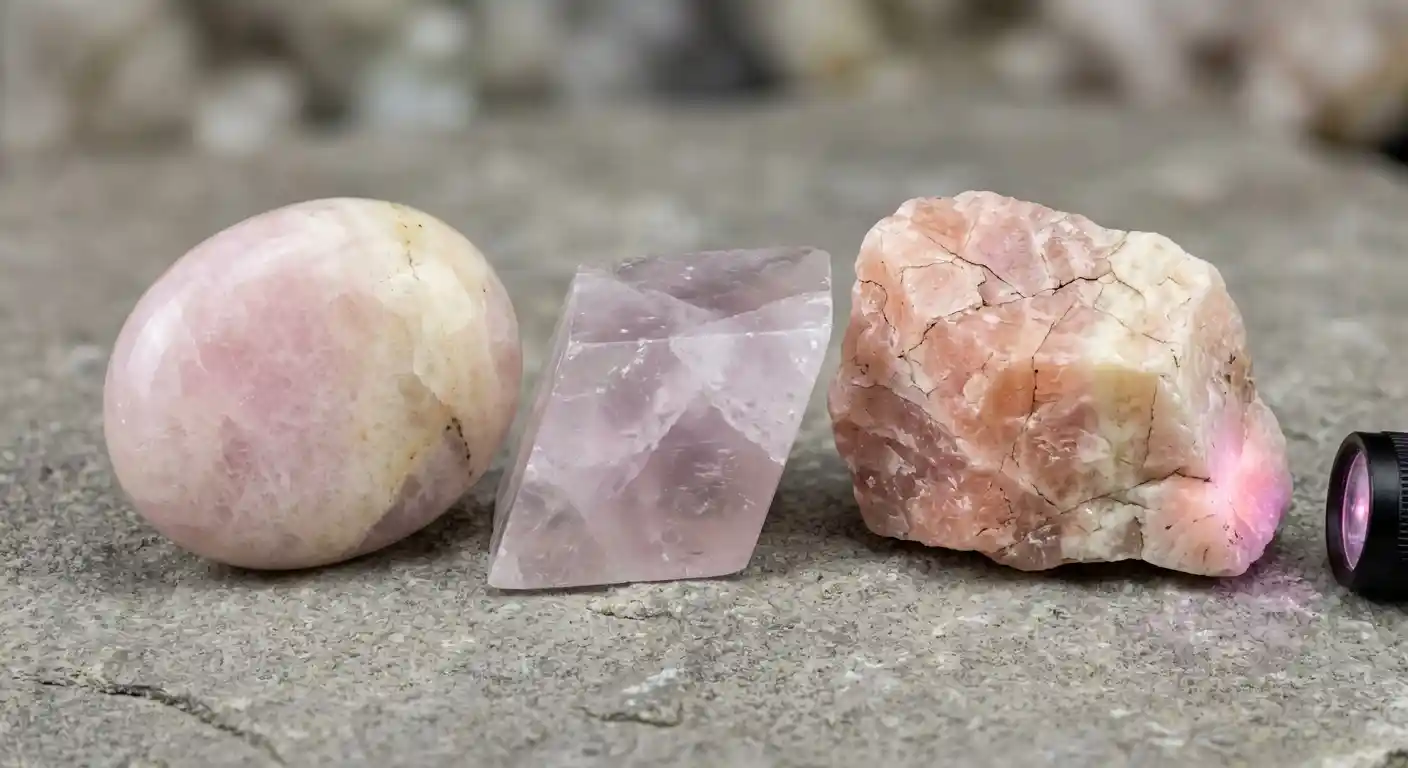
Mangano calcite healing properties are commonly associated with compassion, emotional calm, self-acceptance, forgiveness, relationship awareness, patience, confidence, resilience, reflection, and heart-centered spiritual practice. Its pale pink to rose coloration naturally encourages emotional and relationship symbolism, while some specimens also fluoresce striking orange, pink, or red under ultraviolet light. Neither feature establishes a therapeutic mechanism. Mangano calcite has not been demonstrated to treat anxiety, depression, trauma, cardiovascular disease, hormonal conditions, inflammation, pain, sleep disorders, or another illness, and manganese inside the crystal does not enter the body as a useful supplement simply because the stone is held or worn. Scientifically, mangano calcite is manganese-bearing calcite, commonly represented as (Ca,Mn)CO₃, in which manganese substitutes for some calcium within the calcite structure. It remains a variety of calcite rather than a separate species, retaining calcite’s trigonal crystallography, Mohs hardness near 3, perfect rhombohedral cleavage, brittle tenacity, and strong sensitivity to acids.
10 Mangano Calcite Healing Claims
- Compassion toward oneself and others
- Emotional calm during stressful periods
- Self-acceptance and kinder self-reflection
- Forgiveness without abandoning boundaries
- Relationship awareness and communication
- Patience before reacting
- Confidence in emotionally difficult situations
- Resilience after disappointment
- Reflective awareness of emotional patterns
- Heart-centered spiritual contemplation
These ten themes can support different personal practices without becoming ten scientifically verified effects. Many Mangano Calcite benefits become more useful when converted into behaviors such as slowing down before reacting, journaling honestly, preparing for a difficult conversation, identifying a boundary, or reviewing what can still be changed after disappointment.
Mangano Calcite Mineral Facts
Mangano calcite is calcite containing manganese in place of part of the calcium. Its chemistry is commonly written as (Ca,Mn)CO₃, while pure calcite is CaCO₃. The exact amount of manganese varies, which is one reason the color and fluorescence can differ substantially from one specimen to another.
The stone belongs to the trigonal crystal system because the underlying structure remains calcite. It can form rhombohedral, scalenohedral, elongated, sheaf-like, massive, or clustered habits depending on growth conditions and locality.
Color typically ranges from almost white through very pale pink, peach-pink, rose, and stronger pink. Manganese is closely associated with the coloration, although appearance alone cannot establish the exact Mn concentration. A pink calcite specimen should not automatically be assigned a precise composition without analysis.
Some manganese-bearing calcite fluoresces strongly under ultraviolet light, often in orange-red or pink-orange tones. Manganese can act as a fluorescence activator, but not every mangano calcite specimen fluoresces strongly. Concentration, other impurities, crystal defects, and locality all influence the response. UV fluorescence can therefore be interesting but should not be treated as a universal authenticity test.
Mangano calcite remains physically similar to ordinary calcite. Mohs hardness is about 3, which means it scratches easily compared with quartz, feldspar, glass, and most jewelry gemstones. Perfect cleavage occurs in three directions, allowing the crystal to split into rhombohedral fragments after impact.
Luster is commonly vitreous to pearly, especially on fresh cleavage surfaces. Transparency ranges from transparent and translucent to opaque depending on inclusions, grain size, and internal fractures.
Manganese-Bearing Calcite Formation
Mangano calcite can form in hydrothermal veins, ore deposits, cavities, metamorphic environments, and other settings where calcium carbonate crystallizes in the presence of manganese. Its occurrence is often linked with manganese or polymetallic deposits containing minerals such as rhodochrosite, manganite, galena, sphalerite, pyrite, quartz, and other carbonates.
Important specimens are known from places such as the Kalahari manganese field in South Africa, Dalnegorsk in Russia, Naica in Mexico, Broken Hill in Australia, Cavnic in Romania, deposits in China, and several South American mining districts. Locality strongly influences crystal habit, associated minerals, color intensity, and fluorescence.
The relationship with rhodochrosite can create confusion. Rhodochrosite is a distinct manganese carbonate mineral with the ideal formula MnCO₃, while mangano calcite is still calcite in which calcium remains dominant and manganese substitutes only partially. The two can occur near each other and may form visually similar pink crystals.
The name “mangano calcite” is common in the crystal trade, while “manganoan calcite” or “manganese-bearing calcite” is generally more precise mineralogical wording. None of these names establishes an ancient healing identity. The modern Mangano Calcite meaning built around compassion and emotional healing is primarily contemporary symbolism inspired by its pink color.
Compassion and Emotional Calm
Compassion Through Perspective
Mangano calcite is frequently described as a compassion stone because pale pink gems are often linked with gentleness and emotional openness. The mineral cannot biologically increase empathy. A practical ritual is to use it as a reminder to consider another person’s perspective while still checking whether their behavior is respectful and whether personal boundaries remain necessary.
Calm Through a Deliberate Pause
Another common claim says mangano calcite soothes emotional intensity. Calcium carbonate containing manganese has not been shown to regulate neurotransmitters, heart rate, or stress hormones through touch. It can instead serve as a signal to stop reacting immediately, slow the breathing, reduce stimulation, and identify what actually needs attention.
Self-Acceptance and Forgiveness
Self-Acceptance Through Fairer Self-Talk
Pink mangano calcite is often used in self-love practices. A stone cannot directly change self-esteem, but it can become a cue to notice excessively harsh internal language. Replace vague statements such as “I always fail” with a more accurate description of what happened, what went well, and what can improve. The shift comes from fairer evaluation.
Forgiveness With Boundaries
Mangano calcite is also associated with forgiveness. The stone cannot erase resentment, trauma, or painful memories. Forgiveness should not require returning to an unsafe relationship or ignoring repeated harm. A more useful ritual is to decide what mental burden you want to stop carrying while separately defining what boundary still needs to remain.
Relationships, Patience, and Confidence
Relationship Awareness
Modern crystal practices often link mangano calcite with harmony in close relationships. It cannot make another person honest, loyal, or emotionally available. A practical reflection is to look at repeated behavior: Are expectations communicated clearly? Are promises followed by action? Are boundaries respected? Relationship health is better assessed through patterns than through gemstone symbolism.
Patience Before Reacting
The stone’s soft pink appearance encourages symbolism around gentleness and patience. Mangano calcite does not change impulse control biologically. It can instead become a reminder to delay non-urgent messages, arguments, or decisions until emotional intensity has decreased enough for clearer judgment.
Confidence in Emotional Situations
Mangano calcite is sometimes used when someone wants to speak honestly without becoming overwhelmed. The crystal cannot create confidence. Before a difficult conversation, use it as a cue to prepare the central point, identify the desired outcome, and decide which boundary should remain intact regardless of the response.
Resilience and Emotional Reflection
Resilience After Disappointment
Mangano calcite is occasionally associated with emotional recovery. It cannot biologically create resilience or heal grief. After disappointment, use it as a reminder to separate what cannot be changed from what remains actionable, identify one useful lesson, and decide what next step would reduce repeated harm.
Reflection on Emotional Patterns
Some practitioners say the stone helps reveal emotional habits. Mangano calcite does not uncover hidden psychological information. Keeping it near a journal can still create a repeatable cue to track triggers, reactions, assumptions, and consequences. Repeated observation can reveal patterns through evidence rather than intuition alone.
Mangano Calcite Chakra Meaning
Mangano calcite is most commonly associated with the heart chakra in contemporary crystal systems because of its pink coloration. Themes usually include compassion, affection, forgiveness, emotional openness, relationships, gentleness, and self-acceptance.
Chakras are a spiritual framework rather than anatomical structures. Mangano calcite has not been demonstrated to affect the physical heart, circulation, lungs, endocrine glands, nervous system, or other organs through chakra placement.
The stone’s manganese content should not be converted into a health claim either. Manganese is an essential nutrient at appropriate dietary levels, but manganese locked inside a calcite crystal is not a nutritional supplement delivered through normal skin contact.
Mangano Calcite Care
Mangano calcite requires careful handling because its Mohs hardness is only about 3. Quartz, feldspar, glass, steel, and many common gemstones can scratch it readily. Store specimens separately in a padded compartment instead of allowing them to rub against harder stones.
Perfect rhombohedral cleavage creates an even greater durability concern. A sharp impact can split calcite along smooth planes. Thin crystals, exposed edges, and carved points need protection from drops and pressure.
Brief contact with plain lukewarm water is generally acceptable for a sound untreated specimen, but soaking is unnecessary. Water may also affect attached matrix, adhesives, coatings, repairs, or associated minerals even when the calcite itself survives brief contact.
Acids should be avoided completely. Vinegar, lemon juice, descaling products, acid-based cleaners, and similar liquids react with calcium carbonate and can visibly etch the surface. The fizz produced when calcite encounters acid is a chemical reaction, not a harmless cleaning effect.
Steam and ultrasonic cleaners should not be used. Heat, vibration, cleavage, and hidden fractures create unnecessary risk. A soft dry cloth or very gentle cleaning with lukewarm water and mild non-acidic soap is safer.
Cutting or grinding manganese-bearing calcite produces mineral dust that should not be inhaled or ingested. Wet lapidary methods, extraction, eye protection, and suitable respiratory controls are sensible.
Safe Ritual Cleansing
Ritual cleansing does not require soaking or chemically treating mangano calcite. There is no scientifically demonstrated negative energy that must be extracted from the stone.
Sound, reflection, intentional breathing, or dry placement on a clean surface are low-risk choices. A heart-centered ritual can involve identifying one relationship boundary or one compassionate action that should become more consistent.
Avoid saltwater, vinegar, citrus, acids, abrasive salt, steam, flame, and prolonged immersion. Calcite’s softness and chemical sensitivity make aggressive rituals particularly unsuitable.
Conclusion
Mangano calcite is better understood as manganese-bearing calcite than as a medically active pink crystal. Its varying Mn content can produce appealing pink color and sometimes striking fluorescence, while its calcite structure gives it Mohs 3 hardness, perfect cleavage, and strong acid sensitivity. Its ten healing themes can still support compassion, reflection, patience, boundaries, and emotional awareness when the useful work remains with the person.
FAQs
What are the main mangano calcite healing properties?
Common claims include compassion, emotional calm, self-acceptance, forgiveness, relationship awareness, patience, confidence, resilience, reflection, and heart-centered spiritual practice. These are contemporary wellness beliefs rather than proven therapeutic effects.
What is mangano calcite made of?
It is manganese-bearing calcite commonly represented as (Ca,Mn)CO₃, meaning some manganese substitutes for calcium in the calcite structure.
Is mangano calcite the same as rhodochrosite?
No. Rhodochrosite is the distinct manganese carbonate mineral MnCO₃. Mangano calcite remains calcite with calcium still dominant.
Why is mangano calcite pink?
Manganese substitution is closely associated with the pink coloration. The exact shade varies with Mn concentration and other chemical or structural factors.
Does all mangano calcite fluoresce?
No. Many specimens fluoresce orange, red, or pink under ultraviolet light, but fluorescence intensity varies and some pieces may show little response.
How hard is mangano calcite?
It is about Mohs 3, similar to ordinary calcite, and scratches easily.
Which chakra is mangano calcite associated with?
Modern crystal systems most commonly associate it with the heart chakra. This is a spiritual correspondence rather than an anatomical effect.
Can mangano calcite go in water?
Brief contact with plain water is generally acceptable for a sound untreated specimen, but soaking is unnecessary. Acidic liquids should always be avoided.
Can mangano calcite be cleaned with vinegar?
No. Vinegar reacts with calcium carbonate and can etch the surface permanently.
Does manganese in mangano calcite provide health benefits through touch?
No evidence shows that wearing or holding manganese-bearing calcite supplies a useful nutritional or medicinal manganese dose through the skin.
Crystal healing claims are traditional or personal beliefs and should not replace qualified medical or mental health care.