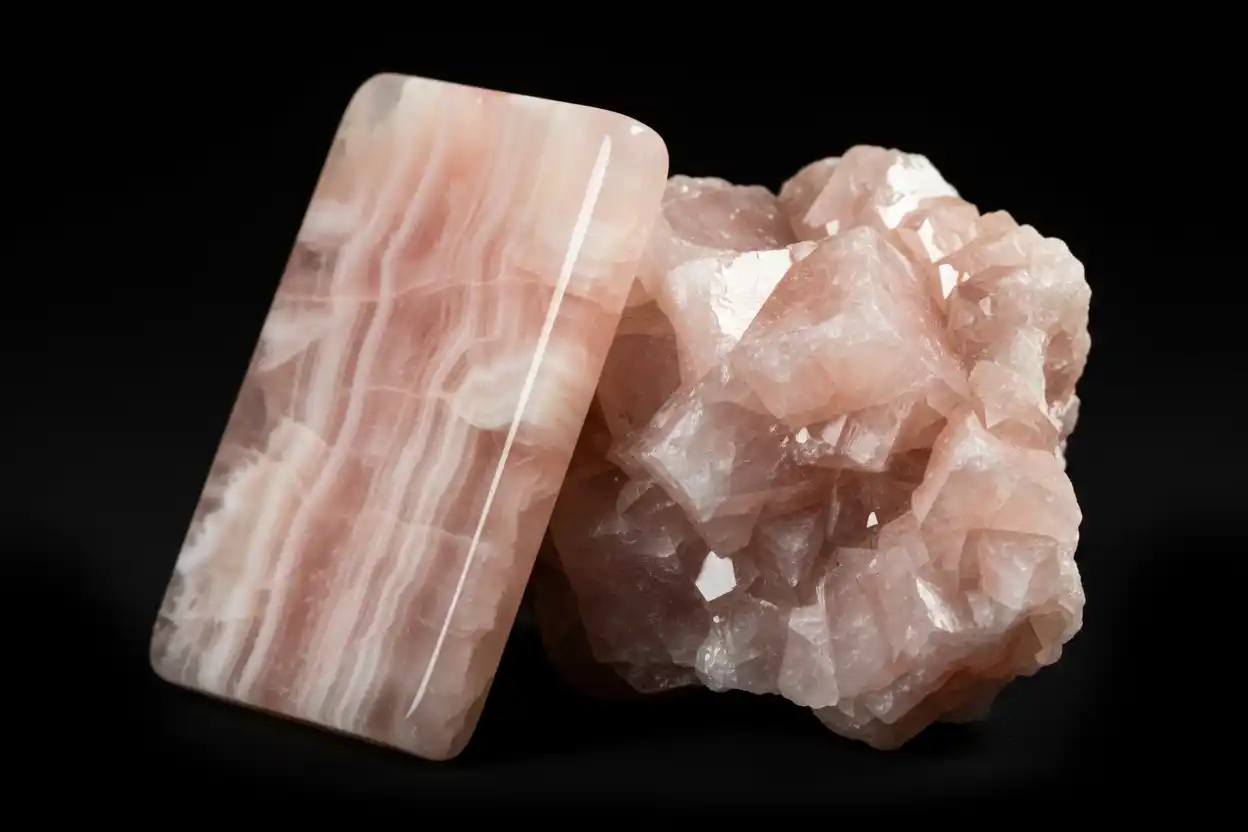
Mangano Calcite: Meaning, Properties & Symbolism
Mangano calcite is a manganese-bearing variety of calcite that commonly appears pale pink, rose, peach-pink, or lavender-pink. Many specimens fluoresce vivid pink, orange, or red under ultraviolet light, which makes the material especially popular with fluorescence collectors.
The name often appears as manganoan calcite, manganese-bearing calcite, manganocalcite, or pink mangano calcite. Although these labels describe a useful gem and collector variety, mangano calcite is not recognized as a separate mineral species.
What “Mangano Calcite” Actually Means
Mangano calcite is calcite in which manganese substitutes for part of the calcium within the crystal structure. Its composition can be expressed broadly as (Ca,Mn)CO₃, although the proportion of manganese varies between specimens.
Calcite and rhodochrosite form a compositional series because both have related carbonate structures. Calcite represents the calcium-rich end, CaCO₃, while rhodochrosite represents the manganese-rich end, MnCO₃.
Material with a relatively small to moderate manganese component remains manganese-bearing calcite. As manganese content rises, identification and nomenclature become more complicated, particularly near intermediate compositions or related ordered carbonates such as kutnohorite.
“Mangano calcite” is therefore best understood as a descriptive variety name, not a fixed chemical formula or independent species.
Mangano Calcite at a Glance
| Property | Mangano calcite |
|---|---|
| Material type | Manganese-bearing variety of calcite |
| General composition | (Ca,Mn)CO₃ |
| Mineral group | Calcite group |
| Common colors | Pale pink, rose, peach-pink, mauve, lavender-pink, white-and-pink banded |
| Crystal system | Trigonal, within the hexagonal crystal family |
| Typical habit | Rhombohedral, scalenohedral, bladed, granular, massive, banded, or clustered |
| Luster | Vitreous; sometimes pearly on cleavage surfaces |
| Transparency | Transparent to opaque |
| Mohs hardness | 3 |
| Cleavage | Perfect rhombohedral cleavage |
| Tenacity | Brittle |
| Fluorescence | Frequently pink, orange, or red; intensity varies |
| Common uses | Mineral specimens, spheres, freeforms, carvings, cabochons, beads, occasional jewelry |
| Main care concern | Scratching, cleavage, acids, prolonged soaking, and impact |
Why Manganese Makes Calcite Pink
Calcium ions occupy defined positions within calcite’s crystal lattice. Manganese ions can substitute for some of that calcium without completely changing the calcite structure.
This substitution alters how the crystal absorbs and emits light. In suitable concentrations and chemical environments, manganese contributes pale pink to rose body color.
The relationship is not perfectly linear. A more strongly colored stone does not always contain a proportionally greater amount of manganese because iron, crystal defects, associated minerals, particle size, and other factors can affect appearance.
Iron can suppress or modify fluorescence, while oxidation near a crystal’s surface may create brown or black manganese oxide staining. Therefore, a pink interior with dark surface patches does not necessarily indicate dye.
The broader calcite color guide discusses why calcite appears in many colors, while the types of calcite guide separates major commercial and collector varieties.
Formation and Mineral Associations
Mangano calcite commonly develops in hydrothermal veins and polymetallic ore deposits. Mineral-rich fluids move through fractures, cool, react with surrounding rock, and deposit calcite together with manganese and metallic sulfides.
Quartz, pyrite, sphalerite, galena, chalcopyrite, fluorite, barite, dolomite, and ordinary calcite frequently accompany manganese-bearing calcite. These associations can create highly collectible specimens, especially when pink crystals contrast with metallic pyrite or dark sphalerite.
Some massive and banded material forms through repeated episodes of precipitation. Changes in manganese concentration, fluid chemistry, and growth conditions produce pale and dark layers visible in spheres, slabs, and freeforms.
Calcite has the same basic CaCO₃ chemistry as aragonite, but their crystal structures differ. Mangano calcite retains calcite’s trigonal structure rather than adopting aragonite’s orthorhombic arrangement.
Notable Localities
Manganese-bearing calcite has been recorded from hundreds of localities. Historically important material was reported from the Banská Štiavnica mining district in present-day Slovakia.
Naica in Chihuahua, Mexico, has produced attractive pink rhombohedral crystals. Cavnic in Romania and the Madan mining district in Bulgaria are also known for manganoan calcite associated with hydrothermal ore minerals.
The Idarado Mine area of Colorado has yielded pink manganese-bearing calcite with strong orange fluorescence. Broken Hill in New South Wales, Australia, has produced pale pink crystals and banded material.
Other specimens reach the market from Peru, China, South Africa, Pakistan, and additional ore districts. Because similar-looking material occurs worldwide, locality should be supported by a label or collection record rather than inferred from color alone.
Fluorescence Under Ultraviolet Light
Manganese can act as a luminescence activator in calcite. When ultraviolet energy excites the crystal, the material may emit visible pink, orange, or red light.
Not every piece fluoresces strongly. Manganese concentration, iron content, crystal defects, wavelength, associated minerals, and surface coatings all influence the response. Some specimens glow under long-wave UV, others respond more strongly to short-wave or mid-wave lamps, and some show little visible reaction.
Fluorescence can vary within one specimen. A pale band may glow intensely while an adjacent layer remains weak because the two zones formed from fluids with different chemistry.
Afterglow or phosphorescence can occur in some calcite, although it is not guaranteed. A piece that stops glowing immediately when the lamp turns off can still be genuine mangano calcite.
UV response supports identification but does not prove it. Other calcites, dolomite, fluorite, synthetic substances, and coatings can also fluoresce.
Identifying Mangano Calcite
Color provides the first clue: natural material generally ranges from very pale blush pink to rose or mauve, sometimes with white banding. Bright neon magenta deserves closer examination because it may represent cobalt-bearing calcite, dye, or another material.
Mangano calcite has a Mohs hardness of 3. A copper coin or steel point may scratch it, although scratch testing should never be performed on a polished or collectible specimen.
Perfect rhombohedral cleavage is one of calcite’s defining features. Broken areas may show flat, reflective cleavage surfaces at characteristic angles. This cleavage also explains why apparently solid pieces can split after impact.
A drop of dilute acid causes calcite to effervesce strongly. However, acids permanently etch the surface and should not be used on jewelry, polished objects, or important specimens.
Transparent sections may display strong double refraction, causing a line viewed through the crystal to appear doubled. Opaque massive pieces do not permit this test.
Professional identification can use refractive index, specific gravity, Raman spectroscopy, infrared spectroscopy, X-ray diffraction, and chemical analysis. The general procedures in how to identify crystals help establish which tests are suitable for finished objects.
Mangano Calcite and Rhodochrosite
Rhodochrosite is manganese carbonate, MnCO₃, rather than calcium-dominant calcite. It commonly displays richer rose-red, raspberry, pink-and-white banded, or stalactitic patterns.
Mangano calcite is generally paler, softer at Mohs 3, and less dense. Rhodochrosite typically measures about 3.5–4 on the Mohs scale and has a noticeably higher specific gravity.
Nevertheless, color and banding overlap. Intermediate chemistry, fine-grained aggregates, and inaccurate retail labels make visual identification unreliable in some cases.
Fluorescence is not a decisive separator. Mangano calcite frequently glows, but fluorescence intensity varies, and some related manganese carbonates can also respond.
Mangano Calcite and Cobaltocalcite
Cobaltocalcite is calcite colored by cobalt rather than primarily by manganese. It often displays more saturated hot pink, magenta, crimson-pink, or purplish coloration.
Cobaltocalcite can form sparkling druses and small crystals on matrix, whereas commercial mangano calcite frequently appears as pale massive material, bladed crystals, rhombs, or banded carvings. However, habit alone does not establish chemistry.
Some specimens may contain both manganese and cobalt or may be sold under whichever trade name attracts greater interest. Laboratory analysis provides the most dependable distinction.
Other Calcite Varieties
Mangano calcite occupies a specific pink manganese-bearing niche within a broad mineral family. It should not be treated as a generic label for every pastel calcite.
Blue calcite and green calcite derive their colors from different impurities, inclusions, or optical effects. Meanwhile, honey calcite ranges from golden yellow to amber-brown.
Orange calcite may overlap with peach-colored material, but genuine mangano calcite should contain measurable manganese and usually leans more clearly toward pink.
A vendor using “mangano calcite” for any pink carbonate without testing may be applying a market label rather than a confirmed mineralogical description.
Jewelry Suitability
Mangano calcite is visually attractive but physically delicate. Its hardness of 3 means ordinary dust, harder gemstones, metal edges, and rough surfaces can scratch it.
Perfect cleavage creates an additional risk. A sharp blow may split the stone even when the surface has few scratches. Consequently, pendants, earrings, brooches, and occasional-wear pieces are safer than exposed rings.
A bezel setting provides more protection than prongs, although the metal must not place excessive pressure on the cabochon. Thin edges and sharp corners should be avoided.
Beads can work in necklaces, but bracelets expose them to frequent collisions. If used in a bracelet, soft spacers and careful wear reduce contact damage.
The gemstone hardness chart places calcite among softer jewelry materials, while gemstone toughness versus hardness explains why cleavage remains a separate durability concern.
Treatments and Market Misidentification
Most collector crystals are sold untreated apart from cleaning. Polished spheres, towers, carvings, and freeforms may simply be cut and polished from massive material.
Dyeing can occur, particularly when low-grade pale calcite is given a stronger pink color. Dye may concentrate in fractures, pits, porous layers, and drill holes.
Resin filling or impregnation can reinforce fractured carving material, improve polish, or conceal voids. Glue may also join broken sections or attach a specimen to a display base.
Surface coatings sometimes increase gloss. Under magnification, coating may pool along edges, cover pits, or show scratches that stop at the artificial layer.
Treatment practices vary widely, so sellers should disclose dye, resin, filling, repair, coating, and assembly. The broader gemstone treatment guide explains these processes without assuming that every polished calcite has been altered.
Mislabeling remains more common than sophisticated imitation. Ordinary pink calcite, pink dolomite, aragonite, rhodochrosite, resin, or artificially colored carbonate may be offered as mangano calcite.
Current Retail Asking Prices
Mangano calcite prices depend heavily on size, fluorescence, crystal quality, associated minerals, workmanship, and locality.
| Product type | Broad retail asking range |
|---|---|
| Small tumbled or pocket stone | About $3–$10 |
| Small rough piece | About $5–$20 |
| Small crystal cluster | About $10–$50 |
| Cabochon or bead strand | About $10–$40 |
| Small polished freeform or tower | About $15–$60 |
| Medium sphere | About $30–$100 |
| Large sphere or polished display piece | About $75–$200 |
| Attractive fluorescent mineral specimen | About $40–$250 |
| Fine locality specimen with associated minerals | Several hundred dollars or more |
These figures are broad asking prices rather than appraisals. A small specimen with sharp crystals, intense fluorescence, and documented provenance may be more valuable than a much larger but common polished freeform.
Detailed retailer selection, authenticity checks, and marketplace comparisons belong on the dedicated guide to buying real mangano calcite.
Value Factors
Color quality affects polished material. Even pale pink can be desirable when it is clean and evenly distributed, while strong natural rose zones or attractive white-and-pink banding often command more.
Fluorescence adds collector appeal, particularly when the response is bright, evenly distributed, or visually different under several UV wavelengths. However, a strong glow cannot compensate for undisclosed repairs or poor crystal damage.
Crystal form matters for specimens. Sharp rhombs, scalenohedra, bladed aggregates, and balanced clusters usually attract more interest than incomplete or heavily contacted crystals.
Associated minerals can raise value. Metallic pyrite, galena, chalcopyrite, sphalerite, clear quartz, or contrasting fluorite may create a more dramatic specimen.
Condition remains essential. Cleavage breaks, bruised crystal tips, glued repairs, acid etching, and unstable matrix reduce value unless rarity outweighs the damage.
Finally, provenance can establish historical and scientific importance. A precise mine and collection label are more valuable than an unsupported country claim.
Buying Mangano Calcite
Ask whether the identification is based on a supplier label, fluorescence, or analytical testing. Retailers often use “mangano calcite” broadly for pale pink calcite, so the certainty level should match the price.
Request photographs under ordinary white light as well as ultraviolet light. UV-only images can conceal surface damage, glue, low saturation, or unattractive matrix.
Check polished pieces for pits, cleavage cracks, filled cavities, and flat or uneven surfaces. Banding should continue naturally around the object rather than appearing as a surface print.
For fluorescent specimens, confirm the lamp wavelength. A seller who reports long-wave, mid-wave, or short-wave response provides more useful information than a generic claim that the stone “glows.”
Do not assume that intense pink color proves superior manganese content. Saturation may come from cobalt, dye, lighting, editing, or another mineral.
Both the crystals beginning with M directory and the gemstones beginning with M directory include mangano calcite, but mineralogical descriptions should still identify it as a calcite variety.
Cleaning and Storage
Use a dry microfiber cloth for routine dust removal. When deeper cleaning is necessary, use lukewarm water, a very small amount of mild soap, and a soft brush.
Keep water contact brief. Although calcite does not instantly dissolve in plain water, fractures, matrix minerals, glue, dyes, and fillings can react unpredictably to soaking. The broader guide to water-safe and water-sensitive crystals provides context for mixed mineral pieces.
Never use vinegar, lemon juice, acidic jewelry cleaners, bleach, or descaling solutions. Acids dissolve and etch calcite rapidly.
Avoid ultrasonic and steam cleaning. Vibration can propagate cleavage cracks, while heat and pressure changes can damage treated or repaired specimens.
Dry the stone immediately and store it in a padded compartment. Keep it away from quartz, topaz, corundum, and harder jewelry.
Collectors should also limit unnecessary handling of delicate crystal clusters. Lifting a specimen by the matrix rather than the crystals helps prevent tip damage.
Readers who use non-contact spiritual care practices can consult how to cleanse and charge calcite, while keeping physical cleaning requirements separate from ritual preferences.
Meaning and Symbolism
Modern crystal traditions commonly associate mangano calcite with tenderness, compassion, emotional reassurance, forgiveness, and gentle communication. Its pale pink color has encouraged links with affection and supportive relationships.
Fluorescent specimens also inspire symbolism involving hidden qualities becoming visible under different conditions. Some people use that visual transformation as a personal metaphor for self-knowledge or unrecognized strengths.
These interpretations are cultural, spiritual, or personal rather than established mineralogical effects. Mangano calcite has not been scientifically demonstrated to treat anxiety, trauma, heart conditions, or other medical concerns.
Its most verifiable qualities remain its manganese-bearing chemistry, delicate calcite structure, variable fluorescence, and visual appeal.
Frequently Asked Questions
Is mangano calcite a separate mineral species?
No. It is a manganese-bearing variety of calcite. The name describes calcite in which manganese substitutes for some calcium.
Is all pink calcite mangano calcite?
No. Pink calcite may receive color from manganese, cobalt, inclusions, staining, dye, or other causes. The mangano label should indicate manganese-bearing composition.
How much manganese does mangano calcite contain?
The proportion varies considerably. There is no single percentage that applies to every specimen sold under the variety name.
Why does mangano calcite glow under UV light?
Manganese can act as a luminescence activator in calcite, absorbing ultraviolet energy and releasing part of it as visible pink, orange, or red light.
Does every piece fluoresce?
No. Fluorescence depends on manganese, iron, defects, wavelength, associated minerals, and other chemical variables. Genuine material may glow weakly or not visibly.
How is mangano calcite different from rhodochrosite?
Mangano calcite remains calcium-dominant calcite, while rhodochrosite is manganese carbonate. Rhodochrosite is generally denser, slightly harder, and often more strongly colored.
Can it be confused with cobaltocalcite?
Yes. Cobaltocalcite can display intense pink or magenta color, while mangano calcite is often paler. Visual appearance alone may not determine which element causes the color.
Where does collectible mangano calcite come from?
Important sources include Slovakia, Mexico, Romania, Bulgaria, the United States, and Australia, with additional material marketed from Peru, China, Pakistan, and other countries.
Is mangano calcite commonly dyed?
Many collector crystals are untreated, but dyed, coated, filled, repaired, and misidentified material can occur, especially among inexpensive carvings and bright pink products.
Is mangano calcite suitable for rings?
Only with caution. Its hardness of 3 and perfect cleavage make it vulnerable to scratches and impact. Protective settings and occasional wear are preferable.
Can mangano calcite be soaked in water?
Prolonged soaking is not recommended. Water may enter fractures or affect matrix minerals, glue, dyes, coatings, and repairs even when the calcite itself appears stable.
What makes a mangano calcite specimen valuable?
Natural color, crystal sharpness, fluorescence, associated minerals, condition, size, aesthetics, rarity, and documented locality all influence collector value.
Mangano calcite is most compelling when its identity is treated precisely: it is not simply any pink stone, but a chemically variable calcite variety whose color, fluorescence, and mineral associations reveal how subtle substitutions can transform a familiar carbonate.