Mookaite Healing Properties: 9 Claims, Geology, Evidence & Safe Use
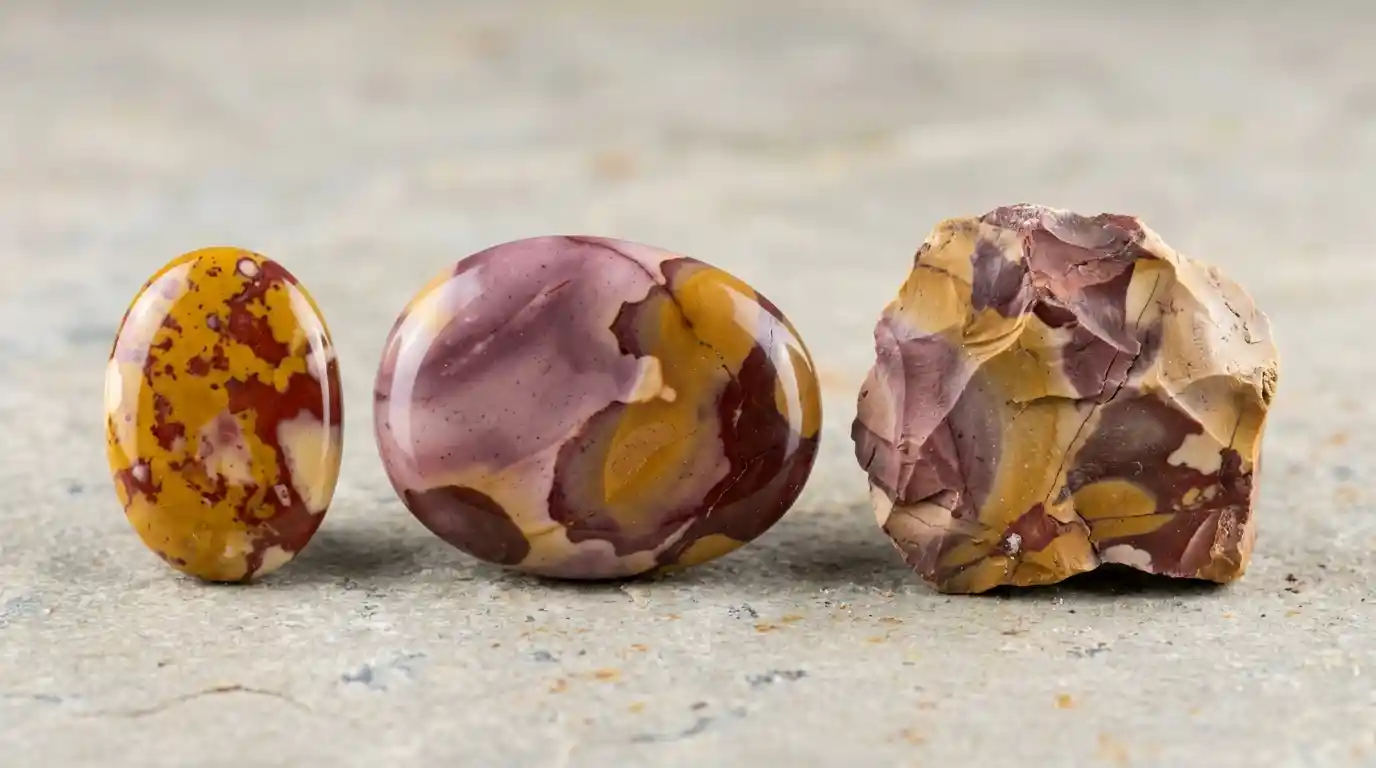
Mookaite healing properties are commonly associated with grounding, confidence, concentration, decision-making, adaptability, resilience, creativity, connection with nature, and spiritual reflection. Its warm mustard, burgundy, cream, purple, red, and yellow patterns give it a distinctly earthy appearance that naturally encourages themes of stability and practical action. Those associations do not establish a therapeutic mechanism. Mookaite has not been demonstrated to treat anxiety, depression, fatigue, blood disorders, digestive problems, inflammation, pain, hormonal conditions, or another illness, and the iron compounds responsible for much of its color do not provide nutritional iron through ordinary skin contact. Geologically, Mookaite is not a single mineral species and has no single crystal system or exact chemical formula. It is a silica-rich ornamental rock from Mooka Creek in Western Australia, associated with silicified and opalized portions of the Early Cretaceous Windalia Radiolarite and containing microscopic structures derived from ancient marine radiolarians.
9 Mookaite Healing Claims
- Grounding and present-moment awareness
- Confidence during difficult choices
- Concentration and practical focus
- Clearer decision-making
- Adaptability when plans change
- Resilience after setbacks
- Creativity and flexible thinking
- Connection with nature and place
- Spiritual reflection on change and direction
These nine themes can support distinct personal practices without becoming nine scientifically proven healing effects. Many Mookaite benefits become more useful when translated into actions such as reducing distractions, reviewing evidence before a decision, trying an alternative approach after failure, or using a familiar stone as a cue to begin a reflective routine.
Mookaite Geology and Composition
Mookaite is widely called Mookaite jasper in the gemstone trade, but its geological identity is more specific than the name suggests. It occurs within the Windalia Radiolarite of Western Australia and represents strongly silicified or opalized radiolarian-rich sedimentary rock. Geological descriptions include chert, porcellanite, radiolarite, and silica-rich lapidary stone depending on texture and degree of alteration.
Radiolarians are microscopic marine organisms that produce intricate silica-based skeletons. Vast numbers accumulated in ancient marine sediments, contributing silica-rich biological debris to the developing rock. Later burial, diagenesis, silicification, weathering, and groundwater activity transformed portions of the Windalia unit into the dense, polishable rock now sold as Mookaite.
The stone is composed mainly of very fine silica phases, including cryptocrystalline silica and locally opaline silica. Iron oxides and hydroxides such as hematite and goethite contribute much of the red, mustard, yellow, brown, and burgundy coloration. Different concentrations and distributions of these compounds create sharp boundaries, swirls, patches, veins, and gradational patterns.
Because Mookaite is a rock containing several phases rather than one crystal species, assigning it a single formula is inaccurate. SiO₂ dominates much of the stone, but opaline silica, iron compounds, clay-related components, fossil structures, and other minor constituents can vary between pieces.
Hardness is commonly around Mohs 6.5 to 7 for strongly silicified polished Mookaite, although individual areas may behave somewhat differently. It generally takes a high polish and has enough durability for cabochons, beads, spheres, carvings, and other ornamental uses.
Mookaite Origin in Western Australia
True Mookaite is strongly associated with Mooka Creek on Mooka Station, west of the Kennedy Range in the Carnarvon region of Western Australia. The commercial stone has been quarried from a relatively restricted zone even though the Windalia Radiolarite itself extends across a much larger geological area.
Government geological descriptions identify Mookaite as an informal locality-derived name for opalized or silicified Windalia Radiolarite colored in red and yellow tones. Mindat records also emphasize the restricted Mooka Creek source and the radiolarian origin visible under microscopic examination.
The Windalia Radiolarite belongs to the Early Cretaceous succession of the Carnarvon Basin. The rock therefore records an ancient marine environment long predating people, but geological age should not be converted into claims of an equally ancient Mookaite healing tradition. The gemstone trade identity developed around the Western Australian locality much later.
Mookaite’s strong colors developed partly through iron-rich groundwater and near-surface alteration. Hematite and goethite granules can create red, yellow, ochre, and brown zones, while silica cementation helped create the dense texture that accepts a glossy polish.
The Mookaite meaning used in modern crystal practice draws heavily from those earthy colors and Australian origin. That symbolism can remain personally meaningful without being presented as archaeological proof of ancient healing use.
Grounding, Confidence, and Focus
Grounding Through Sensory Awareness
Mookaite is frequently described as grounding because its colors resemble soil, ochre, desert rock, and weathered landscapes. The stone does not electrically ground the body or regulate the nervous system through an invisible field. It can still provide a tactile focus. Notice its weight, temperature, smooth surface, color boundaries, breathing rhythm, and physical surroundings. The useful mechanism is directed sensory attention.
Confidence During Difficult Choices
Mookaite is often marketed as a stone for courage and confidence, especially when someone faces a change in work, relationships, travel, or routine. It cannot biologically increase self-esteem. A more practical ritual is to identify what has already been prepared, what remains uncertain, and what first action can be taken despite incomplete information. Confidence develops from preparation and experience.
Concentration and Practical Focus
Another common claim links Mookaite with concentration. Silica-rich rock has not been shown to increase attention span or memory through touch. It can instead become a stable work cue. Place it beside one active task, remove unrelated notifications, and work for a defined interval before changing activities. The routine supports concentration.
Decisions, Adaptability, and Resilience
Clearer Decision-Making
Mookaite is often associated with choosing between alternatives. The stone cannot reveal the correct future. A grounded approach is to list the available options, likely benefits, realistic risks, missing evidence, and whether each choice can be reversed. This turns decision-making into analysis rather than divination.
Adaptability When Plans Change
Its varied colors and complex geological history make change a natural Mookaite theme. The stone does not alter psychological flexibility. When a plan stops working, use it as a cue to distinguish the underlying goal from the method being used to reach it. A different route may preserve the goal more effectively than repeating an unsuccessful approach.
Resilience After Setbacks
Mookaite’s dense silicified structure encourages symbolism around endurance. It cannot make someone psychologically resilient through mineral energy. After a setback, identify what failed, what remains intact, what lesson should affect the next attempt, and what can still be done now. Resilience grows through adaptation and continued action.
Creativity, Nature, and Reflection
Creativity Through Pattern and Color
Mookaite’s irregular reds, yellows, creams, and purples can make each polished piece visually distinctive. A creative worker can use those patterns as prompts for brainstorming, writing, design, or visual association. There is no evidence that the rock changes creative cognition biologically, but a visually engaging object can mark the beginning of a creative routine.
Connection With Nature and Place
Modern Mookaite symbolism frequently emphasizes Earth connection, partly because the stone comes from a specific Australian landscape and preserves traces of ancient marine life. The rock cannot replace actual contact with the natural world. It can serve as a reminder to walk outdoors, learn about local geology, observe seasonal change, or spend time away from constant digital stimulation.
Spiritual Reflection on Direction
Some practitioners use Mookaite during meditation around purpose, direction, and life transitions. These practices can be personally meaningful, but the stone does not transmit ancient radiolarian wisdom or geological memory into the mind. A useful reflection is to ask which values remain stable even when circumstances change and which daily actions actually express those values.
Mookaite Chakra Meaning
Mookaite is commonly associated with the root chakra because of its earthy red, brown, ochre, and yellow colors. Some practitioners extend brighter yellow shades toward solar plexus symbolism and reddish tones toward themes of physical stability, confidence, and security.
Chakras are a spiritual framework rather than anatomical structures. Mookaite has not been demonstrated to affect the spine, adrenal glands, digestive organs, circulation, nervous system, or another physiological system through chakra placement.
Its varied palette can still help organize a personal meditation around stability, confidence, and change while remaining separate from medical claims.
Mookaite Care and Safety
Mookaite’s strong silicification makes polished pieces reasonably durable. Hardness commonly approaches Mohs 6.5 to 7, so the stone resists scratches better than calcite, fluorite, opal, and many decorative gems. Topaz, sapphire, ruby, diamond, and other harder stones can still scratch it.
Because it is a rock rather than one perfectly uniform mineral, fractures, fossil-rich zones, iron-rich areas, and local texture differences can affect toughness. Protect thin slabs, carved points, and sharply edged cabochons from hard impacts.
Brief cleaning with lukewarm water is generally suitable for sound untreated Mookaite. Mild soap and a soft cloth or brush are sufficient for routine care. Long soaking is unnecessary when a piece contains fractures, coatings, adhesives, fillers, or an attached setting.
Strong chemicals should be avoided. Hydrofluoric acid attacks silica and is extremely hazardous, while aggressive acids, alkaline cleaners, and abrasive powders can damage the polish or react with minor constituents.
Steam and ultrasonic cleaners are unnecessary for routine care. Natural fractures, mixed grain textures, repairs, or composite jewelry can make aggressive cleaning less predictable than gentle hand washing.
Cutting and grinding silica-rich Mookaite can generate respirable crystalline silica dust. Lapidary work should use wet methods, effective extraction, eye protection, and appropriate respiratory controls. The stone should not be intentionally powdered or ingested as part of a wellness practice.
Safe Ritual Cleansing
Ritual cleansing does not require physically altering Mookaite. There is no scientifically demonstrated negative energy that must be removed with water, salt, heat, or chemicals.
Sound, quiet reflection, intention-setting, dry placement, or a brief gentle wipe are low-risk choices. A grounding ritual can be made more concrete by identifying one decision that needs evidence, one task that needs action, or one boundary that needs consistency.
Avoid harsh chemicals, flame, abrasive salt, extreme heat, and unnecessary prolonged soaking. Simple symbolic practices preserve the polish while keeping spiritual use separate from unsupported physical claims.
Conclusion
Mookaite’s real story combines Early Cretaceous marine sediments, microscopic radiolarian remains, intense silicification, iron-rich color, and a geographically distinctive Western Australian source. Its nine healing themes can still support grounding, confidence, decisions, resilience, creativity, and reflection when the meaningful effect comes from attention and behavior rather than an unproven property of the stone.
FAQs
What are the main Mookaite healing properties?
Common claims include grounding, confidence, concentration, decision-making, adaptability, resilience, creativity, connection with nature, and spiritual reflection. These are contemporary wellness or spiritual beliefs rather than scientifically proven therapeutic effects.
Is Mookaite really jasper?
“Mookaite jasper” is a well-established trade name, but geologically the stone is more accurately described as strongly silicified or opalized radiolarite, chert, or porcellanite from the Windalia Radiolarite.
What is Mookaite made of?
It consists mainly of very fine silica phases associated with ancient radiolarian-rich sediment, with iron oxides and hydroxides contributing many of its colors.
Are there fossils in Mookaite?
Microscopic examination can reveal structures derived from radiolarians, marine microorganisms with silica-based skeletons. Mookaite therefore has a genuine biogenic sedimentary component.
Where does genuine Mookaite come from?
The defining source is the Mooka Creek area on Mooka Station in Western Australia, within a restricted part of the Windalia Radiolarite.
What gives Mookaite its red and yellow colors?
Iron compounds, particularly hematite and goethite, contribute many of the red, burgundy, ochre, brown, and yellow tones.
How hard is Mookaite?
Strongly silicified Mookaite commonly falls around Mohs 6.5 to 7, although local variation can occur because it is a rock rather than one uniform mineral species.
Which chakra is Mookaite associated with?
Modern crystal systems most commonly connect it with the root chakra, while yellow and red areas may receive additional solar plexus or lower-chakra symbolism. These associations are spiritual rather than anatomical.
Can Mookaite go in water?
Brief washing with lukewarm water is generally suitable for sound untreated Mookaite. Prolonged soaking is unnecessary when fractures, fillers, coatings, or glued settings are present.
Does Mookaite contain ancient healing energy from radiolarians?
There is no evidence that fossilized or silicified radiolarian structures store healing information or biological energy. Their importance is geological rather than therapeutic.
Crystal healing claims are traditional or personal beliefs and should not replace qualified medical or mental health care.