Ocean Jasper Healing Properties: 10 Claims, Geology & Safe Use
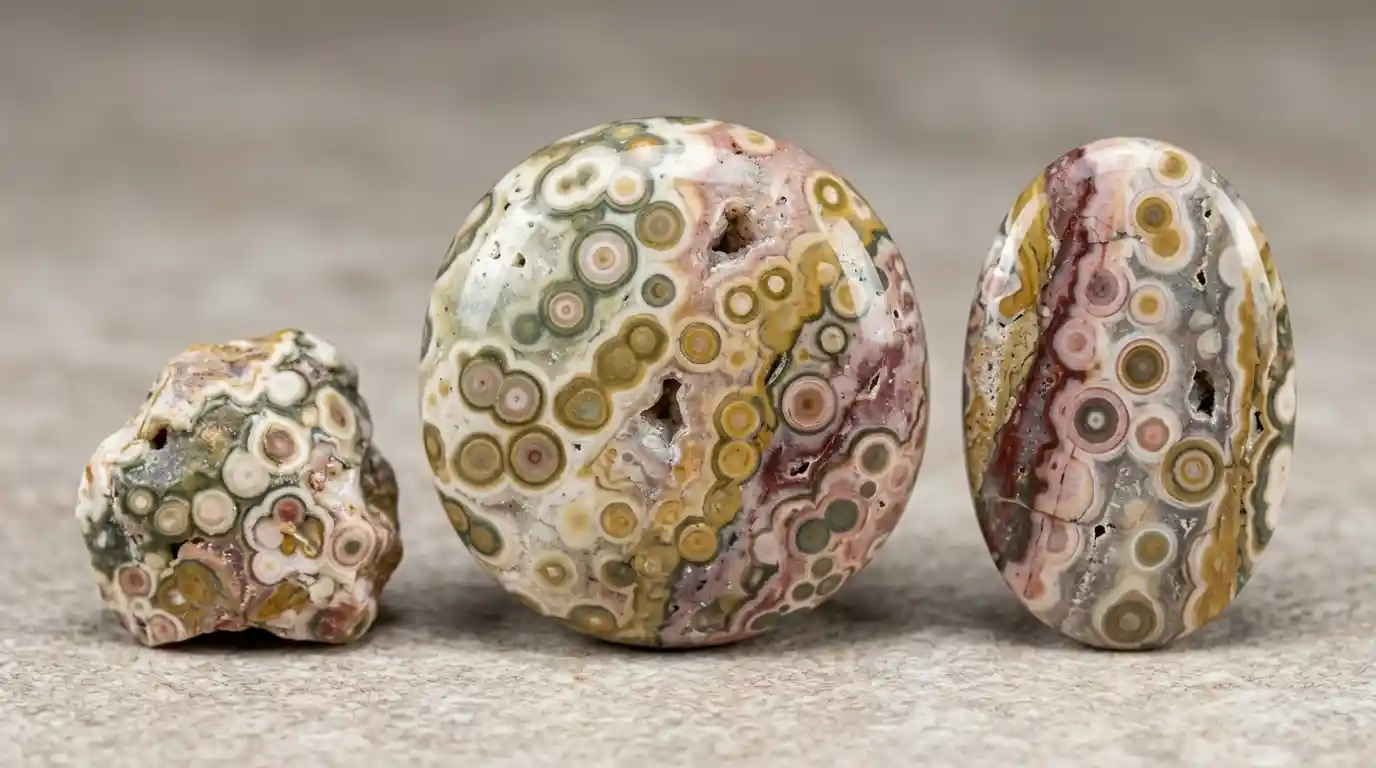
Ocean Jasper healing properties are commonly associated with emotional calm, patience, grounding, optimism, resilience, adaptability, confidence, creativity, relationship awareness, and spiritual reflection. Its rounded circles, layered colors, translucent zones, and occasional druzy pockets can resemble bubbles, waves, cells, flowers, or miniature landscapes, making ideas of flow and gradual change easy to attach to the stone. Those patterns are geological rather than therapeutic. Ocean Jasper has not been demonstrated to treat anxiety, depression, fatigue, pain, inflammation, cardiovascular disease, sleep disorders, hormonal conditions, or another health problem, and its colorful orbicular structures do not emit a medically active energy. Mineralogically, Ocean Jasper is a modern trade name for distinctive orbicular and spherulitic silica-rich rock from Madagascar, commonly dominated by chalcedony and quartz and associated with highly silicified volcanic rock. Its real appeal comes from unusual concentric growth structures, complex color, good polish, and a geographically restricted commercial origin.
10 Ocean Jasper Healing Claims
- Emotional calm during stressful periods
- Patience with gradual progress
- Grounding and present-moment awareness
- Optimism during difficult changes
- Resilience after setbacks
- Adaptability when plans shift
- Confidence through steady action
- Creativity and flexible thinking
- Relationship awareness and communication
- Spiritual reflection on cycles and change
These ten themes can support different personal practices without becoming ten scientifically proven effects. Many Ocean Jasper benefits become more useful when translated into actions such as slowing down before reacting, measuring progress over longer periods, reviewing a setback, adjusting an ineffective plan, or beginning a reflective routine.
Ocean Jasper Geology and Composition
Ocean Jasper is not a formally defined mineral species with one fixed chemical formula. Mindat treats the name as a marketing term for a spherulitic variety of chalcedony, while the best-known Madagascar occurrence has also been described as highly silicified rhyolite or tuff. Laboratory work on representative specimens has identified quartz and chalcedony as dominant silica phases in the orbicular structures and surrounding zones.
This distinction matters because the trade word “jasper” can suggest a uniform opaque microcrystalline quartz stone. Ocean Jasper can instead contain translucent chalcedony, crystalline quartz, druzy cavities, colored spherulites, banded zones, and altered volcanic components within one piece.
Silica remains the dominant chemistry in many tested areas, with SiO₂ making up the quartz and chalcedony components. Trace iron can contribute red, yellow, brown, or pink tones, while some green areas have been associated with fine celadonite or related alteration products. Iron and manganese hydroxides can also contribute darker or earthy coloration.
The orbicular structures are commonly described as spherulites. These rounded growth features can develop in concentric or radial patterns and range from tiny dots to large bullseye-like circles. Some overlap, merge, or form complex compound patterns.
Because Ocean Jasper is a rock with varying textures, assigning every specimen one crystal system is inaccurate. Its quartz component has trigonal crystallography at microscopic scale, while the overall polished stone may contain several silica textures and minor associated phases.
Strongly silicified pieces commonly behave around Mohs 6.5 to 7. They have no useful cleavage in the way calcite or feldspar does, although natural fractures, cavities, grain boundaries, and druzy pockets can create local weaknesses.
Madagascar Ocean Jasper Origin
The best-known Ocean Jasper comes from northwestern Madagascar in the Analalava District of the Sofia Region, especially around Marovato and nearby Kabamby. Marovato is the classic locality associated with highly orbicular stone that became famous in the modern lapidary trade.
The occurrence is linked with silicified volcanic rock. Geological descriptions of the Marovato area identify altered rhyolitic or tuffaceous rock in which silica-rich zones developed through volcanic and hydrothermal processes.
Some early commercial rough was found close to the coast, including occurrences associated with shoreline exposures, which helped reinforce the Ocean Jasper trade identity. Attractive pieces may contain orbicular structures, banded chalcedony, quartz-lined cavities, and druzy surfaces in one specimen.
Characterization work on old-stock Marovato and Kabamby samples found quartz-rich spherulites and chalcedony-rich zones, sometimes with only trace quantities of other elements affecting color. That evidence supports describing Ocean Jasper as a silica-rich orbicular rock rather than inventing biological or mystical explanations for the circles.
The commercial name is modern. There is no documented ancient Ocean Jasper healing tradition tied specifically to the Madagascar trade stone. The Ocean Jasper meaning used today is therefore contemporary symbolism built around its circular patterns, colors, coastal origin, and visual resemblance to natural cycles.
Emotional Calm and Patience
Emotional Calm Through a Pause
Ocean Jasper is frequently described as soothing because rounded patterns and soft color transitions can appear visually gentle. The stone has not been shown to regulate stress hormones, neurotransmitters, or heart rate through contact. A practical ritual is to use it as a reminder to stop multitasking, slow the breathing, and identify the one concern that actually requires attention now.
Patience With Slow Progress
Concentric circles and layered growth make patience an understandable symbolic theme. Ocean Jasper cannot biologically increase patience. A useful practice is to review long-term goals at sensible intervals rather than judging progress every day. Comparing weeks or months can reveal gradual change that is difficult to notice from one difficult moment.
Grounding and Optimism
Grounding Through Sensory Attention
Ocean Jasper is often used for grounding even though its appearance can be bright and colorful. The stone does not electrically connect the body to the Earth. It can provide a tactile anchor by directing attention toward weight, temperature, polished texture, individual circles, breathing rhythm, and immediate surroundings.
Optimism Without Denying Problems
Colorful Ocean Jasper is frequently associated with joy or optimism. A stone cannot produce a positive outcome or alter mood chemistry automatically. A more grounded exercise is to identify one genuine difficulty, one reason improvement remains possible, and one action that could make that improvement more likely.
Resilience and Adaptability
Resilience After Setbacks
Ocean Jasper’s complex structures can symbolize persistence through changing geological conditions. It cannot transfer resilience to the wearer. After a setback, use the stone as a cue to identify what failed, what remains intact, and what lesson should influence the next attempt.
Adaptability When Plans Change
The stone’s mixture of circles, bands, translucent zones, and cavities makes flexibility a natural metaphor. When a plan stops working, use it as a reminder to separate the goal from the method. The goal may still be worthwhile even when the route needs to change.
Confidence and Creativity
Confidence Through Steady Action
Ocean Jasper is sometimes associated with self-confidence and emotional strength. It does not biologically raise self-esteem. A practical routine is to track completed actions, preparation, and follow-through. Confidence grows from accumulated evidence of capability.
Creativity Through Pattern Recognition
Every polished Ocean Jasper piece can present a different arrangement of circles, colors, and textures, making it useful as a visual creative prompt. A writer, artist, or designer might spend several minutes generating ideas from the shapes before evaluating them. The visual stimulus can support a creative routine without proving that the rock changes cognition.
Relationships and Spiritual Reflection
Relationship Awareness
Some practitioners associate Ocean Jasper with cooperation and emotional openness. It cannot make another person honest, loyal, or compatible. A useful relationship exercise is to evaluate repeated behavior: Are expectations communicated clearly? Are boundaries respected? Do actions match promises? Those patterns offer more information than gemstone symbolism.
Spiritual Reflection on Cycles
The orbicular structures naturally suggest circles, cycles, repetition, and renewal. Someone may use the stone during meditation or prayer to reflect on recurring habits, seasons of change, or long-term personal direction. That can be meaningful without suggesting that geological spherulites transmit spiritual instructions.
Ocean Jasper Chakra Meaning
Ocean Jasper is commonly associated with the heart chakra because green and pink colors frequently appear in polished pieces. Yellow and red zones may also be linked with solar plexus, sacral, or root symbolism depending on the individual stone.
Chakras are a spiritual framework rather than anatomical structures. Ocean Jasper has not been demonstrated to affect the heart, digestive organs, reproductive organs, spine, endocrine glands, or nervous system through chakra placement.
Because the stone contains many colors, chakra assignments vary widely and should be understood as modern symbolic choices rather than fixed geological properties.
Ocean Jasper Care and Safety
Strongly silicified Ocean Jasper is relatively durable, commonly behaving around Mohs 6.5 to 7. Quartz-rich surfaces resist ordinary scratching better than calcite, fluorite, opal, and many feldspars, but topaz, sapphire, ruby, and diamond can still scratch them.
Natural cavities and druzy pockets require more care than solid polished areas. Thin crystalline coatings can chip, and dirt can collect inside small cavities. Use a soft brush gently rather than trying to scrape deposits out mechanically.
Warm water, mild soap, and a soft cloth are generally suitable for sound untreated pieces. Brief water contact is appropriate for quartz-rich Ocean Jasper. Long soaking is unnecessary when a stone contains open fractures, surface coatings, glue, fillers, or attached jewelry components.
Steam and ultrasonic cleaning are unnecessary defaults. Differences between chalcedony, quartz-lined cavities, fractures, and associated phases can make aggressive cleaning less predictable than hand washing.
Strong chemicals and abrasive powders should be avoided. Hydrofluoric acid attacks silica and is extremely hazardous.
Cutting, drilling, or grinding Ocean Jasper produces respirable silica-bearing dust. Lapidary work should use wet cutting, effective extraction, eye protection, and appropriate respiratory controls. The stone should never be intentionally powdered or ingested for wellness purposes.
Safe Ritual Cleansing
Ocean Jasper does not need saltwater, prolonged soaking, heat, or chemical sprays for ritual cleansing. There is no scientifically demonstrated negative energy that must be physically removed.
Sound, intention-setting, quiet reflection, dry placement, or a brief gentle wash are lower-risk choices. A cycle-themed ritual can involve identifying one repeated pattern that should continue and one that should change.
Avoid flame, extreme heat, abrasive salt, strong chemicals, and rough handling of druzy areas. Simple practices preserve the stone’s natural orbicular features and polish.
Conclusion
Ocean Jasper stands out because of its real geology: Madagascar silica-rich rock containing spherulitic chalcedony, quartz, colorful orbicular structures, and occasional druzy cavities. Its ten healing themes can still support calm, patience, grounding, resilience, creativity, and reflection when those practices remain behavioral or spiritual rather than medical.
FAQs
What are the main Ocean Jasper healing properties?
Common claims include calm, patience, grounding, optimism, resilience, adaptability, confidence, creativity, relationship awareness, and spiritual reflection. These are contemporary wellness or spiritual beliefs rather than scientifically proven effects.
Is Ocean Jasper really jasper?
The trade name is well established, but mineralogically Ocean Jasper is commonly described as spherulitic chalcedony or highly silicified volcanic rock rather than a simple uniform jasper.
What is Ocean Jasper made of?
Quartz and chalcedony dominate many analyzed specimens. Trace iron, celadonite-related green phases, iron-manganese compounds, and other minor constituents can contribute color.
What causes the circles in Ocean Jasper?
The circles are spherulitic or orbicular growth structures formed during geological processes involving silica-rich volcanic rock and later alteration. They are not fossil cells or bubbles preserved as biological structures.
Where does Ocean Jasper come from?
The classic commercial source is northwestern Madagascar, especially the Marovato and Kabamby areas of the Analalava District.
How hard is Ocean Jasper?
Strongly silicified pieces commonly fall around Mohs 6.5 to 7, although local texture can vary because the stone is a rock rather than one uniform mineral species.
Which chakra is Ocean Jasper associated with?
Modern crystal practice often links it with the heart chakra, while individual colors may receive root, sacral, or solar plexus associations. These are spiritual correspondences rather than anatomical effects.
Can Ocean Jasper go in water?
Brief washing with lukewarm water is generally appropriate for sound untreated pieces. Avoid unnecessary long soaking when fractures, cavities, glue, fillers, or coatings are present.
Is Ocean Jasper still mined?
Different Madagascar orbicular silica deposits have been worked at different times, and trade supply includes both older and newer production. The locality name and appearance should not be used alone to guarantee a specific mine or extraction period.
How should Ocean Jasper be cleaned?
Use mild soap, lukewarm water, and a soft cloth or gentle brush. Avoid harsh chemicals, abrasive powders, extreme heat, and aggressive cleaning of druzy cavities.
Crystal healing claims are traditional or personal beliefs and should not replace qualified medical or mental health care.