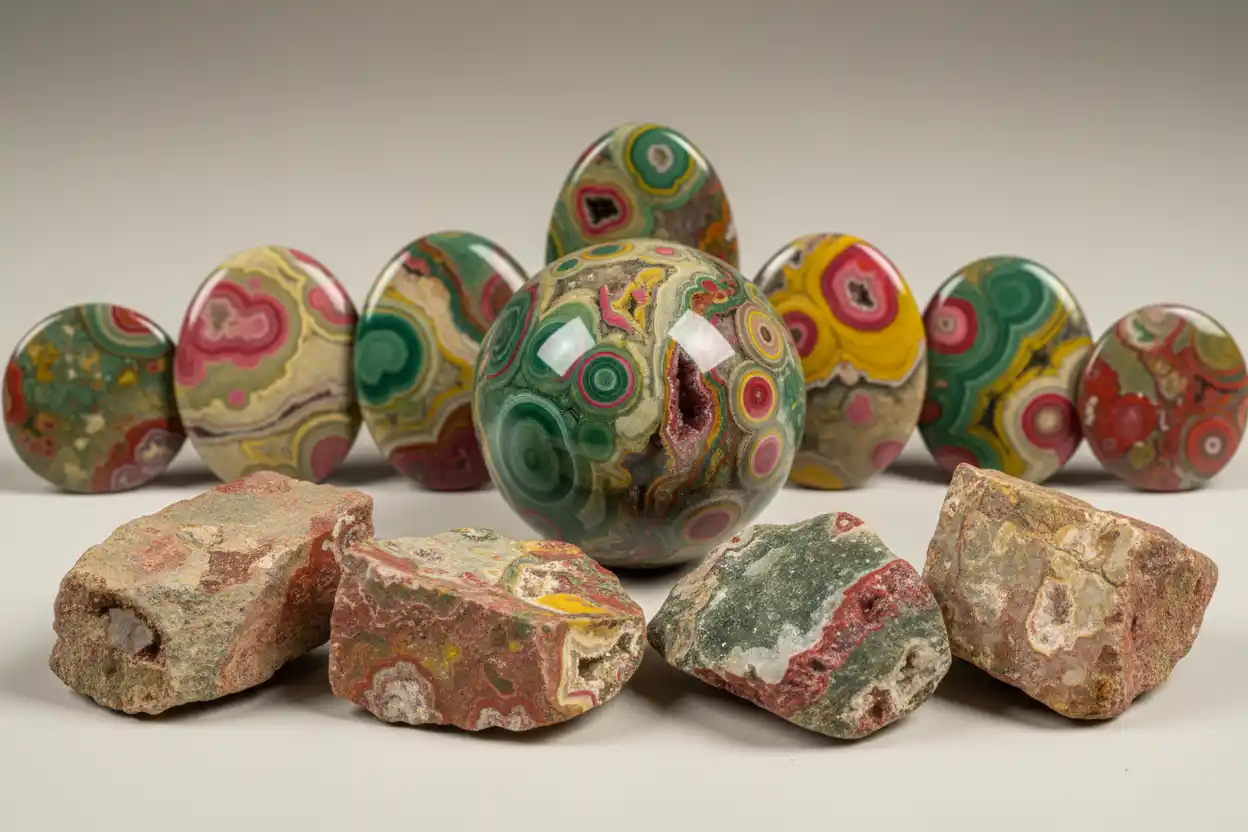
Ocean Jasper Meaning, Properties, Types & Value
Ocean Jasper is a commercial name for colorful orbicular and spherulitic lapidary material from northwestern Madagascar. Its polished surfaces can show rounded “orbs,” concentric eyes, flower-like structures, wavy bands, brecciation, translucent chalcedony, and small quartz-lined cavities.
Although commonly sold as a jasper variety, mineralogical descriptions identify much of the material more precisely as spherulitic chalcedony or a highly silicified rhyolite or tuff. Ocean Jasper is therefore a patterned rock and locality-based trade material rather than one mineral species.
Ocean Jasper at a Glance
| Property | Ocean Jasper |
|---|---|
| Material type | Orbicular silica-rich volcanic rock and locality-based trade material |
| More precise descriptions | Spherulitic chalcedony; highly silicified rhyolite or tuff |
| Main composition | Variable chalcedony, quartz, feldspar, iron oxides, and other volcanic or alteration minerals |
| Common colors | Green, cream, white, pink, red, yellow, orange, brown, gray, black, and multicolored |
| Crystal system | No single crystal system applies to the whole rock |
| Texture | Orbicular, spherulitic, banded, brecciated, vuggy, massive, and locally translucent |
| Luster | Dull or waxy when rough; waxy to vitreous after polishing |
| Transparency | Mostly opaque, with translucent chalcedony and quartz-rich zones |
| Mohs hardness | Variable; dense silica-rich areas commonly about 6.5–7 |
| Cleavage | No single cleavage for the whole rock |
| Tenacity | Brittle, with possible weakness around vugs, fractures, and mineral boundaries |
| Common uses | Cabochons, beads, pendants, spheres, palm stones, carvings, slabs, bowls, and display specimens |
| Main care concern | Edge chipping, open vugs, hidden fractures, resin or dye, unsupported provenance, and silica dust |
What the Ocean Jasper Name Covers
Ocean Jasper is a trade name rather than an approved mineral species. Its commercial identity is tied to orbicular material from Madagascar, particularly the Marovato and Kabamby areas.
The parent jasper guide explains the broad use of the jasper name for opaque, silica-rich ornamental materials. Ocean Jasper requires a narrower definition because locality and spherulitic volcanic texture are central to its identity.
Mineralogical sources differ slightly in wording. Some call it spherulitic chalcedony, emphasizing the fibrous silica orbs. Others describe it as a highly silicified rhyolite or tuff containing radial aggregates of quartz and feldspar.
These descriptions are not necessarily contradictory. A volcanic host can undergo silicification while developing chalcedony- and quartz-rich spherulites.
The types of jasper guide should own the family-level directory of named materials, while this page focuses on Madagascar origin, orb development, identification, and market use.
How the Orbs Form
Ocean Jasper’s circular structures are spherulites or orbicular aggregates. They grew outward from small nucleation points within the volcanic or silica-rich host.
Fine chalcedony fibers, quartz, feldspar, or combinations of these minerals radiated from the centers. When cut across their growth direction, the structures appear as circles, rings, flowers, eyes, or polygonal forms.
Where neighboring orbs grew into one another, their boundaries became compressed or angular. This interference can produce flower clusters, cellular patterns, or irregular polygons.
Iron oxides and other mineral inclusions may concentrate at the center or along growth zones. These components create red, yellow, brown, black, and green contrasts.
Later fractures and silica-rich fluids added bands, veins, drusy quartz, and translucent areas. Consequently, one slab may record several separate stages of mineral growth.
No single formation model explains every texture. Ocean Jasper can contain radial orbs, flow patterns, brecciation, cavities, crystalline quartz, and massive chalcedony within one deposit.
Marovato and Kabamby
The best-known Ocean Jasper comes from the Marovato locality near Ambolobozo in the Analalava District of Madagascar’s Sofia Region.
Marovato material became internationally prominent around the turn of the twenty-first century. Many high-contrast orbicular pieces with pink, green, cream, red, and yellow colors are associated with this source.
Kabamby lies inland in the same broader region and has supplied dark green, golden-yellow, pink, red, cream, and patterned material. Its textures can differ from classic Marovato parcels.
Retailers often use generation numbers, vein names, or labels such as old stock. These systems are not universal geological classifications.
An old-stock claim may indicate material purchased from earlier production, but it should be supported by provenance. The term alone does not prove superior pattern, rarity, or source.
Ocean Jasper’s name does not mean that every specimen formed in seawater or was necessarily collected from the ocean. The commercial name reflects locality history and branding rather than one scientific formation mechanism.
Must Ocean Jasper Have Orbs?
Strong circular orbs are the most recognizable and desirable texture. Nevertheless, documented material from the same mining areas can contain bands, swirls, breccias, translucent zones, or vugs with few obvious circles.
Therefore, the absence of perfect orbs does not automatically prove that a piece is incorrectly labeled. Reliable locality and texture documentation still matter.
However, sellers should not use Ocean Jasper for any multicolored jasper-like stone from Madagascar or another country. A generic swirled material without orbicular texture or credible source deserves a more cautious description.
The dedicated orbicular jasper guide owns the broader geological and visual category. Ocean Jasper represents a specific Madagascar commercial material within that larger orbicular group.
Colors and Mineral Inclusions
Green areas may reflect chlorite, iron-bearing silicates, altered volcanic minerals, or fine inclusions within the silica-rich host.
Red, pink, orange, yellow, and brown commonly involve hematite, goethite, limonite-like iron compounds, and variations in oxidation.
Cream and white zones contain cleaner silica, feldspar, or less intensely stained material. Gray and black can come from darker volcanic components or mineral inclusions.
Translucent portions may consist of chalcedony or coarser quartz. Small cavities can contain sparkling quartz crystals.
The visual meaning of these colors is covered broadly in the jasper color guide, but the actual geological cause must be determined from mineral content rather than symbolism.
Color saturation can vary dramatically under different lighting. Wet surfaces and polished finishes also deepen tones compared with dry rough.
Ocean Jasper and Other Madagascar Stones
Kambaba Jasper commonly shows dark green and black rounded patterns and also comes from Madagascar. However, its appearance, deposits, and mineral assemblage differ from classic Ocean Jasper.
Kambaba’s circles are generally darker and less flower-like. It should not be relabeled as low-grade Ocean Jasper simply because both materials contain green rounded features.
Other Madagascar chalcedonies, agates, and volcanic rocks can produce orbs or bands. A country of origin alone does not establish the Ocean Jasper name.
The marketplace occasionally uses terms such as sea jasper, Atlantis stone, or Madagascar orbicular jasper. Some are synonyms, while others are promotional phrases without precise boundaries.
Ocean Jasper, Mookaite, and Noreena Jasper
Mookaite is a Western Australian silicified porcelanite associated with radiolarian sediment. It commonly shows broad red, yellow, cream, pink, and purple areas rather than radial volcanic orbs.
Noreena Jasper is a Pilbara silicified mudstone known for angular fracture networks and mosaic patterns.
Picture Jasper generally emphasizes scenic bands, sedimentary layers, or landscape-like staining.
All four materials can produce attractive multicolored cabochons, yet their source, structure, and characteristic patterns differ. A buyer should not rely on the word jasper alone.
How to Identify Ocean Jasper
Look first for internal orbicular or spherulitic structures. Properly cut orbs should continue into the stone rather than appearing as printed surface circles.
Rotate the piece under strong light. Translucent chalcedony zones, quartz-lined cavities, mineral-filled fractures, and changing depth become easier to see.
Magnification may reveal radial growth within the orbs, fine quartz grains, feldspar, iron staining, natural pits, resin, and dye.
Dense areas commonly approach quartz hardness. However, cavities, altered volcanic minerals, and fractured boundaries can be softer or structurally weaker.
The identification methods in how to identify crystals help combine texture, luster, fracture, hardness, and magnification without relying on one destructive test.
Laboratory work can use microscopy, Raman spectroscopy, X-ray diffraction, and chemical analysis to identify silica phases, feldspar, and iron-bearing inclusions.
A laboratory may describe the specimen as orbicular chalcedony or silicified volcanic rock rather than certifying Ocean Jasper as a mineral species.
Vugs, Druzy Areas, and Natural Pits
Small cavities are common in some Ocean Jasper. They can contain colorless quartz, chalcedony, or sparkling drusy crystals.
A natural vug can add visual interest, especially when it is clean and positioned intentionally within a polished freeform.
However, cavities reduce structural strength. A vug near the girdle of a cabochon may trap dirt or create a chipping point.
Open pits differ from well-formed crystal-lined cavities. Excessive undercutting, crumbly edges, and polishing compound trapped inside holes indicate lower finishing quality.
Resin may be used to fill cavities or stabilize surrounding fractures. This can make a piece more practical, but the treatment should be disclosed.
Jewelry Suitability
Dense Ocean Jasper is suitable for pendants, earrings, brooches, beads, bracelets, and protected rings.
Its silica-rich portions resist ordinary scratching well, as shown by the gemstone hardness chart.
Nevertheless, the rock remains brittle. Orb boundaries, vugs, and fractures can chip after a sharp blow, which illustrates the distinction in gemstone toughness versus hardness.
A bezel protects cabochon edges and prevents fabric from catching on open cavities. Low-profile settings are preferable for rings.
Beads should have smoothly drilled holes without cracks or exposed vugs. Large bracelets benefit from knots or softer spacers.
A heavily vuggy collector piece may be better displayed as a pendant or freeform than worn in a ring.
Treatments and Imitations
Most attractive Ocean Jasper is sold after cutting and polishing. However, resin stabilization can strengthen fractures and fill pits.
Dye can intensify green, red, purple, black, or pink areas. Pigment concentrated in cracks, cavities, or drill holes deserves scrutiny.
Oil and wax deepen color temporarily. Clear coatings can create a uniform gloss but may scratch, yellow, or conceal a poor polish.
Reconstituted products combine rock fragments with resin. Composite material may contain genuine Ocean Jasper while no longer being a single natural piece.
Printed resin, ceramic, glass, and unrelated orbicular rock can imitate the pattern. Repeated identical circles, mold seams, round bubbles, low weight, or surface-only designs provide warning signs.
The fake-crystal buying guide covers these indicators, while gemstone treatments explains filling, stabilization, dyeing, and coating.
Current Ocean Jasper Asking Prices
Ocean Jasper has a wide market because common palm stones and tumbles coexist with premium old-stock slabs, spheres, and strongly orbicular collector pieces.
| Ocean Jasper product | Broad retail asking range |
|---|---|
| Small tumbled stone | About $3–$12 |
| Small commercial cabochon | About $8–$30 |
| Strongly orbicular or translucent cabochon | About $25–$100 |
| Premium old-stock or artist-cut cabochon | About $75–$250 or more |
| Bead strand | About $15–$75 |
| Palm stone or small freeform | About $15–$75 |
| Medium sphere, tower, or carving | About $50–$250 |
| Large sphere or polished display piece | About $150–$750 or more |
| Premium slab or collector specimen | About $100–$1,000 or more |
| Exceptional documented Marovato material | Individually priced |
These figures represent broad current retail asking prices rather than formal valuations or guaranteed resale returns.
Size alone does not determine price. A small cabochon containing sharply defined concentric orbs may command more than a large plain green freeform.
What Makes Ocean Jasper Valuable?
Orb quality has the strongest influence. Well-defined circles, concentric rings, flower-like patterns, and overlapping spherulites attract the greatest attention.
Color balance matters. Contrasting pink, green, cream, yellow, red, and white usually appears more dynamic than muddy or uniform material.
Translucency can raise value, especially when light penetrates the orbs or reveals chalcedony between them.
Druzy cavities add interest when clean and structurally secure. Broken, dirty, or resin-filled cavities may have the opposite effect.
Cutting orientation controls whether the orbs appear circular, elongated, or incomplete. An experienced lapidary studies the slab before choosing the cutting plane.
Polish, symmetry, edge condition, and treatment disclosure remain essential.
Provenance can raise collector confidence. Marovato, Kabamby, and genuinely documented older stock should be distinguished from unsupported generation numbers or vague Madagascar claims.
Buying Ocean Jasper
Ask whether the seller can identify the material as Marovato, Kabamby, another documented Madagascar source, or simply orbicular jasper.
Request photographs under neutral light and transmitted light when the material contains translucent zones.
Inspect every visible cavity, edge, and fracture for resin, glue, dye, chips, and polishing residue.
Do not assume that a piece without prominent orbs is fake. Instead, evaluate whether its source and volcanic-silica textures support the name.
Conversely, do not accept every circular-pattern stone as Ocean Jasper. Orbicular rocks occur in many localities.
Terms such as rare vein, first generation, old stock, and mine closed should be supported by traceable supplier information.
Detailed seller evaluation belongs on the dedicated guide to buying real Ocean Jasper.
Ocean Jasper appears in the crystals beginning with O directory and the gemstones beginning with O directory.
Cleaning and Storage
Clean an intact polished piece with lukewarm water, mild soap, and a soft cloth or brush. Rinse briefly and dry it thoroughly.
Use a soft brush carefully around druzy cavities. Forceful scrubbing can loosen crystals or pack lint inside a vug.
Avoid prolonged soaking when fractures, resin, dye, glue, or porous areas are present. The broader water-safety guide explains the relevant limitations.
Do not use steam or ultrasonic cleaning on vuggy, fractured, filled, or assembled pieces.
Avoid bleach, strong acid, abrasive powders, and household descalers. These can damage treatments, associated minerals, metal settings, and polish.
Store Ocean Jasper separately from harder gemstones. Pad large spheres and freeforms so they cannot roll against one another.
Ocean Jasper Meaning and Symbolism
Modern crystal traditions commonly associate Ocean Jasper with patience, optimism, emotional flexibility, renewal, and accepting natural cycles.
Its repeated orbs inspire symbolism involving interconnected experiences, gradual growth, and the way individual events become part of a larger pattern.
Green areas receive associations with balance and renewal, while pink, red, yellow, and cream areas are interpreted through modern color symbolism involving affection, energy, confidence, and calm.
The Ocean Jasper name is modern, so claims of one specific ancient tradition using that commercial term should be treated cautiously.
These meanings remain spiritual, artistic, cultural, or personal interpretations. Scientific evidence does not show that Ocean Jasper treats disease, controls emotions, or produces guaranteed energetic effects.
Frequently Asked Questions
Is Ocean Jasper a mineral?
No. It is a trade name for a variable silica-rich orbicular rock rather than one mineral species.
Is Ocean Jasper technically jasper?
The gem trade commonly classifies it as jasper. Mineralogical descriptions often identify it more precisely as spherulitic chalcedony or highly silicified rhyolite or tuff.
Where does genuine Ocean Jasper come from?
Recognized material comes from northwestern Madagascar, particularly the Marovato and Kabamby areas near Ambolobozo.
What causes the round orbs?
Fibrous chalcedony, quartz, feldspar, or mixed minerals grew radially from nucleation points, producing spherulites that appear circular in cross-section.
Does real Ocean Jasper always have visible circles?
No. Material from documented deposits may also show bands, brecciation, swirls, vugs, and massive chalcedony with few obvious orbs.
Did Ocean Jasper form in the ocean?
The commercial name does not prove marine formation. The material is associated with silicified volcanic rock, and its name reflects trade history and locality.
What is old-stock Ocean Jasper?
The phrase usually refers to material acquired from earlier mining periods or older commercial parcels. It is not a standardized geological grade and requires provenance.
How is Ocean Jasper different from Kambaba Jasper?
Kambaba usually shows dark green and black rounded patterns with a different geological and commercial identity. Ocean Jasper more commonly shows multicolored spherulites, translucent chalcedony, and vugs.
Is Ocean Jasper durable enough for rings?
Dense material can work in a protective low setting. Stones with open cavities, thin edges, or major fractures are better suited to pendants or display.
Is Ocean Jasper commonly treated?
Many pieces are untreated apart from polishing, but resin filling, stabilization, dye, wax, oil, and coating can occur.
Can Ocean Jasper go in water?
Brief washing is generally acceptable for sound untreated material. Avoid soaking pieces with vugs, fractures, resin, dye, glue, or coatings.
What makes premium Ocean Jasper expensive?
Sharp orbs, unusual color combinations, translucency, clean druzy cavities, fine polish, strong cutting orientation, documented provenance, and genuine older stock increase value.
Ocean Jasper reveals the full structure of its orbs only when a slab is cut across the correct growth direction. That challenge makes it a particularly instructive material within the guide to gemstones for cabochons and carving.
Cutting, drilling, sanding, or polishing Ocean Jasper can release respirable silica-rich dust. Use wet lapidary methods, effective local extraction, eye protection, and suitable respiratory protection rather than dry grinding.