Scolecite Healing Properties: 12 Modern Wellness Themes, Zeolite Facts & Safe Care
Scolecite healing properties are commonly associated with calm, emotional perspective, patience, self-reflection, communication, concentration, adaptability, creativity, resilience, sleep preparation, meditation, and spiritual awareness. The mineral’s delicate white sprays and radiating needle-like crystals give it a quiet appearance that fits contemporary ideas about stillness and reflection, but appearance does not establish a therapeutic mechanism. Scolecite healing properties have not been scientifically demonstrated to treat anxiety, depression, insomnia, neurological conditions, pain, inflammation, cardiovascular disease, hormonal problems, or another medical condition. Scientifically, Scolecite is a hydrated calcium aluminosilicate zeolite with the formula CaAl₂Si₃O₁₀·3H₂O. It crystallizes in the monoclinic system, measures about Mohs 5 to 5.5, has perfect cleavage, and is brittle.
12 Scolecite Healing Properties Themes
- Emotional calm during overstimulation
- Perspective before reacting
- Patience with gradual progress
- Self-reflection and pattern awareness
- Clearer and more deliberate communication
- Concentration during quiet work
- Adaptability when plans change
- Creativity and imaginative thinking
- Resilience after interruption
- Better preparation for sleep
- Meditation and present awareness
- Spiritual reflection on simplicity and direction
These twelve scolecite healing properties make more sense as prompts for behavior than as twelve automatic effects. Calm can mean reducing unnecessary stimulation, patience can mean measuring progress over a realistic period, and concentration can mean working on one task without constant interruption. The separate Scolecite benefits page can address practical uses, while this article keeps scolecite healing properties centered on wellness beliefs, evidence limits, zeolite science, and safe care.
Scolecite Is a Hydrated Zeolite Mineral
Understanding scolecite healing properties begins with the mineral’s actual identity. Scolecite belongs to the zeolite group and more specifically to the natrolite subgroup. Its ideal composition is CaAl₂Si₃O₁₀·3H₂O, which means water is an integral part of its hydrated crystal structure rather than simply moisture sitting on the surface. Mindat lists Scolecite as monoclinic, transparent to translucent, vitreous in ordinary crystals and sometimes silky in fibrous aggregates, with Mohs hardness around 5 to 5.5.
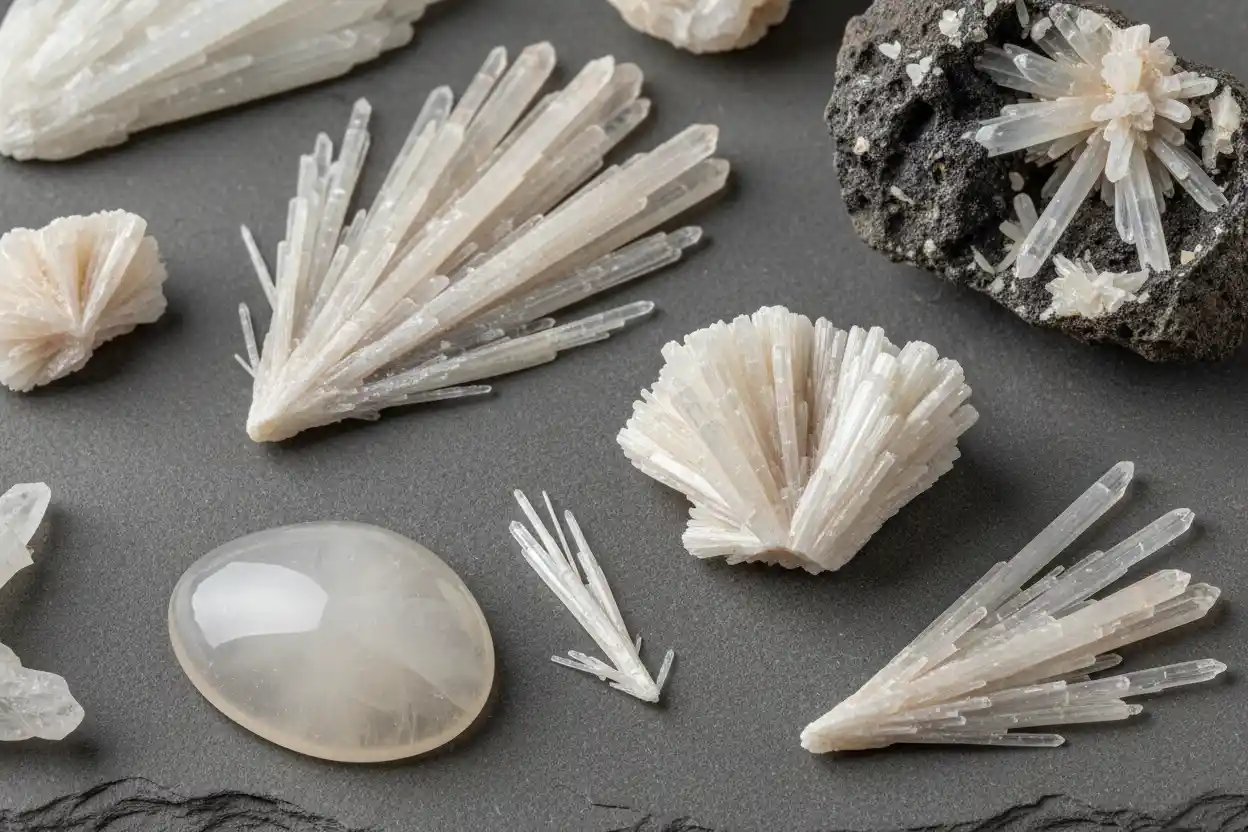
Scolecite commonly appears colorless or white, although pale pink, salmon, reddish, or greenish examples can occur. Long slender prisms may gather into radiating sprays, fans, balls, or dense fibrous aggregates. These growth habits are a major reason Scolecite is visually associated with softness and stillness even though the individual crystals are physically brittle.
Perfect cleavage occurs in two directions, and fracture is generally uneven. That means scolecite healing properties should never distract from the fact that a beautiful crystal spray can be damaged easily by drops, pressure, brushing, or rough storage.
How Scolecite Forms in Basalt Cavities
Scolecite healing properties are modern interpretations, but the mineral’s geology is much more specific. Zeolites commonly form through low-temperature alteration of volcanic rocks and from mineral-rich fluids moving through cavities and fractures.
Scolecite is particularly well known from basalt-hosted cavities. Maharashtra in India, especially areas within the Deccan volcanic province, has produced spectacular sprays associated with apophyllite, stilbite, heulandite, and other zeolites. Mindat records confirmed Scolecite from basalt quarries in the Pune and Nashik regions and notes India among its major localities.
Iceland is another classic zeolite region. Scolecite occurs there with stilbite, heulandite, mesolite, and related minerals in altered basaltic rocks, particularly in eastern Iceland.
These geological associations give scolecite healing properties an interesting contrast. The delicate crystals often developed in empty spaces created by volcanic rocks, but that formation history does not give them a scientifically measurable calming or spiritual field.
The Scolecite Name Comes From a Heat Reaction
One of the most distinctive scientific facts behind Scolecite has nothing to do with wellness. The name comes from the Greek word associated with a worm because the mineral curls or bends into worm-like forms when heated strongly in a blowpipe flame.
Scolecite was described under its modern mineral identity in the early nineteenth century. Historical mineralogical references connect the name with Gehlen and Fuchs and the characteristic heat reaction.
This history matters when discussing scolecite healing properties because the mineral should not be given an invented ancient healing tradition merely because it has a Greek-derived name. Its current metaphysical reputation is largely contemporary.
The workbook’s Scolecite meaning topic can explore modern symbolism separately, while scolecite healing properties remain focused on the specific wellness associations people use today.
Emotional Calm, Perspective, and Patience
Calm Through Lower Stimulation
Emotional calm is among the most common scolecite healing properties. There is no evidence that hydrated aluminosilicate regulates cortisol, serotonin, heart rate, or another biological stress pathway through skin contact.
A practical interpretation is to use the mineral as a cue to reduce stimulation. Move away from unnecessary notifications, lower background noise, slow the breathing, and decide which issue actually requires attention now.
Perspective Before Reacting
Another part of scolecite healing properties is emotional perspective. The stone cannot reveal hidden truth or automatically separate emotion from fact.
Before reacting to a difficult message or event, identify what definitely happened, what interpretation was added, and what information may still be missing. If no immediate response is required, delaying the reaction can improve perspective.
Patience With Gradual Progress
Scolecite healing properties frequently include patience because its delicate crystal growth suggests gradual development.
The mineral cannot biologically make someone more patient. A useful practice is to evaluate long-term goals on an appropriate timescale instead of judging an entire project, relationship, or habit from one difficult day.
Self-Reflection, Communication, and Focus
Self-Reflection Through Written Patterns
Self-awareness appears frequently among scolecite healing properties. Scolecite cannot retrieve hidden memories or disclose subconscious information.
Keeping it near a journal can create a consistent cue to record situations, reactions, assumptions, and consequences. Repeated patterns become visible because they are documented over time.
Communication Before Assumption
Modern scolecite healing properties are also associated with gentle or thoughtful communication.
The crystal cannot make another person understand or agree. Before a difficult conversation, identify the central point, separate requests from accusations, and decide what boundary or question needs to be expressed clearly.
Concentration During Quiet Work
Concentration is another common interpretation of scolecite healing properties. No zeolite-specific effect has been shown to increase attention span or memory.
Use the stone as a cue for one defined work interval. Remove unnecessary notifications, choose one active task, and avoid switching until the planned stopping point.
Adaptability, Creativity, and Resilience
Adaptability When Plans Change
Scolecite healing properties sometimes include flexibility and acceptance. The stone cannot make someone psychologically adaptable.
A useful response to changing conditions is to separate the goal from the original method. If evidence shows that the method is no longer effective, changing the approach does not necessarily mean abandoning the goal.
Creativity Through Fine Crystal Patterns
Creativity fits naturally within scolecite healing properties because radial sprays and intersecting crystals provide a visually complex focus.
Scolecite does not biologically increase creativity. Writers, artists, designers, or problem-solvers can instead use it to mark a brainstorming interval in which several ideas are generated before any are evaluated.
Resilience After Interruption
Resilience is another modern theme within scolecite healing properties. The mineral cannot transfer psychological strength.
After an interruption, identify what remains usable, what caused progress to stop, and which first step makes restarting realistic. Recovery becomes a sequence of actions rather than an energetic reset.
Sleep Preparation and Scolecite Healing Properties
Better sleep is frequently included among scolecite healing properties because the stone is marketed as peaceful or soothing. There is no evidence that keeping Scolecite near a bed changes melatonin, sleep stages, neurological activity, or insomnia through a mineral-specific mechanism.
A more practical use is to let the stone mark the start of a consistent evening routine. Lower bright light, reduce stimulating screen use, stop adding unnecessary tasks, and write unfinished responsibilities down so they do not need to be mentally rehearsed in bed.
Scolecite healing properties can therefore support sleep preparation symbolically without turning the mineral into a sleep treatment.
Anyone experiencing persistent insomnia, breathing problems during sleep, severe daytime sleepiness, or another ongoing sleep concern should seek appropriate professional evaluation rather than relying on a crystal.
Meditation and Present Awareness
Meditation is one of the easiest scolecite healing properties to translate into a real practice. A cluster of fine white crystals provides many stable visual details for attention.
Choose one crystal tip, fan, or radiating group and observe it without constantly changing the focus. When attention wanders, return to the same point or to the breath.
This exercise genuinely practices sustained attention. It does not prove that Scolecite alters brain waves, opens psychic channels, or changes consciousness through a mineral frequency.
Scolecite healing properties are more defensible when meditation is described as something the person does rather than something the mineral performs.
Spiritual Reflection on Simplicity
The final theme within scolecite healing properties concerns spiritual awareness, inner quiet, connection, or simplicity.
Some practitioners describe Scolecite as a stone for higher consciousness, communication with guides, dream messages, or spiritual travel. These interpretations belong to contemporary spirituality and have not been verified as measurable properties of the mineral.
A grounded spiritual practice can instead focus on values. What deserves attention? Which commitments create unnecessary noise? Which relationship, responsibility, or habit deserves more deliberate care?
The stone can serve as a reminder of those questions without being treated as a transmitter of supernatural information.
Scolecite Chakra Associations
Scolecite healing properties are most commonly associated with the crown and third-eye chakras in modern crystal systems because the mineral is usually white or colorless and is used for meditation and reflective practices.
Some systems also connect it with the heart because of themes involving calm communication and compassion.
Chakras are spiritual frameworks rather than anatomical structures. Scolecite healing properties have not been demonstrated to affect the brain, pineal gland, nervous system, endocrine glands, heart, or another physiological structure through chakra placement.
Scolecite Care and Physical Fragility
Scolecite healing properties do not change the mineral’s physical limitations. Mohs hardness around 5 to 5.5 offers only moderate scratch resistance, while perfect cleavage and brittle tenacity make slender crystals especially vulnerable.
Store crystal sprays where other stones cannot press against or scrape them. Quartz, topaz, corundum, and many common gemstones can scratch Scolecite.
Loose dust should be removed with very gentle air movement or an exceptionally soft brush rather than forceful scrubbing. Fine crystal sprays can snap at their bases even when individual crystals look substantial.
Heat deserves particular caution because Scolecite is a hydrated zeolite. Its historical name itself refers to its dramatic response to strong heating. Flame, steam, hot ultrasonic baths, and deliberate thermal “cleansing” should therefore be avoided.
Can Scolecite Go in Water?
Water advice around scolecite healing properties is often oversimplified. Scolecite is a hydrated zeolite rather than a highly water-soluble mineral like gypsum, so brief contact with clean water does not automatically dissolve a sound crystal.
That does not make prolonged soaking a good care method. Fragile sprays, attached matrix minerals, natural fractures, repairs, and other associated zeolites can respond differently, while drying water can leave deposits within narrow spaces.
If a compact polished specimen needs cleaning, brief gentle contact with lukewarm water may be reasonable. Delicate natural clusters are better kept as dry as practical and cleaned conservatively.
Scolecite healing properties do not become stronger after immersion, and crystal water rituals provide no scientific benefit that justifies unnecessary handling risk.
Safe Ritual Cleansing
Scolecite healing properties can be incorporated into personal rituals without water immersion, salt, flame, or direct heating. There is no scientifically demonstrated unwanted energy that must be physically extracted from the mineral.
Sound, quiet reflection, intentional breathing, dry placement, or meditation are safer choices. A calm-focused practice can involve identifying one unnecessary source of stimulation and removing it for a defined period.
Avoid abrasive salt, rough burial, steam, flame, high heat, and vigorous brushing. These methods create a more realistic risk of physical damage than any unverified energetic contamination.
Conclusion
Scolecite healing properties are contemporary wellness and spiritual beliefs attached to a genuine hydrated zeolite with delicate radiating crystals, monoclinic structure, perfect cleavage, and an unusual historical response to heat. Calm, patience, focus, creativity, resilience, sleep preparation, meditation, and reflection can become useful personal practices when Scolecite serves as a cue rather than a claimed treatment. The mineral’s actual strengths are its crystal structure, geology, and beauty, while its physical fragility deserves careful handling.
FAQs
What are scolecite healing properties?
Scolecite healing properties commonly refer to beliefs involving calm, perspective, patience, reflection, communication, concentration, adaptability, creativity, resilience, sleep preparation, meditation, and spiritual awareness.
What is Scolecite made of?
Scolecite is a hydrated calcium aluminosilicate zeolite with the formula CaAl₂Si₃O₁₀·3H₂O.
How hard is Scolecite?
Scolecite measures about Mohs 5 to 5.5 and is brittle with perfect cleavage.
Why is Scolecite called Scolecite?
Its name comes from a Greek word associated with a worm because the mineral develops worm-like curling behavior when strongly heated in a traditional blowpipe test.
Are scolecite healing properties ancient?
No well-documented ancient Scolecite healing system is established. Most scolecite healing properties used in crystal practice are modern interpretations.
Where does Scolecite come from?
Important specimens occur in basaltic zeolite environments, especially in Maharashtra, India, and classic zeolite regions of Iceland.
Which chakras are associated with Scolecite?
Modern crystal practice commonly links Scolecite with the crown and third-eye chakras. These are spiritual associations rather than anatomical effects.
Can Scolecite go in water?
Brief contact with clean water does not necessarily destroy Scolecite, but prolonged soaking is unnecessary, especially for fragile clusters, matrix specimens, repaired pieces, or unknown associated minerals.
Can Scolecite be heated?
Strong heat should be avoided. Scolecite contains structural water and responds noticeably to heating.
Are scolecite healing properties medically proven?
No. Scolecite healing properties are contemporary spiritual or personal wellness beliefs rather than scientifically established therapeutic effects.
Scolecite healing properties are modern spiritual or personal wellness beliefs and should not replace qualified medical or mental health care.