Seraphinite Healing Properties: 11 Modern Associations, Clinochlore Facts & Safe Care
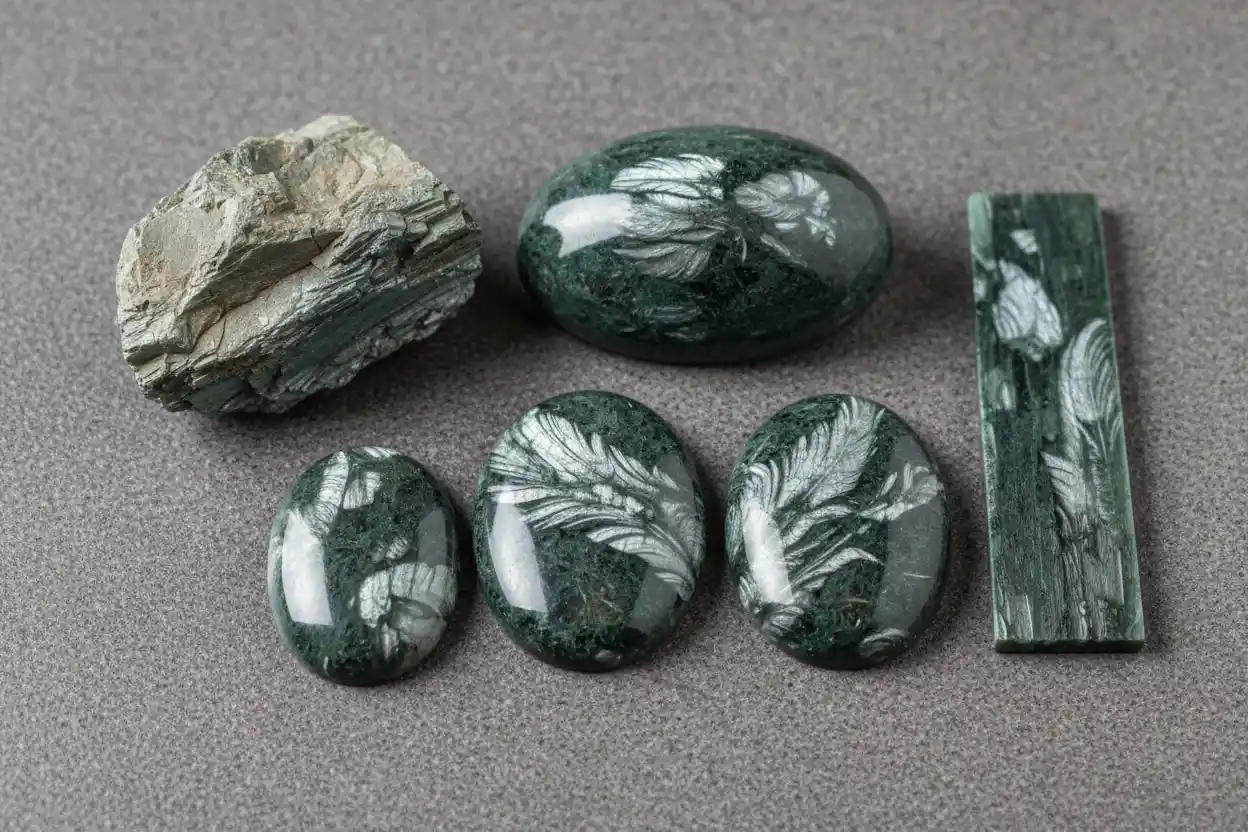
Seraphinite healing properties are commonly associated with emotional calm, compassion, self-reflection, resilience, boundaries, concentration, creativity, meditation, spiritual renewal, intuition, and connection with personal values. The deep green bodycolor crossed by silvery feather-like patterns resembles wings, which explains why modern crystal culture often connects Seraphinite with angels and spiritual guidance. That visual resemblance does not establish a therapeutic mechanism. Seraphinite healing properties have not been scientifically demonstrated to treat anxiety, depression, heart disease, cellular disorders, pain, inflammation, nerve conditions, sleep problems, or another medical illness. Mineralogically, Seraphinite is not a separate species. It is a decorative variety of clinochlore, a chlorite-group mineral with the ideal formula Mg₅Al(AlSi₃O₁₀)(OH)₈. Clinochlore is monoclinic, very soft at Mohs 2 to 2.5, and commonly shows pearly, greasy, or dull luster.
11 Seraphinite Healing Properties Associations
- Emotional calm during stressful periods
- Compassion balanced with clear judgment
- Self-reflection and pattern awareness
- Resilience after disappointment
- Stronger emotional boundaries
- Concentration during quiet work
- Creativity and imaginative thinking
- Meditation and present awareness
- Spiritual renewal after transition
- Intuition balanced with evidence
- Reflection on values and personal direction
These eleven seraphinite healing properties are most useful when treated as contemporary spiritual or wellness associations rather than automatic effects of a green stone. Compassion can mean understanding another person’s perspective while retaining boundaries, intuition can mean testing a first impression against evidence, and renewal can mean changing behavior after a transition. The separate Seraphinite benefits page can address practical uses, while this article keeps seraphinite healing properties centered on modern beliefs, mineral identity, evidence limits, and safe care.
Seraphinite Is a Variety of Clinochlore
Understanding seraphinite healing properties begins with correcting the idea that Seraphinite is an independent mineral species. Mineralogical references classify it as a variety of clinochlore distinguished by a radiating or plumose structure that produces its decorative feather-like appearance.
Clinochlore belongs to the chlorite group and has the ideal formula Mg₅Al(AlSi₃O₁₀)(OH)₈. Natural specimens can contain significant iron and smaller amounts of manganese, zinc, calcium, chromium, or other substituting elements.
The mineral belongs to the monoclinic crystal system and is extremely soft, only about Mohs 2 to 2.5. Its luster can be pearly, greasy, or dull, while Seraphinite’s fibrous structure creates flashes that become much more noticeable after polishing.
Seraphinite healing properties do not arise from a mineral species unique to spiritual use. The stone is clinochlore with an unusually attractive internal texture.
Why Seraphinite Looks Like Silver Feathers
The feathered appearance behind seraphinite healing properties comes from radiating, plumose clinochlore crystals within the green stone. When light reaches those differently oriented fibers or plates, sections can reflect strongly and appear silver, pale green, or almost white.
As a polished cabochon moves, these reflective areas can seem to spread across the surface like wings. Gemological examination of Russian Seraphinite has described a green, mottled, fibrous, chatoyant chlorite-group stone with visible pleochroism in more transparent portions.
This optical structure explains both the trade appeal and the name. The feather-like flashes are physical reflections from clinochlore textures, not light emitted by a spiritual energy source.
Seraphinite healing properties connected with angels or wings therefore belong to symbolism inspired by appearance rather than measurable mineral behavior.
The Seraphinite Name Is a Modern Trade Name
Seraphinite healing properties should not be described as an ancient healing system. Clinochlore itself has been known mineralogically for centuries, but “Seraphinite” is a varietal and trade name connected with modern ornamental use.
The name refers to seraphim, the winged beings described in religious tradition, because the silvery radiating markings resemble feathers or wings. Mineral collectors and gem dealers have used the name for attractive plumose clinochlore cut into cabochons, slabs, carvings, and decorative objects.
That naming origin explains modern angelic symbolism but does not demonstrate that historical religious communities used Seraphinite as a gemstone for contacting angels.
The Seraphinite meaning page can explore wing and spiritual symbolism more deeply, while seraphinite healing properties remain focused on contemporary wellness interpretations and their limits.
Russian Seraphinite and Its Main Locality
Commercial Seraphinite is particularly associated with Russia. Mindat records the variety at the Korshunovskoye iron deposit near Zheleznogorsk-Ilimsky in Irkutsk Oblast, where radiating clinochlore produces the characteristic decorative stone.
This locality connection is important because “Seraphinite” is often marketed as though any green chlorite automatically qualifies. The trade identity is strongest when the material displays the recognizable radiating, plumose structure that creates silvery feather-like flashes.
Dense fine-grained clinochlore has also been called “chlorite jade,” although Seraphinite is not jadeite or nephrite and should not be confused with either jade mineral.
Seraphinite healing properties are unaffected scientifically by geographic origin. Russian provenance may matter to collectors or buyers, but it does not create stronger therapeutic action.
Calm, Compassion, and Self-Reflection
Calm Through Reduced Stimulation
Calm is among the most common seraphinite healing properties. Clinochlore has not been shown to regulate cortisol, serotonin, heart rate, or another stress pathway through skin contact.
A useful interpretation is to make the stone a cue to reduce stimulation. Silence unnecessary notifications, slow breathing, and identify which concern actually requires attention rather than reacting to everything at once.
Compassion With Clear Judgment
Green stones are frequently associated with compassion, making this another familiar part of seraphinite healing properties.
The stone cannot biologically create empathy. A practical compassion exercise considers another person’s perspective without automatically excusing harmful behavior. Understanding and boundaries can exist at the same time.
Self-Reflection Through Patterns
The layered and feathered appearance also makes reflection a natural theme within seraphinite healing properties.
Keeping the stone near a journal can provide a consistent cue to record situations, emotional reactions, assumptions, and consequences. Recurring patterns become clearer because they are documented, not because the clinochlore reveals hidden memories.
Resilience, Boundaries, and Focus
Resilience After Disappointment
Seraphinite healing properties frequently include recovery, transformation, or personal growth. The mineral cannot heal trauma or transfer psychological resilience.
After disappointment, identify what cannot be changed, what remains usable, what support is available, and what first action can restart progress.
Boundaries as Practical Protection
Protection sometimes appears within seraphinite healing properties because angelic symbolism is often extended into ideas of spiritual guardianship.
No evidence shows that Seraphinite creates an invisible protective field. A practical interpretation uses boundaries: decide what behavior is unacceptable and what action follows when the boundary is ignored.
Concentration During Quiet Work
Seraphinite healing properties are sometimes associated with clarity or mental focus. Clinochlore has not been shown to increase attention span.
Use the stone as a visual cue for one uninterrupted task, reduce unrelated inputs, and define a stopping point before beginning. The structure of the routine creates the benefit.
Creativity and Meditation
Creativity Through Feather-Like Patterning
Creativity is a natural modern interpretation of seraphinite healing properties because the surface patterns can suggest feathers, leaves, frost, forests, or flowing light.
The stone cannot directly increase creative cognition, but it can provide a visually distinctive starting cue for writing, drawing, design, or brainstorming. Generate several ideas before judging them.
Meditation With Moving Reflections
Meditation is one of the most practical seraphinite healing properties when described accurately. Slowly tilt a polished cabochon and follow one silvery plume as its brightness changes.
When attention wanders, return to the same feature or to the breath. This genuinely practices sustained attention without proving that Seraphinite alters consciousness through a special frequency.
Spiritual Renewal and Seraphinite Healing Properties
Spiritual renewal is one of the defining themes within seraphinite healing properties because the trade name itself evokes winged spiritual beings.
Contemporary practitioners may use the stone during prayer, reflection, or rituals involving transformation and renewal. Such practices can be personally meaningful without claiming that clinochlore provides verifiable contact with angels or supernatural entities.
A grounded renewal exercise identifies one habit or commitment that should end, one lesson worth keeping, and one action that begins the next stage.
Seraphinite healing properties work best in this context as symbolic structure rather than a supernatural guarantee.
Intuition Balanced With Evidence
Intuition is another commonly repeated part of seraphinite healing properties. The stone cannot provide extrasensory information or predict future events.
A more reliable practice is to write down the initial instinct about a decision and then compare it with evidence, realistic consequences, uncertainty, reversibility, and alternative explanations.
The first impression may still be useful. The important distinction is that intuition becomes one input in judgment rather than proof supplied by the stone.
Values and Personal Direction
The eleventh of the seraphinite healing properties concerns connection with personal purpose, values, or spiritual direction.
Rather than asking a gemstone to reveal a predetermined destiny, use the stone during reflection on concrete questions. Which commitments deserve continued effort? Which behaviors conflict with stated values? Which relationship or responsibility requires a clearer decision?
This approach preserves the reflective appeal of seraphinite healing properties while keeping personal agency with the person making the decision.
Seraphinite Chakra Associations
Seraphinite healing properties are most commonly associated with the heart chakra because of the stone’s green color. Contemporary systems connect it with compassion, emotional openness, relationships, forgiveness, and personal growth.
Its silvery feather patterns also lead some practitioners to associate Seraphinite with the crown chakra and spiritual awareness.
Chakras are spiritual frameworks rather than anatomical structures. Seraphinite healing properties have not been demonstrated to affect the physical heart, lungs, brain, nervous system, endocrine glands, immune system, or another physiological structure through chakra placement.
Seraphinite Is Very Soft
Physical care is particularly important because seraphinite healing properties do not change clinochlore’s very low hardness. Mohs 2 to 2.5 means the polished surface can be scratched by a fingernail, coin, metal edge, quartz dust, or nearly any harder gemstone.
Seraphinite is therefore much better suited to pendants, earrings, cabochons, carvings, and carefully handled collector pieces than exposed everyday rings.
Store it individually in a soft pouch or padded compartment. Do not let it rub against quartz, feldspar, metal jewelry, or harder crystals.
Repeated abrasion can quickly dull the silvery feather effect that makes the stone attractive.
Water, Heat, and Cleaning Safety
Seraphinite healing properties do not require aggressive physical cleansing. For routine care, a soft dry or barely damp cloth is preferable to prolonged washing.
Brief contact with clean water is unlikely to dissolve clinochlore, but soaking is unnecessary, particularly for porous specimens, pieces with fractures, matrix, polish treatments, glue, or repaired areas.
Ultrasonic and steam cleaning should be avoided. The stone is soft, commonly fibrous or platy, and may contain cleavage-related weaknesses that vibration or heat can exploit.
Avoid acids, strong alkaline cleaners, abrasive powders, and chemical jewelry dips. Even when the mineral itself resists a particular household substance, such treatment offers no advantage for a soft decorative stone.
Safe Ritual Cleansing
Seraphinite healing properties can be incorporated into spiritual practice without salt, flame, chemical sprays, or long water immersion. There is no scientifically demonstrated unwanted energy that must be physically removed from clinochlore.
Sound, intentional breathing, quiet reflection, dry placement, prayer, or gentle wiping are safer choices.
An intention-focused ritual can be made practical by identifying one action that better reflects a personal value and carrying it out after the reflection.
Avoid abrasive salt, rough burial, steam, ultrasonic devices, and vigorous scrubbing because preserving the soft polished surface should take priority.
Conclusion
Seraphinite healing properties are modern spiritual and wellness associations inspired by one of clinochlore’s most visually distinctive varieties. Seraphinite is soft monoclinic chlorite with radiating plumose crystals that create silvery feather-like reflections, especially in Russian material from the Irkutsk region. Calm, compassion, resilience, boundaries, meditation, intuition, and spiritual renewal can become meaningful reflective themes when symbolism remains separate from medical or supernatural certainty.
FAQs
What are seraphinite healing properties?
Seraphinite healing properties commonly refer to beliefs involving calm, compassion, self-reflection, resilience, boundaries, concentration, creativity, meditation, spiritual renewal, intuition, and personal values.
What is Seraphinite made of?
Seraphinite is a variety of clinochlore, a chlorite-group mineral with the ideal formula Mg₅Al(AlSi₃O₁₀)(OH)₈.
Is Seraphinite a separate mineral?
No. Seraphinite is a decorative variety and trade name for clinochlore with a distinctive radiating or feather-like structure.
Why does Seraphinite look like angel wings?
Radiating plumose clinochlore crystals reflect light as silvery or pale feather-like patterns. The resemblance inspired the Seraphinite trade name.
How hard is Seraphinite?
Clinochlore measures only about Mohs 2 to 2.5, making Seraphinite very soft and easy to scratch.
Are seraphinite healing properties ancient?
No standardized ancient Seraphinite healing tradition is established. Most seraphinite healing properties and angelic associations belong to contemporary crystal culture.
Where does Seraphinite come from?
The best-known commercial Seraphinite is associated with the Korshunovskoye iron deposit in Irkutsk Oblast, Russia.
Which chakras are associated with Seraphinite?
Modern crystal practice commonly links Seraphinite with the heart chakra and sometimes the crown chakra. These are spiritual rather than anatomical associations.
Can Seraphinite go in water?
Brief contact with clean water may be tolerated, but prolonged soaking is unnecessary. A soft dry or slightly damp cloth is safer for routine cleaning.
Are seraphinite healing properties medically proven?
No. Seraphinite healing properties are contemporary spiritual or personal wellness beliefs rather than scientifically established therapeutic effects.
Seraphinite healing properties are modern spiritual or personal beliefs and should not substitute for qualified medical or mental health care.